

📌 Key Takeaways
Traditional pharma packaging RFQs fail because they hide compliance-critical supplier signals behind unstructured responses, creating audit risk that far exceeds any unit-cost savings.
- Opacity Tax Arrives During Audits: Missing change-control records, qualification evidence, and traceability data turn sourcing decisions into compliance scrambles when regulators ask for proof.
- Certificates Don’t Equal Capability: An ISO certificate proves a supplier passed an audit once; verified capability requires structured evidence of consistent performance under your quality expectations.
- Six Blind Spots Create Risk: Spec ambiguity, unstructured responses, weak change notification, certificate gaps, hidden subcontracting, and disconnected stakeholders allow compliance failures to hide until batch holds occur.
- Evidence Packs Enable Defense: Requiring change-control SOPs, 12-month change logs, traceability protocols, and subcontractor disclosures upfront transforms RFQ responses into audit-ready qualification files.
- Transparency-First RFQs Prevent Crises: Measurable CTQ specifications, structured templates, cross-functional sign-off gates, and documented evidence requirements turn sourcing into risk governance rather than documentation roulette.
Defensible sourcing decisions require asking different questions and treating supplier evidence as a deliverable, not an afterthought.
Pharma packaging procurement managers facing audit anxiety will gain actionable risk-reduction frameworks here, preparing them for the transparency-first implementation blueprint that follows.
The supplier fails a check. The backup list is outdated. The audit team wants documentation—change-control records, qualification evidence, traceability data—that your RFQ process never requested.
You scroll through unstructured quote responses, searching for proof of compliance capability that simply isn’t there.
How did we get here?
This scenario plays out across pharma packaging procurement teams more often than anyone admits. The root cause isn’t bad suppliers or poor negotiation. It’s something more fundamental: opacity. Traditional RFQs in pharma packaging create opacity that hides compliance-critical signals, leading to audit anxiety and preventable downstream costs.
RFQ Opacity refers to the gaps in visibility that occur when bid processes fail to require structured, verifiable evidence of supplier capability—leaving procurement teams unable to compare quotes on compliance-critical dimensions or produce audit-defensible documentation when regulators ask questions. Think of it another way: opacity is the gap between what a supplier’s bid claims and what an audit will force the team to prove.
Why Pharma RFQs Fail: The Real Issue Is Opacity, Not Price
The False Diagnosis Trap: Treating Packaging Like a Commodity
When packaging costs rise or lead times slip, procurement teams often default to a familiar diagnosis: “We need better prices.” The instinct is to cast a wider net, solicit more quotes, and pressure suppliers on unit cost. This misses the point entirely.
In regulated environments, the problem is rarely price—it’s risk hiding behind price. A primary packaging component acquired at a discount, yet lacking documented change-control rigor, can trigger batch sequestrations and multi-week deviation investigations. These secondary costs frequently exceed the initial unit-cost savings by a significant margin, often escalating into six-figure compliance remediation efforts.
A robust supply chain functions as a preventative control layer. Beyond sourcing, its primary utility is the identification and exclusion of operational ‘pathogens’—non-compliant processes—before they integrate into the production lifecycle. Traditional RFQs that focus only on price are like an immune system that stopped checking for pathogens. If the only thing a bid proves is that a supplier can send a PDF on time, the organization isn’t sourcing—documentation roulette is running the show.
What Opacity Looks Like in a Real RFQ Workflow
Opacity in RFQ responses hides supplier quality-system and change-control risk. It shows up in predictable ways: vague specifications that leave critical-to-quality attributes undefined, unstructured responses that make comparison impossible, missing evidence of qualification and validation discipline, and certificates submitted without verification that the scope covers your materials.
Hidden supplier risk increases audit findings and business disruption likelihood. You cannot see what you did not ask for.
The Opacity Tax Shows Up When Teams Least Want It
Opacity feels manageable—right up to the moment it isn’t.
When a sourcing choice has to stand up to scrutiny, missing clarity becomes work. Operational friction scales into schedule slippage, which ultimately manifests as regulatory and financial risk. In pharma packaging, that risk touches patient safety and corporate integrity, and it spreads across functions fast.
The “approved vendor” spreadsheet is months out of date. Packaging engineering is asking for change-control history, QA is asking for validation evidence, and procurement is staring at three quotes that look clean—until the questions start. The opacity tax arrives precisely when the team can least afford it: during audits, deviations, or qualification reviews that demand proof under time pressure.
Why Pharma Packaging Procurement Has a Different Risk Profile
The GDP/GMP Mindset: Traceability, Qualification, and Change Control
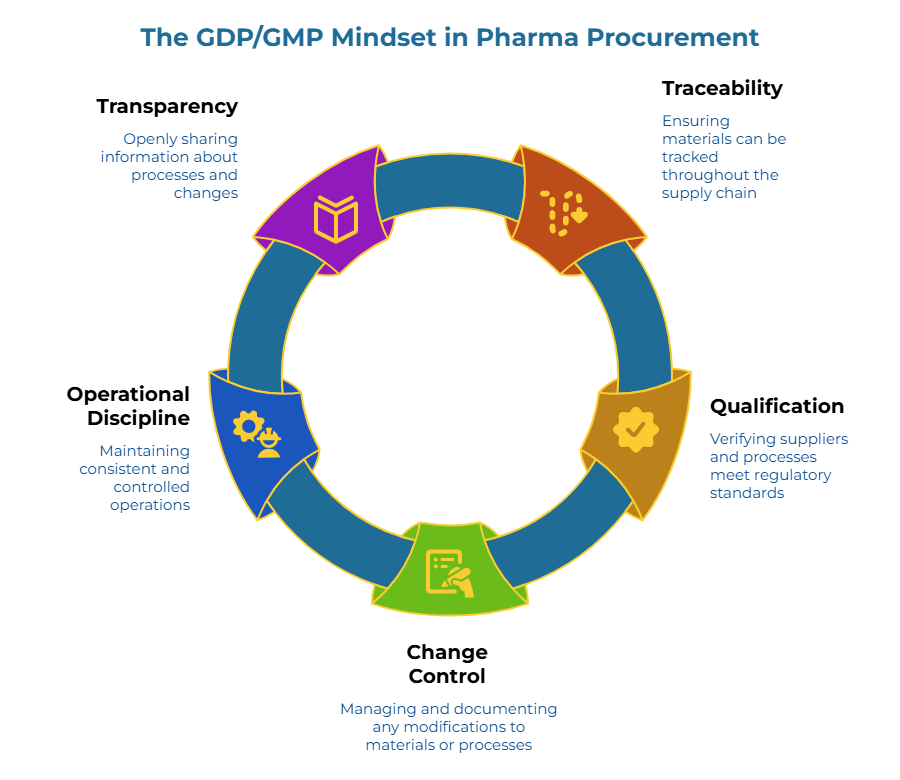
Pharma packaging procurement requires traceable documentation and qualification evidence. Good Distribution Practice expectations are built around control, traceability, and documented processes—not just outcomes. WHO Good Distribution Practice guidelines and EU GDP requirements establish clear expectations: materials entering the pharmaceutical supply chain must be traceable, suppliers must be qualified, and changes must be controlled.
On the manufacturing side, qualification and validation discipline shows how regulated organizations think about controlled processes and evidence of fitness-for-use. EU GMP Annex 15 frames this principle: processes that matter should be qualified, and changes should be controlled and documented.
Change notification discipline protects validated packaging performance assumptions. When a supplier modifies a raw material or shifts production facilities, those changes can invalidate your qualification data. If your RFQ process doesn’t establish notification requirements upfront, you’ll learn about changes during an audit or after a batch failure.
The practical RFQ implication is simple: solicit verifiable artifacts of operational discipline—shifting the burden of proof from static certification to active process transparency.
Why a Quote Is Not Evidence of Compliance Capability
A quote tells you what a supplier will charge. It tells you nothing about their QMS maturity, deviation history, or change-control discipline. The difference between a certificate and verified capability is substantial—a certificate proves someone passed an audit at a point in time; verified capability means you have structured, traceable evidence that the supplier can consistently deliver under your quality expectations.
A supplier can be certified and still fail a program if process controls are weak, subcontracting is opaque, or change control is informal. Stop asking “Do you have ISO/GMP/GDP-aligned practices?” and start asking “Show the documented system and the last time it was used.”
Six Ways Traditional RFQs Create Blind Spots in Pharma Packaging
1. Spec Ambiguity: Free-Text Specifications Create Hidden Variation. When RFQs don’t specify critical-to-quality attributes with measurable tolerances, suppliers interpret requirements differently. When the spec is incomplete or non-measurable, suppliers fill gaps differently. The bids may look similar while describing different realities—materials, processes, tolerances, inspection plans. The team thinks it has optionality; it actually has ambiguity. Standardized bid templates improve apples-to-apples comparability, favoring a specification-first strategy that forces clarity through measurable requirements, explicit tolerances, and defined test methods.
2. Unstructured Responses: No Comparability Across Vendors. Free-form responses make it impossible to evaluate suppliers on equivalent dimensions. Comparability reduces false-low-bid selection errors.
3. Weak Change-Notification Language. A packaging program stays stable only if changes are controlled: raw material substitutions, tooling updates, site moves, line changes, new subcontractors, revised test methods. Traditional RFQs rarely ask for change-control procedure excerpts, notification thresholds, or example records. Asking “Do you have change control?” gets a yes. Asking for the SOP and recent change log gets evidence.
4. Evidence Gaps: Certifications Without Verification. AAn ISO certificate proves the supplier passed an audit. It doesn’t prove the scope covers your specific materials or that their quality system aligns with your requirements. For teams that want a broader evidence-ladder approach to supplier verification—moving beyond certificates to documented proof—adopting a tiered evidence framework helps separate signals from proof. Certificates are documents. Capability is behavior over time.
5. Subcontracting and Site Reality Stay Invisible. Global sourcing adds friction: time zones, language nuance, inconsistent document conventions, and fragmented regulatory landscapes. When the RFQ does not force site disclosure and subcontracting transparency, qualification can drift toward a story instead of a facility. In regulated supply chains, traceability is a discipline requiring batch/lot linkage, record retention, and rapid retrieval under time pressure. For drug supply chains, traceability and product identification have explicit regulatory framing, such as the U.S. FDA’s DSCSA overview.
6. Disconnected Stakeholders (Procurement vs. Engineering vs. QA). Procurement needs defensible comparability. Engineering needs spec integrity. Quality needs evidence. Supply chain needs continuity and backup capacity. When perspectives aren’t integrated into a shared checklist, critical requirements fall through the cracks. Each function runs its own parallel verification track, creating expensive duplication while gaps remain because no one owns the full picture.
The Hidden Risk Calculator: Visible RFQ Costs vs. Hidden Compliance Costs
| RFQ Cost (Visible) | What Opacity Hides | What It Looks Like in Real Life | Evidence Request | Transparency-First Mitigation |
| Unit price | Undisclosed material substitution | Trial documentation is missing when QA asks for it; moisture sensitivity issue triggers deviation investigation | Change-control SOP; 12-month change log | Contractual change notification clause |
| Lead time | Capacity constraints at subcontractors | Material/process changes occur without timely buyer notification | Subcontractor list with qualification status | Subcontractor transparency in RFQ template |
| Freight cost | Inadequate transit packaging | Packaging performance not aligned to distribution conditions leads to line downtime | Transit validation report | Transit packaging requirements in CTQ section |
| MOQ terms | Single-source raw material risk | Lot linkage cannot be reconstructed quickly during an investigation | Supplier’s supplier qualification records | Dual-source disclosure requirement |
| Tooling amortization | Undocumented process changes | Supplier stress leads to late shipments or quality shortcuts | Process validation protocol | Revalidation trigger language |
| Print/labeling cost | Artwork version control gaps | Scrap / rework from labeling errors | Label change control SOP | Artwork approval process requirement |
How Different Stakeholders Experience the Same Hidden Cost
The same opacity-driven risk manifests differently depending on where you sit:
- Procurement: “The bids aren’t defensible because the answers aren’t normalized.”
- Packaging Engineering: “The spec is interpreted differently, so design intent is at risk.”
- Quality/Supplier Quality: “Evidence is missing, so approval becomes slow or impossible.”
- Supply Chain/Operations: “Backup options are unclear, so continuity is fragile.”
Consider the first row. The visible cost is straightforward—what you pay per unit. But if your RFQ didn’t require disclosure of material change history, you wouldn’t know that the supplier substituted a different paperboard grade six months ago. That substitution remains invisible until a moisture sensitivity issue triggers a deviation investigation, pulling your QA team into root-cause analysis and CAPA documentation. The hidden cost isn’t the unit price. It’s the compliance workload that opacity concealed.
What Supplier Documents Belong in an RFQ Evidence Pack?
An evidence pack is a small, standardized set of documents that proves operating discipline. Typical examples (adapt to internal QA requirements and jurisdiction):
- Site and legal-entity identifiers (who is actually responsible)
- Certification list plus scope statement (what the certificate covers)
- Change-control procedure excerpt (how changes are governed)
- Traceability and record-retention description (how evidence is retrievable)
- Quality contact tree and escalation path (who answers under pressure)
- Subcontractor disclosure (where work can move without notice)
For teams that want a broader ‘evidence ladder’ approach to supplier verification—moving beyond certificates to documented proof—adopting a tiered evidence framework helps separate signals from proof.
A Transparency-First RFQ Blueprint for Pharma Packaging
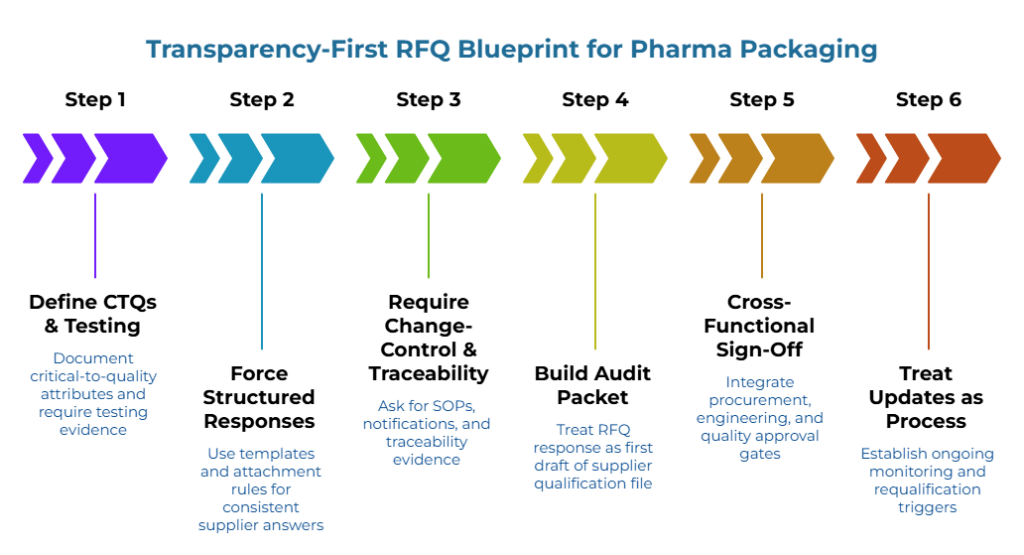
The aim is to make bids defensible by design—before any “lowest quote” decision is even possible.
Step 1: Define CTQs and Testing Evidence Requirements. Document every critical-to-quality attribute with measurable specifications. Require suppliers to provide testing evidence—not just claims. A spec-true RFQ approach forces comparability from the start by making the spec measurable, defining key parameters, tolerances, and test methods, and removing free-text ambiguity.
Step 2: Force Structured Responses (Templates + Attachment Rules). Create templates requiring suppliers to answer specific questions in specific formats. A consistent table-based response reduces omission and improves normalization. This eliminates the interpretive latitude that allows opacity to creep in.
Step 3: Require Change-Control and Traceability Disclosures. Ask for the change-control SOP, the last 12 months of notifications, and how traceability is maintained consistent with regulatory expectations. Request evidence that shows operating discipline—change control, deviation handling, record retention, and subcontractor control.
Step 4: Build an Audit Packet as a Deliverable. Treat the RFQ response as the first draft of your supplier qualification file. Every document requested during sourcing is one you won’t chase during an audit.
Step 5: Build Cross-Functional Sign-Off Into the RFQ. Procurement, engineering, and quality each get a defined evidence gate. If cross-functional alignment is the bottleneck, a short procurement-quality approval checklist can reduce cycle time during onboarding and re-approval. Standardized approval matrices can facilitate this cross-functional handoff, ensuring that quality gates are cleared prior to commercial commitment.
Step 6: Treat Updates as Part of the Process. An RFQ is a snapshot; qualification needs a refresh cadence and trigger list for re-verification. Establish ongoing monitoring or requalification triggers rather than treating supplier approval as a one-time event.
Audit-Defensible Questions to Ask Suppliers (By Role)
Procurement (comparability, scope clarity, response completeness): How does your response format enable apples-to-apples comparison? What factors could extend standard lead time? Are subcontractors involved, and what is their qualification status?
Packaging Engineering (materials, performance envelope, controls): What testing evidence can you provide for specified CTQ attributes? What is your process for controlling changes that could affect performance?
Quality/Supplier Quality (QMS, deviations, change control, traceability): Can you provide your change-control SOP and a log of changes from the past 12 months? What is your deviation rate and average CAPA closure time?
Where Marketplaces Fit and Where They Do Not
A marketplace does not replace qualification discipline. It can reduce early-stage opacity when supplier profiles are structured, credentials are visible, and verification signals exist—especially when the alternative is email outreach, generic directories, and spreadsheets that age badly.
A neutral supplier directory can help build (and refresh) a defensible longlist before deeper qualification begins. To explore how verified supplier directories can support transparency in your sourcing workflow, find and evaluate packaging suppliers or submit an RFQ to receive structured quotes.
From Quote Collection to Compliance Visibility
Traditional RFQs fail in pharma packaging because they optimize for the wrong outcome—capturing price data while allowing compliance-critical signals to remain invisible. The shift to compliance visibility isn’t about adding bureaucracy. It’s about asking different questions, requiring structured answers, and treating supplier evidence as a deliverable.
When bids are structured, evidence is requested up front, and changes are treated as inevitable (and therefore controlled), the sourcing decision becomes defensible. Less time gets burned chasing documents during an audit panic. More time goes into managing suppliers like a system.
This capability forms the foundation of something larger. As supply chain disruptions become more frequent and regulatory expectations intensify, teams that master transparency-first procurement evolve into enterprise resilience leaders—capable of defending sourcing decisions under pressure and adapting strategies when conditions change.
The question isn’t whether your next supplier will pass a check. It’s whether your RFQ process will produce the evidence to prove it.
Frequently Asked Questions
What should be included in a pharma packaging RFQ to reduce audit risk?
An audit-defensible RFQ should include measurable CTQ specifications, structured response templates, change-control disclosure requirements, traceability documentation requests, and subcontractor qualification evidence. The goal is producing an audit packet as a deliverable, not just collecting quotes.
How do GDP and GMP expectations influence packaging supplier qualification?
GDP and GMP frameworks establish that materials entering pharmaceutical supply chains must be traceable, suppliers must be qualified through documented processes, and changes must be controlled with proper notification. These expectations require RFQs to request evidence of operating discipline, not just certificates.
What is the difference between a supplier certificate and verified capability?
A certificate proves a supplier passed an audit at a specific point in time. Verified capability means you have structured, comparable, traceable evidence that the supplier can consistently deliver what your specifications require under your quality expectations—including change-control discipline and deviation management.
Disclaimer: This article provides educational information about pharmaceutical packaging procurement practices. Regulatory requirements vary by jurisdiction and product type. Consult qualified compliance and legal professionals for guidance specific to your situation.
Our Editorial Process:
Our expert team uses AI tools to help organize and structure our initial drafts. Every piece is then extensively rewritten, fact-checked, and enriched with first-hand insights and experiences by expert humans on our Insights Team to ensure accuracy and clarity.
About the PaperIndex Insights Team:
The PaperIndex Insights Team is our dedicated engine for synthesizing complex topics into clear, helpful guides. While our content is thoroughly reviewed for clarity and accuracy, it is for informational purposes and should not replace professional advice.