
📌 Key Takeaways
Pre-qualification delays stem from undefined evidence requirements, not from supplier capability gaps.
- Standardized Evidence Eliminates Rework: Clear document requirements with scope, expiry, and registry verification links reduce qualification cycles from months to weeks by preventing back-and-forth clarification requests.
- Verification Before Validation: Suppliers who self-check certificate scope, test registry status, and confirm entity-site matches submit complete packets on the first attempt, accelerating buyer review timelines.
- Scope Mismatches Cause Disqualification: Certificates must explicitly cover kraft paper manufacturing at the specific production site—generic manufacturing scopes or corporate-level certifications fail verification immediately.
- Registry Links Create Accountability: Providing direct links to FSC, PEFC, and ISO registry entries allows buyers to confirm active status in minutes rather than days, while creating a permanent audit trail.
- Twelve-Month Test Windows Balance Control and Practicality: Laboratory reports refresh annually by default, recognizing kraft paper process stability while allowing buyers to specify tighter intervals for regulated applications.
Clear evidence standards transform supplier qualification from detective work into systematic verification—faster onboarding, stronger compliance, fewer downstream failures.
Procurement teams, sourcing managers, and QA leaders at packaging converters and corrugators will find the framework here, preparing them for the detailed evidence requirements and verification protocols that follow.
Standard supplier onboarding fails at the evidence stage. A mill sends generic certificates, an exporter submits expired lab reports, and your procurement team spends three weeks chasing missing documents. Meanwhile, production timelines slip and your internal audit flags compliance gaps before the first container even ships.
Pre-qualification questionnaires (PQQ) exist to prevent this exact scenario, yet most remain too vague to be useful. When a buyer asks for “quality certifications” without specifying scope, expiry windows, or verification methods, suppliers respond with whatever documentation they have on hand—whether it meets your actual requirements or not. This mismatch creates rework loops that delay supplier approval by weeks or even months.
A standardized PQQ built around verifiable evidence changes this dynamic completely. When suppliers know exactly which documents you need, in what format, and with what validation steps, they can assemble complete submission packets on the first attempt. When buyers use a structured evidence matrix to track and verify each item, they can move qualified suppliers through approval faster while maintaining rigorous standards. The result is a more efficient qualification process that protects both parties from costly misunderstandings downstream.
Why a Standard PQQ Saves Weeks
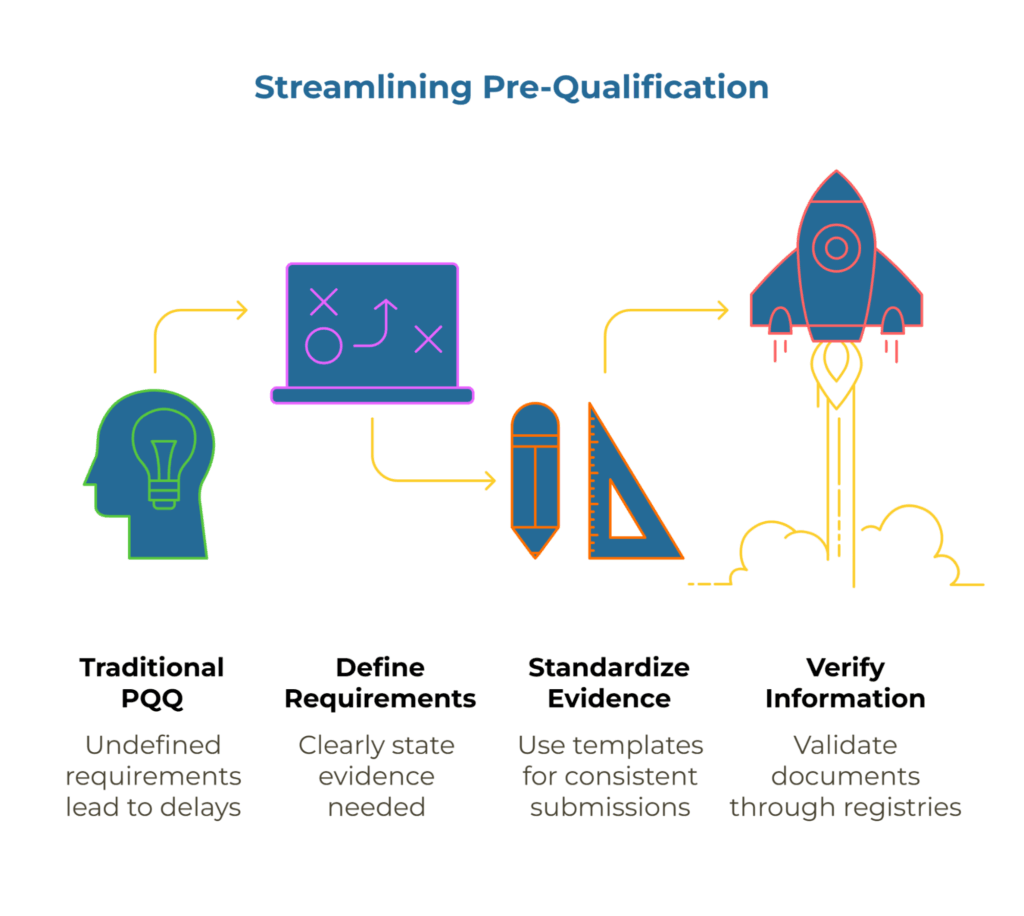
Pre-qualification typically consumes 4 to 8 weeks when evidence requirements remain undefined. Buyers request “relevant certifications.” Suppliers submit what seems reasonable. The procurement team discovers gaps during technical review. Follow-up requests go out. Suppliers scramble to locate additional documentation. The cycle repeats until someone—usually the buyer—accepts incomplete evidence just to meet a launch deadline.
Standardized evidence accelerates pre-qualification because clearly defined, scope-true documents reduce rework and decision latency. When every item is named, dated, and verifiable through registries, reviewers spend time validating rather than chasing missing information.
Three helpful frames underpin this approach:
- Definition: “Minimum evidence” means documents that are current, match the offered products and manufacturing site, and can be verified in a registry or through records.
- Problem-solving: Most delays come from expired certificates, wrong scope or site details, missing method IDs on lab tests, and unverifiable references.
- Process: Use the template to request; use the matrix to check; apply acceptance rules; log gaps; decide.
This pattern creates risk on both sides. Buyers who approve suppliers based on partial evidence face quality failures, compliance issues, or audit findings later. Suppliers who invest time in lengthy back-and-forth communications without clear endpoints often lose opportunities to competitors who happen to submit the right documents faster.
A template-driven approach eliminates this ambiguity. When the PQQ explicitly states “ISO 9001 certificate with scope covering kraft paper manufacturing, current validity period, and registry verification link,” there’s no room for interpretation. The supplier either provides this exact evidence or flags it as unavailable during self-check. The buyer’s verification step becomes a simple registry lookup rather than a negotiation about what constitutes adequate proof.
Speed improves because both parties work from the same checklist. Suppliers can prepare complete packets before initial contact, reducing their response time from weeks to days. Buyers can run parallel verification checks across multiple candidates instead of serial follow-ups with each one. The entire qualification cycle compresses from months to weeks when evidence requirements are explicit, standardized, and verifiable from the start.
How to Use This Template
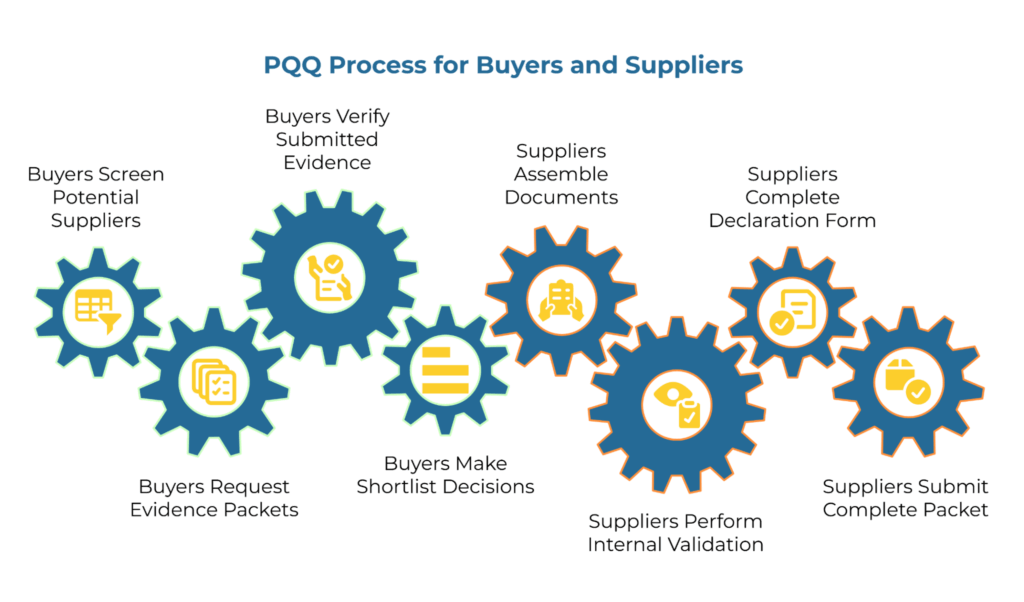
This PQQ functions as a two-sided tool—one workflow for buyers screening suppliers, another for suppliers preparing submission packets.
For buyers, the process follows four distinct stages. First, you screen potential suppliers by sharing the PQQ and evidence matrix as part of your initial RFQ or discovery outreach. This immediately filters out vendors who cannot meet your minimum requirements, saving evaluation time on non-viable candidates.
Second, you request complete evidence packets from shortlisted suppliers, setting a clear submission deadline. The evidence matrix serves as your tracking tool here—each line item represents a required document, with columns for file name, expiry date, registry link, and reviewer notes.
Third, you verify submitted evidence using the validation steps built into each category. For certificates, this means checking registry databases to confirm active status and scope alignment. For lab reports, it means confirming method IDs match recognized standards and results fall within your specification tolerances. For trade references, it means conducting spot checks with at least one named contact.
Fourth, you make shortlist decisions based on evidence completeness and verification outcomes. Suppliers who submit 100% of required evidence with valid scope and current dates advance. Those with minor gaps receive one focused follow-up request. Those with major gaps or unverifiable claims are removed from consideration.
For suppliers, the preparation workflow emphasizes self-checking before submission. You begin by assembling all documents listed in the minimum evidence section, organizing files according to the naming convention specified in the documentation integrity requirements.
Next, you perform internal validation using the same criteria buyers will apply. Check certificate expiry dates, confirm scope statements include the grades you’re offering, verify that entity names on legal documents match your manufacturing site exactly, and test registry links to ensure they resolve to active records.
You then complete the supplier declaration form, which serves as your attestation that all submitted evidence is current, authentic, and represents your actual capabilities. This declaration creates accountability and speeds buyer verification by confirming you’ve already performed first-level checks.
Finally, you submit the complete packet as a single organized folder or compressed file, using the evidence matrix as your table of contents. This allows the buyer to process your submission systematically rather than hunting through disconnected attachments.
The template creates alignment because both workflows reference the same evidence requirements, acceptance rules, and verification methods throughout.
Minimum Evidence: Required vs Optional

Evidence requirements divide into nine categories, each serving a specific due diligence function. Understanding which items are mandatory versus conditional helps suppliers prepare complete packets and helps buyers focus verification efforts where risk is highest.
Legal and Trade Foundation
Required items establish that your company exists as a legal entity authorized to manufacture or export kraft paper. This includes business registration or incorporation documents, tax or VAT identification numbers, factory address with geographic coordinates, export licenses where applicable, and a banking reference letter for trade verification.
The banking letter should confirm account standing and years of relationship without disclosing sensitive account details. Geographic coordinates for manufacturing sites allow buyers to verify facility locations against satellite imagery and assess logistics feasibility for their supply chain.
Optional items in this category include beneficial ownership structure summaries, which some buyers request for enhanced due diligence or compliance with anti-corruption policies.
Product and Capability Fit
Required items define what you actually produce and your operational parameters. Buyers need your complete grade list with specifications, GSM and burst/tensile strength capability ranges, machine deckle width and key equipment inventory, furnish mix percentages for virgin versus recycled content, annual capacity figures, minimum order quantities, typical lead times, main loading ports, preferred Incoterms, top HS codes, and primary export markets.
This information allows buyers to quickly determine product-market fit before investing time in detailed technical evaluation. A converter seeking 80 GSM bleached kraft in 2.8-meter reels can immediately see whether your machines and product mix match their requirements.
Quality Management Systems
Required items demonstrate process control capability regardless of certification status. Every mill should be able to provide a process flow diagram showing major production stages, a sampling plan summary explaining how and when quality checks occur, statistical process control example charts for key parameters, and a change control plus corrective action overview describing how you manage process deviations.
Required if claimed means you must provide your ISO 9001 certificate with full scope details and current validity period if you list this certification in marketing materials or supplier profiles. Buyers verify ISO claims through official registrar databases, so scope must genuinely cover kraft paper manufacturing at the specific site being qualified.
The distinction matters because some suppliers hold ISO 9001 for corporate headquarters or unrelated product lines, then mistakenly represent this as covering their kraft operations. Scope mismatches create immediate disqualification during verification.
Environmental and Chain-of-Custody Credentials
Required if claimed or mandated applies to ISO 14001 environmental management certification, FSC or PEFC chain-of-custody certificates, and applicable effluent or emissions permits.
If you promote FSC or PEFC certification in your marketing, you must provide the actual CoC certificate showing your certificate code, scope covering kraft paper products, and current validity. You must also provide the registry verification link so buyers can confirm active status in the FSC certificate search or PEFC public database.
If a buyer’s end market requires certified fiber, this evidence shifts from optional to mandatory. European buyers sourcing for food packaging applications often require PEFC or FSC as a non-negotiable specification, making CoC evidence a gating requirement for those opportunities.
For exporters, note that selling certified kraft paper requires your own CoC certificate even if you source from certified mills. The chain-of-custody certification follows the product through each change of ownership, meaning an exporter without CoC cannot legally sell FSC-labeled grades regardless of mill credentials.
Food-Contact and Safety Compliance
Required if relevant means this evidence category applies when your kraft grades target food-contact applications such as food wrap, bags for flour or sugar, or inner plies for corrugated boxes storing produce.
You must provide a Declaration of Compliance mapping specific grades to intended end uses, accredited laboratory test reports with method IDs demonstrating compliance with applicable regulations, and ISO 22000 or FSSC 22000 certification if you claim food safety management systems.
For mills exporting to the European Union, compliance with EU Regulation 1935/2004 (framework regulation for food-contact materials) and EU Regulation 2023/2006 (good manufacturing practices) is mandatory. For mills targeting U.S. markets, demonstration of compliance with FDA 21 CFR Part 176 provisions applicable to paper and paperboard is expected.
Test reports must come from accredited laboratories using recognized methods, with clear traceability between the tested sample and the commercial grade being offered. Generic “kraft paper food safety report” documents without grade-specific details do not satisfy this requirement.
Laboratory Test Reports
Required for all suppliers regardless of market or application. Current test reports with method identification provide objective evidence of product specifications and process consistency.
Reports must be dated within the last 12 months and include method IDs such as TAPPI T 410 for grammage, TAPPI T 403 or ISO 2758 for burst strength, TAPPI T 494 or ISO 1924 for tensile strength, ISO 535 or TAPPI T 441 for Cobb water absorption, and ISO 287 for moisture content.
A sample Certificate of Analysis aligned to offered grades demonstrates what documentation accompanies commercial shipments. This allows buyers to assess whether your standard CoA format includes the data points they need for incoming inspection and whether your typical tolerance reporting matches their internal specifications.
The 12-month refresh window recognizes that kraft paper manufacturing processes remain relatively stable, but buyers need confidence that recent production continues to meet stated specifications. Suppliers with strong process control often maintain rolling test data and can provide updated reports on request without difficulty.
Track Record and References
Required or optional depending on buyer risk tolerance and supplier maturity. Most buyers request at least two recent trade references including contact details, region served, and product supplied, or alternatively a shipment summary covering the last 12 to 24 months.
An on-time delivery and claims summary provides quantitative evidence of reliability. Buyers specifically want to see OTIF (On-Time In-Full) percentages and quality claim rates, which predict future performance better than general reputation statements.
New suppliers or those entering new markets may not have extensive kraft paper references but should be prepared to provide evidence from adjacent product categories or commit to trial order terms that mitigate buyer risk.
Documentation Integrity Standards
Required for all submissions regardless of supplier size or experience level. Every document in your evidence packet must include expiry dates where applicable, version control notations showing currency and update history, registry URLs or identification numbers for certificates, and consistent file naming following the pattern: SupplierName_DocumentType_Date_VersionNumber.
This standardization allows buyers to process evidence efficiently and ensures that future updates or renewals can be tracked systematically. When a buyer needs to verify ISO 9001 status 18 months after initial qualification, clear file naming and embedded registry links allow quick revalidation without returning to the supplier for assistance.
Operational Proof of Process Control
Required items demonstrate real-world execution, not just documented systems. Buyers increasingly request rolling 90-day OTIF data showing actual delivery performance, instrument calibration and verification logs confirming that testing equipment produces reliable results, and sampling plus acceptance records with non-conformance and corrective action history for grades you’ve actually supplied to customers.
This evidence closes the gap between what your quality manual promises and what your operations deliver. A mill with excellent ISO 9001 documentation but poor OTIF performance signals execution problems that documentation alone cannot reveal. Conversely, a mill with strong operational metrics builds confidence even if some documentation appears less polished.
You can explore kraft paper manufacturers and suppliers through PaperIndex’s curated supplier directory, where you can filter by capability, certification, and geographic region.
Acceptance Rules and Recency Windows
Evidence submitted today must remain valid throughout the qualification process and into active supply relationship periods. Clear recency windows and scope alignment criteria prevent disputes about what constitutes acceptable documentation.
| Rule | Practical Meaning |
| Certificates must be valid with explicit expiry date | Review the date and confirm the certificate is not suspended or withdrawn in the issuer’s public registry (e.g., FSC certificate search, PEFC database). |
| Entity/site must match manufacturing location | The legal entity and physical site on the certificate should correspond to the mill that produces the offered grades. |
| Product scope must cover offered grades/categories | The scope line should include the relevant grade family (e.g., kraft paper) or applicable category. |
| Lab tests: refresh ≤ 12 months | Treat 12 months as the default maximum; buyers may require tighter windows for critical uses. |
| Provide registry links/screenshots | Link out to the public record for each certificate; keep a dated screenshot in the file set for audit continuity. |
| Buyer spot-checks references or shipments | Validate 1–2 references or a recent shipment summary to confirm performance claims. |
Verification protocols require that suppliers provide working registry links or registry identification numbers for all certificates so buyers can independently confirm active status. For ISO certifications, this means providing the certificate number and registrar name so buyers can check the registrar’s public database. For FSC or PEFC CoC certificates, this means providing the certificate code and direct link to the certificate holder’s entry in the FSC or PEFC public certificate database.
Buyers commit to spot-checking one to two trade references or verifying shipment documentation for at least one claimed customer relationship. This spot-check approach balances due diligence needs with practical time constraints, while creating accountability for reference accuracy.
Scope alignment checks prevent the common problem where a certificate’s technical scope fails to cover products actually being sold. A certificate for “paper manufacturing” is too broad—buyers need confirmation that scope includes kraft paper specifically, and ideally the grade categories such as virgin kraft, recycled kraft, or bleached kraft that match your product offering.
For food-contact declarations, the scope alignment check verifies that test reports map to specific grades and intended end uses claimed in your Declaration of Compliance. A generic migration test on “brown kraft paper” does not automatically validate food safety for multiple different grades with varying furnish, sizing, or coating specifications.
When certificates list multiple sites, buyers verify that the specific manufacturing location being qualified appears explicitly in the scope. Group certificates covering corporate entities do not automatically extend to newly acquired facilities or sites in different regions unless scope amendments reflect these additions.
General note on food-contact claims: For packaging intended to contact food, buyers commonly align to EU and US frameworks. As general references, see EU Regulation 1935/2004 on food-contact materials and EU Regulation 2023/2006 on Good Manufacturing Practice. In the United States, paper-contact substances are addressed in 21 CFR Part 176. Requirements vary by grade, end use, and jurisdiction; confirm specifics in your quality plan.
Red Flags and How to Resolve Them
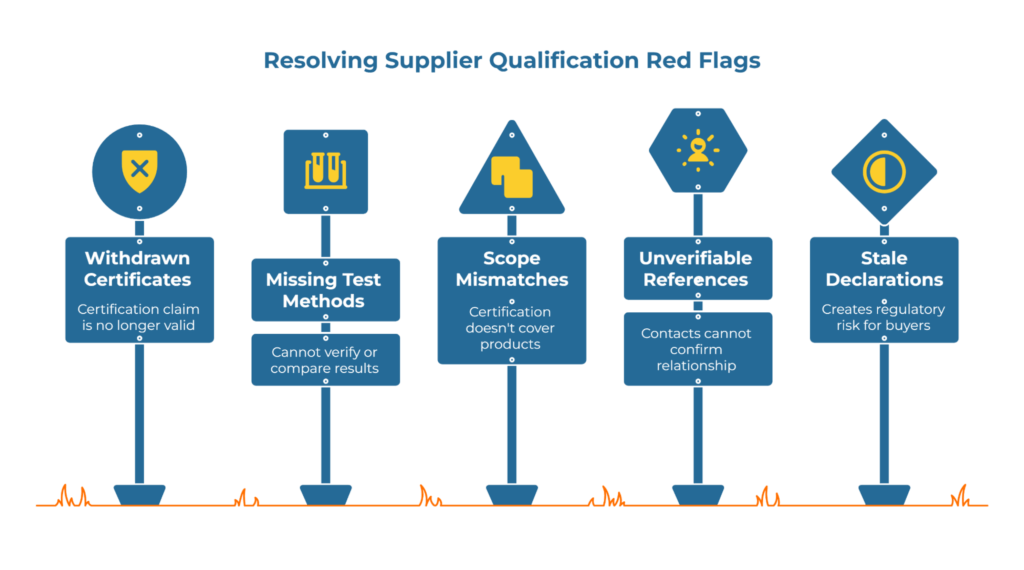
Certain evidence patterns immediately signal risk and trigger either immediate disqualification or mandatory resolution before qualification proceeds.
Withdrawn or expired certificates represent the most serious red flag. If registry checks reveal that a submitted ISO, FSC, or PEFC certificate has been withdrawn, suspended, or expired, the supplier loses the right to claim that certification in marketing or sales materials. Buyers who discover this discrepancy during verification typically disqualify the supplier immediately unless the supplier can demonstrate that renewal is actively in process with a confirmed timeline and interim evidence of continued compliance.
The resolution path requires the supplier to either complete certificate renewal and resubmit valid documentation, or remove the certification claim from all marketing materials and proceed with qualification based on other evidence of capability. Attempting to present expired certificates as current represents a material misrepresentation that destroys trust.
Laboratory test reports without method identification cannot be verified or compared against specification requirements. If a burst strength result shows “28 points” without specifying TAPPI T 403, ISO 2758, or another recognized test method, buyers cannot assess whether that result meets their specification or compare it meaningfully with quotes from other suppliers using different methods.
Resolution requires the supplier to either obtain compliant test reports with full method identification from an accredited laboratory, or provide detailed test procedure documentation that allows the buyer’s technical team to assess method equivalency. Generic “in-house testing” without method references rarely satisfies buyers operating under ISO 9001 or other quality frameworks that require calibrated, standardized measurement systems.
Scope mismatches between certificates and offered products occur when a mill holds valid certifications that simply don’t cover the grades being sold. An ISO 9001 certificate scoped for “office paper manufacturing” does not validate kraft paper operations even if both occur in the same facility.
Resolution requires the supplier to request a scope amendment or extension from the certification body to explicitly include kraft paper manufacturing, or to acknowledge the limitation and proceed without claiming ISO coverage for kraft products. Buyers appreciate transparency here—acknowledging scope gaps honestly maintains trust, whereas attempting to imply broader coverage destroys it.
Unverifiable references emerge when buyers attempt spot checks and discover that provided contacts cannot confirm the business relationship, or that shipment documentation shows inconsistent details. This sometimes results from innocent administrative errors such as outdated contact information, but can also indicate fabricated references.
Resolution requires the supplier to provide alternative verifiable references with current contact details and authorization for the buyer to conduct reference checks. If multiple reference checks fail, buyers typically require additional evidence such as redacted commercial invoices, bills of lading, or other shipment documentation to validate track record claims.
Stale Declarations of Compliance or test reports for food-contact applications create regulatory risk for buyers. Food safety requirements evolve as new migration limits are established or as analytical methods improve. A five-year-old migration test may not address current regulatory requirements even if the grade formulation remains unchanged.
Resolution requires updated testing aligned with current regulations such as the European Union’s most recent amendments to food-contact frameworks or FDA guidance updates. Suppliers serving regulated food-contact markets should maintain routine testing schedules that keep compliance documentation current without buyer prompting.
For each red flag, the PQQ evidence matrix includes a “Resolution Notes” column where buyers can document the issue, the supplier’s proposed remedy, and the verification outcome. This creates a clear audit trail for internal procurement reviews or external compliance audits.
Frequently Asked Questions
Which certifications actually matter for kraft paper suppliers?
Start with what is claimed and what is required. For quality systems, ISO 9001 is often cited when claimed; for environmental systems, ISO 14001 when claimed. If chain-of-custody claims are made for certified fiber, a valid FSC or PEFC CoC certificate is essential, and it must match the site and product scope in the FSC certificate search or PEFC database.
How do I verify FSC/PEFC scope and validity?
Use the scheme’s public registry and search by certificate code or organization name. Confirm status (active), scope (covers kraft or the relevant category), site (manufacturing location), and expiry. Save a link and a dated screenshot in the evidence matrix.
Do exporters need their own Chain-of-Custody?
Generally, CoC requirements follow the scheme rules and who takes legal ownership while making certified claims. If an exporter takes possession and passes on certified claims, CoC is typically required; check scheme guidance and verify in the registry.
What proves food-contact safety for kraft grades?
Submit a Declaration of Compliance that maps the grade to the end use, plus accredited lab reports with method IDs. For frameworks and expectations, see EU 1935/2004, EU 2023/2006 GMP, and US 21 CFR Part 176. Specifics vary by application; align with your customer’s quality requirements.
How often should lab tests be refreshed?
Use 12 months or less as the default maximum unless a buyer specifies a tighter window (common for sensitive uses). Each report must show the relevant TAPPI/ISO methods.
Downloadables and How PaperIndex Helps
This standardized PQQ functions as an operational system, not just a checklist. Four downloadable tools work together to streamline both supplier preparation and buyer verification.
The PQQ template is available as an editable DOCX file, allowing suppliers to complete the questionnaire digitally and allowing buyers to customize sections for company-specific requirements. The template mirrors the evidence categories outlined above, providing a structured framework for collecting consistent information across all supplier evaluations.
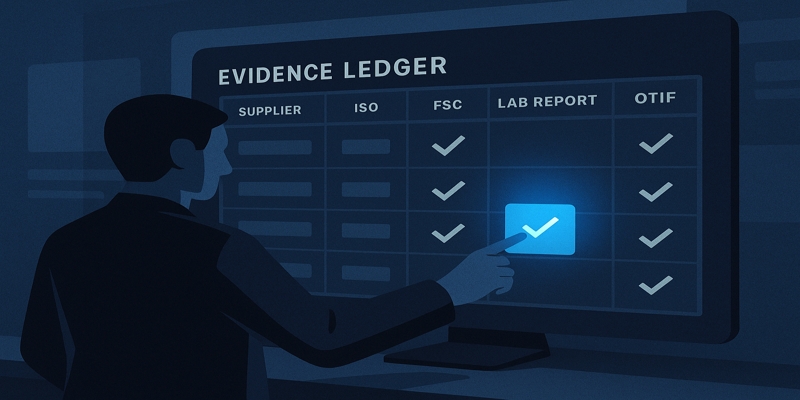
The Evidence Matrix in Excel format serves as the central tracking tool for buyers managing multi-supplier evaluations. Column headers include Evidence Item, Required (Y/N), Provided (Y/N), File Name, Expiry Date, Registry Link, Reviewer Name, and Notes. This format allows procurement teams to assign verification tasks, track completion status, and maintain organized records for audit purposes.
When evaluating five potential kraft suppliers simultaneously, the evidence matrix prevents oversight by ensuring every required document from every supplier receives proper verification. Color-coding or conditional formatting can highlight items pending verification, expired documents, or evidence gaps requiring follow-up.
The Buyer Verification Log provides an additional layer of process control, with columns for Supplier Name, Evidence Gaps Identified, Follow-Up Actions Required, Qualification Decision, Decision Date, and Responsible Owner. This log captures the decision-making narrative that sits behind the evidence matrix data, documenting why certain suppliers advanced to contract negotiation while others were removed from consideration.
For buyers operating under ISO 9001 or similar quality management systems, this verification log provides audit evidence that supplier qualification followed defined procedures and applied consistent criteria across all candidates.
The Supplier Declaration form requires supplier signature and date, creating a formal attestation that all submitted evidence is authentic, current, and accurately represents capabilities. This declaration includes consent for buyers to verify submitted information through registry checks, reference contacts, or other reasonable means.
The declaration builds accountability into the process. Suppliers who knowingly submit false or expired evidence face reputational consequences and potential disqualification from future opportunities, while buyers gain legal recourse if material misrepresentations later emerge.
PaperIndex supports this qualification workflow by providing a neutral platform where buyers can discover qualified suppliers and where suppliers can demonstrate capabilities transparently. As the world’s largest specialized B2B marketplace for the pulp and paper industry, PaperIndex connects over 59,000 members across the globe, maintaining a stringent supplier vetting process with less than 20% acceptance rate to ensure marketplace quality.
Buyers can submit RFQs specifying evidence requirements up front, allowing suppliers to self-select based on qualification criteria before investing time in quotation. Suppliers can join PaperIndex free to establish verified profiles that demonstrate certifications, capabilities, and track record to potential buyers proactively.
The PaperIndex Academy provides additional educational resources on international trading, Incoterms, quality standards, and supply chain risk management—helping both buyers and suppliers navigate the complexities of global kraft paper sourcing with confidence.
Quick-Reference Checklist
Use this checklist to verify evidence completeness before finalizing supplier qualification decisions:
- Evidence covers legal/trade, capabilities, quality, environment/CoC, food contact (if relevant), lab tests, track record, documentation integrity, and operational proof
- Every certificate shows scope, site, expiry, and has a registry link
- Lab tests are 12 months old or less and list method IDs
- Filenames use a clear convention and include versions/dates
- Verification log is complete; 1–2 references or shipments spot-checked
- Red flags (if any) are resolved with updated, scope-true documents
When suppliers submit complete, verifiable evidence packets from the first interaction, and when buyers apply consistent verification standards across all candidates, pre-qualification shifts from a bottleneck to a competitive advantage. The result is faster supplier onboarding, stronger compliance posture, and fewer quality failures downstream—all built on a foundation of standardized, evidence-based qualification.
Our Editorial Process
Our expert team uses AI tools to help organize and structure our initial drafts. Every piece is then extensively rewritten, fact-checked, and enriched with first-hand insights and experiences by expert humans on our Insights Team to ensure accuracy and clarity.
About the PaperIndex Insights Team
The PaperIndex Insights Team is our dedicated engine for synthesizing complex topics into clear, helpful guides. While our content is thoroughly reviewed for clarity and accuracy, it is for informational purposes and should not replace professional advice.