

📌 Key Takeaways
Landed cost shouldn’t trigger quarterly panic—five simple guardrails turn reactive scrambling into predictable, defensible decisions.
- Spec Comparability Blocks Hidden Cost: Method-named tests and tolerances ensure quotes reflect the same material, preventing yield losses and claims from derailing “low price” awards.
- To-Door Normalization Reveals True Winners: Converting EXW, FOB, CIF, and DDP quotes to a single delivery basis eliminates Incoterms confusion and makes ranking mechanical rather than guesswork.
- Freight Scenarios Expose Fragile Awards: Stress-testing normalized quotes at baseline, +30%, +40%, and +50% freight levels flags winners that flip under volatility—before contracts are signed.
- Terms and Triggers Prevent Invoice Surprises: Quarterly driver reviews, explicit change thresholds, and 30-60 day notification protocols transform mid-term adjustments from chaos into structured conversations.
- Responsibility Maps End the Blame Loop: A simple matrix clarifying who proposes, approves, and owns specification changes, logistics shifts, and surcharges ensures cost movements land with the right stakeholder.
Use these five controls, and renewals become routine process execution rather than detective work.
Procurement and sourcing professionals at packaging converters will gain a complete mental model here, preparing them for the detailed guardrail framework that follows.
Every quarter, the same anxiety cycle repeats. Ocean freight surges. Currency shifts. A supplier sends a revised quote, and suddenly the “winning” bid from last month no longer makes sense. The procurement team scrambles to recalculate, finance questions the accrual accuracy, and everyone wonders whether the original decision was ever valid.
This isn’t just inefficiency. It’s a fundamental gap in how most organizations approach containerboard cost management. The default approach treats landed cost as a moving target—something to chase, react to, and hope stabilizes long enough to get through the next review cycle.
There’s a better way. Instead of guessing or reacting to cost volatility, procurement teams can install five simple guardrails that turn landed cost from an anxiety driver into a predictable, controllable input. Think of it as cruise control on a hilly road. The terrain changes, but the guardrails keep your speed—and your accruals—steady.
Why Guardrails Beat Guesswork for Landed Cost
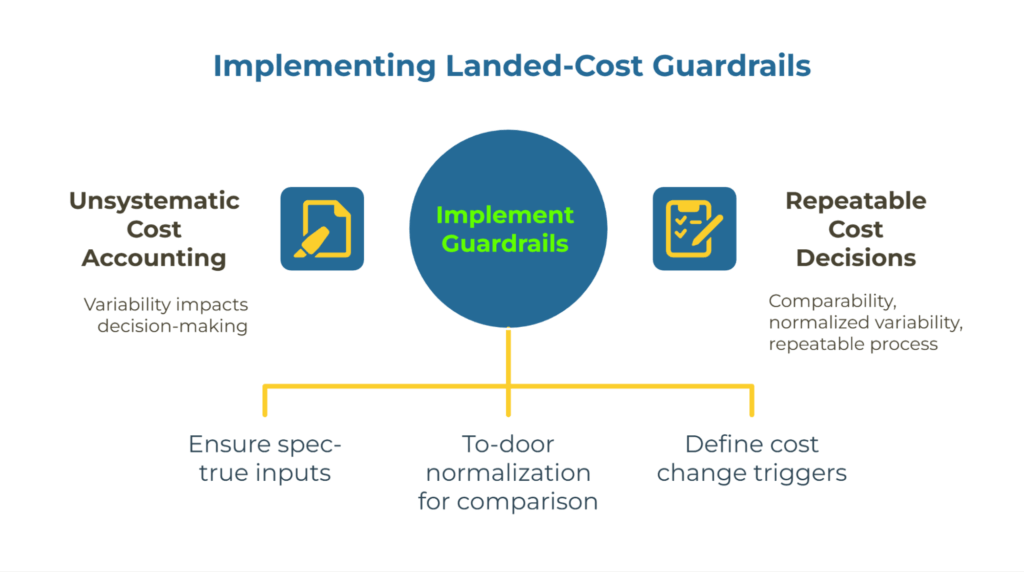
The core problem isn’t that containerboard costs fluctuate. Markets move, freight rates swing, and currency pairs shift daily. That’s normal. The problem is that most organizations lack a systematic way to account for this variability when comparing quotes, awarding contracts, and forecasting spend.
Landed-cost guardrails are the minimum, non-negotiable controls that govern how specifications, pricing bases, freight exposure, contract terms, and organizational responsibilities are defined and reviewed. These controls ensure that supplier rankings don’t flip with every market rumor, rate swing, or internal hand-off.
The mental model follows three steps. First, align what you’re buying through spec-true inputs. Then, align where the price ends through to-door normalization. Finally, align when and how costs can change through documented terms and triggers. These three steps remove the noise, so quarterly business reviews can focus on supplier performance rather than detective work.
A guardrail approach changes the game. Rather than chasing the lowest spot price, procurement installs five controls that ensure comparability, normalize variability, and create a repeatable process for cost decisions. These guardrails don’t eliminate market volatility—they contain its impact on your decision-making process.
Each guardrail addresses a specific failure point where hidden costs typically emerge. Spec mismatches create yield losses. Incoterms confusion hides freight obligations. Freight surges flip winners. Unclear change control processes lead to surprise invoices. And without a responsibility map, no one knows who owns what when costs shift.
Install these five guardrails, and renewals become routine rather than reactive.
Guardrail #1: Spec Comparability Before Price
The first guardrail is the most fundamental: never compare prices until specifications are truly comparable. This sounds obvious, but in practice, many procurement teams jump straight to pricing without verifying that quotes are actually for the same material.
Containerboard specifications include multiple variables—basis weight, caliper, burst strength, moisture content, packaging format, and quality tolerances. When suppliers provide quotes with different test methods, different tolerance ranges, or unstated moisture assumptions, the apparent “lowest price” may deliver the highest real cost once yield losses and claims materialize.
The fix is method-named specifications. Every request for quotation should specify exact test methods (ISO 536 for basis weight, ISO 2758 for burst strength, ISO 287 for moisture content), acceptable tolerance ranges (±2% is common for basis weight), and moisture windows (typically 6.5-8.5% for containerboard). Lock these minimum fields to the run target—target caliper for crush performance, moisture window for warp control—and require method parity so numbers mean the same thing across suppliers.
Treat specification changes as formal revisions, not clerical updates. A new tolerance or method is a change that requires version control and documented approval.
For a deeper exploration of how specification clarity prevents hidden costs, see the comparability before price: the spec-true mindset framework. When specifications are method-named and tolerance-bound, quotes become genuinely comparable, and the lowest number actually means the lowest cost.
Guardrail #2: To-Door Normalization (One Basis, One Decision)
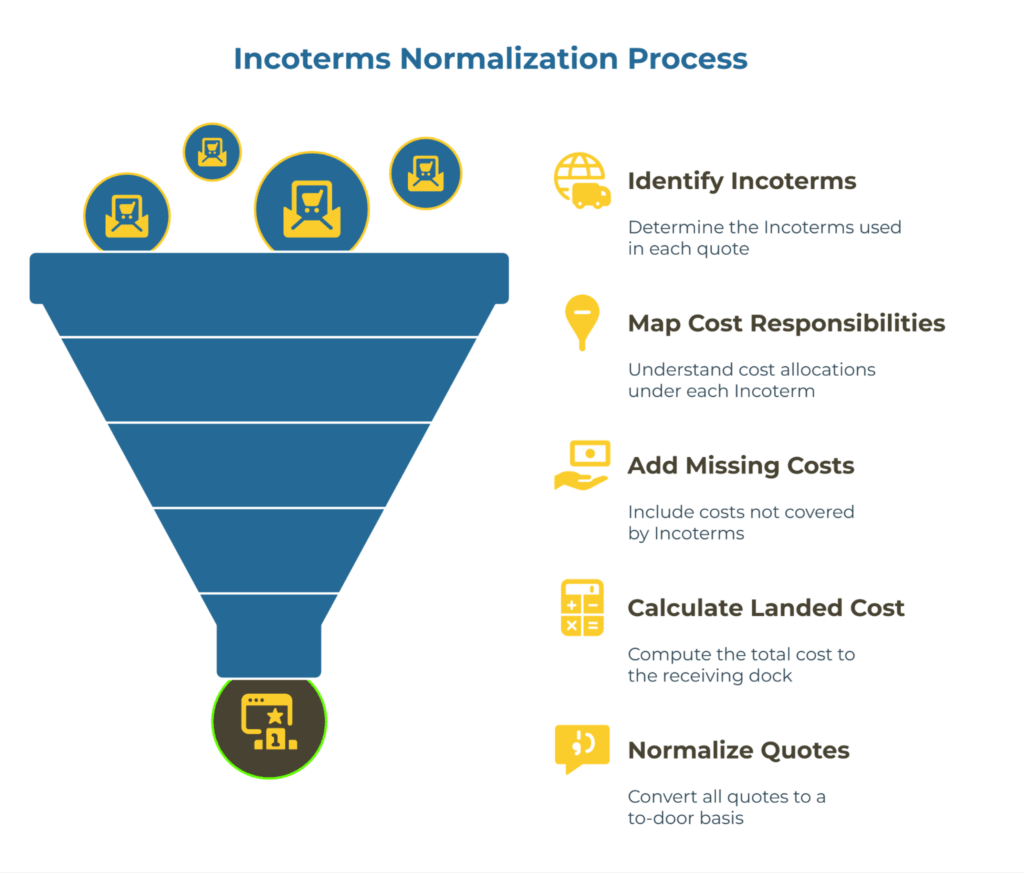
The second guardrail addresses Incoterms confusion. Suppliers quote on different commercial terms—some EXW (Ex Works), others FOB (Free on Board), still others CIF (Cost, Insurance, and Freight) or DDP (Delivered Duty Paid). Comparing these directly is meaningless because each term represents a different point in the supply chain where cost responsibility transfers.
Incoterms® 2020 allocate obligations, risks, and costs of delivery, but they do not set everything about a contract or transfer of title. Your analysis must convert each offer to the same to-door basis before ranking suppliers fairly.
To-door normalization solves this by converting every quote to the same delivery basis: your receiving dock. This requires mapping the cost responsibilities under each Incoterm and adding the missing components to reach a true landed cost.
Here’s the working formula (illustrative, currency-neutral):
To-Door Unit Cost =
- Supplier Price (on their stated term)
- Ocean/Truck to Port/Terminal (if not included)
- Main Carriage (if not included)
- Insurance (if not included)
- Port/Terminal & Handling
- Inland Freight to Your Site
- Customs Duties, Taxes, Fees*
- Bank/Documentation/Admin
*Note: Customs valuation and duty/tax calculation are jurisdiction-specific. Use your customs broker’s method and the WTO Customs Valuation Agreement framework as the anchor for “transaction value” and allowable adjustments.
An EXW quote needs inland freight from the mill, export documentation, ocean freight, insurance, import duties, and final-mile delivery added. A CIF quote already includes ocean freight and basic insurance but still needs import duties and last-mile transport.
The landed-cost framework for kraft paper provides a systematic methodology for this normalization process. Once all quotes reflect the same to-door basis, ranking becomes straightforward. The lowest normalized number wins—not the lowest quote number.
This guardrail also forces transparency around assumptions. Document freight estimates, insurance percentages, duty rates, and inland costs with dates and sources. When rates change, updating the normalized comparison is a mechanical process rather than a guessing game.
Guardrail #3: Freight Scenarios That Flip Winners
The third guardrail prevents the most common procurement failure: awarding a contract based on current freight rates, only to watch the winner become uncompetitive when ocean rates surge. Freight can represent a significant and highly volatile portion of landed cost for containerboard, in some cases exceeding 30% of the total, and carrier surcharges (Peak Season Surcharge, General Rate Increase) can add substantial double-digit percentage increases, often with little warning.
The need for scenario testing is well-documented. Even when broad commodity baskets ease, as seen during 2023-2024, episodes of transport cost volatility often persist. This well-documented market behavior, often analyzed by groups like the World Bank, makes scenario tests prudent for any sourcing decision with freight exposure.
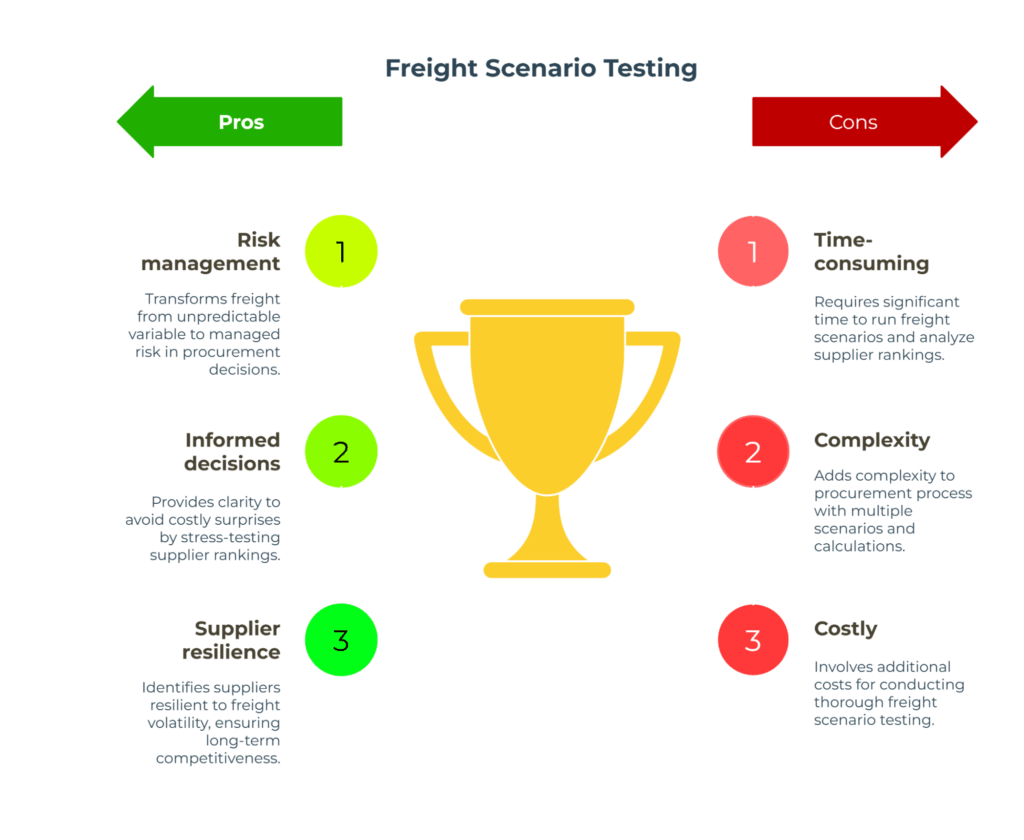
Stress-testing prevents this. Before awarding, run freight scenarios on each normalized quote. Apply different percentage adjustments to main carriage (ocean or long-haul truck) and inland drayage separately, since these components move independently. Re-rank suppliers at each scenario level and flag any rank-order flips.
If Supplier A wins at baseline but Supplier B wins when freight increases 40%, the award is fragile. The decision becomes visible: accept the baseline winner and monitor freight closely, or choose the more freight-resilient option.
This approach transforms freight from an unpredictable variable into a managed risk. The freight scenarios that flip supplier rankings guide demonstrates how to build and interpret these scenario models. Most organizations find that a simple spreadsheet with three scenarios provides enough clarity to avoid costly surprises.
Quick Scenario Math (20-Minute Exercise)
Take two normalized quotes: Supplier A at $850/tonne to-door (20% freight component = $170), Supplier B at $880/tonne to-door (15% freight component = $132). At baseline, A wins. Now stress-test:
- At +40% freight: A becomes $850 + ($170 × 0.40) = $918; B becomes $880 + ($132 × 0.40) = $933. A still wins but the margin shrinks.
- At +50% freight: A becomes $850 + ($170 × 0.50) = $935; B becomes $880 + ($132 × 0.50) = $946. A still narrowly wins.
If freight exposure is a concern, consider a blended sourcing strategy (70% A, 30% B) to hedge the risk. The math is illustrative; actual freight components vary by lane and product.
Guardrail #4: Terms, Triggers & Change Control
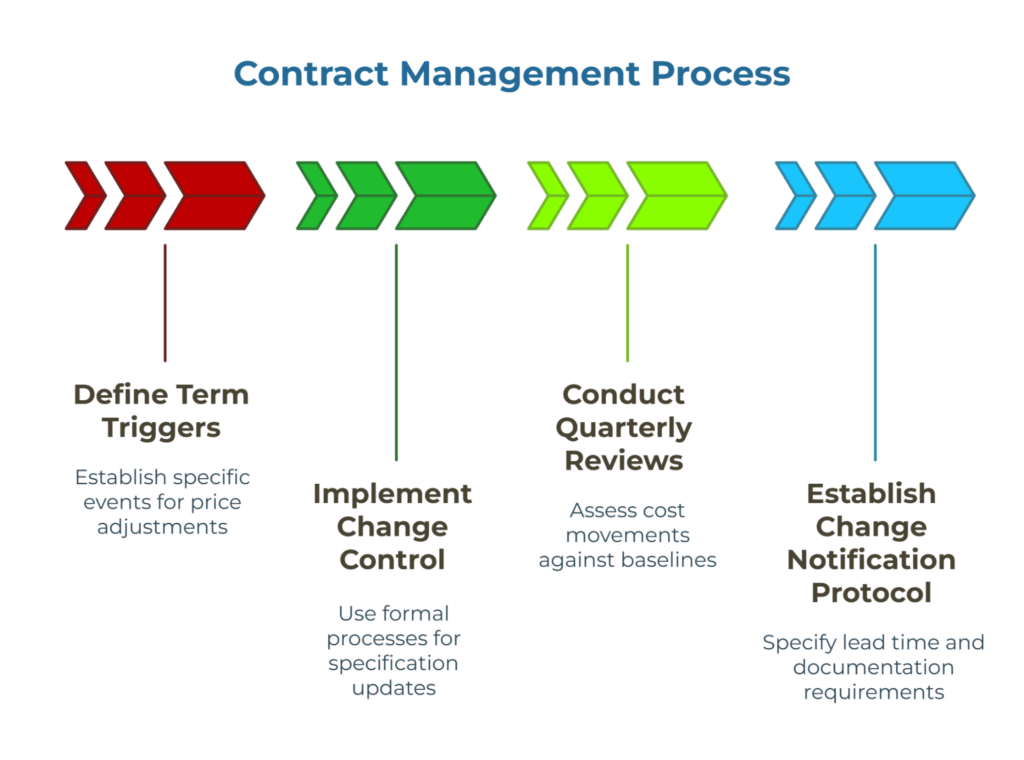
The fourth guardrail addresses contract terms and change control. Without clear triggers for price review and documented processes for handling mid-term adjustments, contracts devolve into constant renegotiation or surprise invoices that blow accrual budgets.
Effective terms include three components. First, define term triggers—the specific events that allow an adjustment, such as index-based fiber surcharges, fuel index changes beyond floor or ceiling levels, or documented specification changes. These thresholds prevent every market ripple from becoming a renegotiation opportunity.
Second, implement formal change control. Treat specification updates, method revisions, or tolerance changes as controlled changes requiring written approval and an effective date. This aligns with quality management principles—ISO 9001 emphasizes controlled changes and documented information for production and service provision. Use a single-page change form and route it with your purchase order amendment.
Third, establish a quarterly review cadence where both parties assess movement in fiber costs, energy prices, and freight rates against agreed baselines. This isn’t automatic repricing—it’s a structured conversation using public indices to determine whether adjustment discussions are warranted.
Research on procurement digitization shows that organizations using digital workflows and structured review processes reduce delays and errors in procurement governance. Illustrative examples of such triggers might include freight rate changes exceeding 20%, currency movements beyond 10%, or documented input cost shifts above 15%.
A change notification protocol specifies lead time (typically 30-60 days), documentation requirements (supplier must provide third-party evidence of cost driver movement), and dispute resolution steps. This prevents “surprise” invoices that force finance to explain variance after the fact.
For sourcing teams working with packaging paper suppliers, these terms create mutual predictability. Suppliers gain confidence that legitimate cost increases will be heard; buyers gain confidence that prices won’t shift arbitrarily.
Guardrail #5: Responsibility Map & QBR Rhythm
The fifth guardrail is organizational: a responsibility matrix that clarifies who owns what when costs shift, paired with a quarterly business review rhythm that keeps everyone aligned.
The matrix uses two dimensions. One axis separates specification decisions (technical requirements, quality standards, testing methods) from commercial terms (Incoterms, payment terms, volume commitments, price adjustment mechanisms). The other axis separates risk management (scenario planning, hedging strategies, multi-sourcing decisions) from cost control (accrual accuracy, invoice validation, budget tracking).
Here’s a practical responsibility template:
| Change Type | Who Proposes | Who Approves | When It Applies |
| Spec (basis/caliper/moisture/tolerance/method) | Converter QA/Operations | Procurement + QA | Dated addendum to PO |
| Logistics (routing/Incoterm shift) | Supplier Logistics | Procurement | Next shipment after written confirmation |
| Surcharges (fiber/fuel) | Supplier Commercial | Procurement (Finance informed) | Following pre-agreed trigger window |
| Admin (packaging/labeling/documentation) | Either party | Procurement | Immediately if no cost impact; otherwise next cycle |
Clear ownership prevents the most common dysfunction: when costs shift, everyone assumes someone else is managing it. Procurement typically owns commercial terms and supply risk. Finance owns invoice accuracy and budget discipline. Quality or Technical teams own requirements and alternative qualification. Operations or Planning owns actual consumption and waste minimization.
The quarterly business review brings these stakeholders together to work through a structured agenda:
- Confirm to-door benchmarks against latest normalized quotes
- Review flips in freight scenarios at current market rates
- Address open change requests and their effective dates
- Assess supplier scorecard trends (on-time delivery percentage, confirmation rate, quality escapes)
- Identify next-quarter risk watchlist items
This rhythm turns cost management from a reactive scramble into a predictable calendar event. It’s cruise control: set the structure once, then monitor and adjust as conditions require.
Put It Together: A Calm, Repeatable Play
These five guardrails form a complete system. Spec comparability ensures quotes reflect the same product. To-door normalization ensures quotes reflect the same cost basis. Freight scenarios ensure awards remain valid under volatility. Terms and triggers ensure mid-term adjustments are structured rather than chaotic. And the responsibility map ensures the right people are managing the right variables.
The result is a procurement process that feels routine rather than reactive. Renewals become straightforward: pull the latest quotes, normalize to-door, run the freight scenarios, review against existing terms, and make a decision. Finance can trust the accruals because the methodology is documented and repeatable. Operations can plan confidently because supply risk is actively managed.
For a comprehensive view of how these guardrails integrate with broader cost intelligence practices, explore the price-to-door playbook, which connects driver-based benchmarking with landed-cost frameworks for defensible supplier selection.
The guardrails also create a foundation for continuous improvement. Once the baseline process is stable, teams can add sophistication: multi-origin sourcing strategies, currency hedging analysis, or predictive freight modeling. But those enhancements only make sense after the five core guardrails are in place.
5 Guardrails to Stabilize Landed Cost — Quick Reference
The one-pager summarizes the complete framework:
- Spec Comparability: Method-named tests (ISO 536, ISO 2758, ISO 287), tolerances (±2% basis weight), moisture windows (6.5-8.5%)
- To-Door Normalization: Convert all quotes (EXW, FOB, CIF, DDP) to the same delivery basis using Incoterms® 2020 responsibilities
- Freight Scenario Grid: Baseline, +30%, +40%, +50% to identify winner flips
- Terms & Triggers: Quarterly driver review, change thresholds (freight >20%, FX >10%, input costs >15%), 30-60 day notification
- 2×2 Responsibility Map: Change Type × Approval Authority with effective dates and clear QBR cadence
This one-pager can be saved as a process reference and shared with finance, operations, and supplier relationship teams to ensure alignment across functions.
Next Steps for Procurement Teams
Whether sourcing from kraft paper manufacturers, working with kraft paper suppliers, or evaluating containerboard options, these five guardrails create a foundation for confident, repeatable cost decisions.
For buyers looking to source containerboard with these principles in mind, submit an RFQ to connect directly with verified suppliers. For suppliers seeking to demonstrate cost transparency and structured commercial terms to prospective buyers, join PaperIndex free to access the global buyer network. Additional tools and frameworks are available through PaperIndex Academy.
Our Editorial Process
Our expert team uses AI tools to help organize and structure our initial drafts. Every piece is then extensively rewritten, fact-checked, and enriched with first-hand insights and experiences by expert humans on our Insights Team to ensure accuracy and clarity.
About the PaperIndex Insights Team
The PaperIndex Insights Team is our dedicated engine for synthesizing complex topics into clear, helpful guides. While our content is thoroughly reviewed for clarity and accuracy, it is for informational purposes and should not replace professional advice.