

📌 Key Takeaways
Your procurement team already has the buying intelligence it needs — it’s just trapped in emails, spreadsheets, and people’s memories.
- Organize Data Before Adding Tools: AI can only compare supplier quotes when the underlying records use consistent names, fields, and formats across your files.
- Start With Quote History: Logging every new quote with the same fields — supplier, product, specs, price, and terms — turns scattered emails into reusable pricing intelligence.
- Fix Names First: When the same supplier appears three different ways across spreadsheets, even basic spend reports and trend analysis break down.
- Assign Ownership to Roles: Without a named person responsible for each data area, even a thorough cleanup decays within weeks as old habits return.
- Clean Forward, Not Backward: Setting up a repeatable logging process for new quotes matters more than spending days fixing old spreadsheets while messy data keeps flowing in.
Structure your records first — then let the tools do the math.
Procurement leads and operations teams at growth-stage paper trading businesses will find a clear starting point here, preparing them for the detailed data-readiness checklist that follows.
~ ~ ~ ~ ~ ~ ~ ~ ~ ~ ~ ~ ~ ~ ~ ~ ~ ~
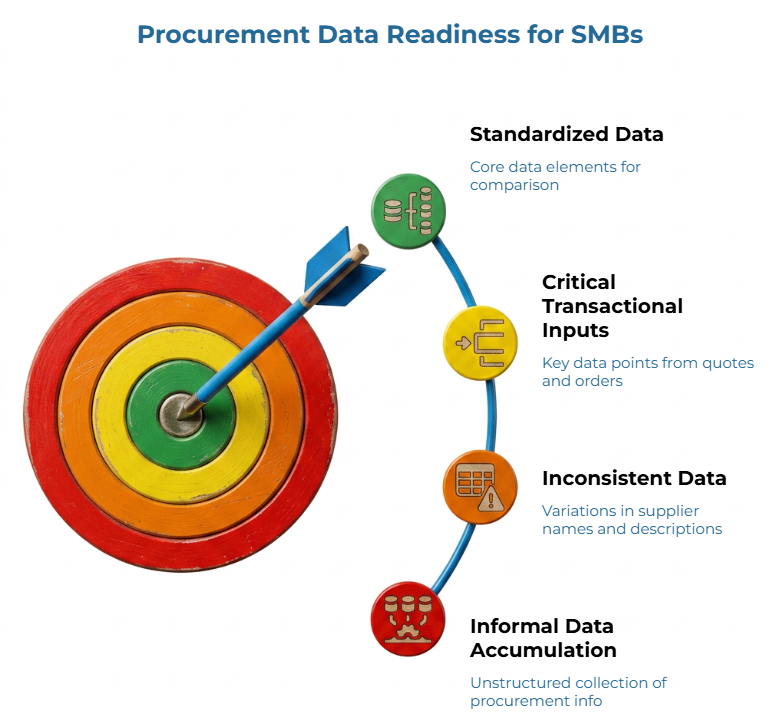
For growth-stage paper trading SMBs, the challenge is specific. Valuable procurement intelligence accumulates quickly but informally. Supplier names are spelled three different ways across spreadsheets — a problem that compounds when you’re trying to find suppliers across multiple product categories. Product descriptions shift from one quote to the next. Purchase records capture what was ordered but not what was quoted. Teams rely on memory instead of structured records, which works until someone is unavailable — or leaves.
A common mistake is starting with tools before organizing the data those tools must read. If one quote lives in an email body, another in a PDF, and another in a spreadsheet with missing terms, AI can summarize fragments. It still cannot know whether those fragments describe comparable offers unless the core fields are clear. The first step toward better procurement decisions isn’t automation. It’s readiness — isolating critical transactional inputs and standardizing them so comparative math works out of the box.
The Five Procurement Data Areas to Organize First
Not all procurement data carries equal weight. These five areas form the foundation of usable buying intelligence for paper traders — and they’re where inconsistency causes the most friction.
Supplier Master Data
Supplier master data is the foundational record for each supplier: company name, known aliases, contact details, location, product categories, lead times, payment terms, and status. When consistent, your team can compare suppliers reliably and track performance over time.
The common problem? Variation. The same supplier might appear as different across different files — breaking any attempt at trend analysis or spend reporting. Finance may also struggle to connect invoices, purchase records, and approvals when supplier names don’t match.
A practical first step is choosing one canonical name per supplier and keeping alternate spellings in an alias field. Mark suppliers as active, inactive, under review, or approved for specific categories. A shared reference list eliminates the most damaging inconsistencies. Your spreadsheets worked at lower volumes, but at scale, inconsistent records make even basic supplier comparison unreliable.
Quote History
Quote history is the record of pricing and terms received from suppliers — supplier name, date, product, specifications, quantity, unit price, currency, freight terms, and validity period. When captured consistently, it becomes your most powerful tool for standardizing supplier quotes and making fair comparisons.
For most paper trading SMBs, quote history lives in email. A supplier sends a PDF or types pricing into a message. Someone saves it, maybe copies a number into a spreadsheet. Three months later, nobody can reconstruct what was quoted or how it was compared.
Consider a hypothetical scenario: Fourteen kraft linerboard quotes arrive in a single week, each formatted differently. Some include freight; others quote ex-works. One supplier puts validity in the attachment while another sends a revised offer two hours later with a changed quantity. Without a structured way to capture those data points, every comparison means digging through inboxes. For the mechanics of how to normalize those fields once captured, this guide to AI-assisted quote comparison walks through a 10-field comparison matrix. If the team logs the supplier, date, product description, quantity, price, currency, terms, and missing fields in one place, the quote becomes reusable intelligence. The fix is a repeatable capture step — a template where each quote is logged with the same fields, in the same format. Consistency in new data matters more than cleaning old email threads.
Purchase Records
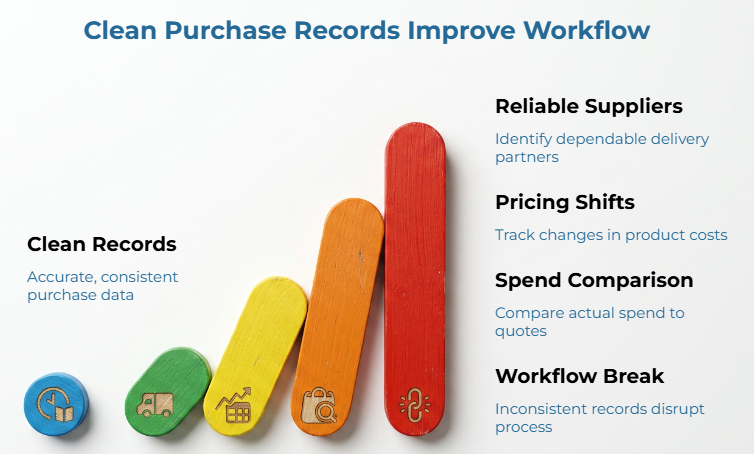
Purchase records connect what was quoted to what was actually bought — supplier, product, quantity, agreed price, order date, and delivery terms. When they’re clean, your team can answer questions that matter: which suppliers deliver reliably, where pricing has shifted, and how actual spend compares to quotes. When they’re inconsistent, the quote-to-purchase workflow breaks.
A purchase record doesn’t need to explain every commercial detail. It should show the supplier, product, quantity, date, agreed terms, and any meaningful difference between the quote and the final order. If a quoted product changed before purchase, record that change. If a delivery term was updated, note it. This helps procurement, finance, and operations read the same version of history — and helps new team members understand why a supplier decision was made instead of relying on someone’s memory from seven months ago.
The priority is linking purchases to quotes. Even a simple reference number or date match creates a thread of intelligence that reduces repeated manual lookup.
Product Attributes
In paper trading, product attributes drive comparability. Grade, basis weight (GSM), sheet size, brightness, finish, and certification all affect whether two quotes are genuinely comparable — a challenge explored in depth in comparability before price: the spec-true mindset that reduces kraft paper RFQ chaos. The exact attributes vary by product category and should be confirmed by internal product or procurement expertise before being formalized.
The problem is naming inconsistency. One spreadsheet lists “80gsm woodfree offset” while another records it as “80g WF offset.” When attributes differ, like-for-like comparisons become impossible — stalling automated matching and forcing manual reconciliation of mill invoices.
Consider a hypothetical example: two suppliers quote what appears to be the same product, but one description includes a specification note and the other uses only a broad trade name. If your spreadsheet records both under a generic product label, the offers look comparable too early. A better record flags the missing specification and keeps the comparison open until the field is clarified. A short, shared list of standard attribute fields prevents this drift. Don’t create a detailed paper taxonomy unless your team will maintain it — a simple set of required fields does more than an elaborate system nobody updates.
Email-to-System Workflows
This isn’t a data category — it’s the bridge between where procurement data originates (email) and where it needs to live for analysis. Email is still a practical procurement channel. The problem isn’t the email itself. The problem is leaving decision-critical data inside email after the quote arrives. A practical capture workflow changes that:
- Save the original supplier quote in the agreed folder or record.
- Extract key fields (supplier, product, specs, price, terms, date) into a shared log.
- Mark missing or unclear fields for supplier follow-up.
- Link the log entry back to the original email and, if an order is placed, to the final purchase record.
The data becomes searchable, sortable, and comparable. This doesn’t require new software. A shared spreadsheet with clear field definitions and a team habit of logging quotes on arrival is enough. Spreadsheet cleanup alone won’t hold if no process change follows. The workflow makes the data stick.
Procurement Data Readiness Checklist
Use this checklist to diagnose where your procurement data stands today.
| Data Area | What “Ready” Looks Like | Common Issue | First Cleanup Action |
| Supplier master data | One consistent name, contact, aliases, and category per supplier | Duplicate or variant supplier names across files | Merge obvious duplicates and create a shared supplier reference list with canonical names |
| Quote history | Each quote logged with supplier, date, product, specs, price, and terms | Quotes trapped in email with no structured capture | Adopt a standard quote-logging template for all new quotes |
| Purchase records | Orders linked to original quotes with consistent fields | Purchase logs disconnected from quote history | Add a quote reference field to your purchase tracking |
| Product attributes | Standard fields (grade, GSM, size, certification) used across all records | Inconsistent or abbreviated product descriptions | Define and publish a short list of required attribute fields by product category |
| Email-to-system workflows | A repeatable step exists between receiving a quote and logging it | No defined capture step; data stays in inboxes | Create a capture routine and assign a team member to log incoming quotes within 24 hours |
| Ownership | Each key data area has a named responsible role | Cleanup happens once, then records decay | Assign responsibility for updates and corrections to specific roles |
Assign Ownership Before You Clean the Data
Data readiness isn’t a one-time project. It’s an ongoing workflow responsibility. Without clear data ownership, even well-organized records decay within weeks. New suppliers get added inconsistently. Quote logging lapses during busy periods. Product descriptions revert to shorthand.
Here’s a scenario: your team spends 11 working days cleaning up the supplier reference list. The file looks better for about a month. Then a new supplier is onboarded during a rush, the naming convention is skipped, and three months later the same inconsistencies are back. Nobody owned the update process, so nobody maintained it. The cleanup was real, but the process maturity wasn’t there yet.
In most SMBs, data ownership is split across procurement, finance, sales, operations, and — often overlooked — whoever maintains the shared files, folders, or systems that support the process. Instead of centralizing every task, assign specific checkpoints to specific roles. Who updates the supplier list when a new vendor comes in? Who logs quotes before the end of week? Who reviews product attribute fields when a new category enters the mix? Who flags mismatches between purchase records and invoices?
Process maturity doesn’t mean a large procurement department. It means your team has repeatable habits. New quotes are captured the same way. Supplier names follow a controlled list. Purchase records connect to quote context. Exceptions are recorded instead of explained only in conversation. Benchmarking research from the American Productivity & Quality Center (APQC) demonstrates that establishing clear process and data ownership is a primary driver of data accuracy and supply chain efficiency; for a growth-stage paper trading operation, this translates to assigning role-based responsibility for validation rules and record maintenance.
Assign these responsibilities to roles, not individuals. Write them down somewhere the team can see them. The overhead is minimal.
How to Know You’re Ready for AI-Supported Procurement
Procurement process maturity — the consistency and documentation of your sourcing workflows — determines whether AI tools can add value or just frustration. Readiness isn’t about perfection. It’s about having enough structure for useful comparison.
Your team is approaching readiness when it can answer “yes” to most of these questions:
Can the team compare past quotes by supplier and product without digging through email? Are supplier names consistent across active files? Can someone retrieve purchase history for a specific product within minutes? Are product attributes consistent enough for like-for-like comparison? Is new quote data captured in a repeatable way? Are exceptions, missing fields, and revised terms documented?
A “no” to one or two isn’t a problem. But if most answers are “no,” introducing AI or procurement analytics tools will likely produce unreliable outputs and frustrate the team more than it helps.
The ISO 8000 series—the international standard for data quality—establishes that data quality cannot be measured by an arbitrary, static benchmark; instead, it requires structured processes for master data provenance, syntax verification, and semantic compliance to ensure information is genuinely fit for purpose. The practical lesson is simple: quality isn’t a one-time cleanup event. It’s a managed condition.
This is where the “our spreadsheets work well enough” objection deserves respect. Spreadsheets often do work well enough at first. They help teams move quickly. They become harder to trust when supplier names, quote fields, product descriptions, and purchase references vary across tabs and people. Keep the spreadsheet if it works. Strengthen the rules around it.
This doesn’t mean you need to be fully mature before using any technology. It means the data foundation should be in place for the specific areas where you want AI to help. If your priority is quote comparison, start with quote history and product attributes — then apply the normalization method described in why paper RFQs are hard to compare manually and where AI can help first. If you want to increase spend visibility, focus on purchase records and supplier master data first.
And if your team already knows the suppliers well? That experience is valuable. But structured sourcing history helps teams compare across time, transfer knowledge when people move roles, and scale decision-making beyond what any single person can hold in memory.
What to Do Next Without Overbuilding
Start with the highest-value data category. For many paper trading teams, that’s quote history — because comparing supplier pricing is a daily activity that depends on accessible records. The PaperIndex Academy offers several practical guides for building that comparison workflow.
Clean recent, active records first. A focused 90-day quote log covering recurring products and active suppliers is usually more useful than a half-cleaned archive from years ago. Then tighten supplier names. Then connect purchases back to the quote or decision note — the same quote-to-order thread described in The hidden cost of unstructured price history in paper procurement. Work forward before working backward.
This sequencing also helps leadership. Founders, finance leaders, operations teams, and technology owners don’t need to approve a full transformation plan first. They need to see that the team can create a more reliable buying record without slowing daily procurement.
Resist the urge to clean everything at once. Trying to overhaul all procurement data simultaneously stalls progress. Prioritize the quotes and purchases most likely to inform upcoming decisions.
Start by reviewing the checklist above and choosing one procurement data area to standardize before expanding into AI or analytics.
Frequently Asked Questions
Do we need perfect data before using AI in procurement?
No. AI requires structural standardization, not historical perfection. If you enforce uniform fields for new intake, models can execute line-by-line comparison across your core categories immediately. Supplier names, quote fields, product attributes, and purchase records should be clear enough that two team members can reach the same interpretation. Improve data quality incrementally as you learn which gaps matter most.
What procurement data should paper traders organize first?
Begin with the foundational data streams driving your daily transactions — specifically your incoming vendor quotes and verified vendor names — where data formatting variance immediately disrupts margin calculations. If you’re sourcing kraft paper, the kraft paper RFQ fields that change the quote guide shows exactly which 12 fields to standardize.
Should we clean old procurement spreadsheets or fix new workflows first?
Establish an immediate data gatekeeping process for new intake. It is far more efficient to ensure tomorrow’s data is clean than to spend administrative hours patching legacy spreadsheets while messy inputs continue to flood the system. Once the new protocol is stable, selectively backfill the past two quarters.
Who should own procurement data quality?
Ownership may sit with procurement, operations, finance, or a shared role. What matters is that responsibilities are explicit. Someone should own supplier record updates, someone should own quote logging, someone should review product attributes periodically, and someone should handle purchase record accuracy and exception handling. For SMBs, these can be added to existing roles.
From Scattered Records to Procurement Intelligence
The procurement data your team generates every day — quotes, supplier records, purchase orders, product specs — already contains the buying intelligence you need for faster sourcing decisions and more reliable supplier comparison. AI becomes more useful only when that story is clear enough to compare. The work is practical: standardize supplier names, capture quote history, connect purchases, clarify product attributes, and assign ownership.
You don’t need enterprise systems or perfect records. You need one shared supplier list, one quote-logging template, one set of product attribute standards, and one person responsible for keeping them current. Stop treating procurement data as scattered evidence. Start treating it as buying intelligence.
Disclaimer:
This article is for educational and informational purposes only and does not constitute professional procurement, technology, or business advice. Consult qualified professionals before making procurement system or process changes.
Our Editorial Process:
Our expert team uses AI tools to help organize and structure our initial drafts. Every piece is then extensively rewritten, fact-checked, and enriched with first-hand insights and experiences by expert humans on our Insights Team to ensure accuracy and clarity.
About the PaperIndex Insights Team:
The PaperIndex Insights Team is our dedicated engine for synthesizing complex topics into clear, helpful guides. While our content is thoroughly reviewed for clarity and accuracy, it is for informational purposes and should not replace professional advice.