

📌 Key Takeaways
Your past orders already hold the clues to which suppliers will deliver and which ones will let you down.
- Track Patterns, Not Just Single Events: One late delivery is normal—three out of eight late orders is a warning sign that deserves attention before your next commitment.
- Slow Confirmations Preview Late Shipments: When a supplier consistently takes days to confirm your order, the actual delivery is likely to slip too.
- AI Organizes What Your Team Already Knows: AI can turn scattered order records into clear supplier scorecards, but it works best with clean data and still needs human judgment.
- Score the Situation, Not Just the Supplier: A supplier may handle standard orders well but struggle with urgent or complex ones—compare performance by order type for a fairer picture.
- Verify Before You Commit: Check recent exceptions, confirm current stock, and test responsiveness before locking in any order tied to a customer promise.
Price opens the door, but execution history tells you whether to walk through it.
Paper buyers and procurement professionals managing supplier relationships will gain a practical framework for spotting reliability risks early, preparing them for the detailed scorecard and verification steps that follow.
~ ~ ~ ~ ~ ~ ~ ~ ~ ~ ~ ~ ~ ~ ~ ~ ~ ~
The quote looks right. A competitive price per metric ton, confirmed availability in the grade you need, and a delivery window that fits your customer’s timeline. The supplier checks every box on the screen in front of you.
But somewhere in your order history—buried across confirmation emails, ERP notes, and a colleague’s memory of a shipment that arrived late last quarter—a different story may be forming.
You have seen this before.
A supplier’s price was sharp, the terms were acceptable, and then the execution did not match the promise. A late confirmation stretched into a delayed shipment. A partial delivery forced you to scramble for backup stock. Your customer did not care whose fault it was. They cared that their order was short.
The frustrating part is not that the warning signs were absent; rather they were scattered across too many places for anyone to connect them in time. Supplier reliability is something most procurement professionals believe is important but find hard to measure consistently. With a structured approach to historical order analysis—supported by AI where the data allows—you can surface those patterns before your next purchase commitment and make sourcing decisions with greater fulfillment confidence.
Why Supplier Reliability Matters as Much as Price in Paper Buying
Every procurement manager understands that price drives margins. Fewer recognize how quickly unreliable execution erodes them.
A paper supplier who quotes 1.8 percent below the competition but delivers late on 3 of 11 orders is not saving you money. That supplier is generating expedited freight charges, reworked schedules, strained customer relationships, and hours spent chasing updates that should have arrived unprompted.
Supplier execution directly shapes your ability to honor customer commitments. When a supplier confirms availability and then falls short on the actual shipment, the cost extends beyond the inventory gap. It is the downstream conversation with a buyer who now questions whether you can deliver reliably—a question that mirrors the exact doubt you should have been asking about the supplier.
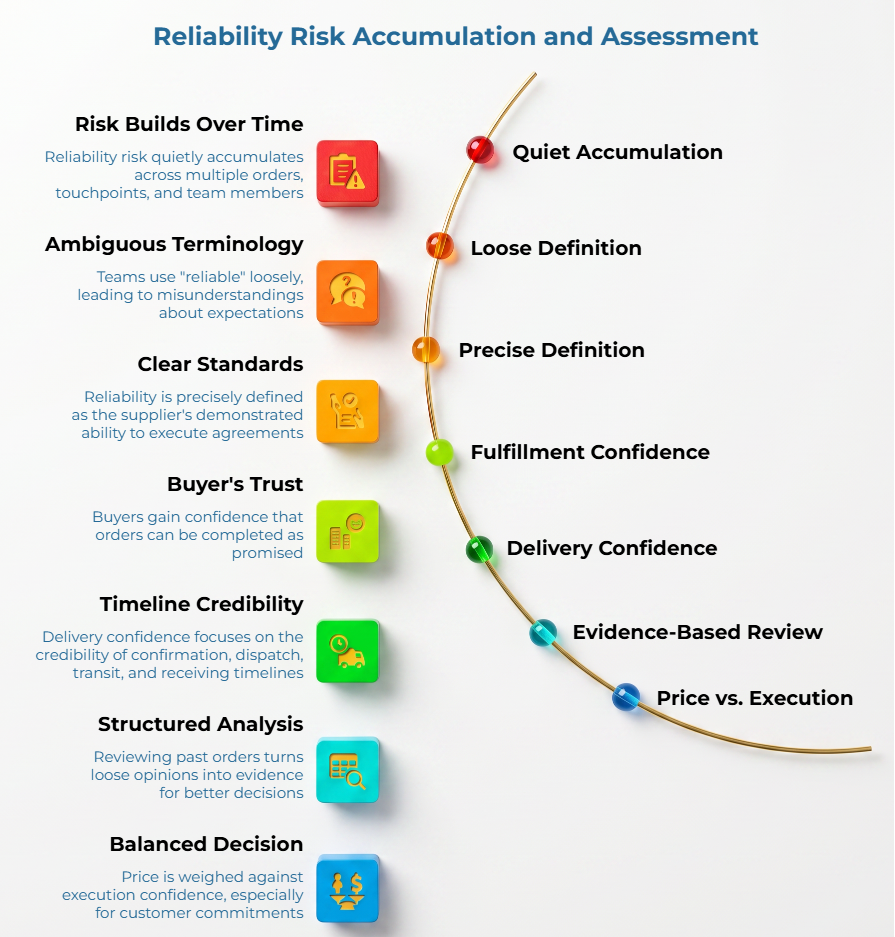
Reliability risk rarely announces itself. It accumulates quietly across multiple orders, multiple touchpoints, and multiple team members. And part of the problem is that teams use the word “reliable” loosely. One team member may mean “answers quickly.” Another may mean “ships the full quantity.” Operations may care most about clean documents and predictable receiving. Supplier reliability, defined precisely, is the supplier’s demonstrated ability to execute what was agreed. Fulfillment confidence is the buyer’s confidence that the order can be completed as promised. Delivery confidence is narrower: whether the expected confirmation, dispatch, transit, and receiving timeline looks credible. These distinctions matter because a structured review of past orders can turn loose opinions into evidence—and evidence supports better decisions than memory alone.
This does not make price irrelevant. Price remains a real decision factor. The point is simpler: price should be weighed against execution confidence, especially when a customer commitment depends on the supplier’s follow-through.
The Supplier Reliability Patterns Often Hidden in Past Orders
Pull up the last twelve months of orders with a given supplier, and certain signals start to tell a story. None of these signals alone is a verdict. Together, they form a reliability profile that deserves attention before you commit to the next purchase.
- Delayed confirmations. As a hypothetical illustration: you submit a purchase order on Monday, and the confirmation does not arrive until Thursday—repeatedly. That gap between submission and acknowledgment often previews a gap between promised and actual delivery. Order confirmation speed, tracked over multiple transactions, is one of the clearest early indicators of downstream delays.
- Repeated late deliveries. A single late shipment happens to every supplier; the true signal is recurrence. If three of the last eight orders arrived outside the agreed window, that is a pattern worth investigating, not explaining away.
- Inconsistent responsiveness. Some weeks, replies arrive within hours. Other weeks, follow-ups go unanswered for days. Response consistency matters because it affects your ability to make timely commitments to your own customers. A fast first quote, though, is not the same as dependable communication through the whole order cycle. As a hypothetical example: a supplier answers the RFQ within the same business day, then takes repeated follow-ups to confirm whether the quoted GSM and reel width are actually available. That delay does not automatically disqualify the supplier, but it does tell you to request written confirmation earlier on the next similar order.
- Partial availability. You ordered 37 metric tons of kraft paper and received 29, with the balance “to follow.” When this happens once, it is logistics. When it happens across multiple orders, it suggests the supplier is confirming stock positions they cannot consistently fulfill.
- Repeated short shipments. A short shipment is distinct from partial availability. Partial availability means the supplier flags a stock gap before or during confirmation. A short shipment is discovered after the buyer has already planned around the full quantity. One isolated short shipment may have a specific cause. A recurring pattern—where shipped quantity differs from confirmed quantity across similar orders—changes the risk interpretation and should trigger closer verification before your next commitment.
- Documentation gaps. Certificates of analysis arrive late or incomplete. Shipping documents require correction. These are not minor administrative issues—they signal process gaps that can delay customs clearance, receiving, and payment. For international orders where documentation rigor is paramount, understanding how to verify supplier capability beyond the price list can strengthen your pre-commitment assessment.
- Repeat order exceptions. An order exception is any deviation from the agreed terms of a purchase order. A supplier who regularly triggers the same type—repeated weight discrepancies or recurring grade substitutions—may have a systemic quality control issue rather than a one-time mistake.
Each of these signals is easy to dismiss individually. That is exactly how avoidable patterns persist. Supplier performance may also vary by order type—a supplier may execute standard stock orders well but struggle with urgent orders, mixed-grade requirements, custom sizes, or documentation-heavy shipments. That nuance protects you from unfair blanket conclusions and lazy trust.
How AI Can Help Buyers See Patterns Manual Review Misses
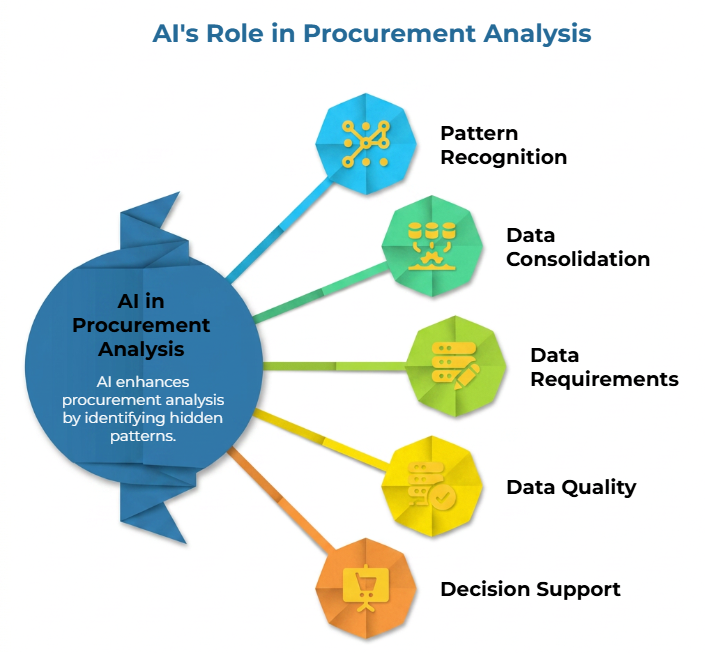
Reviewing a single supplier’s order history is manageable. Reviewing five suppliers across hundreds of orders, with data spread across your ERP, email threads, and spreadsheet trackers, is a different challenge entirely. This is where AI can offer practical support—not as a decision-maker, but as a pattern-recognition tool.
Where a procurement manager might remember that a supplier was late “a few times,” an AI-assisted review of structured order records can quantify the pattern: late on four of the last ten orders, with an average delay of three business days. That specificity changes the conversation from gut feeling to evidence-based assessment.
Depending on your data quality, AI can help with grouping repeated exception types by supplier, identifying responsiveness trends, comparing fulfillment consistency across similar order sizes, and flagging documentation delays that correlate with downstream problems. The practical value is consolidation—compressing weeks of manual cross-referencing into a structured summary your team can evaluate faster.
The data needed does not have to be complicated. Useful fields include supplier name, order date, grade or product type, requested quantity, confirmed quantity, promised date, actual dispatch or delivery status, exception notes, document status, and follow-up history. If the records are messy, start with recent orders and the exceptions that caused the most operational pressure.
AI output is only as useful as the data behind it. If your order records are incomplete or scattered across disconnected systems, the patterns AI surfaces may be incomplete too. Teams that recognize this tend to start small—feeding structured, clean data from their core ERP rather than trying to unify every source at once. Ultimately, procurement teams must treat algorithmic findings strictly as decision support rather than automated authority.
This also answers a common objection: AI does not need to overcomplicate a relationship-driven process. It can simply organize the evidence your team already has. Supplier relationships still matter. Current communication still matters. The AI output is a starting point for review, not a final judgment.
For related buying workflows, reviewing internal or industry resources on data structuring—such as standardizing paper supplier quotes before using AI to compare them—is generally recommended.
A Simple Supplier Reliability Pattern Scorecard
Recognizing reliability signals is one step. Organizing them into a repeatable evaluation method is what makes this approach operational. The ISO 9001 Auditing Practices Group guidance on external providers reinforces a practical principle: supplier selection should consider the ability to supply consistently, not only economical price. The scorecard below is an editorial framework—not a certified scoring methodology—designed to help you structure your pre-commitment review.
| Signal | What to Look For | Why It Matters | Risk Level | Pre-Commitment Action |
| Delayed confirmations | Confirmation consistently arrives later than stated lead time | Previews downstream delivery delays | Moderate | Request written confirmation with a specific deadline before placing the next order |
| Repeated late deliveries | Three or more late arrivals in recent order history | Directly affects customer delivery commitments | High | Review recent on-time performance; consider adjusted promise dates |
| Inconsistent responsiveness | Fast quote but slow answers to specific execution questions; reply times vary significantly across similar inquiries | Communication quality affects order control and timely customer commitments | Moderate | Test responsiveness with a pre-order inquiry before time-sensitive commitments |
| Partial availability | Shipped quantity falls short of confirmed quantity across multiple orders | Suggests unreliable stock position | High | Verify current stock position independently before accepting a customer order |
| Repeated short shipments | Discrepancies identified post-receipt, disrupting downstream production allocations | Forces urgent sourcing or customer adjustment | High | Consider backup supplier or adjusted promise date for similar order profiles |
| Documentation gaps | Recurring delays or errors in certificates, shipping docs, or invoices | Slows receiving, customs, and payment | Moderate | Confirm documentation requirements and timelines before order acceptance |
| Repeat order exceptions | Same exception type recurs across orders | Suggests systemic quality or process control issues | High | Request root-cause explanation and corrective action evidence before reordering |
Integrating a data-completeness metric (High/Medium/Low) directly into your assessment prevents statistical skew; a single delay across a four-order history carries vastly different strategic weight than a recurring pattern across twenty transactions.
How to Use Reliability Signals Without Overreacting
A scorecard is a decision-support tool, not a blacklist generator.
One late delivery does not make a supplier unreliable. The value of this approach lies in identifying patterns—repeated behaviors that suggest a structural tendency rather than an isolated incident. Weight recent performance more heavily than older history. A supplier who had delivery problems eighteen months ago but has performed cleanly since may have resolved the underlying issue.
Classify your findings rather than reducing everything to pass-or-fail. “Strong signal” means the pattern is clear, consistent, and recent. “Weak signal” means the data suggests a possible trend but does not confirm it. “Needs confirmation” means the evidence is too thin to act on—reach out to the supplier directly.
Data quality also affects confidence. If the team’s records are incomplete, do not force a precise ranking. Mark the finding as “needs confirmation” and ask the supplier direct questions. Messy data can still be useful, but it should not be dressed up as certainty.
This graduated assessment is especially important in paper trading, where supplier relationships often span years and switching costs are not trivial. The goal is not to punish past imperfection. It is to enter your next commitment with delivery confidence grounded in evidence.
If supplier performance seems too situational to score, score the situation instead. Compare suppliers by order type, product category, urgency, documentation need, and customer deadline. That approach is more useful than one broad supplier rank.
What to Check Before Committing to a Supplier
Before you finalize a purchase commitment—especially one tied to a downstream customer promise—run through these verification steps:
- Review recent order exceptions. Pull the last six to twelve months of orders. Identify any recurring issues by type.
- Check response consistency. How quickly has the supplier responded to your last three to five inquiries? Look for patterns, not just averages.
- Confirm current availability. Verify stock position for the specific grade, weight, and quantity you need right now—not last month’s confirmation.
- Validate documentation readiness. Confirm the supplier can provide required certificates, shipping documents, and invoices in the format and timeline your process demands.
- Ask about known constraints. Directly ask whether the supplier faces any current production, logistics, or capacity limitations that could affect your order.
- Identify backup options for high-risk orders. If the order is time-sensitive, identify at least one alternative paper supplier before you confirm.
- Verify AI-generated summaries against source records. If you used AI to review supplier history, cross-check the output against your original order data before relying on it for a commitment decision.
For broader supplier discovery, buyers can use PaperIndex to find paper suppliers, then apply their own reliability review before committing.
Use Past Orders to Make Supplier Risk Visible Earlier
The supplier who quoted the sharpest price at the beginning of this article? With a structured review of past orders, you would know whether their execution history supports the confidence their quote implies.
Historical order patterns will not predict the future with certainty. But they are a signal most procurement teams already have access to and rarely use systematically. AI can help surface and organize those signals faster. Your judgment still determines what they mean and how to act on them.
Use the supplier reliability scorecard to review your current suppliers against recent order history before your next purchase commitment. Start with your highest-volume or highest-risk relationships. The patterns are already in your data. Price opens the comparison. Reliability protects the promise.
Frequently Asked Questions
Can past orders really predict supplier reliability?
While historical data cannot predict real-time force majeure events, it establishes an empirical baseline of historical performance. Sourcing leaders leverage these trends to isolate high-variance vendors and enforce tighter Service Level Agreements (SLAs) pre-commitment.
What supplier reliability signals should paper buyers look for first?
Start with the signals that most directly impact your ability to meet customer commitments: repeated late deliveries, partial availability patterns, repeated short shipments, and recurring order exceptions. These connect directly to fulfillment confidence and delivery confidence. Then look at leading indicators like delayed confirmations, inconsistent responsiveness, and documentation gaps.
How can AI help with supplier reliability analysis?
AI can help summarize and group recurring issues across historical orders and structured records, depending on the data available. For a practical example, see how AI-assisted quote comparison applies similar principles to the supplier evaluation stage. It works best when fed clean, structured data from a core system like your ERP, and its output still requires human review and interpretation.
Should buyers stop working with suppliers that have past issues?
Not necessarily. The relevant question is whether the problems are isolated, recurring, recent, or resolved. Use the “strong signal, weak signal, needs confirmation” classification to make proportional decisions rather than binary ones. A supplier with past issues may still be suitable for the right order type.
Disclaimer:
This article is published for educational purposes. The information here supports procurement decision-making and does not constitute professional advice.
Our Editorial Process:
Our expert team uses AI tools to help organize and structure our initial drafts. Every piece is then extensively rewritten, fact-checked, and enriched with first-hand insights and experiences by expert humans on our Insights Team to ensure accuracy and clarity.
About the PaperIndex Insights Team:
The PaperIndex Insights Team is our dedicated engine for synthesizing complex topics into clear, helpful guides. While our content is thoroughly reviewed for clarity and accuracy, it is for informational purposes and should not replace professional advice.