

📌 Key Takeaways
Small packaging converters feel kraft paper price spikes more sharply than large buyers, not because of poor negotiation, but because of structural disadvantages in volume, contracts, and allocation priority.
- Volatility Hits in Clusters, Not Curves: Kraft paper prices jump unevenly as pulp, energy, freight, and currency shifts compound, often delivering multiple increases within weeks rather than gradual, predictable adjustments.
- Small Buyers Face Structural Exposure: Lumpy ordering patterns, spot-heavy contracts, and limited working capital force small converters to buy closer to each price spike without the smoothing mechanisms that protect larger, steadier buyers.
- Budget Bands Replace Panic with Planning: A simple low/base/high scenario framework transforms price increases from crisis moments into pre-mapped data points, giving buyers credible answers for owners and customers.
- Structure Matters More Than Scale: The goal isn’t to match large buyers in volume but to borrow their approach—clear bands, agreed triggers, and regular reviews turn reactive firefighting into proactive cost management.
- Pre-Agreed Thresholds Enable Calm Conversations: When actual spend approaches the upper band, it becomes a signal for structured action rather than blame, shifting procurement from scapegoat to strategic partner.
Budget bands give small converters a way to acknowledge market reality while maintaining financial discipline and emotional stability—walking into owner meetings with scenarios and plans instead of apologies.
Procurement and sourcing managers at small and mid-sized packaging converters worldwide will find a practical framework here, preparing them for the detailed budget band methodology that follows.
The email lands in your inbox at 9:47 AM. Subject line: “Kraft paper price adjustment – effective immediately.” Your stomach drops. Before you can finish reading, your phone buzzes. It’s the owner. “We need to talk about these kraft costs. Now.”
You walk into that meeting knowing what’s coming. Questions about margins. Concerns about customer pricing. And the unspoken question hanging in the air: why didn’t you see this coming, and what are you going to do about it?
If you’re sourcing kraft paper for a small or mid-sized packaging converter, this scenario probably feels painfully familiar. Price increases arrive with little warning, compressed timelines, and immediate pressure to explain both the “why” and the “what now” to owners who are watching margins shrink in real time.
This article explains why these price swings hit smaller converters harder than their larger competitors, and introduces a simple tool—budget bands—that can transform reactive panic into proactive planning.
What Volatility Actually Looks Like for Kraft Paper
Kraft paper prices don’t move in smooth, predictable lines. They shift in response to multiple underlying cost drivers: pulp prices, energy costs, ocean freight rates, currency fluctuations, and regional supply-demand imbalances. These factors often move independently, which means increases can cluster together in short bursts, creating sharp jumps that feel more like shocks than gradual trends.
Global commodity analyses demonstrate how broad input-cost indices can move sharply over just a few quarters, especially when energy markets or logistics face disruption (Source: World Bank, Commodity Markets Outlook). Forestry-market reviews similarly highlight repeated cycles of tight and loose wood pulp supply that translate directly into paper price changes at the converter level (Source: UNECE, Forest Products Annual Market Review).
A converter might see stable pricing for three months, then face two separate increase notices within six weeks. Pulp costs rise due to mill maintenance shutdowns in Scandinavia. Simultaneously, bunker fuel surcharges spike because of new environmental regulations. Currency shifts make imports more expensive. Each driver adds a layer, and the combined effect lands on your invoice as a single, sometimes substantial, percentage increase.
The challenge isn’t just the size of any individual move. It’s the unpredictability of timing and the compounding effect when multiple factors align. This makes traditional annual budgeting feel inadequate, because the assumptions you locked in during January planning can be outdated by March.
Why Small Converters Feel Every Spike More Sharply
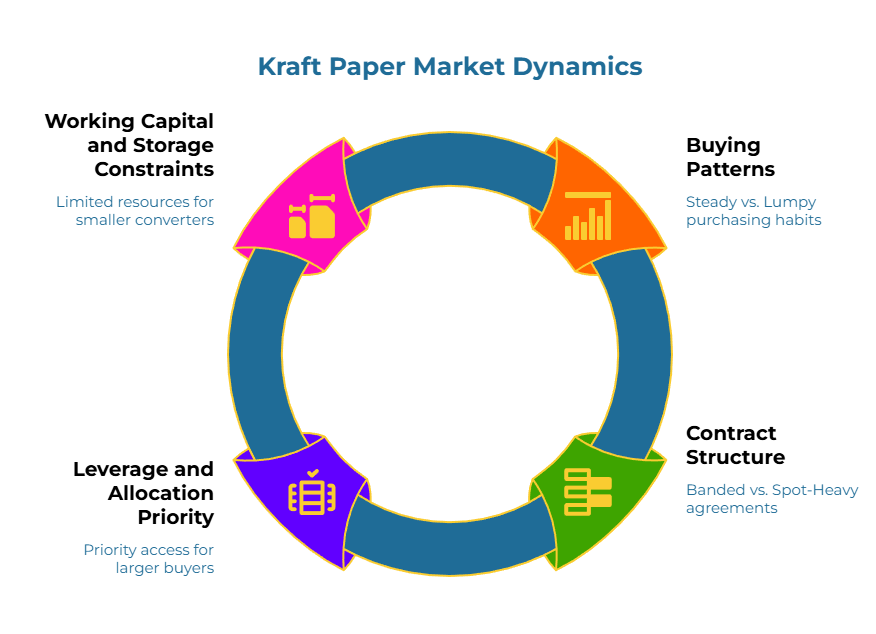
Large packaging companies and small converters both face the same kraft paper market, but they don’t experience price volatility the same way. Understanding why requires looking at three structural differences: buying patterns, contract leverage, and financial buffers.
Buying Pattern: Steady vs. Lumpy
A large converter with multiple production lines runs kraft paper continuously. They order in consistent monthly volumes, often tied to index-linked contracts or negotiated bands that smooth out some of the month-to-month noise. Their purchasing rhythm is steady, predictable, and allows suppliers to plan capacity and pricing with confidence.
A small converter, by contrast, might buy based on job flow. Orders are lumpy—three tons this month, eight tons next month, two tons the month after that. This irregularity makes it harder to lock in favorable contract terms. Brown paper suppliers see less predictability and often default to spot pricing or short-term list prices that capture current market conditions without the smoothing effect of longer commitments.
Contract Structure: Banded vs. Spot-Heavy
Larger buyers typically negotiate contracts with some form of price protection. This might be a direct index link (where prices adjust based on a published pulp index with a lag and a band), or it might be a fixed price for a portion of volume with quarterly review clauses. These structures don’t eliminate volatility, but they make it more predictable and phased.
Smaller buyers often operate mostly on spot terms or informal arrangements. When a cost driver moves, the supplier issues a price increase notice, and the small buyer either accepts it or scrambles to find an alternative source—usually at similar or higher pricing. There’s little buffering mechanism between the underlying cost shift and the invoice price.
Leverage and Allocation Priority
When kraft paper supply tightens or a mill faces allocation decisions, larger buyers get priority. This is a structural allocation issue, not a reflection on the professionalism of the smaller buyer. Suppliers prioritize larger, stable, contract-backed volumes and customers with predictable offtake and long-standing relationships.
Smaller, irregular buyers often face different treatment: stricter payment terms, less favorable delivery slots, and quicker pass-through of price increases. During tight markets, they might encounter not just higher prices but also longer lead times or outright allocation delays.
This dynamic means that small converters experience price volatility with less control, less visibility, and more pressure to accept terms quickly to keep production running.
Working Capital and Storage Constraints
Larger converters can sometimes carry buffer stocks or pre-buy when prices look favorable. Many small and mid-sized converters operate with limited warehouse space and tight working-capital constraints. That means purchasing more frequently and closer to each price move, just when the market is most volatile. The timing disadvantage compounds the structural disadvantage.
How This Translates to Budget and Margin Pain
Consider a small converter budgeting $180,000 for kraft paper annually, based on stable pricing assumptions. Mid-year, two increases arrive within eight weeks—first a 4% adjustment for pulp, then a 3% adjustment for freight and energy surcharges. Individually, these seem manageable. Combined, they represent a 7% increase on the remaining half-year spend.
That 7% isn’t just a number on a spreadsheet. It translates to roughly $6,300 in unplanned costs for the second half of the year. If customer contracts were locked in at the start of the year with fixed pricing, that $6,300 comes directly out of margin. For a business running on thin operating margins—common in small-scale converting—this can mean the difference between a profitable year and a breakeven or loss scenario.
The financial pain is compounded by the emotional and relational pressure. Owners expect explanations. Customers resist mid-contract price adjustments. The procurement or sourcing lead becomes the focal point for frustration, often without the data, tools, or negotiating power to change the underlying situation.
Without a shared framework, these conversations easily become personal: “Why didn’t you see this coming?” or “Why didn’t you negotiate harder?” The real issue is that nobody agreed on a realistic band for what “normal volatility” actually meant.
The Simple Fix: Budget Bands as a Shock Absorber
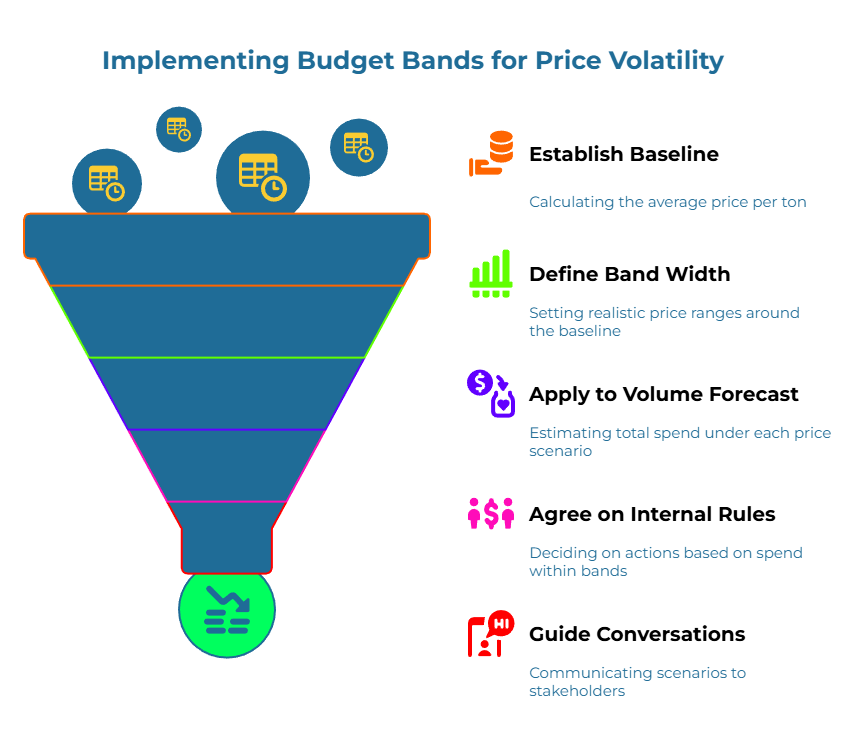
Budget bands are a straightforward framework that acknowledges price volatility upfront and builds in flexibility without abandoning cost discipline. Risk management specialists emphasize that even basic scenario ranges can make organizations more resilient to commodity-price and foreign-exchange volatility.
Instead of setting a single fixed budget number, you define three scenarios: a low case, a base case, and a high case. Each represents a plausible price path based on current market signals and your risk tolerance. The emotional benefit matters as much as the mathematical precision: if actual spend stays between base and upper band, the situation isn’t a crisis—it’s the system working as intended.
Here’s how to set them up in under an hour using data you already have—recent invoices and supplier quotes:
Step 1: Establish Your Baseline
Pull your last six to twelve months of kraft paper invoices. Calculate the average price per ton or per unit you’ve been paying. This becomes your “base case” price assumption. If you’re buying at $850 per ton on average, that’s your baseline.
Step 2: Define the Band Width
Based on recent price history and your conversations with suppliers, set a realistic range around that baseline. A common starting point for kraft paper is ±5% to ±8%, though this can be wider if you’re in a particularly volatile period or narrower if you have some contract protection.
For the $850 baseline example:
- Low case: $800/ton (assuming prices stabilize or soften slightly)
- Base case: $850/ton (current reality continues)
- High case: $920/ton (multiple cost drivers move upward)
Step 3: Apply the Bands to Your Volume Forecast
Estimate your tonnage needs for the next quarter or next six months. Multiply that tonnage by each of the three price scenarios to generate three budget outcomes.
If you expect to purchase 200 tons over the next six months:
- Low case spend: $160,000
- Base case spend: $170,000
- High case spend: $184,000
Step 4: Agree on Internal Rules
Decide what should happen as actual spend moves through the band. Who needs to be informed when spend approaches the upper band? At what point do customer prices need review? What levers are available—volume commitments, specification reviews, alternative suppliers? Pre-agreeing these triggers transforms potential surprises into pre-planned responses.
Step 5: Use the Bands to Guide Conversations
Share these three scenarios with your owner or finance team at the start of the planning period. Frame the conversation around the range, not a single number. This sets realistic expectations and shifts the discussion from “why did you miss the budget?” to “we’re tracking within the expected band.”
When a price increase lands mid-period, you can immediately assess which scenario you’re trending toward. If the new price puts you at $880/ton, you’re moving from base case toward the high case, but you’re still within the anticipated range. This allows you to communicate calmly: “We’re seeing the price pressure we flagged in the high scenario. We have $14,000 of buffer remaining before we need to consider customer pricing adjustments.”
Buyer A vs. Buyer B: Why Structure Matters More Than Size
A simple comparison helps when explaining this dynamic to owners and teams. This can work well as a visual in presentations or internal meetings under the title “Why Small Buyers Feel Every Spike: Buyer A vs. Buyer B.”
Buyer A – Larger, More Structured
- Commits annual or quarterly volumes
- Buys steadily through the year, averaging prices
- Uses banded or partly index-linked pricing structures
- Experience: relatively smooth effective cost line, even when market indices jump
Buyer B – Small, Irregular Buyer
- Places smaller, lumpy purchase orders when stock runs low
- Buys mostly on list or spot pricing
- Limited storage and working capital prevent opportunistic pre-buying
- Experience: sharp cost steps that mirror each market spike
The reassuring message for small converters: the goal isn’t to magically become Buyer A in volume. The goal is to borrow Buyer A’s structure—through budget bands, clearer rules, and where feasible, modest volume commitments or simple banded agreements.
What Budget Bands Actually Do for You
The primary value of budget bands isn’t sophisticated forecasting. Most small converters don’t have access to proprietary market intelligence or complex modeling tools, and that’s fine. Budget bands work precisely because they don’t require those things.
What they do provide is emotional and operational breathing room. When a price increase email arrives, it’s no longer an unexpected crisis that requires immediate damage control. It becomes a data point that you compare against your pre-established scenarios. You’ve already done the mental and financial preparation for this possibility. You know which scenario you’re moving into, what your remaining budget buffer is, and at what threshold you need to escalate the conversation internally or with customers.
This shifts your role from reactive explainer to proactive manager. Instead of being blamed for cost overruns, you’re seen as someone who anticipated the risk, built in flexibility, and can guide the business through the volatility with structure and data.
For further guidance on turning these concepts into actionable spreadsheet formulas and tracking mechanisms, the step-by-step guide to building kraft paper budget bands in Excel walks through the mechanics in practical detail.
Using Bands to Change Conversations with Owners and Customers
Budget bands are most powerful when they’re visible and shared, not hidden in spreadsheets.
Internal Conversations with Owners
Instead of reacting defensively to each price increase email, you can say: “Our kraft paper budget for this quarter is built on a base price, with an expected band of X to Y. We’re currently near the upper edge of that band. Here are the three options we agreed on for this situation.”
This shifts the tone from blame to joint decision-making. It also positions procurement as structured and prepared, not merely a price taker. For a fuller framework on connecting bands, scenarios, and contract structures, the broader playbook on kraft paper price volatility and budget management provides the complete strategic context.
Conversations with Customers
Budget bands also help answer the difficult question: “When should customer prices move?” By linking customer pricing reviews to the same low/base/high logic, you can explain that input costs are being monitored within an agreed band, and that price discussions are triggered by clear, pre-defined thresholds rather than opportunistic moves.
The scenario planning guide for kraft paper helps practice these thresholds and conversation scripts in more detail.
Staying Ahead of the Curve
Budget bands aren’t a one-time setup. To remain useful, they need regular review—ideally monthly, or at minimum quarterly. Each review cycle should include:
- Actual vs. band tracking: Are you trending low, base, or high? If you’ve been consistently in the high band for two months, it may be time to reset your baseline upward.
- Supplier signal checks: Have your key suppliers mentioned upcoming adjustments, raw material pressures, or allocation concerns? Feed this into your next band setting.
- Volume adjustments: If your production schedule changes or you win a new contract, recalculate the bands against the new tonnage forecast.
This ongoing cadence transforms budget bands from a static planning artifact into a living management tool. You’re not predicting the future with precision—you’re building a system that helps you respond to whatever actually happens with less stress and more credibility.
Small and mid-sized packaging converters will always face structural disadvantages in kraft paper sourcing compared to their larger competitors. You can’t change the fact that you buy in smaller, less predictable volumes, or that you have less leverage in supplier negotiations. But you can change how you plan for and respond to price volatility.
Budget bands give you a way to acknowledge reality—prices will move, often unpredictably—while maintaining financial discipline and emotional stability. They let you walk into the next owner meeting with numbers, scenarios, and a plan instead of apologies and reactive scrambling. For a small converter running lean, that shift in posture can be the difference between feeling victimized by market forces and feeling capable of managing them.
Disclaimer: This article is provided for educational purposes only.
Our Editorial Process
Our expert team uses AI tools to help organize and structure our initial drafts. Every piece is then extensively rewritten, fact-checked, and enriched with first-hand insights and experiences by expert humans on our Insights Team to ensure accuracy and clarity.
About the PaperIndex Insights Team
The PaperIndex Insights Team is our dedicated engine for synthesizing complex topics into clear, helpful guides. While our content is thoroughly reviewed for clarity and accuracy, it is for informational purposes and should not replace professional advice.