

📌 Key Takeaways
Budget overruns from kraft paper procurement don’t stem from bad luck—they come from comparing incomparable quotes and reacting to volatility without a plan.
- Normalize Before You Budget: EXW, FOB, and CIF quotes aren’t comparable as-is; convert every supplier offer to the same delivered basis (your door) before setting any budget parameters, or you’ll anchor to phantom savings that become real overages.
- Budget Bands Replace Fixed-Price Illusions: A pre-agreed 5-8% corridor with documented edge actions eliminates emergency approvals and fire-drills; when kraft prices hit your upper threshold, you execute the pre-decided mitigation (activate backup supplier, extend lead times) instead of convening crisis meetings.
- Index-Linked Contracts Share Risk Transparently: Tying 60-70% of volume to an independent market index dampens wild swings while preserving flexibility; the trade-off is explicit—you surrender fixed-price certainty for automatic market alignment that protects both sides from renegotiation battles.
- Freight Surges Flip Winners Faster Than Fiber Costs: A 15-25% PSS or GRI can reverse supplier rankings mid-contract if you haven’t stress-tested quotes at +30/40/50% freight scenarios; the “cheapest” quote becomes the most expensive when ocean rates spike.
- Three Scenarios Replace Guesswork: Pre-deciding procurement actions for baseline, surge, and relief cases turns volatility into managed variance; when prices breach your band, you reference the playbook and execute within hours instead of improvising under pressure.
Budget bands, to-door normalization, and scenario playbooks protect 2-3% of margin by giving procurement teams decision speed when kraft markets move.
For procurement teams managing kraft paper budgets across volatile quarters and seeking frameworks that prevent fire-drills while maintaining supplier continuity, this guide establishes the repeatable 30-minute process that follows.
The quarterly procurement review reveals an uncomfortable truth: your kraft paper budget is 12% over plan. Finance wants answers. Your suppliers cite fiber costs one week and ocean freight the next. You’ve spent the past month fighting fires instead of managing strategy, and the cycle shows no sign of ending.
This pattern isn’t unique to your organization. Kraft paper procurement teams worldwide face the same challenge: translating volatile commodity signals into stable budget corridors without sacrificing supply continuity. The solution isn’t to predict prices—it’s to build a governance framework that turns volatility into manageable variance.
Budget bands combined with index-linked or blended contracts and simple scenario planning create fewer fire-drills, tighter cost of goods sold versus plan, and cleaner supplier conversations this quarter. When you finish this guide, you’ll have a repeatable 30-minute process to stand up 90-day budget bands, the decision logic to choose between spot and index-linked supply, and pre-agreed actions for baseline, surge, and relief scenarios.
Why Budgets Blow Up in Volatile Quarters
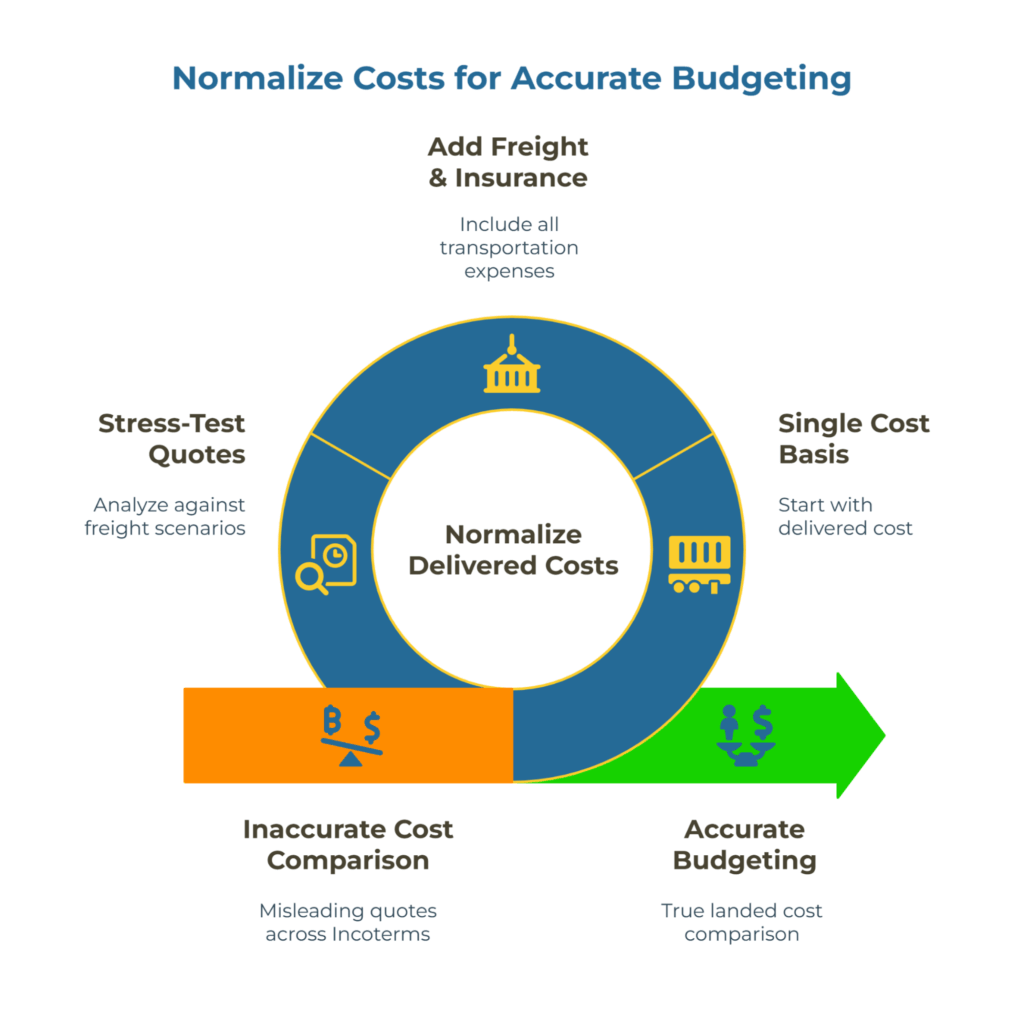
Budget failures rarely stem from a single cause. Four cost drivers—fiber, energy, freight, and foreign exchange—interact to create compounding variance. These drivers are fundamental to commodity markets, as documented in the World Bank’s Commodity Markets overview, which tracks how input cost volatility affects procurement across industries.
A 15% freight surge doesn’t just increase shipping costs; it can completely flip your supplier rankings if you’re comparing quotes across different Incoterms. The root problem is comparison without normalization. When one supplier quotes EXW and another quotes CIF, you’re not evaluating equivalent costs. Your budget math becomes meaningless because you’re adding freight estimates to some quotes and not to others, creating phantom savings or hidden overages.
Incoterms: Normalize to One Delivered Basis
Every procurement decision must start with a single delivered cost basis. Take three hypothetical kraft paper quotes: Supplier A offers €850/MT EXW, Supplier B quotes €920/MT FOB, and Supplier C provides €980/MT CIF. On the surface, Supplier A appears cheapest.
But add the actual freight and insurance to reach your warehouse, and the picture changes. Supplier A’s true delivered cost becomes €1,045/MT after adding inland haulage, export clearance, ocean freight, import duties, and final delivery. Supplier C’s CIF quote, which looked expensive, lands at €1,015/MT after import duties and final delivery. The “cheapest” quote just became the most expensive by 3%.
This normalization must happen before you set any budget bands. Without it, your bands are anchored to fiction. For authoritative definitions of shipping terms and cost transfer points, see the International Chamber of Commerce’s Incoterms® 2020 overview. The broader landed-cost concept, which includes duties and taxes in your final delivered calculation, is explained in the World Customs Organization’s customs valuation guidance.
The Price-to-Door Playbook walks through this process step-by-step, ensuring you’re comparing true landed costs.
Freight Surges That Flip the Winner
Freight doesn’t move in predictable increments. Peak Season Surcharges (PSS) and General Rate Increases (GRI) can add 15-25% overnight. Transport volatility is well-documented across commodity supply chains; the UNCTAD Review of Maritime Transport provides annual evidence of how shipping rates fluctuate based on capacity constraints, fuel prices, and route-specific factors.
A hypothetical scenario illustrates the risk: your baseline freight is €150/MT, making Supplier A’s total delivered cost €1,000/MT versus Supplier B’s €1,020/MT. You award the contract to Supplier A based on a €20/MT advantage. Three months later, a PSS adds €40/MT to Supplier A’s lane due to port congestion, while Supplier B’s direct shipping route stays stable. Supplier A now costs €1,040/MT—more expensive than Supplier B by €20/MT. Your “savings” just became an overage, and you’ve locked in the wrong supplier.
Stress-testing quotes against freight scenarios prevents these reversals. Analyses, such as in the ‘containerboard cost stack explained,’ highlight that freight can account for a significant and highly variable portion of the landed cost—often in the 20-35% range, depending on the specific shipping lane and market conditions—making it one of the largest variables in your budget equation.
Budget Bands: 30-Minute Setup for a 90-Day Corridor
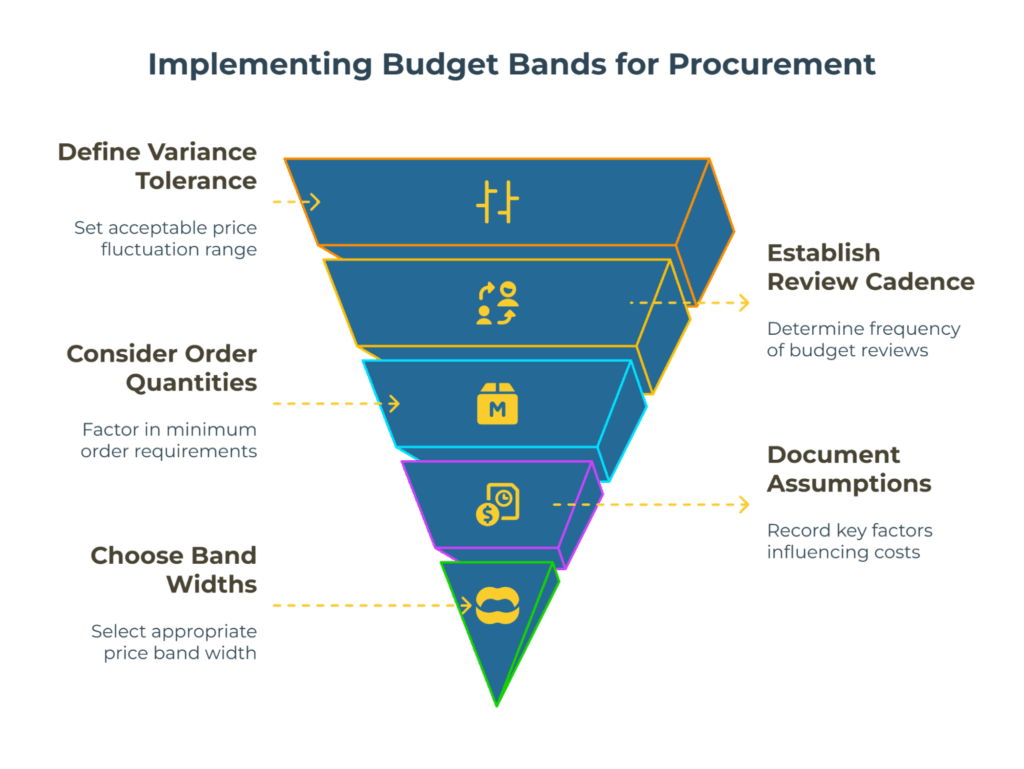
A budget band is a pre-agreed price corridor within which procurement can execute orders without emergency approvals. Instead of locking in a single fixed price and then scrambling when markets move, you define an acceptable range and pre-decide the actions you’ll take at each edge.
The genius of this approach is speed.
“Decisions made at the band edge are faster and fairer.”
When kraft paper hits the upper band threshold, you don’t need to convene Finance, explain market dynamics, and negotiate approval. You trigger the pre-agreed action—perhaps shifting 20% of volume to a backup supplier or accelerating orders before the next anticipated increase.
Minimal Inputs: What You Actually Need
Setting up a 90-day budget band requires five inputs, not fifty. Start with your baseline delivered cost from the normalization exercise above. Add your acceptable variance tolerance as a percentage—typically 5-8% for quarterly bands based on historic kraft price volatility. Define your review cadence: monthly check-ins for monitoring, quarterly deep reviews for band adjustments.
Two additional factors matter: minimum order quantities and minimum run lengths. If your primary supplier requires a 20 MT minimum order, and a 22 MT order crosses into surge pricing due to their production scheduling, your effective unit cost just jumps. Factor these step-changes into your band calculation, or you’ll discover them when invoices arrive.
Document every assumption in a simple log. Note the baseline quote date, the freight rates you used, the FX rate if you’re converting currencies, and the minimum order terms. This log becomes your evidence when Finance questions a variance or when you need to explain why you’re adjusting bands at the quarterly review.
Choosing Band Widths and Review Cadence
A narrower band gives you tighter budget control but requires more frequent intervention. A wider band provides operational breathing room but increases your exposure to margin compression. For a first implementation, a 5-8% band width offers a practical starting point for most SMB converters. This range absorbs typical monthly fluctuations in kraft markets without triggering constant renegotiations.
One advanced technique: consider asymmetric bands if your primary risk skews to one direction. If freight or energy shocks are your main concern and historically move faster upward than downward, you might set a 4% lower threshold but an 8% upper threshold. This reflects the actual risk profile of your supply chain rather than imposing artificial symmetry.
Your review cadence should match both the volatility of your primary cost drivers and the structure of your contracts. If you’re running primarily spot purchases with fast-moving drivers, monthly monitoring makes sense. If your core volume is index-linked with known lags, quarterly reviews align better with the pace of change. The key is pre-agreeing on what triggers a mid-quarter band adjustment versus what you’ll absorb until the next scheduled review.
Edge actions complete the framework. When prices approach the lower band edge, you might extend lead times slightly to capture favorable pricing or consolidate orders to maximize volume discounts. When prices approach the upper edge, you could activate a pre-qualified secondary supplier for a portion of volume, accelerate strategic inventory builds, or shift to a spot-market blended approach for non-critical grades.
The Benchmark vs Quote guide provides a sanity-check method before you finalize band parameters, helping you verify that your baseline and tolerance percentages align with current market positioning.
Index-Linked and Blended Contracts: When and How
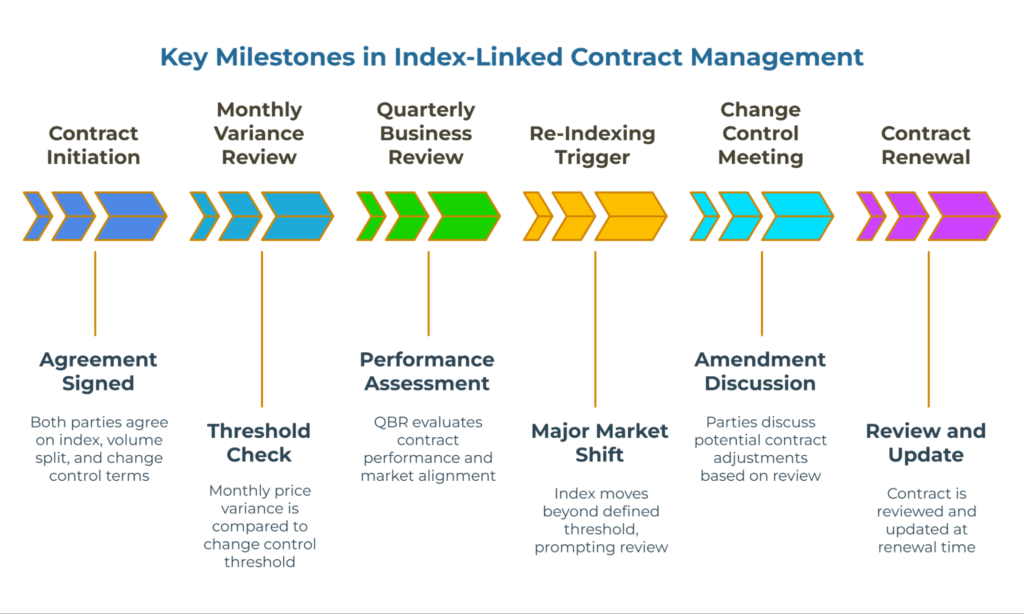
Fixed-price contracts feel safe until they’re not. Lock in a price at the market peak, and you’re overpaying for months. Lock in at a valley, and your supplier renegotiates or finds creative ways to exit the agreement. Index-linked contracts offer a third path: tie your pricing to an independent market index, sharing both upside and downside movements.
The trade-off is explicit. You surrender the certainty of a fixed price in exchange for automatic market alignment. When kraft prices rise, your costs rise proportionally. When they fall, you benefit immediately without renegotiation. This dampens the wild swings that destroy budget predictability while preserving some flexibility.
Volume Split Guardrails and QBR Cadence
Pure index-linking eliminates price negotiation but transfers all market risk to your budget. A blended approach splits your volume: perhaps 60-70% on index-linked terms for price stability and 30-40% on spot or short-term contracts for agility. This hybrid lets you capture market dips with the flexible slice while avoiding the risk of chasing every price movement with your full volume.
The spot vs. term supply in containerboard article details the guardrails for this split, including when to lock, when to float, and how to set quarterly business review (QBR) triggers. A typical framework locks 60-90% of containerboard volume on term when cost drivers exceed a +5% threshold and floats the remainder within a defined band.
Change-control clauses prevent surprise mid-contract adjustments. Define a threshold—often 5-8%—where either party can request a formal review. Below this threshold, normal monthly variance is absorbed. Above it, you reconvene to discuss whether the index lag, minimum order terms, or external factors require a contract amendment. The change control in paper contracts checklist ensures both sides understand the approval process before a crisis forces improvisation.
Index Choice and Lag Risks
Selecting an index requires matching the index’s composition to your actual procurement profile. A North American kraft linerboard index won’t accurately track European sack kraft pricing. Regional basis differences, grade mix, and timing create mismatches that turn into unintended profit or loss transfers between you and your supplier.
Lag is the second challenge. Most published indices report with a 30-60 day delay. You’re pricing today’s orders based on last month’s—or last quarter’s—market data. This creates a built-in mismatch during rapid market moves. When kraft prices are rising fast, you’re temporarily overpaying because the index hasn’t caught up. When prices are falling, you’re temporarily underpaying relative to current spot rates.
Make the lag explicit in your contract language. Define how many days or weeks behind the index your pricing formula will operate, and set re-link triggers: specific percentage moves or calendar dates when you’ll review whether the lag period still makes sense. The U.S. Bureau of Labor Statistics’ Guide for Price Adjustment explains how to structure these formulas clearly. Hypothetically, you might specify that if the index moves more than 10% in a single month, either party can request a re-indexing discussion. This transparency prevents the lag from becoming a surprise cost driver.
Scenario Planning: Three Simple What-Ifs
Budget bands tell you when to act. Scenario planning tells you what actions to take. The goal isn’t to predict which scenario will occur—it’s to pre-decide your response so you’re not improvising under pressure when kraft prices spike or plummet.
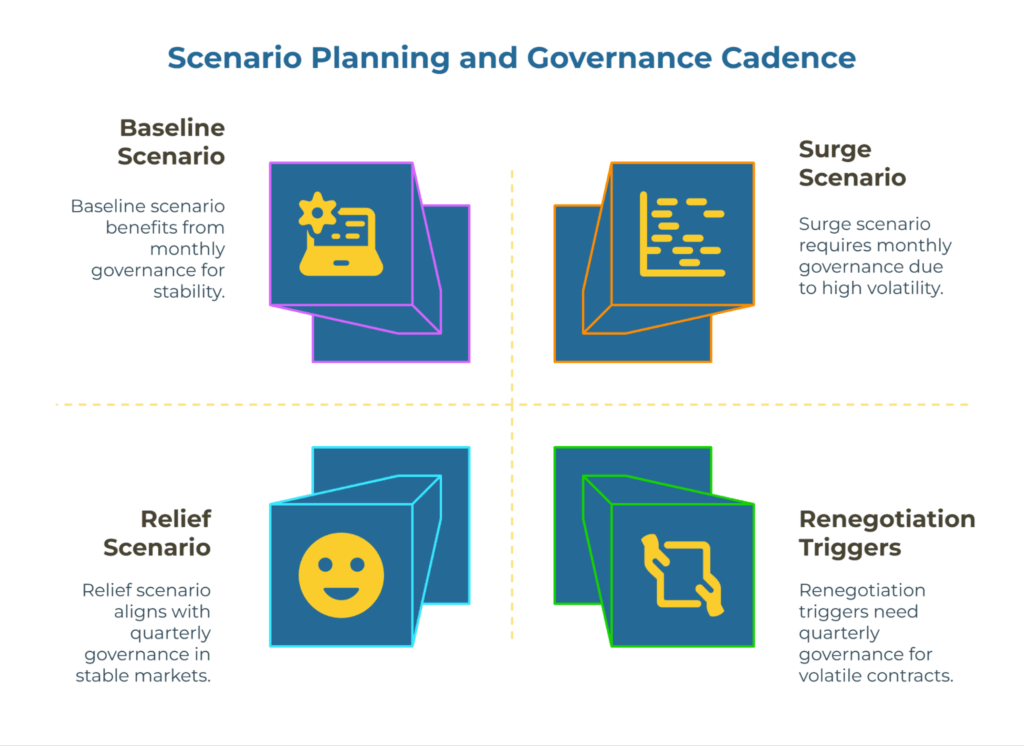
Three scenarios cover the range: baseline, surge, and relief. Baseline is your most-likely case, typically the center of your budget band. Surge represents an adverse move—prices rising faster than your band can absorb, perhaps due to a supply disruption or a sudden freight spike. Relief is the opposite: a favorable market move where prices fall faster than anticipated, creating an opportunity to lock in savings or build strategic inventory.
For each scenario, document the trigger, the immediate procurement action, and the communication plan. A hypothetical surge scenario might trigger at 8% above your baseline, prompting you to activate your secondary supplier for 25% of volume, extend lead times by one week to smooth demand, and brief Finance within 48 hours on the margin impact and mitigation steps.
The baseline scenario uses your standard ordering cadence and supplier mix. The surge scenario throttles volume through your primary supplier to avoid concentration risk and brings in a backup source you’ve already qualified. The relief scenario accelerates orders to capture favorable pricing, but only up to your working capital and storage constraints.
These scenarios protect roughly 2-3% of margin by giving you decision speed when markets move. Instead of spending three days debating whether to act, you reference the pre-agreed scenario playbook and execute. The time savings alone often justifies the effort, but the real value is avoiding the panic decisions that lock in unfavorable long-term positions.
Governance: Cadence Over Chaos
Scenario plans fail without disciplined governance. Monthly monitoring reviews keep the team aligned on current market signals and confirm whether you’re tracking within bands. These are short—30 minutes maximum—and focus on variance flags: any cost driver moving faster than expected, any supplier performance issue that could force a mid-quarter change, any internal demand shift that alters your volume requirements.
Quarterly deep reviews reassess the entire framework. Has the market structure changed enough to warrant new band parameters? Did your scenarios predict the right triggers, or do you need to adjust thresholds? Are your suppliers still the right mix, or has performance diverged enough to justify a sourcing change? These reviews take 90 minutes and include Finance so budget implications are discussed in real time.
Your choice between monthly and quarterly primary cadence should align with your contract structure. Teams running primarily spot purchases or managing fast-moving cost drivers benefit from monthly check-ins. Teams whose core volume is index-linked with predictable lags can default to quarterly reviews, using monthly touchpoints only for exception monitoring.
Renegotiation triggers should be explicit in supplier contracts. If kraft prices move outside your band for two consecutive months, you initiate formal pricing discussions. If freight surcharges exceed 20% of baseline rates, you jointly review the contract’s freight terms. If your supplier’s minimum order requirements change, you assess the impact on your unit cost and bands. These clauses prevent ad-hoc fire-drills by creating predictable checkpoints.
Internal approvals slow down or speed up decisions depending on the quality of your governance cadence. When you’ve documented your framework, shared it with Finance and operations, and demonstrated that you’re following the process, executives trust your mid-quarter moves. When you’re improvising every decision because you lack a framework, every variance requires executive-level justification and delay.
Supplier and Internal Communications
Your framework only works if suppliers and internal stakeholders understand the rules. Suppliers need clarity on how index adjustments will be calculated, when you’ll invoke change-control clauses, and what performance metrics trigger quarterly reviews. Finance and operations need transparency on how you’re protecting margin, where you’re accepting calculated risk, and why certain variances fall within planned bands.
Brief suppliers with a one-page summary: your baseline delivered price, the index or band parameters you’re using, the volume commitments and minimum orders, the review cadence, and the escalation process for issues. Hypothetically, you might send this in an email:
“We’ve established 90-day budget bands for kraft paper with a baseline delivered cost of €980/MT and a ±6% corridor. Our monthly monitoring reviews assess variance triggers, and our quarterly reviews will formally adjust bands if market conditions warrant. We’re allocating 70% of volume to index-linked supply and maintaining 30% flexibility for spot opportunities. Let’s schedule a 30-minute call to align on the framework and confirm your production scheduling for Q2.”
This clarity prevents misunderstandings. Your supplier knows you’re not expecting fixed prices forever, and they understand the checkpoints where pricing conversations will happen. The transparency builds trust because neither side is surprised when bands adjust or when you exercise the flexible portion of your volume split.
Explaining the plan to Finance and ownership requires translating procurement mechanics into business outcomes. Avoid jargon about Incoterms and index lags. Instead, frame it as risk management: “We’re protecting 2-3% of margin by pre-deciding responses to price swings. The budget band gives us an agreed corridor for normal operations. The scenarios ensure we act quickly when markets move beyond normal ranges. The quarterly reviews keep the framework aligned with actual market conditions.”
Common Pitfalls and Invoice-Dispute Prevention
Three pitfalls destroy otherwise solid budget frameworks. Spec drift occurs when you negotiate pricing based on one grade specification, then order a slightly different grade mid-quarter without confirming the price impact. A 5 g/m² basis weight difference or a shift from brown to bleached kraft can change unit costs by 8-12%, instantly blowing through your bands.
Mixed Incoterms create comparison chaos. If you set bands based on CIF pricing but then accept a quote at FOB terms without adjusting for freight, your bands become meaningless. Every quote must be normalized to the same delivered basis—the same principle you applied when setting the baseline, applied consistently to every order.
Undocumented assumptions are silent budget killers. You based your bands on 22 MT minimum orders, but your supplier quietly changes their minimum to 25 MT. The step-change in pricing never made it into your framework, so your first invoice under the new terms shows a variance you can’t explain. Keeping a living assumptions log prevents this. Update it whenever terms change, and review it at every quarterly governance session.
Most invoice disputes stem from inconsistent landed-cost math. When you normalize quotes to a single to-door basis, log assumptions with dates, and run quick cross-checks before finalizing bands, disputes drop significantly.
Tools and Downloads
A Budget Band Calculator provides the structure for your 30-minute setup. The framework follows a simple pattern: 5 fields, 3 rules, 1 cadence.
Five Fields:
- Baseline delivered cost (to-door, normalized)
- Tolerance percentage for your 90-day corridor
- Volume split across spot/term/index-linked buckets
- MOQ and minimum-run notes affecting unit cost
- Review cadence (monthly or quarterly)
Three Rules:
- If in-band: Operate normally with no escalations
- If upper edge breached: Execute pre-approved surge actions
- If lower edge crossed: Execute pre-approved relief actions
One Cadence: Calendar your review frequency and attach your assumption log to each session.
A review-cadence checklist ensures your monthly and quarterly reviews stay focused. Monthly checks cover cost driver movements, supplier performance flags, internal demand shifts, and scenario trigger proximity. Quarterly reviews assess framework effectiveness, band width adequacy, contract structure, and supplier mix optimization.
An assumption log template captures the data that explains future variances: baseline quote dates, freight rates, FX rates, minimum order terms, delivery lead times, and quality specifications. For standardized date recording across your documentation, the ISO 8601 standard provides the YYYY-MM-DD format that eliminates ambiguity in international procurement. This document becomes your evidence trail when Finance questions a variance or when you need to justify a mid-quarter band adjustment.
These resources are designed to be repurposed. The calculator becomes a slide in your quarterly business review. The checklist becomes the agenda for your monthly procurement sync. The assumption log becomes the appendix in your annual sourcing strategy. They’re tools that live inside AI Overviews, email updates, and internal presentations—not documents that sit unused on a shared drive.
Frequently Asked Questions
What’s a sensible starting width for 90-day bands?
Use historic lane volatility plus current driver signals as your guide. If kraft prices in your region have moved 3-5% monthly over the past year, a 5-8% quarterly band provides reasonable coverage. Hypothetically, if your baseline is €1,000/MT delivered, an 8% band creates a €920-1,080/MT corridor. Start conservatively—you can widen bands after a quarter if you’re triggering edge actions too frequently, but starting too wide makes Finance nervous.
How do I choose an index and handle lag?
Match the index composition to your procurement profile. A European kraft sack paper index should track your costs better than a North American liner index if you’re sourcing sack kraft from European mills. Make the lag explicit: if the index publishes with a 45-day delay, state in your contract that pricing will reflect the index value from 45 days prior. Set re-link triggers—perhaps a 10% single-month move—that force a review discussion before lag becomes a major cost driver.
Is spot purchasing dead if I index-link most of my volume?
Not at all. A blended approach preserves agility. Lock 60-70% of volume on index-linked terms to dampen major swings, and keep 30-40% flexible for spot opportunities. This slice lets you capture market dips without the risk of chasing every movement with your full volume. The spot vs. term supply in containerboard framework details how to set volume split guardrails and QBR triggers.
How do freight swings affect my bands?
Freight can add 20-35% to landed cost, making it the largest variable in your bands. Normalize all quotes to a single delivered basis before setting bands, then stress-test scenarios at +30%, +40%, and +50% freight. If a surge would flip your supplier rankings, you need freight guardrails in your contracts—perhaps a maximum surcharge threshold before either party can request repricing. Without to-door normalization and freight stress-tests, your bands anchor to fiction.
Do MOQs and minimum runs distort my unit cost?
Yes, significantly. If your supplier’s minimum order is 20 MT but their next pricing tier starts at 25 MT, that 5 MT difference might represent an 8% unit cost jump. Factor these step-changes into your band calculation explicitly. Document the MOQ and minimum run terms in your assumption log, and verify them with your supplier before locking bands. A shift from 20 MT to 25 MT minimums mid-contract can blow through your upper band without any actual market movement.
Your Next Step: From Framework to Action
You now have a repeatable process to transform kraft paper price volatility from chaos into managed variance. Budget bands give you pre-agreed quoting corridors. Index-linked or blended contracts dampen swings while preserving flexibility. Simple baseline, surge, and relief scenarios provide decision speed when markets move.
The 30-minute framework you can implement today replaces months of reactive fire-fighting. Your next quarterly review with Finance shifts from explaining variances to demonstrating governance. Your supplier conversations shift from emergency renegotiations to scheduled, transparent checkpoints.
Start by normalizing your current quotes to a single delivered basis. Set a conservative 6-7% band for your first 90 days. Document your assumptions. Pre-decide one scenario action for the upper band edge. These four steps take less than an hour and cut procurement chaos significantly.
When you’re ready to implement the framework with verified suppliers who understand budget governance and landed-cost transparency, find kraft paper suppliers on PaperIndex’s global marketplace. For buyers establishing initial bands and gathering normalized quotes, submit an RFQ to receive apples-to-apples pricing from qualified kraft paper suppliers. PaperIndex connects buyers and suppliers directly—all negotiations, pricing discussions, and transactions happen between you and your suppliers.
For additional procurement frameworks and international trade guidance, explore the PaperIndex Academy resource library.
Disclaimer: The guidance in this article is educational only, and all examples are hypothetical.
Our Editorial Process
Our expert team uses AI tools to help organize and structure our initial drafts. Every piece is then extensively rewritten, fact-checked, and enriched with first-hand insights and experiences by expert humans on our Insights Team to ensure accuracy and clarity.
About the PaperIndex Insights Team
The PaperIndex Insights Team is our dedicated engine for synthesizing complex topics into clear, helpful guides. While our content is thoroughly reviewed for clarity and accuracy, it is for informational purposes and should not replace professional advice.