

📌 Key Takeaways
Remote vetting filters out problematic wholesale paper bag suppliers before you commit significant orders or long-term contracts.
- Identity First: Verify business registration certificates against website domains and email addresses to catch mismatches before detailed discussions.
- Documents Beat Promises: Request ISO 9001, FSC/PEFC certificates, and food-contact declarations, then cross-check certificate numbers in official registries.
- Technical Requests Deter Fraud: Suppliers who cannot provide GSM specs, burst factor data, and time-stamped production photos often withdraw when asked.
- Trial Orders Test Reality: Modest trial shipments reveal on-time delivery rates, documentation accuracy, and problem-resolution patterns before volume commitments.
- Systematic Beats Ad-Hoc: A five-step checklist transforms supplier selection from unstructured experiments into evidence-backed qualification pools.
Structured verification catches obvious problems before they become expensive ones.
SMB buyers sourcing paper bags internationally will gain a repeatable qualification method, preparing them for the detailed five-step audit framework that follows.
The quote came back 15% cheaper than anyone else. The samples looked fine. Three months later, 40,000 bags arrived with handles that tore under half the rated weight.
This scenario plays out regularly for SMB buyers who source paper bags internationally. Without a structured way to verify suppliers remotely, decisions often come down to price comparisons and product photos, leaving buyers hoping everything works out. When it doesn’t, the costs extend far beyond the initial order: lost sales, reprints, emergency reorders, damaged customer relationships, and the exhausting cycle of starting the supplier search over again when packaging fails at the customer’s hand.
Remote vetting is no longer a luxury reserved for large procurement teams with travel budgets. It has become baseline risk management for any business sourcing wholesale paper bags across borders. The good news? You can filter out most problematic suppliers from your desk, before you send your first significant order.
The following five steps provide a systematic remote audit process: verifying identity, checking documents, requesting product evidence, assessing operational reliability, and running a structured trial order. By the end, you’ll have a repeatable method to qualify or reject paper bag suppliers with confidence.
Step 1: Pre-Qualify Suppliers with Basic Legitimacy Checks
Before investing time in detailed discussions, filter out obviously risky or fraudulent suppliers through basic identity verification.
Start by requesting fundamental company information: full legal name, business registration number, tax identification number, year of establishment, and registered office address. Ask for a scanned copy of the business registration certificate and cross-check these details against the supplier’s website, email domain, and any proforma invoices or quotes already shared. Inconsistencies between these sources, such as a registration certificate showing one company name while emails come from a different domain, warrant immediate caution. A mismatch in legal name or address often indicates a Trading Company (Exporter) versus Factory (Manufacturer) structure; while common and legal, you must request a formal authorization letter linking the two entities to ensure accountability.
Evaluate the supplier’s digital footprint for signs of legitimacy and focus. A professional website should show consistency with claimed manufacturing capabilities. Look for evidence of paper bag specialization: multiple bag types displayed, production facility photographs, and technical language that demonstrates industry knowledge. Suppliers who appear to sell “everything from bags to electronics” often lack the specialized expertise that wholesale paper bags require.
Check whether the supplier appears in neutral B2B directories, industry associations, or trade databases. Presence across multiple independent platforms suggests an established business rather than a hastily created front.
For suppliers reading this: these checks represent baseline transparency that serious buyers expect. Established professional exporters are prepared for these due diligence requests and can provide standard compliance documentation without significant delay. Being prepared to provide this information promptly signals professionalism and builds trust from the first interaction.
Step 2: Verify Certifications, Capabilities, and Compliance on Paper
Document verification serves as your first line of defense against low-quality and non-compliant suppliers. This step is faster and cheaper than shipping physical samples, and it immediately filters out suppliers who cannot meet basic documentation requests.
Request and cross-verify these core documents:
Business registration certificates should be clear, legible, and unedited. Compare the registered company name and address against all previous communications.
Quality management certifications such as ISO 9001 indicate systematic quality processes, though their absence doesn’t automatically disqualify a supplier. When provided, verify the certificate number and company name directly on the certification body’s website, confirming validity dates and suspension status.
Sustainability certifications like FSC or PEFC matter if your customers require certified products. Critically, verify that the certificate’s scope actually covers the bag products you intend to purchase. A supplier may hold FSC certification for certain product lines while the specific bags you need fall outside that scope. Check status directly in the FSC certificate database or equivalent registry.
Food-contact compliance declarations become essential when sourcing bags for food service, hospitality, or retail food applications. In many regions, food-contact packaging is subject to specific jurisdictional mandates—most commonly US FDA 21 CFR 176 or EU Regulation (EC) No 1935/2004—rather than a single global rule. Request documentation demonstrating compliance with relevant food-contact regulations for your market, recognizing that requirements vary significantly by jurisdiction. This documentation helps you assess the supplier’s awareness of compliance obligations rather than providing legal certification.
Aim to collect a minimum document pack of three to five key documents before proceeding further—documents that together answer three questions: who is this company, how is quality managed, and what external bodies independently verified. Suppliers who struggle to provide basic registration and certification documents often struggle with more complex requirements later.
When reviewing certificates, watch for warning signs: mismatched company names between the certificate and correspondence, expired validity dates, obvious digital alterations, or certificate numbers that don’t verify in official registries.
Step 3: Request Product Evidence and Samples That Are Hard to Fake
Moving from paper claims to testable evidence separates serious suppliers from those who disappear when asked for specifics. Fraudulent or low-quality vendors often withdraw when they are asked for precise, technical proofs. Detailed technical requests tend to deter these operators who lack actual manufacturing capability.
For wholesale paper bag sourcing, request the following evidence:
Technical datasheets for the specific bag grades you intend to purchase. These should specify basis weight (GSM), Tensile Strength (MD/CD) for handling load-bearing capacity, burst factor for puncture resistance, and Cobb value for moisture absorption. If a supplier cannot provide specifications for their own products, this indicates either a lack of manufacturing control or that they’re simply reselling products they don’t fully understand. For deeper background on how these specifications affect bag performance, the guide on understanding GSM and burst factor provides essential context.
Recent third-party laboratory test reports (dated within the last 12 months) validate general capability, while internal Certificate of Analysis (COA) reports linked to specific production batches (dated within 30 days) verify current consistency. Look for reports that name specific test methods, whether ISO or TAPPI standards, include clear units of measurement, and show pass/fail criteria or specification bands. The methodology matters: a burst strength test conducted using ISO 2758 produces different results than one using TAPPI T 403, so ensure you’re comparing equivalent methods.
Physical samples of finished bags and, where relevant, the base kraft paper used in production. Samples allow you to verify that quoted specifications match actual products.
Time-stamped visual evidence such as photographs or short videos from production lines, converting operations, warehouses, and packaging areas. Dates visible in the footage, whether from timestamps or dated newspapers in frame, help verify that the facility shown actually belongs to the supplier and operates currently.
When samples arrive, compare test results against quoted specifications. Red flags include burst factor values lower than quoted, Cobb values inconsistent with claimed moisture resistance, or GSM measurements outside stated tolerances. For guidance on structuring these evidence requests systematically, the approach outlined for kraft paper RFQ evidence packs adapts well to bag sourcing.
Buyers do not need to become laboratory experts. The key is to insist on traceable evidence, to check that it is internally consistent, and to notice when a supplier resists or delays reasonable technical requests.
Step 4: Assess Operational Reliability and Export Readiness
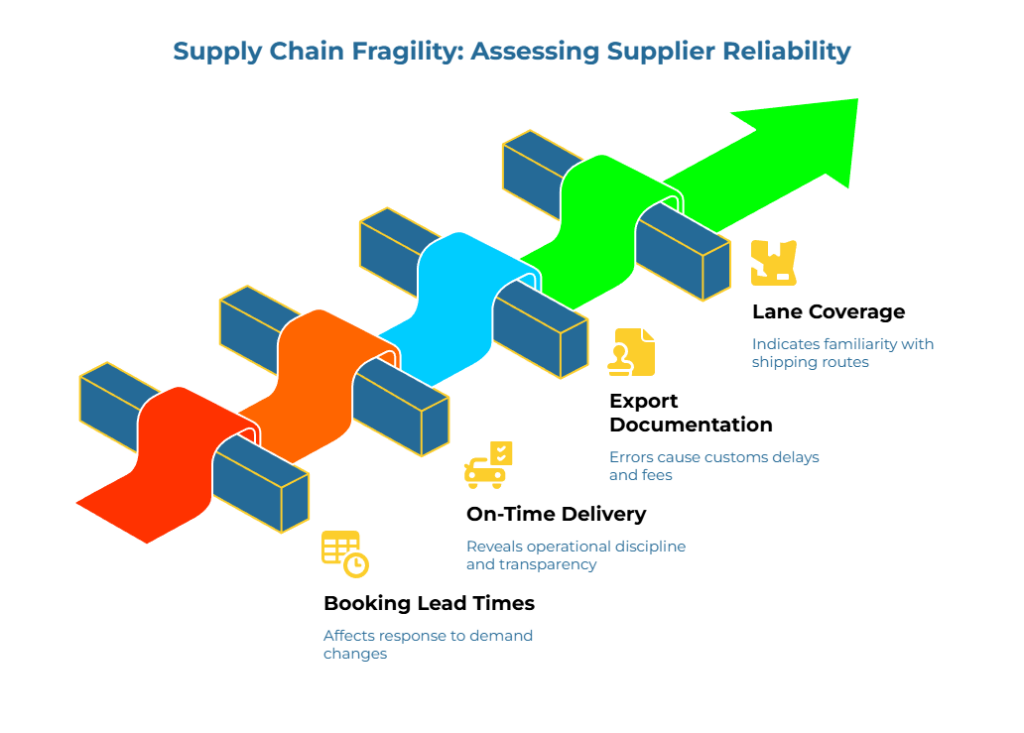
A supplier who makes acceptable bags but delivers them late, with incorrect documentation, or through unreliable logistics channels still creates supply chain fragility. This step evaluates whether the supplier can perform reliably across the full order cycle.
Consider scoring potential suppliers on a simple 0–5 scale across key reliability dimensions:
Booking lead times and capacity flexibility affect how quickly you can respond to demand changes. Ask directly: “What is your standard lead time for 10,000 bags of type X?” and “How much advance notice do you need for orders 50% larger than typical?”
On-time delivery history reveals patterns. While suppliers won’t volunteer poor performance data, asking about their typical on-time rate and how they handle delays provides insight into their operational discipline and transparency.
Export documentation accuracy matters enormously for cross-border shipments. Documentation errors cause customs delays, additional fees, and shipment holds. Ask how frequently their shipments require documentation corrections and how they handle situations when customs flags issues.
Lane coverage and regional experience indicates familiarity with shipping to your location. Ask: “Which ports and routes do you typically use for customers in [your region]?” Suppliers experienced with your trade lanes will answer confidently with specific details.
These scores will inevitably rely on self-reported data and references, so they should be treated as directional rather than precise measurements. However, they help buyers compare suppliers on more than just price. The Academy article kraft paper supplier reliability scorecard: booking lead times, lane coverage & documentation accuracy compared provides a deeper framework that can be adapted for bag suppliers.
Request samples of export documents with sensitive commercial data redacted: Bill of Lading, commercial invoice, packing list, and relevant certificates such as Certificate of Origin or fumigation certificates. Reviewing these documents reveals their documentation standards and attention to detail. The export documentation evaluation checklist provides field-by-field guidance on what to examine.
Trust, but verify—especially when you can’t visit the factory floor.
Step 5: Run a Structured Trial Order Before Committing Fully
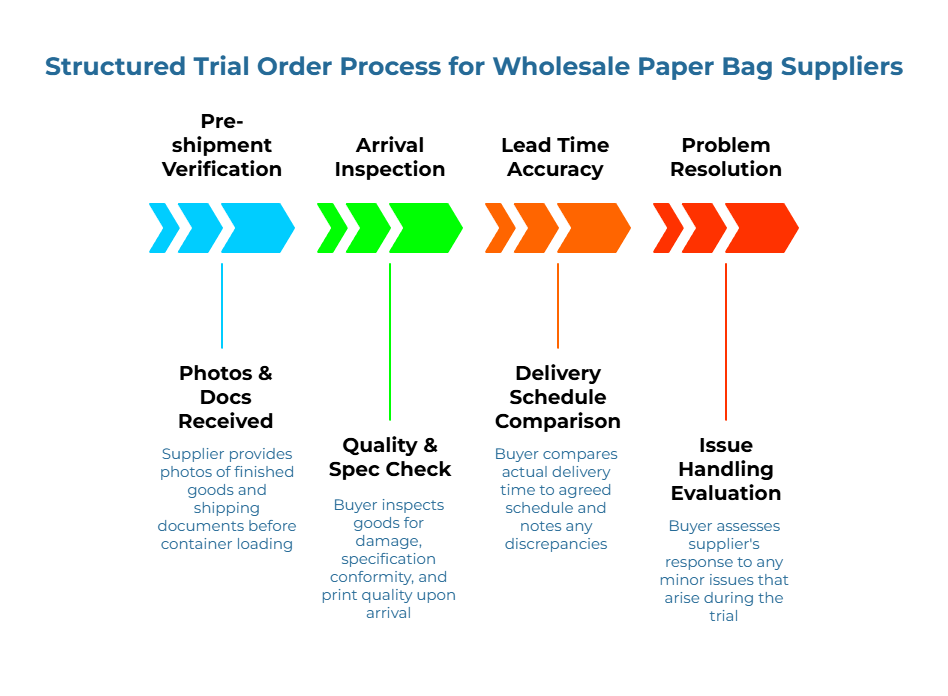
A trial order transforms your checklist findings into a real-world test of the supplier relationship. The objective is not to obtain the lowest possible price, but to evaluate how the supplier performs end-to-end. This isn’t merely a sample shipment; it’s a dress rehearsal for ongoing business.
Design a modest trial order that tests quality against specifications, on-time delivery performance, documentation accuracy, and communication responsiveness when issues arise.
Structure your evaluation around these checkpoints:
Pre-shipment verification should include photographs of the finished goods and complete shipping documentation received a specified number of days before container loading. Suppliers who scramble at this stage often struggle with larger, time-sensitive orders.
Arrival inspection examines damage rates, specification conformity, and any moisture or print quality issues. Document findings systematically, noting which specifications were met and which showed variance.
Lead time accuracy compares actual time from purchase order to arrival against the agreed schedule. Note any surprises, whether positive or negative, and how the supplier communicated about delays or changes.
Problem resolution reveals character. Minor issues arise in most shipments. What matters is how quickly and professionally the supplier responds, whether they acknowledge problems or deflect, and whether proposed solutions are reasonable.
Treat the trial order as a dress rehearsal of the future relationship. A supplier that performs well, communicates clearly, and willingly addresses minor problems during a small trial is more likely to be a stable partner over time.
For suppliers, a trial order represents an opportunity to demonstrate reliability and distinguish your operation from competitors who under-invest in customer service. Buyers remember suppliers who handle trial orders professionally, even when small problems occur.
The supplier onboarding checklist provides additional structure for moving from initial qualification through first orders.
Your Remote Supplier Audit Checklist
This consolidated checklist serves as a zero-click reference and the foundation for a downloadable verification document:
- Pre-qualify identity and legitimacy
- Collect legal name, registration number, tax ID, and registered address
- Verify registration certificate against website and email domain
- Check digital footprint across neutral directories
- Confirm paper bag specialization versus generalist profile
- Verify documents and certifications
- Obtain business registration certificate
- Request and verify quality management certifications
- Confirm sustainability certification scope covers your products
- Collect food-contact compliance documentation if applicable
- Cross-check all certificates in official registries
- Request product evidence
- Obtain technical datasheets with GSM, burst factor, Cobb values
- Request recent lab reports with named test methods
- Order physical samples of bags and base materials
- Ask for time-stamped production and facility photographs
- Assess operational reliability
- Score lead times, delivery history, documentation accuracy, and lane coverage
- Request sample export documents for review
- Ask specific questions about routes, ports, and problem handling
- Run a structured trial order
- Verify pre-shipment documentation and photos
- Inspect arrival for damage and specification conformity
- Compare actual versus promised lead time
- Evaluate communication and problem resolution
A printable Supplier Verification Checklist PDF, structured around these five steps with fields for supplier name, requested evidence, verification dates, findings, and overall scoring, allows you to standardize this process across your team. It works both as a buyer’s internal SOP and as a self-audit tool that suppliers can complete proactively.
What This Checklist Changes in Your Sourcing Process
Before implementing a structured remote audit, supplier decisions often rely on price comparisons, product photographs, and a handful of email exchanges. Each new supplier is an unstructured experiment, and every delay or off-spec delivery feels like a fresh surprise. The process feels reactive and anxiety-inducing, with buyers hoping nothing goes wrong rather than actively verifying that things will go right.
After adopting this approach, every potential wholesale paper bag supplier runs through the same five-step verification sequence. The result is a diversified, evidence-backed pool of qualified suppliers rather than a fragile dependency on whoever quoted lowest. Over time, this creates a supply chain that is less dependent on any single relationship.
This shift directly addresses the hidden costs explored in the hub article on why unverified suppliers ultimately break your budget. Understanding those risks creates motivation; this checklist provides the method.
When the checklist has reduced the list of candidates to a manageable shortlist, neutral discovery tools can help expand options without changing the buyer’s responsibility for vetting. For example, buyers can browse paper bags, search paper bag suppliers, or refine by kraft paper bags while continuing to apply the same evidence-first audit. Suppliers, in turn, can use options such as join PaperIndex free or contact buyers to present themselves to serious purchasers with their documentation and reliability story ready.
For those seeking additional depth, the guide on verifying international paper bag suppliers covers safe online sourcing practices, while the five-step checklist for verifying international suppliers without travel addresses cross-border verification more broadly. This article narrows the focus specifically to wholesale paper bag suppliers and provides deeper structure for remote auditing when factory visits aren’t feasible.
The goal isn’t perfection in supplier selection. It’s replacing ad-hoc intuition with systematic verification that catches obvious problems before they become expensive ones.
Disclaimer:
This article is for educational purposes only. All examples are illustrative.
Our Editorial Process:
Our expert team uses AI tools to help organize and structure our initial drafts. Every piece is then extensively rewritten, fact-checked, and enriched with first-hand insights and experiences by expert humans on our Insights Team to ensure accuracy and clarity.
About the PaperIndex Insights Team
The PaperIndex Insights Team is our dedicated engine for synthesizing complex topics into clear, helpful guides. While our content is thoroughly reviewed for clarity and accuracy, it is for informational purposes and should not replace professional advice.