
📌 Key Takeaways
Vet the supplier and plan the first order at the same time — not in separate meetings.
- Two Tracks Create Blind Spots: When procurement checks the supplier alone and operations plans timing alone, neither team catches where those answers clash.
- Lock Your Own Numbers First: Define weekly parent roll consumption, a four-to-eight-week coverage window, and trade terms before any supplier data enters the conversation.
- Test the Supplier Against the Window: A credible mill can still be wrong for the first order if its production slot, transit time, or booking rhythm does not fit your actual timeline.
- Score Three Things Together: Rate supplier credibility, cadence fit, and your own operational readiness side by side using one shared matrix before approving anything.
- “Not Yet” Is a Real Decision: Holding a good supplier while gaps close protects the business better than forcing a commitment through unconfirmed assumptions.
One shared decision pack beats two separate approvals every time.
Procurement managers, operations leads, and founders at small toilet tissue converting businesses will gain a usable 48-hour approval sequence here, guiding them into the phase-by-phase details that follow.
~ ~ ~ ~ ~ ~ ~ ~ ~ ~ ~ ~ ~ ~ ~ ~ ~ ~
Two approvals. One blind spot.
The replenishment sheet is open. A promised mill window is highlighted. The bathroom tissue converting line cannot afford a miss this month. Can this first order actually hold?
While earlier sourcing work highlighted why reactive ordering fails and why surface-level supplier checks are unsafe, the next step is synchronizing both decisions before the first parent roll window is approved. A synchronized 48-hour decision framework is a buyer-owned method for evaluating a potential mill and the first workable ordering cadence simultaneously. Treat it like locking both the pilot and the flight schedule before takeoff.
A verified bathroom tissue raw material supplier may still lack the operational alignment required for the initial window, just as a theoretical cadence model fails if predicated on unverified supplier claims. The first commitment is not just a commercial decision. It is an operational timing decision.
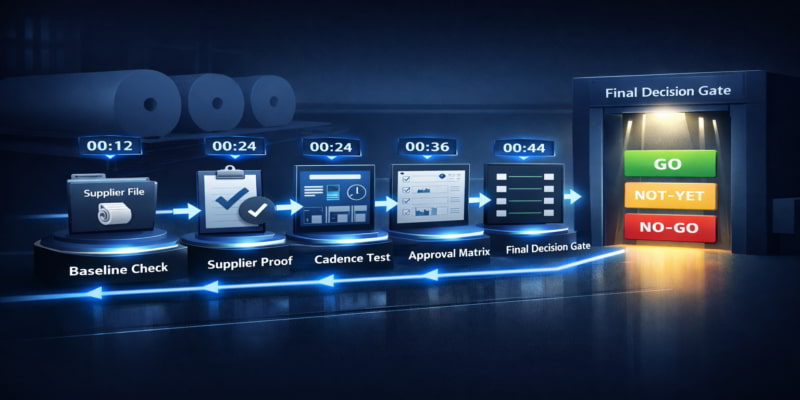
The practical goal is simple: build one shared decision pack that combines supplier proof, cadence assumptions, responsibilities, and a final approval checkpoint within 48 hours. That is how the security shield of supplier verification makes the cadence engine safe to run.
Why Toilet Tissue Lead-Time Planning and Supplier Vetting Must Be Decided Together
Many toilet tissue converting teams still split the work. Procurement checks whether the supplier looks legitimate. Operations checks whether the lead-time math looks workable. Leadership worries about cash exposure. Each conversation sounds reasonable on its own. The risk appears when those approvals never truly meet.
Supply chain analysts generally observe that many international sourcing failures stem from organizational silos rather than purely commercial issues. Difficulties frequently arise when supplier trust and cadence logic are approved in separate conversations. One team hears “verified.” Another hears “covered.” The plant hears something else a week later. Too late.
That split becomes dangerous as soon as the old method stops working. Manual order-point triggers may carry a converter through the earliest stage. Once the business adds a second line, more shifts, or more lane complexity, reactive ordering starts creating gaps that buffers cannot cover without locking too much working capital. The same pattern shows up in vetting. Basic digital checks may filter obvious noise, but they are not enough to separate real mills from unstable or intermediary-led supply paths once international sourcing becomes more serious.
| Separate-Track Evaluation | Synchronized Evaluation |
| Procurement treats toilet tissue supplier legitimacy as one approval. | Procurement tests legitimacy against the exact first tissue roll window the business wants to protect. |
| Operations models timing from supplier promises. | Operations start from buyer-owned run-rate, coverage, lane, and buffer assumptions. |
| Leadership reviews cash exposure late. | Leadership sees the commercial, timing, and continuity implications before commitment. |
| Risk appears after the first decision. | Risk is surfaced before the first cadence window is locked. |
A practical rule follows from that comparison: do not approve a toilet tissue jumbo roll supplier in isolation from cadence fit, and do not lock the first cadence window in isolation from supplier proof depth.
The Decision Team: What Procurement, Operations, and Founders Each Need in the First 48 Hours
This is not a one-owner decision. It is a one-path decision.
| Role | Core Question | Required Proof | Approval Trigger |
| Procurement | Is this toilet tissue supplier real, reachable, and commercially usable? | Legal identity, trading entity match, mill reality, response quality, document consistency | No unresolved identity or channel-risk issue |
| Operations | Can this supplier support the first toilet tissue parent roll window without starving the line? | Weekly consumption, required coverage, production-slot realism, booking and transit assumptions | First-window timing works against actual run-rate |
| Founder or Owner | Is the first commitment defensible from a continuity and cash-discipline standpoint? | MOQ implications, working-capital exposure, escalation plan, unresolved risks | The team can defend the first order decision in one page |
A shared clock helps. So does visible ownership.
| By Hour | What Must Exist | Primary Owner |
| 6 | Buyer-owned baseline for consumption, coverage, lane, and trade-term assumptions | Operations with Procurement |
| 18 | Supplier proof pack covering identity, mill reality, and communication quality | Procurement |
| 30 | Stress test of supplier capability against the first cadence window | Operations |
| 42 | Shared approval matrix with scores, gaps, and open risks | Cross-functional lead |
| 48 | Go, no-go, or not-yet memo with named next owner | Founder or final approver |
That is The First 48-Hour Blueprint. Not a best-practices list. A usable decision path.
Hour 0–6: Lock Your Buyer-Owned Toilet Tissue Parent Roll Baseline
Start here. Always.
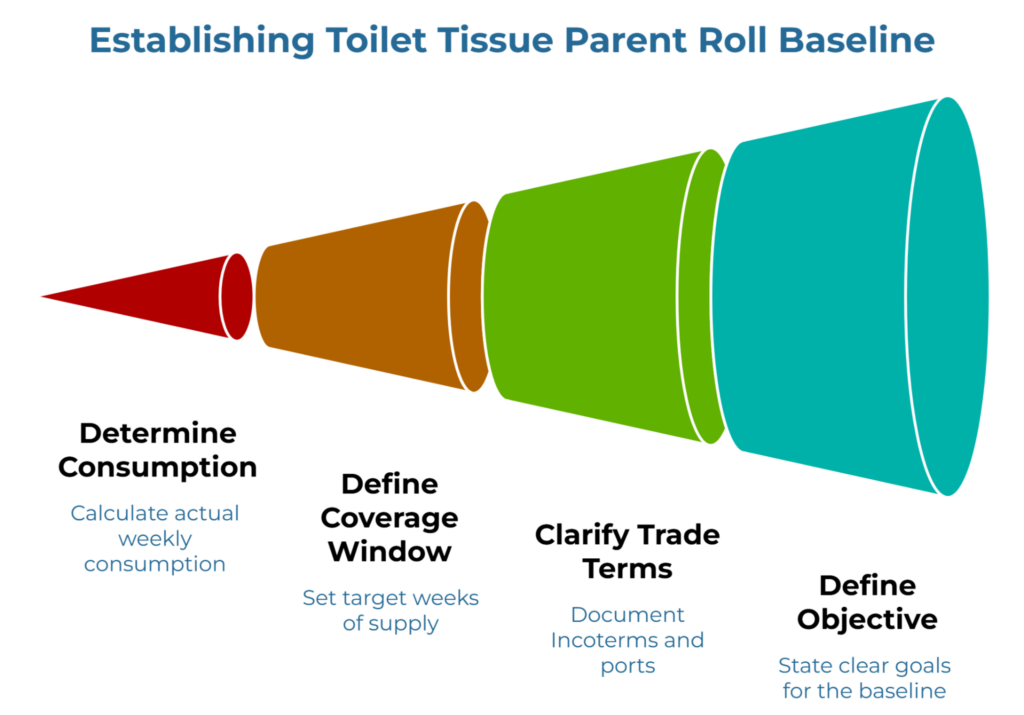
If the first cadence model begins with bath tissue parent roll supplier claims, the model is already tilted. The opening six hours belong to the buyer. Lock the baseline before anyone compares suppliers.
The audit begins with three core metrics:
- What does the bathroom tissue converting line actually consume each week? Use real run-rate logic, not rough monthly memory. If shifts vary, use the weighted average of actual production weeks. For converters running multiple shifts, separating consumption by shift pattern exposes where coverage gaps are most likely to appear.
- What first coverage window are you trying to protect? The first order is usually not a full supply strategy. It is a continuity decision. For many small toilet tissue converters, standard inventory liquidity planning heuristics typically suggest aiming for an estimated four to eight weeks of uninterrupted parent roll supply — quantified in weeks to ensure granularity, adjusted for the specific lead-time variances of domestic versus international lanes. A window that is too long locks working capital prematurely—and may trigger demurrage costs if receiving capacity is mismatched. A window that is too short leaves no room for transit variability.
- What lane and trade-term assumptions are shaping the clock? EXW, FOB, and CIF do not start risk, cost, and responsibility at the same point. When trade terms are still fuzzy, the timing model is fuzzy too. Before Hour 6 ends, document the target Incoterm, the origin port or region, and the destination port. An FOB quote from one mill and a CIF quote from another cannot be placed side by side without normalization. The official Incoterms® rules are the right reference point when your team needs a shared language for those assumptions.
This stage should also define the first-window objective in plain language. Are you protecting the line through a known demand period? Are you trying to establish a repeatable booking rhythm? Are you testing whether a new raw material supplier can hold a realistic slot? Clarity here reduces later disagreement.
Hour 6–18: Verify the Supplier Before the Cadence Model Starts Trusting Them
Now the supplier work begins.
A good toilet tissue supplier review in this window is not a hunt for perfection. It is a test of whether the supplier is credible enough, stable enough, and clear enough to deserve space inside the first cadence model.
Focus on four proof layers.
- Legal identity. Confirm the supplier’s registered legal entity and cross-reference it against the entity that would appear on commercial invoices and shipping documents. The trading entity, the contact trail, and the document trail should all point to the same counterparty. For toilet tissue raw material procurement specifically, verify whether the entity is the actual mill or a trading intermediary. A trading company may offer competitive pricing but introduces a layer of production uncertainty that a cadence plan cannot absorb.
- Mill reality. A polished website or fast reply is not proof of actual production capability. The question is whether the claimed mill relationship is real and operationally relevant to your parent roll requirement.
- Technical communication quality. Send a focused technical query about toilet tissue parent roll specifications — GSM tolerances, moisture targets, core dimensions — and measure the response. Technical responsiveness is a proxy for production control; direct mills typically provide specific GSM variance tolerances (e.g., ±5%) immediately, whereas intermediaries often pivot to generalized specification sheets. If questions about product details, slot timing, packaging, or process control produce slippery answers, the risk is already visible.
- Relationship stability. Ask for evidence of production stability: recent shipment records to comparable markets, quality management certification status, and references from current buyers in similar product categories. A supplier can sound confident and still depend on a fragile, intermediary-led path. That matters because the first order window usually breaks on hidden channel instability long before it breaks on presentation quality. If the supplier cannot provide stability evidence within a 12-hour window, that delay itself is useful data.
This is where general quality-system signals can support the review without replacing it. Formal systems language such as ISO 9001:2015 — Quality management systems — Requirements can help frame process discipline, but certification alone does not prove that the supplier can support your first toilet tissue parent roll window. It serves as a baseline for process discipline rather than a guarantee of specific window performance. The real test remains fit for the actual order path.
For deeper verification logic, keep the supplier review tied to the same category-specific workflow by using the multi-layer verification blueprint: advanced risk mitigation for toilet tissue parent roll procurement, beyond the broker: three steps to direct toilet tissue raw materials supplier authentication, and the first 72 hours: how to audit your current cross-border toilet tissue parent rolls supplier vetting process.
Hour 18–30: Test Whether the Supplier Can Support the First Cadence Window
This is the hinge point.
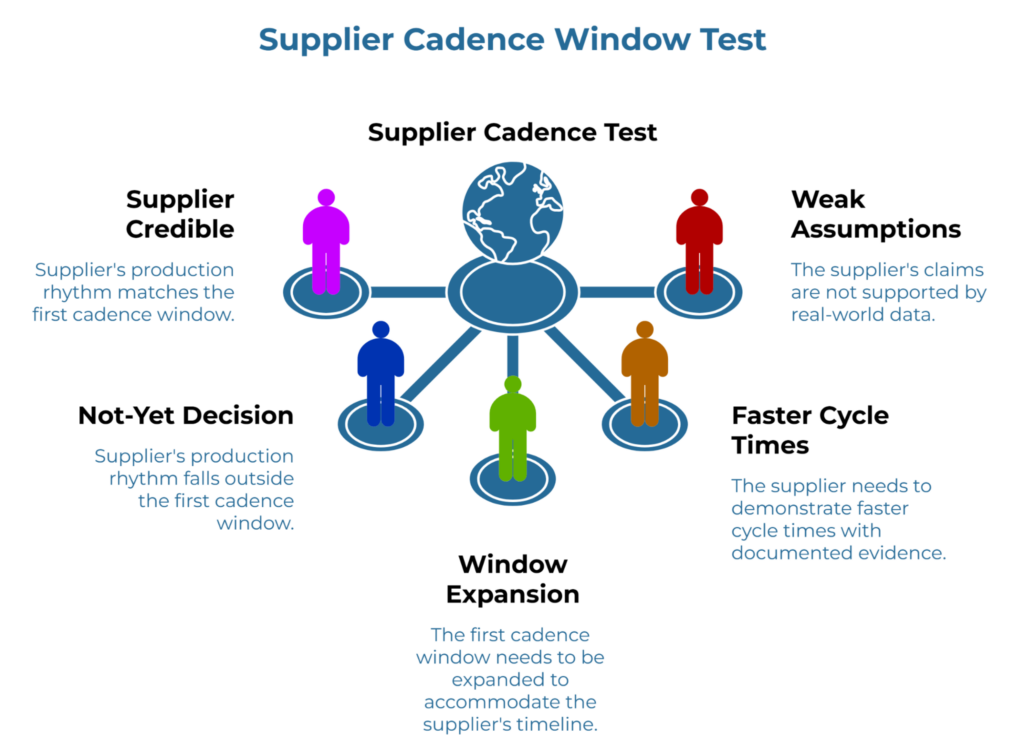
Up to now, the team has two things: a buyer-owned timing baseline and a supplier proof pack. The next move is to connect them. Not loosely. Directly.
Take the supplier’s claimed production rhythm and test it against your first-window requirement. Ask the supplier for their earliest confirmed production slot for the target bath tissue parent roll specifications. Compare that slot against the first coverage window defined in Hour 0–6. Can the mill’s available slot actually match your run-rate timing? If the mill’s earliest available slot falls outside the coverage requirement, the supplier may still be credible — but not for the first window. That distinction is a Not-Yet decision, not a No-Go.
Map the full timeline from order confirmation to parent roll arrival at the converting plant. Include booking lead time, production lead time, transit duration, customs clearance, and inland delivery. Factor in the true landed cost implications of each segment. Add a realistic buffer for each segment. If the total exceeds the first coverage window, either the window needs to expand or the supplier needs to demonstrate faster cycle times with documented evidence. Do booking cutoffs, transit assumptions, and buffer logic still hold once the lane is described honestly? If one step slips, does the line still stay covered?
That pressure test should expose weak assumptions fast. A supplier may look credible and still be wrong for the first cadence window because the timing only works on paper. A cadence model may look clean and still be unsafe because it trusts responses that have not been proven deeply enough. That is why the bridge logic matters: supplier verification protects the credibility of the first cadence commitment, and buyer-owned cadence planning translates supplier promises into operational timing decisions.
Document every assumption that has not been independently confirmed: unverified mill production capacity for the required GSM and diameter specifications, untested transit times for the specific lane, missing documentation on moisture tolerance or test methods. These do not automatically disqualify the supplier. They do change the confidence level of the approval decision — and they must be visible to every stakeholder who enters the next phase.
Where supply-chain security thinking needs a more formal reference point, ISO 28000:2022 — Security and resilience — Security management systems — Requirements can be a useful framework. It is still a framework. It does not replace route-specific and supplier-specific judgment.
Hour 30–42: Build the Shared Approval Matrix
Once the proof and timing work have been done, stop arguing in paragraphs and start deciding in columns.
A useful approval matrix scores three things together using a simple three-point scale — confirmed, partially confirmed, or unconfirmed — for each dimension:
| Decision Lens | What You Are Scoring | What a Low Score Usually Means |
| Supplier Credibility | Identity clarity, mill reality, communication quality, relationship stability | The supplier story is incomplete or unstable |
| Cadence Fit | Slot realism, booking rhythm, transit timing, buffer adequacy, MOQ relative to weekly consumption | The first toilet tissue parent roll window depends on wishful assumptions |
| Organizational Readiness | Warehouse space confirmed, receiving process documented, quality inspection protocol in place, payment terms agreed internally | The business is not ready to defend the first order decision |
Each “unconfirmed” item adds conditional risk. Each “partially confirmed” item needs a named owner and an expected resolution date. The value is not mathematical elegance. The value is forcing Procurement, Operations, and leadership to look at the same facts at the same moment.
This is also the right time to draft the decision memo.
| Decision Memo Field | What to Capture |
| Supplier Summary | Legal identity status, mill-direct confirmation, communication score, production stability evidence, reference outcomes |
| Cadence Assumptions | Weekly consumption figure, first coverage window target, Incoterm, confirmed mill slot, total lead-time estimate with buffers |
| Open Risks | Every “unconfirmed” or “partially confirmed” item from the approval matrix, with owner and expected resolution date |
| Recommended Decision | Go, no-go, or not-yet — with rationale, signed by all three stakeholder functions |
| Named Next Owner | Who moves the decision forward over the next 24–72 hours |
Short. Visible. Defensible.
Hour 42–48: Make the Go, No-Go, or Not-Yet Decision
The final gate should be plain.
- Go Approve the supplier and lock the first toilet tissue parent roll window only when supplier credibility, cadence fit, and internal readiness all clear the threshold the team agreed in advance. All three stakeholders sign off on the same decision memo. If Go: issue the first PO against the confirmed window.
- Not-yet: Hold the supplier in play but delay the window when the supplier is viable, but the timing assumptions or lack of proof leave too much operational exposure. The supplier relationship stays active. The first window shifts until the gaps close. This is the right call when the mill is credible but the transit lane is untested, or when internal receiving processes need another week of preparation. Set a re-evaluation date.
- No-go: Reset the search when identity remains muddy, mill status is unverified, or the first cadence window requires ‘perfect-path’ execution without realistic buffers. The cadence model is irrelevant at this point. The team returns to supplier discovery and restarts the clock.
The exact threshold can vary by lane, business size, and working-capital tolerance. The discipline should not. One approval gate. One decision pack. One outcome.
The First 48-Hour Checklist for Toilet Tissue Parent Roll Supplier Approval and Cadence Lock-In
| Timeframe | Action Item | Owner |
| Hour 0–6 | Define weekly bulk tissue consumption (actual, not projected) | Buyer team |
| Hour 0–6 | Set first coverage window in weeks (target: 4–8 weeks) | Operations + Founder |
| Hour 0–6 | Document target Incoterm, origin port/region, and destination port | Procurement |
| Hour 0–6 | State the first-window objective in one sentence | Operations |
| Hour 6–18 | Confirm supplier legal identity and match to invoicing entity | Procurement |
| Hour 6–18 | Verify mill-direct status versus intermediary or trading company | Procurement |
| Hour 6–18 | Send technical query on toilet tissue jumbo roll specifications; assess response quality | Procurement + QA |
| Hour 6–18 | Request production stability evidence (shipment records, certification status, references) | Procurement |
| Hour 6–18 | Surface any intermediary-led or unstable supply-path risk | Procurement |
| Hour 18–30 | Obtain mill’s earliest confirmed production slot for target specifications | Procurement |
| Hour 18–30 | Map full order-to-arrival timeline including booking, production, transit, customs, and delivery | Supply Chain |
| Hour 18–30 | Compare total lead time against buffer-adjusted first coverage window | Operations |
| Hour 18–30 | Document all unconfirmed assumptions and flag for the approval matrix | All stakeholders |
| Hour 30–42 | Score supplier credibility (identity, mill-direct, communication, stability, references) | Procurement |
| Hour 30–42 | Score cadence fit (slot alignment, lead-time gap, MOQ vs. weekly consumption) | Operations |
| Hour 30–42 | Score organizational readiness (warehouse, receiving, QA protocol, payment terms) | Founder + Operations |
| Hour 42–48 | Compile decision memo with supplier proof, cadence assumptions, unresolved risks, and recommendation | Lead evaluator |
| Hour 42–48 | Hold cross-functional approval gate: Go, No-Go, or Not-Yet | All stakeholders |
| Hour 42–48 | If Go: issue first PO against confirmed window. If Not-Yet: set re-evaluation date | Procurement + Founder |
Frequently Asked Questions
Can a verified toilet tissue supplier still be wrong for the first cadence window?
Yes. Verification can show that a supplier is credible enough to review seriously. It does not automatically prove that the supplier can support your first toilet tissue parent roll window at the timing your business actually needs. Available production slots, booking timelines, and logistics infrastructure may not align with the specific timing the first cadence window requires. That is a Not-Yet decision, not a No-Go.
What is the minimum proof needed before locking a first parent roll ordering window?
The minimum proof is not one certificate or one clean quote. At minimum, the team needs: confirmed legal identity matching the invoicing entity, mill-direct status verification, at least one reference from a current buyer in a comparable market, a confirmed production slot that fits within the buffer-adjusted coverage window, and documented internal readiness covering warehouse space, receiving protocol, and payment terms. If any of these is missing, the first window should be held pending rather than approved with gaps.
Who should own the final decision in a small toilet tissue converting business?
One person should own the final call, but not in isolation. In many small and growth-stage toilet tissue converting businesses, the founder or operations head acts as final approver after Procurement and Operations complete the shared decision pack. The procurement lead or the operations head typically compiles the decision memo and facilitates the approval gate, depending on which role has the clearest view of both supplier data and production scheduling. The founder’s role is to validate risk tolerance and cash-flow exposure, not to evaluate technical supplier details.
The production board looks different when supplier trust and cadence logic stop competing for attention and start reinforcing each other. That is the real shift inside the first 48 hours. You move from two-track thinking to one-track decision design.
Once the framework is in place, the next step is to evaluate live options against it, starting with bath tissue parent roll suppliers. If the team still needs more context before comparing suppliers, continue the evaluation path in the PaperIndex Academy or widen the search through Find Suppliers.
Disclaimer:
This content is for informational purposes only and does not constitute supply chain, procurement, or professional business advice. Lead times, supplier reliability, and cadence planning outcomes vary by lane, supplier, and operational conditions. Consult qualified supply chain and procurement professionals before making supplier commitments or ordering decisions.
Our Editorial Process:
Our expert team uses AI tools to help organize and structure our initial drafts. Every piece is then extensively rewritten, fact-checked, and enriched with first-hand insights and experiences by expert humans on our Insights Team to ensure accuracy and clarity.
About the PaperIndex Insights Team:
The PaperIndex Insights Team is our dedicated engine for synthesizing complex topics into clear, helpful guides. While our content is thoroughly reviewed for clarity and accuracy, it is for informational purposes and should not replace professional advice.