

📌 Key Takeaways
Paper bag supplier verification is a five-step framework that validates legal identity, manufacturing capability, quality compliance, delivery reliability, and specification consistency before any bulk commitment.
- Verification Prevents Supply Chain Collapse: Confirming supplier legitimacy through documentation gates eliminates fraud risk, quality failures, and delivery disruptions that can freeze operations.
- Legal Confirmation Comes First: Business registration, tax identification, and signatory authority must align across all documents before discussing specifications or pricing.
- Manufacturing Proof Beats Marketing Claims: Timestamped factory videos, production samples, and machinery documentation separate real manufacturers from trading fronts adding hidden margin layers.
- Certifications Require Database Verification: ISO 9001 and FSC claims mean nothing without current certificates verified through official databases matching the supplier’s legal entity and product scope.
- Sample-to-Pilot Ladders Eliminate Bulk Risk: Pre-production samples, production samples, and pilot orders validate consistency at scale before committing to commercial volumes.
Request evidence, verify claims, test before trust.
Procurement professionals managing paper bag sourcing for e-commerce, food service, or retail operations will find actionable verification gates here, preparing them for the detailed step-by-step protocol and downloadable checklist that follows.
In supply chain management, a primary supplier delivery failure—often occurring without warning or viable alternatives—represents a critical operational single point of failure.
For procurement teams, the absence of a vetted backup is an operational single point of failure. When primary delivery timelines slip, the lack of pre-verified alternatives converts a delay into a fulfillment crisis.
Here’s what makes this situation preventable: the supplier was never properly verified in the first place. A low quote won over a systematic check. Now a single vendor delay threatens to paralyze order fulfillment.
Consider a different scenario: a mid-sized online food delivery platform needs branded paper bags for a seasonal campaign. The Procurement Manager wants quick quotes, Operations wants stable lead times, and Brand/Marketing wants print quality that matches guidelines. The fastest path is not “get three prices.” The safest path is shortlist, verify, then request pricing.
Paper bag supplier verification is a repeatable framework for validating that a supplier is real, capable, compliant, and reliable—before you stake your brand reputation and operational continuity on their performance. Think of it as a background check for your supply chain.
This guide provides a practical, five-step protocol you can execute today. Each step includes what evidence to request, what “good” looks like, and the red flags that signal you should walk away. By the end, you’ll have a clear pass-or-fail gate for every supplier conversation—plus a structured checklist and a copy-paste email template to request the evidence you need.
Why Verification Matters Before Price: The Risks SMEs Can’t Afford
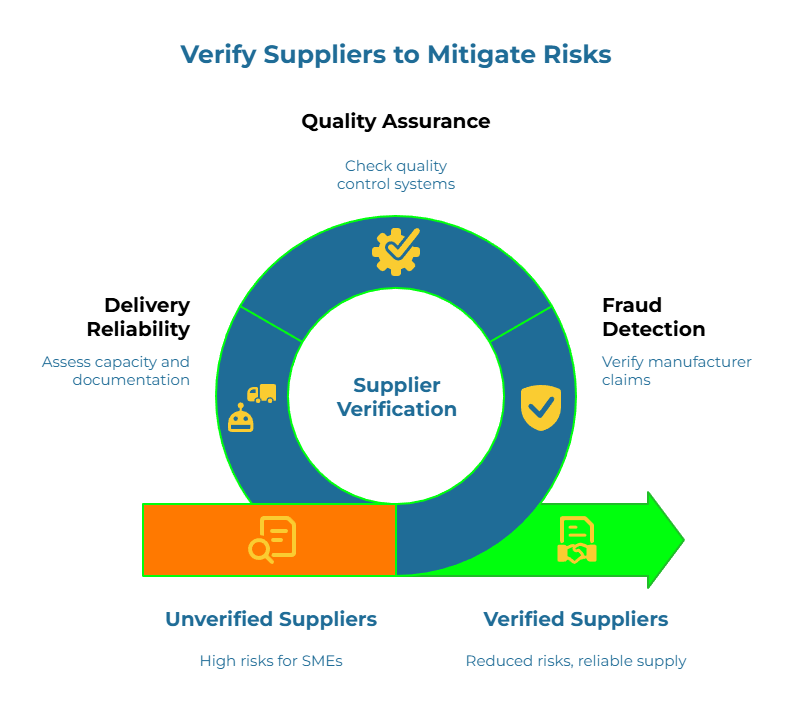
Finding suppliers is not the same as verifying suppliers.
A quick online search—or browsing specialized platforms like the PaperIndex supplier directory—can surface dozens of potential paper bag manufacturers.. But a list of names tells you nothing about whether those companies can actually deliver what they promise, when they promise it, at the quality level your brand requires.
The risks of skipping verification fall into three categories:
Fraud and misrepresentation. Some entities present themselves as manufacturers when they’re actually trading companies adding margin without adding value. Others use stock images of factories they don’t own. A few are outright fraudulent, collecting deposits for orders they never intend to fulfill.
Quality failure. A supplier might produce acceptable samples, then substitute cheaper materials for bulk orders. Without verification of their quality systems, you have no early warning. The first sign of trouble arrives when customers complain—or when your bags tear at the checkout counter.
Delivery disruption. Suppliers operating at capacity constraints or lacking proper export documentation can cause delays that cascade through your operations. For e-commerce retailers and food delivery platforms, a packaging stockout doesn’t just inconvenience customers. It stops revenue.
The “Just Buy Local” Counter-Argument
Some procurement teams avoid international sourcing complexity by defaulting to local distributors. This approach offers speed and simplicity. But it creates its own risks.
Dependence on a single regional source limits your options when demand spikes or when that distributor faces their own supply problems. Local distributors often lack the scale to support rapid growth. And the opacity remains—you’re trusting the distributor’s vetting process instead of conducting your own.
Working through distributors can reduce visibility into factory processes, change control, and documentation. If one intermediary controls supply, negotiating power and flexibility can shrink. When allocation tightens, a distributor becomes a single point of failure.
The verification protocol outlined here works regardless of whether your supplier is across town or across the ocean.
Step 1: Confirm Legal Existence and the Real Operating Entity
This step confirms the supplier is a legitimate legal entity and that the person you’re communicating with is authorized to represent it.
Before discussing specifications or pricing, establish that you’re dealing with a real company. This step catches fraudulent operators and clarifies exactly who would appear on your contracts and invoices.
What to Request
- Business registration certificate showing the legal company name, registration number, and date of incorporation
- Tax identification or VAT number (where applicable to the supplier’s jurisdiction)
- Registered business address and primary factory address (these may differ)
- Signatory authority documentation confirming that your contact can bind the company to agreements
Cross-Check Actions
Compare names across documents. The company name on the registration certificate should match the name on invoices, the email domain, and any certificates they provide. Mismatches aren’t always disqualifying—companies do operate under trade names—but they require explanation.
Validate address plausibility. Use mapping tools and business directories to confirm the address exists and appears consistent with manufacturing operations. This is a screening step, not a guarantee. A real address doesn’t prove a real factory. But a nonexistent address proves a problem.
For EU-based suppliers, VAT numbers can be validated through the VIES database, which confirms whether a VAT number is currently registered and matches the company name provided.
Crucial Distinction: Procurement teams must not mistake a professional website or rapid responsiveness for proof of legitimacy.
Red Flags
- Entity name on registration doesn’t match entity name on communications or quotes
- Personal email addresses (gmail, yahoo, hotmail) used for corporate invoicing
- Reluctance or delays when asked for basic registration documents
- Multiple “company names” used interchangeably without clear explanation
- Address that maps to a residential building or empty lot
Step 1 Gate:
- Pass: Legal entity details are consistent across all registration and tax documentation
- Conditional: Minor inconsistencies with a clear, verifiable explanation
- Fail: Mismatched entities, evasive behavior, or unverifiable invoicing identity
If a supplier cannot or will not provide basic legal documentation within a reasonable timeframe, stop the evaluation. No price advantage justifies contracting with an entity you cannot verify exists.
Step 2: Validate Manufacturing Capability (Not Just a Trading Front)
This step confirms the supplier can actually manufacture the paper bags you need, at your required scale, in their own facility.
Many entities in global trade are traders or agents rather than paper bag manufacturers—there’s nothing inherently wrong with working through intermediaries, but you need to know what you’re dealing with. There’s nothing inherently wrong with working through intermediaries—but you need to know what you’re dealing with. A trader adds a margin layer and reduces your visibility into production. A manufacturer gives you a more direct line to the factory floor.
Evidence to Request
Factory documentation:
- Timestamped photos or video walk-through of the production facility (not stock images)
- List of primary machinery and production lines
- Photos of the packaging line and finished goods storage
Production evidence:
- Recent production samples (client branding can be blurred for confidentiality)
- Examples of similar products they’ve manufactured
- General capacity indicators: number of production lines, shift patterns, approximate monthly output range
Capability alignment:
- Confirmation they produce the specific bag types you need (flat, gusseted, with handles, custom printing, etc.)
- Confirmation they work with the materials you require (virgin kraft, recycled kraft, food-grade substrates)
Practical SME Gates
For standard orders with moderate volume, factory photos and production samples may provide sufficient confidence. For high-volume orders or strict specifications, consider requiring a third-party inspection—either virtual or on-site—before committing to bulk quantities.
Virtual factory audits have become increasingly common. They don’t replace physical inspections entirely, but they add a layer of verification beyond self-reported documentation.
Red Flags
- Stock images that appear on multiple supplier websites
- Refusal to show the production floor via photos, video, or live call
- Answers about capacity or capability that shift depending on who you ask
- Claims of manufacturing capability but all evidence points to trading activity
- Facility photos that don’t match the stated location or company name
Step 2 Gate:
- Pass: Factory evidence is specific, consistent, and matches your bag type
- Conditional: Evidence is partial, but the supplier agrees to close gaps (live walkthrough, inspection)
- Fail: Evidence appears generic, inconsistent, or is withheld
If you cannot obtain credible evidence of manufacturing capability, treat the supplier as unverified. They may be legitimate traders, but they haven’t passed the verification standard for a direct manufacturing relationship.
Step 3: Verification of Quality Management Systems (QMS) and Regulatory Compliance
This step reduces quality rejection and compliance risk by establishing documented proof, not verbal promises.
Suppliers often make claims about quality certifications and sustainability credentials. These claims are only as valuable as the evidence behind them. This step establishes whether stated certifications are current, relevant, and actually cover the products you’re purchasing.
Quality System Evidence
ISO 9001 certification indicates that a supplier has implemented a quality management system meeting international standards—a topic explored in depth in our guide on how to verify supplier capability. It doesn’t guarantee product quality, but it demonstrates systematic processes for quality control. If a supplier claims ISO 9001 certification, request a copy of the certificate and verify:
- The certificate is current (not expired)
- The certifying body is accredited
- The scope covers paper bag manufacturing (not just an unrelated business unit)
To verify a certificate, locate the ‘Certificate Number’ and the ‘Certifying Body.’ You should primarily cross-reference this via the IAF CertSearch database (iafcertsearch.org). If the certificate does not appear there, locate the website of the specific Accreditation Body (e.g., UKAS, ANAB) and search their directory directly to rule out database synchronization delays.
Sustainability and Chain-of-Custody Claims
If a supplier claims FSC (Forest Stewardship Council) certification for sustainably sourced materials, request the specific FSC certificate number and chain-of-custody documentation—our article on avoiding greenwashing in sustainability claims provides a detailed verification protocol for FSC and other environmental certifications
Verify the certificate through the FSC public database, which allows you to confirm certificate validity, scope, and current status. Be specific: an FSC certificate for one product line doesn’t automatically cover all products a supplier offers. The approach here is verify, then trust—not accept a logo on a brochure.
Test Reports and Lab Evidence
Some suppliers provide lab test reports for material properties (burst strength, grammage, food-contact safety). When evaluating these reports:
- Confirm the test methods referenced are consistent with recognized standards
- Check whether the testing laboratory holds ISO/IEC 17025 accreditation, which indicates competence for testing and calibration
- Verify the test report date and whether the tested material specifications (grade, grammage, composition) match the material intended for your order
For paper bags used in food delivery or retail food applications, food-grade certification standards require additional verification beyond general quality certifications—buyers should confirm compliance with FDA 21 CFR 176 or EU 1935/2004 depending on their market.
Red Flags
- Certificates with company names or addresses that don’t match the supplier’s documentation
- Expired certifications presented as current
- Certification scope that doesn’t include paper bag manufacturing
- Vague “eco-friendly” or “sustainable” claims without verifiable certification codes
- Test reports from labs that cannot be independently verified
- Reluctance to provide certificate numbers for independent verification
Step 3 Gate:
- Pass: Certificates and test evidence are verifiable, current, and match the entity and site
- Conditional: Evidence exists but needs clarification (scope, site listing, updated documents)
- Fail: Evidence cannot be verified or is repeatedly inconsistent
Claims without verifiable evidence should be treated as unsubstantiated. If sustainability or quality certifications are important to your sourcing criteria, verification is non-negotiable.
Step 4: Stress-Test Reliability: References, Export Proof, and Communication
This step confirms the supplier can deliver consistently—not just produce one acceptable batch.
Manufacturing capability proves a supplier can make your product. Reliability proves they can deliver it repeatedly, on schedule, with consistent quality. This step evaluates operational discipline and communication responsiveness.
Reliability Checks
References and shipment history:
- Request two to three customer references, if the supplier is willing to provide them
- Alternatively, ask for anonymized shipment documentation showing export history to your region
- Inquire about their experience with buyers of similar size and order volume
Change control processes:
- Ask how they handle specification revisions mid-order
- Ask how artwork updates or design changes are managed
- Understand their process for communicating production issues before they become delivery failures
Communication Discipline
Many supplier relationships fail without a dramatic event. They fail because nobody owns communication. An SME doesn’t need perfect systems. It needs a clear, named path for decisions and updates.
Establish these basics:
- Expected response times for inquiries
- A named quality control contact for escalation
- Confirm their working hours relative to your time zone and how urgent issues are handled
- How delays are communicated and documented
Global Supply Chain Realities
International sourcing involves inherent variability—our checklist for verifying international suppliers without travel addresses how to manage cross-border verification when site visits aren’t feasible. Shipping lanes have different transit times. Customs processes vary by destination. Weather, port congestion, and carrier capacity all introduce uncertainty.
Reliable suppliers don’t eliminate this variability—they manage it through documented processes and proactive communication. The question isn’t whether problems will occur. The question is whether the supplier has systems to identify problems early and communicate them promptly.
Red Flags
- Inability or unwillingness to provide any customer references
- No documented process for handling specification changes
- Slow or inconsistent communication during the evaluation phase (unlikely to improve after you’ve placed an order)
- No clear escalation path for quality or delivery issues
- Responses that contradict previous statements
Step 4 Gate:
- Pass: Evidence of repeat delivery exists, and communication ownership is clear
- Conditional: Evidence is limited but the supplier accepts structured updates and escalation
- Fail: Communication is unreliable or evidence is consistently withheld
A supplier who cannot demonstrate reliable delivery processes during evaluation is unlikely to develop them after receiving your purchase order. Communication patterns during vetting typically predict communication patterns during fulfillment.
Step 5: Run a Sample-to-Pilot Validation Before Any Bulk Commitment
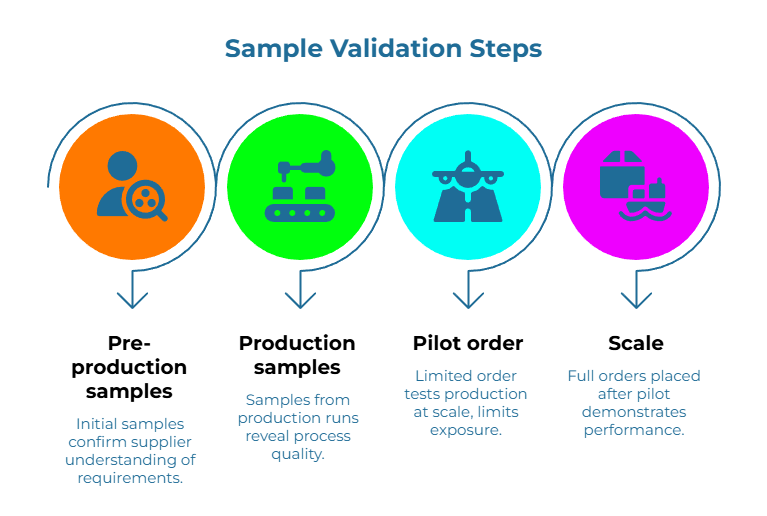
This step confirms the supplier can hit your specifications consistently before you commit significant volume.
Verification on paper reduces risk. Verification through actual production eliminates guesswork. This step establishes a structured sampling ladder that protects you from bulk commitment before capability is proven.
The Sampling Ladder
Use a staged approach that reduces risk at each level:
- Pre-production samples: Initial samples using your specifications. These confirm the supplier understands your requirements and can produce a representative example.
- Production samples: Samples pulled from an actual production run (not hand-made prototypes). These reveal whether production processes match sample quality.
- Pilot order: A limited commercial order, large enough to test production at scale but small enough to limit exposure if problems emerge. The pilot validates lead times, packaging, documentation, and delivery performance—not just product quality.
- Scale: Full commercial orders, placed only after the pilot demonstrates consistent performance.
Defining “Pass”
Before requesting samples, establish clear acceptance criteria—the principles outlined in our guide to paper bag raw material grades (GSM and Burst Factor) provide the technical foundation for defining measurable acceptance thresholds:
- Critical defects: Conditions that make the product unusable or unsafe (structural failure, contamination, wrong materials). Any critical defect in samples should disqualify the supplier.
- Major defects: Conditions that significantly affect function or appearance but don’t render the product unusable. Define an acceptable threshold.
- Minor defects: Cosmetic variations within tolerance. Define what “within tolerance” means for your application.
Document these criteria before sampling begins. Share them with the supplier so expectations are explicit.
Pre-Shipment Inspection
For pilot orders and early bulk orders, consider requiring pre-shipment inspection before goods leave the factory. This catches problems while correction is still possible—before you’ve paid for ocean freight on defective products.
Pre-shipment inspection can be conducted by third-party inspection firms, by your own staff (if feasible), or through remote video inspection for lower-risk situations.
Red Flags
- Pressure to skip sampling and proceed directly to bulk orders
- Sample quality that varies significantly between batches
- Unwillingness to document tolerances or acceptance criteria
- Resistance to pre-shipment inspection
- Samples that don’t match the specifications you provided
Step 5 Gate:
- Pass: Samples and pilot demonstrate consistent production against defined acceptance criteria
- Conditional: Minor issues exist with a documented corrective plan and verified re-sample
- Fail: Results remain inconsistent or undocumented
No bulk commitment without validated samples. This principle protects you from the most common sourcing failures: suppliers who can produce one good sample but cannot maintain consistency at volume. Our framework for building a supplier shortlist using scored criteria shows how to systematically compare verified candidates before making final sourcing decisions.
Checklist and Supplier Evidence Request Email
The verification protocol above can be distilled into a practical checklist for your procurement files. Each step becomes a gate: pass, conditional pass (requires follow-up), or fail.
The 5-Step Verification Checklist Summary
Step 1: Legal Existence
- [ ] Business registration certificate obtained and reviewed
- [ ] Tax/VAT number verified (where applicable)
- [ ] Entity names match across all documents
- [ ] Address plausibility confirmed
- [ ] Signatory authority documented
Step 2: Manufacturing Capability
- [ ] Timestamped factory photos/video obtained
- [ ] Machinery and production line documentation reviewed
- [ ] Production samples received and evaluated
- [ ] Capacity alignment with order requirements confirmed
Step 3: Quality and Compliance
- [ ] Claimed certifications verified through official databases
- [ ] Certificate scope matches products being sourced
- [ ] Test reports reviewed for methodology and lab credibility
- [ ] Sustainability claims substantiated with chain-of-custody documentation
Step 4: Reliability
- [ ] Customer references or export history obtained
- [ ] Change control process documented
- [ ] Communication responsiveness evaluated
- [ ] Named QC contact identified
Step 5: Sample Validation
- [ ] Acceptance criteria defined and shared with supplier
- [ ] Pre-production samples approved
- [ ] Production samples approved
- [ ] Pilot order completed successfully
Overall Gate Decision:
- [ ] PASS: Proceed to commercial orders
- [ ] CONDITIONAL: Address specific gaps before proceeding
- [ ] FAIL: Do not proceed with this supplier
Copy-Paste Supplier Evidence Request Email
The following template can be adapted for your initial outreach to potential suppliers. It requests the core documentation needed for verification in a single, organized request.
Subject: Documentation Request for Supplier Qualification – [Your Company Name]
Dear [Supplier Contact Name],
We are evaluating potential paper bag suppliers for [brief description of your requirements]. Before proceeding to detailed specification discussions, we require the following documentation to complete our supplier qualification process:
1. Legal Entity & Authorization
- Business registration certificate
- Tax identification or VAT number
- Registered business address and factory address
- Confirmation of signatory authority for the contact managing our account
2. Factory Capability (Paper Bags)
- Factory address and a timestamped video walkthrough of the production floor
- Machinery/process overview for forming, printing, finishing, and packing
- Recent production examples (client details may be blurred)
3. Quality & Compliance Evidence (If Applicable)
- ISO 9001 certificate (if claimed), including scope documentation and site address
- FSC chain-of-custody certificate code (if FSC is claimed) and the scope of certified products
- Any relevant lab test reports, including test methods/standards referenced
4. Reliability & Communication
- 2–3 references (where feasible) or anonymized shipment proof
- Named primary QC/contact person for production quality decisions
- Your proposed update cadence during sampling and production, plus escalation contact
- Description of your change control process for specification revisions
5. Sample-to-Pilot Plan
- Proposed sampling steps (pre-production sample → production sample → pilot order)
- Sample lead times and what constitutes acceptance criteria for pass/conditional/fail
- Whether pre-shipment inspection is supported for early orders
Please provide the above documentation within [timeframe, e.g., 10 business days]. We will review your submission and follow up with any clarifying questions.
Once these items are received and verified, the next step will be to confirm the sample plan and then proceed to an RFQ if verification gates are passed.
Thank you for your interest in working with [Your Company Name]. We look forward to your response.
Best regards, [Your Name] [Your Title] [Your Contact Information]
Once you have verified a supplier using this framework, you can explore sourcing options through the PaperIndex supplier directory, which connects buyers with paper bag manufacturers globally. After verification gates are passed, you can proceed to submit an RFQ to request competitive quotes from verified suppliers.
For additional guidance on sourcing and procurement best practices, the PaperIndex Academy provides educational resources on topics ranging from specification development to international trade documentation.
FAQ: Common Supplier Verification Questions
How do you verify a paper bag supplier?
Verification follows a structured sequence: confirm legal existence through business registration documents, validate manufacturing capability through factory evidence and production samples, verify quality certifications through official databases, assess reliability through references and communication patterns, and run a sample-to-pilot validation before committing to bulk orders. Each step serves as a gate—suppliers must pass before proceeding to the next stage.
What documents should a paper bag manufacturer provide?
At minimum: business registration certificate, tax or VAT identification, factory address, timestamped photos or video of production facilities, and documentation of any claimed certifications (ISO, FSC, or other). Suppliers should also provide production samples, capacity information, and a named quality control contact. Reluctance to provide basic documentation is itself a red flag.
How do you verify FSC claims?
Request the supplier’s specific FSC certificate number and chain-of-custody documentation. Then verify the certificate through the FSC public database at info.fsc.org. Confirm that the certificate is currently valid (not expired), that the scope covers the specific products you’re ordering, and that the company name matches the supplier you’re evaluating.
Should you do a factory audit before ordering?
For high-volume orders or strict specifications, factory audits—whether on-site or virtual—provide verification beyond documentation alone. For standard orders with moderate volume, thorough document verification plus a structured sampling process may provide adequate confidence. The decision depends on order value, specification complexity, and your risk tolerance.
What’s the minimum sample process before bulk orders?
A robust sample process includes three stages: pre-production samples to confirm specification understanding, production samples pulled from an actual run to verify manufacturing consistency, and a pilot order to validate lead times, packaging, and delivery performance. Skipping directly from samples to bulk orders bypasses critical validation steps.
How long does supplier verification take?
A thorough verification process typically requires two to four weeks, depending on supplier responsiveness and whether physical samples are required. This investment of time prevents far greater costs from quality failures, delivery disruptions, or fraudulent suppliers. Rushing verification to meet a deadline often creates larger problems than the delay it was meant to avoid.
Can verification guarantee supplier performance?
No verification process eliminates all risk. Verification reduces risk by establishing objective evidence of capability and reliability before you depend on a supplier. It also creates a documented baseline for accountability. Suppliers who pass verification can still underperform—but you’ll have identified and eliminated the highest-risk candidates before they had the opportunity.
Moving From Verification to Verified
The anxiety of supplier dependence—that low-level concern that one delayed shipment could freeze your operations—doesn’t have to be permanent.
Verification transforms sourcing from reactive scrambling into proactive risk management. Each supplier in your network either passes the gate or doesn’t. The ones who pass become genuine backup options, not just names on a list. The ones who don’t get filtered out before they can cause damage.
The five-step protocol above isn’t complicated. It requires discipline more than expertise. Request the evidence. Verify the claims. Test before you trust.
Your supply chain is a lifeline. Verification ensures that the lifeline holds.
Disclaimer: This article is for educational purposes only.
Our Editorial Process:
Our expert team uses AI tools to help organize and structure our initial drafts. Every piece is then extensively rewritten, fact-checked, and enriched with first-hand insights and experiences by expert humans on our Insights Team to ensure accuracy and clarity.
About the PaperIndex Insights Team:
The PaperIndex Insights Team is our dedicated engine for synthesizing complex topics into clear, helpful guides. While our content is thoroughly reviewed for clarity and accuracy, it is for informational purposes and should not replace professional advice.