

📌 Key Takeaways
Strategic sourcing replaces spot-buying chaos with a five-stage framework that filters supplier risk before you commit volume.
- Verification Gates Prevent Expensive Mistakes: Require identity proof, capability evidence, and pilot performance before awarding orders—samples and promises aren’t enough.
- Specification Clarity Eliminates Quote Confusion: Define bag families with measurable specs (GSM, burst factor, tolerances) before contacting suppliers to enable true cost comparison.
- Backup Suppliers Need Pre-Qualification: Test and approve secondary sources quarterly—not during supply crises—so capacity exists when primary suppliers fail.
- Landed Cost Reveals True Value: Normalize all quotes to the same delivery point and include quality costs, freight, and duties before comparing unit prices.
- Change Control Protects Repeatability: Lock spec-critical requirements in contracts with explicit approval gates to prevent suppliers from making “helpful” substitutions mid-contract.
Stage gates transform paper bags sourcing from recurring crisis into operational infrastructure.
Procurement managers and operations leaders at e-commerce retailers and food delivery platforms will gain a repeatable supplier qualification framework here, preparing them for the detailed stage-gate methodology that follows.
The supplier confirmed delivery for Tuesday. It’s Thursday now.
Your warehouse team is stacking the last 200 bags from yesterday’s emergency order—the ones that cost 23% more because you needed them by morning. The operations dashboard shows 847 orders queued for fulfillment. How did we end up here again?
You’ve been here before. The scramble. The calls to whoever can ship fastest. The moment when protecting your delivery promise means accepting whatever quality shows up on the truck.
This isn’t a supplier problem. It’s a sourcing problem. And the difference matters.
Wholesale paper bag sourcing is the strategic process of identifying, vetting, and contracting paper bag suppliers for high-volume procurement — ensuring cost-efficiency and specification adherence across your entire packaging operation. It is a process of technical validation: you are auditing production capabilities and material engineering to ensure operational durability.
Picture a different scenario. A peak-demand week hits, but operations stay stable because verified capacity, pilot-proven specs, and a backup supplier lane were established before the rush. No emergency calls. No premium freight. Just bags arriving on schedule, performing as expected.
That stability isn’t luck. It’s the result of moving beyond spot-buying and establishing a structured sourcing strategy with verified partners.
This guide provides a repeatable method you can apply with existing resources—not a vendor pitch, but a practical framework for building supply chain resilience that protects both operational continuity and brand reputation.
Why Spot-Buying Fails at Scale
Spot-buying feels efficient. You need bags, you find someone who has them, you buy them. Done.
Until it isn’t.
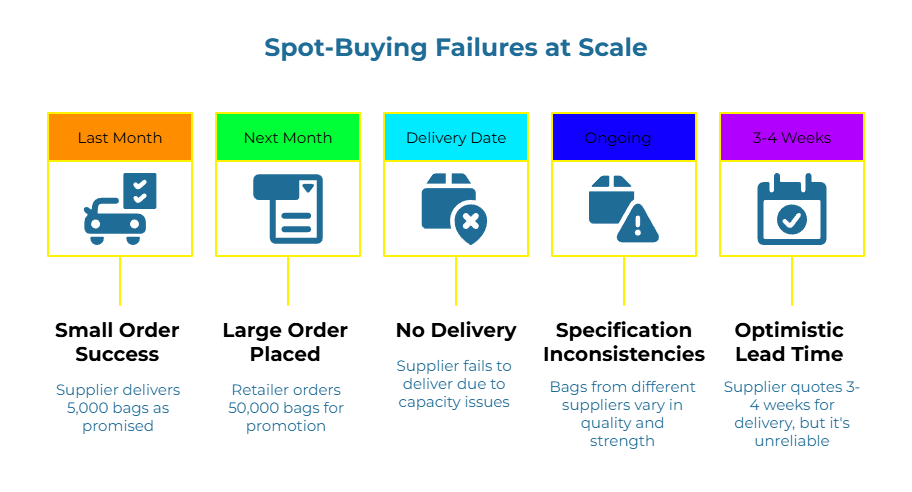
The hidden fragility of spot-buying reveals itself precisely when you can least afford it: during promotional surges, seasonal peaks, or the weeks following a successful product launch. Three vulnerabilities compound under pressure.
Unknown capacity. That supplier who delivered 5,000 bags last month may not have equipment, labor, or raw material allocation to deliver 50,000 next month. You won’t discover this until you place the order—or worse, until the delivery date passes without delivery.
Inconsistent specifications. Bag A from Supplier X uses 80 GSM kraft with a Burst Index of 3.5 kPa.m2/g. Bag B from Supplier Y uses 75 GSM with a Burst Index of 2.5 kPa.m2/g. Both were sold as “standard grocery bags.” One maintains structural integrity under a 3 kg static load… the other suffers catastrophic bottom-seam failure.
Surprise lead times. Production schedules, shipping consolidation windows, customs processing, port congestion—each variable sits outside your visibility when buying a spot. A supplier quoting “3-4 weeks” may be estimating optimistically, and you’ll have no historical data to calibrate that estimate.
For e-commerce retailers and food delivery platforms operating with customer-facing SLAs, these vulnerabilities translate directly into fulfillment failures, expedited shipping costs, and the kind of packaging incidents that generate one-star reviews.
The procurement managers who escape this cycle aren’t necessarily buying from better suppliers. They’re buying differently. They’ve built a sourcing strategy that treats supplier relationships as infrastructure rather than transactions.
Define the Sourcing Target Before You Contact Suppliers
The instinct when facing packaging chaos is to start calling suppliers immediately. Resist it.
Reaching out before you’ve defined what you actually need generates a flood of quotes you cannot meaningfully compare. Different suppliers will interpret vague requirements differently. You’ll receive pricing for products that don’t match each other—and may not match your actual operational needs.
Start by converting chaos into “bag families.”
A bag family groups SKUs by shared operational characteristics: use case, size class, load profile, and compliance requirements. A typical e-commerce operation might identify three to six families covering scenarios like light merchandise (under 1 kg), standard parcels (1-3 kg), heavy items (3-5 kg), and food-contact applications.
For each family, define the critical specifications that separate acceptable performance from failure:
- Dimensions and tolerances: Width, depth, height, and acceptable variance ranges
- Material grade: GSM (grams per square meter), burst factor, moisture resistance requirements—all of which depend on the underlying kraft paper properties used in bag construction
- Construction details: Handle type, reinforcement needs, closure mechanisms
- Compliance requirements: Food-contact certifications where applicable, recyclability standards for specific markets
- Print specifications: If branded bags are needed, ink coverage, color matching standards, artwork requirements
Separate “Spec-Critical” Requirements from Preferences
To keep suppliers from “helpfully” substituting materials, label requirements clearly:
Spec-critical requirements affect performance, compliance, or packing speed and must not change without approval. These typically include dimensional tolerances, paper strength targets, handle construction and reinforcement, seam and bottom structure, and packaging rules that affect damage rates.
Preferences are aesthetic or convenience items that can vary within limits—such as minor color variations or optional packaging features—unless brand standards make them critical.
The goal isn’t perfection—it’s clarity. You’re defining the ‘Minimum Viable Specification’ (MVS) for each family. This allows for a ‘Pass/Fail’ technical screen before commercial negotiations begin.
This specification work takes time upfront. A procurement team typically needs one to two weeks to audit current bag usage, document failure patterns, and translate operational requirements into measurable specifications. That investment eliminates weeks of back-and-forth confusion during supplier evaluation.
For guidance on connecting specifications to supplier selection criteria, the specs-to-sourcing methodology provides a detailed framework.
The 5-Stage Wholesale Paper Bag Sourcing Path
Strategic sourcing follows a sequence designed to filter out risk before you commit volume. Each stage serves as a gate: suppliers who don’t clear one stage don’t advance to the next.
Core Reusable Asset: Wholesale Paper Bag Sourcing Scorecard
Copy this scorecard to maintain consistent sourcing decisions across bag families. The point isn’t bureaucracy—it’s preventing the same mistakes from repeating across different purchasing cycles.
| Stage | Output You Should Have | Pass Gate (Simple) | What Often Goes Wrong |
| Stage 0: Scope | Bag family spec + acceptance rules | Requirements are stable enough to quote | Requirements change after quotes arrive |
| Stage 1: Discovery | Longlist + first-screen notes | Supplier seems relevant and coherent | Traders/brokers present as manufacturers |
| Stage 2: Verification | Identity + capability evidence | Evidence is consistent across channels | Mismatched details; vague capacity claims |
| Stage 3: Pilot | Pilot results + issue log | Bag performs in real workflow | “Nice samples” fail in delivery handling |
| Stage 4: Award | Award + backup rules + change control | Terms protect spec stability | Award made without backup or change rules |
| Stage 5: Governance | Quarterly scorecard + review cadence | Performance is tracked and acted on | Same issues repeat because nobody owns follow-up |
Stage 1: Discovery
Discovery answers a simple question: who makes what you need?
Cast a wide net initially. You’re looking for manufacturers and converters who claim capability in your target bag families—not evaluating whether those claims are accurate yet.
Sources for discovery include specialized B2B marketplace platforms for paper and packaging, trade directories, industry association member lists, trade show exhibitor databases, and referrals from non-competing businesses in adjacent industries.
At this stage, you’re building a long list. Twenty to forty potential suppliers is reasonable for a meaningful sourcing exercise. Document basic information: company name, location, stated product range, contact details, and any initial red flags (unresponsive communication, websites that lack substantive detail).
A fast first-screen helps narrow the field:
- Can the supplier clearly describe the bag type and construction, not just share photos?
- Can the supplier quote to your spec without quietly substituting key elements?
- Can the supplier explain typical order sizes and repeat-order patterns?
- Can the supplier explain how consistency is maintained across repeat production?
Speed of response helps. Clarity helps more.
Stage 2: Verification
Verification separates legitimate manufacturers from traders misrepresenting capability, from companies that exist on paper but lack operational substance.
This stage requires evidence, not promises.
Identity verification confirms the company exists as a registered business entity. Request official business registration documents. Cross-reference company details against government business registries where available. Verify that physical addresses correspond to actual facilities—satellite imagery tools can help confirm that a claimed manufacturing site exists.
A lightweight, remote-friendly approach typically includes company identity cross-checks (legal name, address, registration details, and website alignment), role clarity (manufacturer/converter versus trader versus aggregator), and reference consistency (names and addresses match across documents, invoices, and communication).
Capability verification confirms the supplier can actually produce your specifications. Request equipment lists. Ask for production samples accompanied by test certificates showing GSM, burst strength, and other relevant metrics. Inquire about typical order sizes, production lead times, and capacity constraints during peak seasons.
Capability evidence can include photos or video of relevant production processes, quality checkpoints showing how defects are detected and handled, sample traceability documenting what batch and materials were used, and clear answers on capacity ranges and lead-time constraints.
Consistency verification assesses whether the supplier operates with the discipline your operation requires. How quickly do they respond to inquiries? Do responses address your specific questions, or do they provide generic information? Can they provide references from current customers in similar industries?
Compliance verification becomes critical for food-contact applications. Food-contact compliance varies by market. Requirements depend on where and how your packaging is used. High-authority references that may be relevant include:
- US FDA regulations for paper and paperboard in contact with food: 21 CFR § 176.170
- EU framework regulation for food contact materials: Regulation (EC) No 1935/2004
- EU good manufacturing practice for food contact materials: Regulation (EC) No 2023/2006
These citations illustrate how standards differ by jurisdiction. Your requirements should be set by where your packaging is used and what it contains.
For food-contact applications—particularly relevant when sourcing from kraft paper bag suppliers for food delivery or grocery use—verification extends to compliance documentation. Suppliers should provide certificates demonstrating adherence to applicable standards. The food-grade certification guide details what documentation to request and how to evaluate it.
Verification typically reduces your long list by 60-80%. That’s the point. You’re investing evaluation effort only in suppliers who have demonstrated baseline legitimacy.
Stage 3: Sampling and Pilots
Samples prove capability on paper. Pilots prove capability in practice.
Request production samples—not specially prepared “salesman samples”—from suppliers who clear verification. Specify that samples should come from regular production runs and should include test certificates from the same production batch.
Test samples against your specifications. For critical applications, consider third-party laboratory testing to verify supplier-provided data. The cost of independent testing (typically $200-500 per sample set through accredited labs) is trivial compared to the cost of discovering quality problems after you’ve committed to a large order.
Pilots extend testing into operational reality. Place a small order—typically 5-10% of your anticipated regular volume—and run it through your actual fulfillment process.
What a pilot should test:
- Load and carry: Handle strength under repeated lifts, not a single carry
- Bottom integrity: Especially when items shift during transit
- Print durability: Scuffing and rub during packing and delivery handling
- Workflow fit: Whether the bag slows packing or increases error rates
Track performance: Do bags arrive as specified? Do they perform correctly through packing, shipping, and delivery? Do any failure patterns emerge?
Document everything. Pilot results become your evidence base for awarding volume and for holding suppliers accountable to demonstrated capability.
Stage 4: Award
Awarding isn’t simply placing a purchase order. It’s structuring the commercial relationship to align incentives and manage risk.
For suppliers who passed sampling and pilots, negotiate terms that reflect verified performance rather than promises. Consider:
- Volume commitments: What minimum quantities will you commit to, and over what timeframe?
- Pricing structure: How will pricing adjust for volume tiers, raw material fluctuations, or currency movements?
- Quality terms: What happens when a delivered product doesn’t meet specifications?
- Lead time commitments: What are standard and expedited lead times, and what notice is required?
Change Control Prevents Specification Drift
Change control is what keeps your sourcing program from decaying back into spot-buying chaos. Even a basic award should cover:
- The agreed specification (and what counts as a controlled change)
- The approved sample as a reference point for repeat orders
- Packaging and shipment requirements that affect damage risk
- A defect resolution path (credit/replacement rules, response timelines)
Spec-critical changes require explicit approval before production. This simple rule prevents suppliers from making “helpful” substitutions that undermine performance.
If you reference trade terms for risk and cost responsibility, keep them explicit and aligned to your logistics reality. The International Chamber of Commerce maintains the global standard for trade terms: Incoterms® 2020.
Structure awards to maintain optionality. Concentrating all volume with a single supplier maximizes short-term pricing leverage but creates dangerous dependency. The single-source procurement risks article details how concentration amplifies disruption impact.
A common allocation approach splits volume across a primary supplier (60-70% of volume), a secondary supplier (20-30%), and a pre-qualified backup (tested and ready but not receiving regular orders). This structure provides both competitive pressure and operational insurance.
Stage 5: Governance
Sourcing doesn’t end at the purchase order. Ongoing governance maintains the system you’ve built.
Establish a review cadence—quarterly works for most operations—to evaluate supplier performance against commitments. Track metrics that matter for your operation: on-time delivery rate, specification compliance, responsiveness to issues, flexibility during demand spikes.
Create escalation procedures before you need them. Define what constitutes a minor deviation versus a major quality failure. Specify who has authority to approve concessions on non-conforming products, and under what circumstances.
Review backup supplier readiness periodically. A backup that hasn’t shipped a product in eighteen months may have changed ownership, equipment, or priorities. Annual re-verification keeps backup lanes genuinely available.
Quality and environmental management standards can provide useful frameworks for supplier governance. Common references include ISO 9001 for quality management systems and ISO 14001 for environmental management practices. These certifications are signals rather than guarantees—most valuable when combined with performance evidence and operational history.
Verification Protocols: Evidence Over Promises
Verification deserves deeper treatment because it’s where most sourcing processes fail. The instinct to trust—especially when a supplier is pleasant, responsive, and offers attractive pricing—shortcuts the evidence-gathering that prevents problems.
Approach verification with constructive skepticism. You’re not assuming suppliers are dishonest. You’re recognizing that representations made during sales conversations may not reflect operational reality, and that even well-intentioned suppliers may overestimate their capabilities.
Identity checks establish that you’re dealing with a real business:
- Business registration certificates showing legal entity name, registration number, and registered address
- Tax identification documentation appropriate to the supplier’s jurisdiction
- Physical facility verification through photos, video calls, or third-party inspection
- Digital footprint assessment: Does the company have a substantive online presence consistent with claimed business history?
Capability checks confirm production ability:
- Equipment lists with machine types, capacities, and age
- Production samples from current inventory (not samples produced specially for your evaluation)
- Test certificates from accredited laboratories showing GSM, burst factor, tear resistance, and other relevant specifications
- References from current customers, ideally in industries with similar requirements
Compliance checks verify regulatory adherence where required:
- Certificates of conformity for food-contact materials, citing specific regulatory frameworks
- Chain-of-custody documentation for sustainability certifications (FSC, PEFC) if claimed
- Quality management system certifications (ISO 9001) if claimed, verified against issuing body registries
Consistency checks assess operational discipline:
- Response time patterns: How quickly and thoroughly do they respond to inquiries?
- Documentation quality: Are provided documents complete, current, and professionally prepared?
- Question handling: Do they answer specific technical questions directly, or deflect with generalities?
The remote supplier verification checklist provides a structured approach for conducting verification without site visits—particularly relevant for international sourcing where travel costs and time constraints limit in-person evaluation.
Shortlisting Suppliers Through Technical Normalization
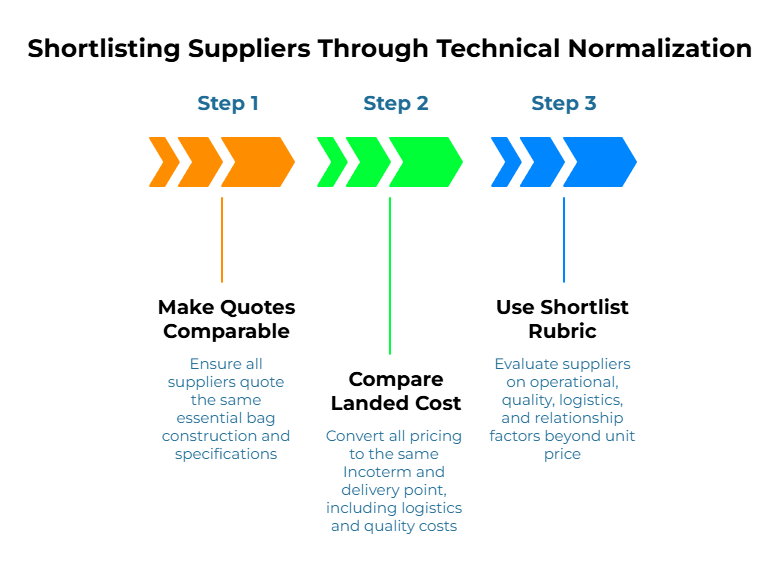
Price matters. But comparing prices before establishing specification comparability generates misleading conclusions.
A supplier quoting $0.12 per bag and a supplier quoting $0.15 per bag may not be offering the same product. Differences in material grade, construction quality, print specifications, or included services (palletization, documentation, delivery terms) can make the “expensive” option actually cheaper on a true cost basis.
Normalize before comparing:
Step 1: Make quotes comparable. Before you compare price, confirm that each supplier is quoting the same essential construction: same bag dimensions and tolerances, same paper grade and strength target, same handle type and reinforcement, same print coverage and ink constraints, same packaging and shipment configuration.
If a supplier proposes an alternative construction, evaluate it deliberately. Don’t let it slip into the comparison unnoticed.
Step 2: Compare landed cost, not unit price. Convert all pricing to the same Incoterm and delivery point. Include logistics costs, import duties, and handling fees where applicable. Factor quality costs: What is the financial impact of the specification differences that remain?
Landed cost includes the downstream effects of inconsistency: rejects and rework, packing slowdowns, damage rates in transit, customer complaints and reshipments, and emergency buys when a supplier misses a delivery window.
The landed cost calculation guide provides detailed methodology for normalizing quotes across different delivery terms.
Step 3: Use a shortlist rubric that rewards repeatability. Once quotes are genuinely comparable, build a shortlist rubric that weights factors beyond unit price:
Operational factors: Lead time reliability, minimum order flexibility, capacity during peak seasons, responsiveness to urgent requests
Quality factors: Specification consistency across orders, defect rates during pilots, testing and documentation rigor
Logistics factors: Shipping lane options, consolidation flexibility, customs documentation quality
Relationship factors: Communication clarity, problem-resolution approach, willingness to collaborate on continuous improvement
Weight these factors based on your operational priorities. A business with highly seasonal demand might weigh capacity flexibility heavily. A brand-conscious retailer might prioritize print quality consistency. A startup managing cash carefully might weigh minimum order flexibility above unit cost.
The trap to avoid: defaulting to the local distributor because it’s “simpler.” Local sourcing has genuine advantages—shorter lead times, easier communication, reduced logistics complexity. But local sourcing without verification creates the same vulnerability as any unvetted supplier relationship. Verify local suppliers with the same rigor you’d apply to international options.
Building Resilience: Backup Sourcing Rules
A backup supplier isn’t a name on a spreadsheet. It’s a tested, pre-qualified source ready to activate when your primary supply fails.
The distinction matters enormously in a crisis. When your primary supplier’s facility floods or their freight forwarder misses a sailing, you don’t have weeks to discover, verify, sample, and qualify an alternative. You need a supplier who has already cleared those gates and can begin production on short notice.
Backup sourcing requires ongoing investment:
Pre-qualification: Backup suppliers must pass the same verification and pilot process as primary suppliers. They’ve demonstrated capability to meet your specifications and operational requirements.
Periodic testing: Place small orders with backup suppliers periodically—quarterly or semi-annually—to maintain the relationship and verify continued capability. Suppliers whose equipment, ownership, or priorities have changed since qualification may no longer be viable backups.
Pre-negotiated terms: Agree on pricing, lead times, and minimum quantities for backup activation before you need them. Negotiating terms during a supply crisis puts you at maximum disadvantage.
Trigger definitions: Specify what circumstances justify backup activation. Primary supplier misses delivery by more than five business days? Activate backup. Quality failure affects more than 2% of a shipment? Partial backup activation. Avoid ambiguity that creates hesitation during time-sensitive decisions.
Practical trigger rules that vary by context:
- Repeated late deliveries without proactive notice
- Repeated quality failures on spec-critical items
- Capacity constraints during peak demand windows
- Material or process changes introduced without approval
Communication protocols: Backup suppliers should know their role. They understand they’re not receiving regular volume but may receive large orders on short notice. This transparency helps them plan capacity and maintain readiness.
The cost of maintaining backup relationships—periodic small orders, relationship management time, slightly higher effective unit costs due to lower volume—is insurance premium. Like all insurance, it feels expensive until you need it. Unlike most insurance, you control whether the coverage is actually available when a crisis arrives.
Supplier-Side Lens: What Legitimate Suppliers Can Provide
Sourcing works best when both sides understand what the other needs.
Legitimate suppliers—whether paper manufacturers producing raw materials or finished paper bag suppliers—who want to win and retain business from serious buyers can accelerate the evaluation process by providing documentation proactively:
Documentation packs: Compile standard information—business registration, quality certifications, equipment lists, product specifications, test certificates—into a ready-to-share format. Buyers asking for this information aren’t being difficult; they’re conducting normal due diligence.
Sample and pilot readiness: Maintain inventory of production samples representing current output quality. Be prepared to fulfill pilot orders promptly, understanding that pilots are evaluation exercises, not guaranteed ongoing business.
Response discipline: Answer inquiries specifically and completely. If a buyer asks about burst factor test methodology, respond with methodology details—not a generic product brochure. Incomplete or evasive responses signal either disorganization or something to hide; neither interpretation helps win business.
Specification clarity: Provide specifications in standard industry terms with defined test methods. “High quality paper” means nothing. “80 GSM kraft, bursting strength 300 kPa minimum per ISO 2758, Cobb value 30 g/m² maximum per ISO 535” means something a buyer can verify and compare.
Transparent capacity: Be honest about production capacity, lead times, and constraints. Overpromising to win an order and then underdelivering destroys relationships. Buyers prefer suppliers who acknowledge limitations upfront and plan accordingly.
This transparency serves suppliers’ interests as well as buyers’. Verification-ready suppliers spend less time responding to repetitive information requests and more time serving qualified customers who understand what they’re buying.
What Strategic Sourcing Looks Like in 30 Days
The transition from spot-buying to strategic sourcing doesn’t require a multi-year transformation program. A focused 30-day sprint establishes the foundation.
Days 1-7: Define the target
Audit current bag usage across your operation. Identify bag families based on use case, size, load requirements, and compliance needs. Document failure patterns—which bags have caused operational problems, and why? Define specification requirements for each family, distinguishing must-have criteria from preferences. Label spec-critical requirements versus preferences to prevent supplier substitutions.
Days 8-14: Build a shortlist pipeline
Build a long list of potential suppliers using multiple discovery channels. Conduct initial outreach requesting basic capability information. Screen responses for responsiveness and relevance, eliminating suppliers who don’t respond, can’t meet basic specification requirements, or raise immediate red flags. Run first-screen filtering using the clarity checks: Can they describe construction details? Can they quote to your spec without substitutions?
Days 15-21: Verify before you trust
Request documentation from suppliers who passed initial screening. Verify business registration, capability claims, and compliance certifications. Conduct video calls with priority candidates to assess communication quality and operational substance. Run identity and capability verification, collecting evidence that supports repeatability and consistency. Reduce your list to suppliers worth pilot testing.
Days 22-28: Pilot, award, and lock in resilience
Request production samples from verified suppliers. Define pilot order quantities and success criteria. Place pilot orders with two to four suppliers for your highest-priority bag family. Run pilots under realistic packing and delivery conditions to test load capacity, bottom integrity, print durability, and workflow fit.
Days 29-30: Governance setup
Document your sourcing framework: specification requirements, verification criteria, pilot evaluation metrics, award allocation principles, review cadence. Award with change control and a pre-qualified backup option. Set a simple quarterly governance cadence to track supplier performance. This documentation transforms individual knowledge into organizational capability that survives personnel changes.
Pilots will take additional weeks to complete. But by day 30, you’ve established the infrastructure: clear requirements, verified suppliers in evaluation, and a repeatable process for ongoing sourcing decisions.
The difference between this approach and spot-buying isn’t complexity. It’s a sequence. You’re doing the same activities—finding suppliers, evaluating capability, placing orders—but in an order that builds knowledge before commitment and maintains options rather than creating dependencies.
That sequence is what transforms sourcing from a recurring crisis into operational infrastructure.
How to Use PaperIndex Without Losing Control
PaperIndex functions as a discovery and connection platform—a starting point for sourcing, not a substitute for your own verification and governance.
The platform connects buyers directly with thousands of suppliers across major manufacturing hubs globally, providing a concentrated source for the discovery phase of your sourcing process. Buyers can browse paper bag suppliers, review supplier profiles, and submit RFQ & receive quotes free to request quotes from multiple suppliers simultaneously.
What PaperIndex provides:
- Access to a global supplier base filtered by product category
- Direct communication channels between buyers and suppliers
- Supplier profiles with basic business information
- RFQ submission and quote collection tools
What PaperIndex does not provide:
- Transaction processing, payment handling, or escrow services
- Brokerage or negotiation on behalf of either party
- Market intelligence, pricing indices, or price recommendations
- Verification or certification of supplier claims
All negotiations, pricing, contracting, and transactions happen directly between you and your suppliers. PaperIndex connects; it doesn’t intermediate or mediate.
This means verification remains your responsibility. A supplier discovered through PaperIndex requires the same verification process as a supplier discovered through any other channel. Platform presence doesn’t substitute for evidence of capability and reliability.
Use PaperIndex strategically: as an efficient discovery tool that expands your potential supplier pool beyond existing networks and local options. Then apply your verification framework to evaluate the opportunities that discovery surfaces.
To begin exploring suppliers, visit the find suppliers portal or browse current paper bags listings. If you want to collect structured supplier responses using a consistent requirement pack, submit your buying requirements and then apply your own stage gates.
Disclaimer: This guide is for educational purposes and outlines common methods used in wholesale paper bag sourcing and supplier verification. Practices and documentation requirements vary by product use case, destination market, and internal quality standards.
Ready to start your sourcing process? Find verified paper bag suppliers on PaperIndex, or browse current paper bag listings to explore available products across global suppliers. For deeper guidance on specific sourcing challenges, the PaperIndex Academy offers additional frameworks and methodologies.
Our Editorial Process:
Our expert team uses AI tools to help organize and structure our initial drafts. Every piece is then extensively rewritten, fact-checked, and enriched with first-hand insights and experiences by expert humans on our Insights Team to ensure accuracy and clarity.
About the PaperIndex Insights Team:
The PaperIndex Insights Team is our dedicated engine for synthesizing complex topics into clear, helpful guides. While our content is thoroughly reviewed for clarity and accuracy, it is for informational purposes and should not replace professional advice.