
📌 Key Takeaways
Supplier verification failures surface during QA release or audits when evidence cannot be produced—not during initial procurement decisions.
- Verification Is a Control System: Supplier safety depends on retrievable evidence of identity, process capability, and traceability controls, not certificates alone.
- Documentation Gaps Cascade Into Compliance Risk: Missing change-control history, vague acceptance criteria, and weak lot traceability create batch holds, audit findings, and emergency sourcing.
- Early Warning Signals Are Detectable: Evasive answers about sub-suppliers, shifting specs between quote and confirmation, and inconsistent legal entity names flag problems before purchase orders are issued.
- Risk-Tiering Prevents Over-Rotation: High-impact packaging lines warrant deeper verification gates; lower-risk items need only baseline checks with lighter ongoing monitoring.
- Platforms Accelerate Shortlisting, Not Qualification: Verified supplier networks reduce discovery time through centralized profiles and trust signals, but buyer-owned qualification remains essential.
Structured onboarding, documented evidence, and continuous monitoring prevent downstream failures before they reach production lines.
Procurement managers and quality professionals in pharmaceutical packaging will gain practical verification workflows here, preparing them for the implementation guide that follows.
A procurement lead signs off on a new packaging supplier to keep a launch on schedule. The quote looks comparable, the certificates look fine, and lead times look workable—until QA asks for a lot of traceability, change-control history, and packaging control evidence. The “cheap and fast” option becomes a release delay and an audit-ready documentation scramble.
The gap between acceptable-looking documents and retrievable evidence creates the problem. A certificate might exist. Test reports might look reasonable. But when quality needs proof—who made the packaging, what changed since last order, how lots are traced—the evidence trail stops. The original Friday afternoon batch release becomes a deviation, an expedited audit, and a weekend of escalation calls.
Treat supplier verification like a control system, not a checkbox. A supplier’s reliability is contingent upon retrievable data: manufacturing origin, change-control logs, and lot-level granularity. When that evidence is missing or inconsistent, the risk shows up downstream—during QA release, an audit, or a deviation investigation—when it is most expensive to fix.
“Unverified Supplier” in Pharmaceutical Packaging?
The term gets used loosely in procurement discussions. Here is a working definition.
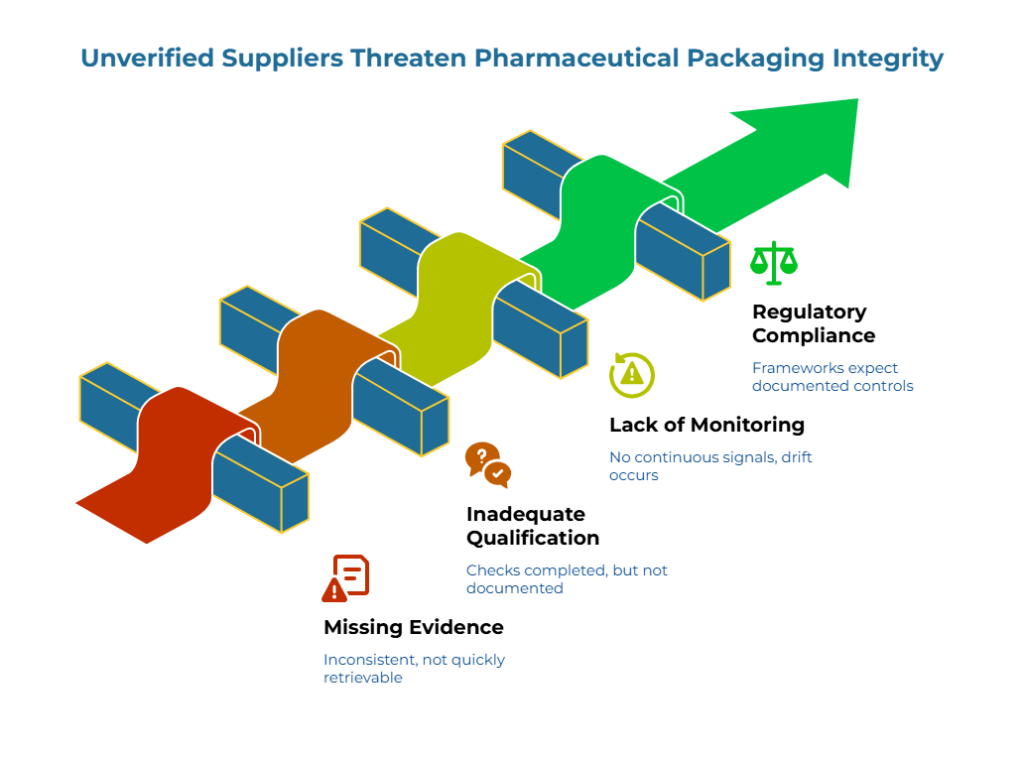
An unverified supplier lacks a validated audit trail—specifically, documented proof of process capability and quality control that survives regulatory scrutiny. They may have a website, a price list, and an ISO certificate. But you cannot produce, on demand, the specific proof that their processes meet your requirements.
A useful progression helps clarify the territory:
- Unverified supplier: Evidence is missing, inconsistent, or not retrievable quickly—common under time pressure when shortcuts seem necessary.
- Qualified supplier: A defined set of checks has been completed and documented, typically covering identity, capability, and initial process review.
- Verified supplier with ongoing monitoring: Qualification plus continuous signals—change-control notifications, periodic re-verification, and performance scorecards that catch drift before it reaches the production line. Verification is continuous, not a one-time event.
Why does this matter for packaging suppliers specifically? Packaging touches labeling, lot traceability, material integrity, and distribution controls. Regulatory frameworks expect documented controls over packaging and labeling materials. The EU Good Distribution Practice guidelines address supplier qualification for distribution integrity. WHO TRS 1025 Annex 7 covers good storage and distribution practices for medical products. FDA 21 CFR Part 211 Subpart G establishes packaging and labeling control requirements.
When a packaging supplier’s evidence is incomplete, the buyer inherits that gap.
The Hidden Risk: How Supplier Uncertainty Becomes Downstream Failure
The most dangerous supplier risk is not the visible failure—a late shipment or a rejected lot. It is the hidden, compounding impact when a supplier’s data, processes, or chain-of-custody cannot be trusted.
Missing evidence creates wrong assumptions. Wrong assumptions create nonconformance. Nonconformance creates delays, rework, or regulatory scrutiny. The original quote never reflected any of this.
The Compliance Risk Radar
| Risk Category | What Goes Wrong | Where It Hits |
| Quality / Release | Variance in materials, unlabeled spec changes, mix-up potential | Batch holds, rework, out-of-spec investigations, incoming failures |
| Compliance / Audit | Missing documentation, weak change control, traceability gaps | Audit findings, CAPAs, regulatory queries, supplier disqualification pressure |
| Operational / Continuity | Single points of failure, late surprises, undisclosed sub-suppliers | Production delays, stockouts, emergency sourcing, firefighting |
| Financial / Reputation | Expedite fees, customer complaints, escalation costs, repeat failure cycles | Margin erosion, damaged relationships, brand exposure, cost blowouts |
This radar maps four categories of downstream impact that never appear in the original supplier quote. A supplier who looks acceptable on price and lead time can still generate significant problems in rework, expedites, and audit remediation.
Early Warning Signs Procurement Teams Can Spot Before Awarding
Most of these failures are detectable—if the right questions get asked before the purchase order goes out. Shift procurement metrics from ‘stated confidence’ to ‘retrievable evidence.’ While ISO certificates indicate baseline intent, they do not substitute for a primary-source evidence package.
Documentation signals worth checking:
Certificates provided without scope details or expiration dates raise questions. Test reports that do not match the material or lot being quoted suggest process gaps. Vague or inconsistent acceptance criteria make future disputes more likely. The absence of change-control history or version-controlled QMS documents indicates weak traceability. Missing revision control, mismatched addresses or legal names, and recycled templates all point to documentation discipline problems.
Process signals worth checking:
Evasive answers about sub-suppliers or material sources deserve follow-up. Lot traceability that stops at an intermediate step leaves gaps. No defined escalation path for deviations or complaints suggests immature quality systems. Specs that shift between quote and confirmation signal internal coordination problems. Test methods omitted from reports, unclear sampling procedures, and “pass/fail” designations without criteria prevent meaningful comparison.
Transparency signals worth checking:
Reluctance to share facility photos, production records, or audit history may indicate something to hide—or simply disorganization. Contact details that cannot be verified against public registries warrant caution. Inconsistent legal entity names across documents create confusion about who is actually responsible.
These are early signals because they show up before a purchase order is issued—when the cost of saying no is still manageable.
The sourcing safety checklist: when to audit vs. when to trust provides a risk-tiering framework that can be applied in under five minutes per supplier.
A Practical Verification Workflow (Before and After Onboarding)

Verification does not have to slow sourcing. It does require structure. The following workflow represents a minimum viable approach that scales with risk.
Before onboarding (pre-qualification):
Start with identity and legitimacy. Confirm the legal entity name against a public business registry. Cross-check contact details. For EU-registered manufacturers, the EMA EudraGMDP database offers public certificate and authorization searches.
Request a documentation package: QMS overview, relevant certifications with scope and validity dates, change-control procedures, and traceability evidence for a recent shipment. Confirm capability: materials, equipment, process controls, and sampling or testing requirements.
Address chain-of-custody transparency. Who else touches the packaging? What controls exist at the sub-supplier or converter level? The relay baton test for chain-of-custody verification offers a practical method for checking documentation continuity.
During onboarding:
Request samples and conduct first-article approval to verify that production output matches quoted specs. Confirm packaging and labeling controls: artwork approval process, label reconciliation, and segregation procedures. Validate that traceability extends from raw material to delivered lot.
Ongoing monitoring:
Establish trigger-based reviews for ownership changes, process or material changes, and quality signals such as complaints, deviations, or audit findings. Schedule periodic re-verification: annual documentation refresh, performance scorecards, and random sample checks. Require suppliers to notify of material changes before shipment. Verification must be continuous to prevent drift after qualification.
Minimum Verification Evidence Pack
| Must-Have | Nice-to-Have |
| Legal registration or business license | Recent audit report (internal or third-party) |
| QMS certificate with scope and validity | Environmental or sustainability certifications |
| Change-control procedure summary | Customer reference list |
| Lot traceability sample (one recent lot) | Equipment and capacity overview |
| Sub-supplier disclosure (if applicable) | Insurance or liability coverage |
Cross-border sourcing requires a phased validation approach, utilizing remote desktop audits and third-party localized inspections where site visits are restricted.
How to Operationalize Verification Without Slowing Sourcing
Teams often skip verification checks under time pressure. The solution is not more paperwork—it is a repeatable control system that makes evidence retrieval normal, even under time pressure.
Two operational moves create fast leverage:
1. Define a minimum verification dataset per supplier, centralized with version control.
Create a standard verification template that travels with every new supplier evaluation. Populate it once during pre-qualification. Update it on a defined schedule and whenever it triggers fire. Centralize documents, track revisions, and make “latest approved” unambiguous. This directly addresses the friction trigger: inconsistent documentation when audit-ready evidence is required.
2. Use risk-tiering to match verification depth to impact level.
Not every supplier needs the same depth of scrutiny. High-impact packaging lines—regulated labeling, cold chain applications, critical secondary packaging—warrant deeper checks and more frequent re-verification. Lower-risk commodity suppliers may need only baseline verification with lighter ongoing monitoring. Risk-tiering prevents over-rotating on low-risk items while ensuring critical suppliers receive appropriate controls.
The From Commodity to Assurance framework offers a useful mental model: treat sourcing as a structured, risk-managed system rather than a transactional commodity purchase.
Where a Verified Supplier Network Can Help (and What It Cannot Replace)
Platforms like PaperIndex can accelerate shortlisting by centralizing supplier profiles, enabling comparable documentation, and providing verification signals that reduce time spent on initial discovery.
PaperIndex’s trust-and-safety approach includes stringent screening, multi-layer verification combining technology checks with manual reviews and cross-referencing against government business registries, and a “Phone Verified” badge.
These signals are helpful inputs. They reduce time spent on initial discovery and help filter out obvious mismatches.
But platforms are not a substitute for buyer-owned qualification. No external verification replaces:
- Internal quality requirements and risk tolerance specific to each organization
- First-article inspection and production validation
- Ongoing monitoring and change-control enforcement
- The relationship-building that makes suppliers responsive when problems arise
Use platforms as a starting point and a signal layer. Own the qualification.
Frequently Asked Questions
How do I make bids comparable?
Force comparability before price discussions: lock specs, define acceptance criteria, require method-identified test reports, and require the same evidence pack for every bidder. This prevents selecting suppliers based on incomplete or non-comparable signals.
How do I prevent spec drift after onboarding?
Use change-control triggers, periodic re-verification, and “evidence refresh” requirements. Drift is often operational—ownership changes, process shifts, material substitutions—not intentional. The monitoring system matters as much as the initial qualification.
From Reactive Firefighting to Proactive Control
Unverified suppliers represent a common and high-impact failure mode in regulated packaging supply chains. The risk rarely shows up in the quote. It surfaces downstream, when evidence is needed and cannot be produced.
The path forward is not more bureaucracy. It is a verification system: structured onboarding, documented evidence, and continuous monitoring that catches drift before it reaches the production line. That Friday afternoon batch hold becomes a preventable scenario rather than an inevitable one.
To implement these controls, organizations should adopt a zero-trust sourcing model and utilize standardized shortlisting protocols to vet partners against specific packaging requirements.
Need supplier options now? Browse suppliers and shortlist partners that match packaging requirements.
Disclaimer:
This article is for general informational purposes and does not constitute legal, regulatory, or quality-system advice.
Our Editorial Process:
Our expert team uses AI tools to help organize and structure our initial drafts. Every piece is then extensively rewritten, fact-checked, and enriched with first-hand insights and experiences by expert humans on our Insights Team to ensure accuracy and clarity.
About the PaperIndex Insights Team:
The PaperIndex Insights Team is our dedicated engine for synthesizing complex topics into clear, helpful guides. While our content is thoroughly reviewed for clarity and accuracy, it is for informational purposes and should not replace professional advice.