

📌 Key Takeaways
Supplier verification should match transaction risk using a three-tier ladder—digital checks, remote validation, or third-party audit—determined by scoring four risk levers in under two minutes.
- Score Risk Before Deciding: Product sensitivity, supplier history, transaction exposure, and enforceability distance combine into objective tier assignment (4-6 points = digital, 7-9 = remote, 10-12 = audit).
- Documentation Protects Organizations: Proof packs capturing identity, capability, quality systems, and claims paperwork demonstrate defensible due diligence when problems emerge later.
- Credible Suppliers Provide Evidence Quickly: Business registration, timestamped facility photos, test reports, and references arrive without friction; resistance signals problems before payment transfers.
- Escalation Triggers Upgrade Tiers: Identity mismatches, inconsistent documentation, deposit pressure before verification completes, or sample-production differences automatically move orders to higher verification levels.
- Normalize Quotes Before Comparing: Incoterms differences create cost variations unrelated to supplier reliability; fair comparison requires normalizing all quotes to the same delivery basis.
Repeatable frameworks transform 7:00 AM urgency decisions into documented, defensible processes.
Procurement leads and operations managers sourcing corrugated packaging will gain an objective classification system here, preparing them for the tier-specific verification protocols that follow.
Stock is running low. The production floor needs corrugated boxes by Thursday. And the inbox holds three quotes from suppliers—two familiar, one brand new with pricing that seems almost too competitive.
Do we have time to verify this new one? What if we skip it and the shipment never arrives?
This tension sits at the center of corrugated packaging procurement. Corrugated packaging functions as the primary physical safeguard for the product; a failure in structural integrity directly impacts brand reliability. For businesses managing packaging paper procurement, this makes supplier verification particularly critical. Yet not every order warrants the same level of scrutiny. A framework for matching verification effort to actual risk transforms reactive decision-making into a repeatable, defensible process.
Sourcing safety is a risk-based approach to deciding how much supplier verification is required before committing to an order. When applied consistently, this approach enables procurement leads, operations managers, and quality teams to classify any transaction into the right verification tier in under two minutes, explain that classification to internal stakeholders without opinion-driven conflict, and maintain a documented proof pack that protects the organization if problems emerge later.
The Three-Tier Verification Ladder
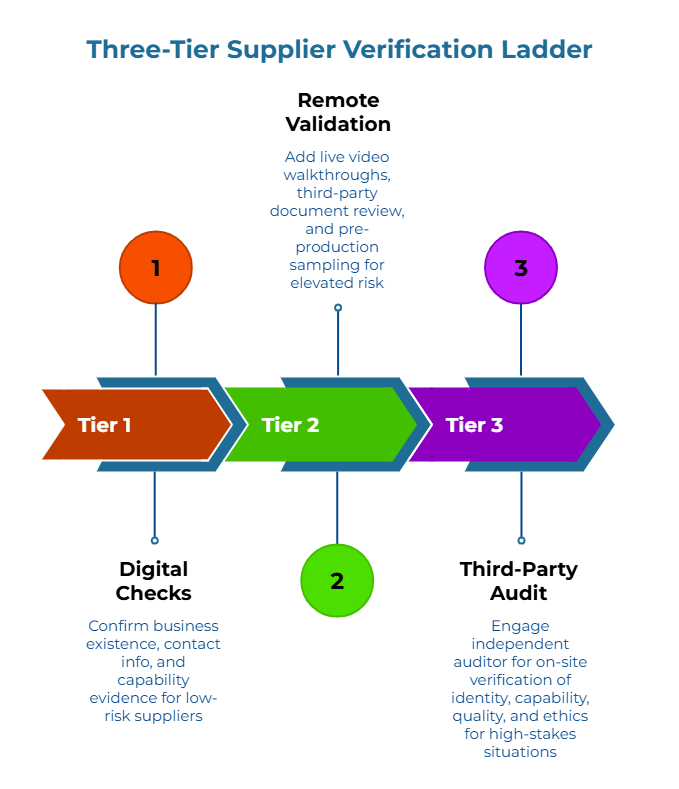
Not every order requires a factory audit. Treating all suppliers as potential risks wastes budget on unnecessary inspections while straining relationships with credible partners who readily provide documentation.
Supplier verification operates as a ladder with three rungs:
Tier 1 – Proceed with Digital Checks: Confirm business existence, validate contact information, request capability evidence. Sufficient for low-risk transactions with proven or low-exposure suppliers.
Tier 2 – Add Remote Validation: Layer in live video walkthroughs, third-party document review, and pre-production sampling. Appropriate when risk factors elevate but don’t warrant physical inspection.
Tier 3 – Commission Third-Party Audit: Engage an independent auditor for on-site verification of identity, capability, quality systems, and ethical practices. Reserved for high-stakes situations where documentation alone cannot establish adequate confidence.
The following matrix maps orders to their respective tiers based on cumulative risk scores.
Scope note: This framework provides global, principle-based guidance for supplier verification across markets. Specific verification requirements vary based on food-contact applications, regulated end-use, and customer-mandated standards. Always confirm verification depth against contract specifications and applicable industry requirements for your specific situation.
Why Binary Thinking Creates Problems
A common misconception holds that a factory audit is always the safest choice. This framing creates two failure modes that drain resources and delay decisions.
Over-verification occurs when teams commission audits for routine reorders from established suppliers. The audit firm bills for services; meanwhile, production waits for paperwork that adds little actionable insight about a partner with a proven track record across dozens of successful shipments.
Under-verification happens when teams interpret the absence of an audit as permission to proceed without any checks. The reasoning goes: we can’t afford a full inspection, so we’ll just trust the quote. Then containers arrive late, specifications don’t match samples, or—in more serious cases—the supplier turns out to be a trading company without actual manufacturing capability.
Both failures stem from inconsistent criteria. Without a shared decision framework, procurement might approve a supplier that quality assurance would reject. An owner might override both based on delivery urgency. Each decision becomes a negotiation rather than a process, and the organization accumulates risk without documentation.
Another misconception worth addressing: a polished website does not prove a supplier is real. Professional web design costs relatively little. Business registration verification, machinery photos with timestamps, and references from customers in similar industries provide more reliable signals than marketing materials.
Four Risk Levers That Determine Verification Level
Before assigning a verification tier, the risk profile needs assessment. Four factors drive that assessment:
Product Risk evaluates what happens if packaging fails. Food-contact applications, fragile contents, and performance-critical specifications—where the packaging is critical to the delivery state—raise stakes considerably. A shipper for durable goods carries different risks than packaging that must maintain structural integrity through humid warehouse conditions or rough handling.
Supplier Risk evaluates relationship history. A vendor vetting protocol treats a supplier with five years and fifty successful orders differently than one discovered through an online search last week. New relationships and unknown track records elevate risk regardless of how competitive the quoted price appears.
Transaction Risk evaluates financial and operational exposure. Order value matters, but payment terms and timing concentrate or distribute that exposure. A $50,000 order requiring 100% advance payment on a rush timeline creates different risk than a $5,000 order with Net-30 terms and flexible delivery windows.
Distance and Enforceability evaluates problem-resolution difficulty. Domestic suppliers operate under familiar legal frameworks and logistics networks. Cross-border transactions introduce language barriers, time zone challenges, and jurisdictions where contractual leverage diminishes significantly once payment clears.
Risk Assessment and Classification Matrix
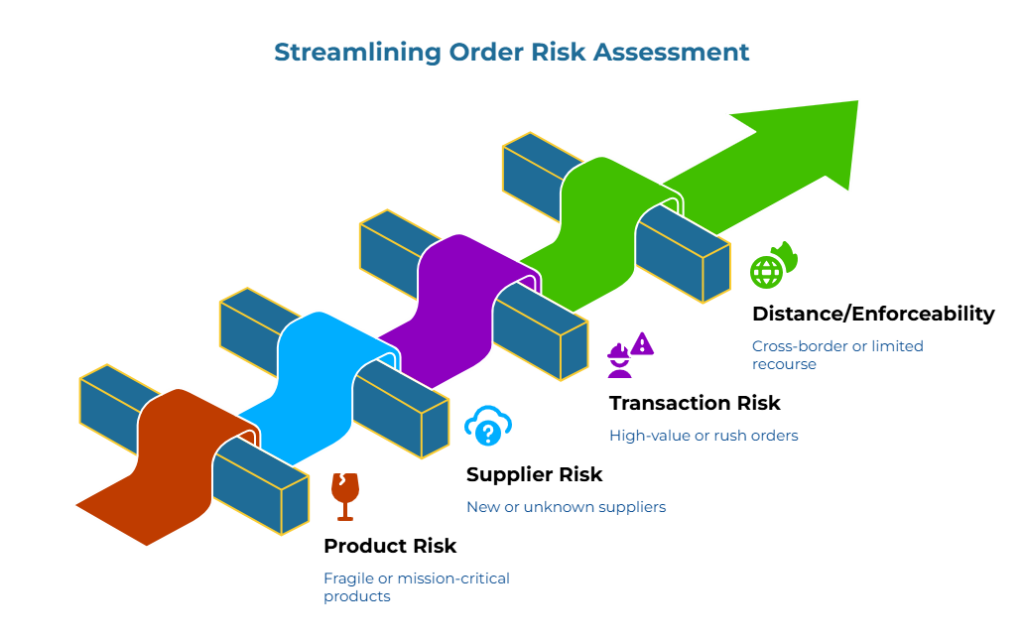
This matrix enables classification of any order in under two minutes. Score each lever as Low (1), Medium (2), or High (3), then sum the total.
| Risk Lever | Low (1) | Medium (2) | High (3) |
| Product Risk | Standard specs, non-food, durable contents | Some performance requirements | Food-contact, fragile, mission-critical |
| Supplier Risk | Proven partner (5+ successful orders) | Known supplier (1-4 orders) | New or unknown supplier |
| Transaction Risk | Under $5,000 USD, Net-30 terms | $5,000-$25,000 USD, partial advance | Over $25,000 USD, full advance, rush |
| Distance/Enforceability | Domestic, familiar legal system | Regional, enforceable contracts | Cross-border, limited recourse |
Score interpretation:
| Total Score | Verification Tier | Default Action |
| 4-6 | Tier 1 | Proceed with digital verification |
| 7-9 | Tier 2 | Add remote validation and sampling |
| 10-12 | Tier 3 | Commission third-party audit |
Approval authority by tier:
| Tier | Sign-Off Required |
| 1 | Procurement lead |
| 2 | Procurement lead + QA/Compliance lead |
| 3 | Procurement lead + QA + Finance or Owner/GM |
When someone asks why an audit was commissioned—or why one wasn’t—the documented score provides the answer. This consistency matters especially when the lowest quote comes from an unknown supplier and the temptation exists to skip verification because the savings look attractive. That temptation represents another misconception: the lowest quote is rarely a smart savings move if it arrives without the documentation needed to establish baseline confidence.
Digital Verification Checklist (Tier 1)
For orders scoring 4-6 points, digital verification provides sufficient due diligence. Credible suppliers can furnish everything on this list quickly—resistance or evasion at this stage itself constitutes a red flag.
Business Existence Verification: Cross-reference company registration against government business registries. Government registries (such as the Ministry of Corporate Affairs in India, Companies House in the UK, or International Trade Administration resources in the US) and the Global Legal Entity Identifier (LEI) index provide primary validation data. Confirm that the legal entity on the quote matches registry records, check registered address and active status, and verify domain registration aligns with claimed company history.
Contact Validation: Confirm phone numbers connect to the actual business rather than a personal mobile forwarded to a remote “sales team.” Verify email domains match the company name and website. Check that physical addresses exist and appear appropriate for claimed manufacturing or trading operations.
Capability Evidence: Request dated photos or video of machinery and production lines. Ask for equipment lists with specifications. Review sample proofs or images of similar completed orders. This documentation helps answer the question: Will these boxes hold up?
Compliance Documentation (when applicable): For sustainability claims, verify chain-of-custody documentation by checking FSC or PEFC certificate codes against public registries. FSC maintains a chain-of-custody database, while PEFC provides certification verification resources. Request test reports from accredited laboratories for performance claims.
Quality and Test Evidence: Verify that quality checkpoints and acceptance criteria exist. When performance specifications matter, request test reports referencing recognized methods. Common corrugated performance tests include edge crush test (ECT) methods such as ISO 3037 (non-waxed edge method) and TAPPI T 811 (waxed edge), though TAPPI T 839 (clamp method) is frequently preferred for routine production quality control due to its speed and non-destructive preparation requirements. Suppliers with ISO 9001 quality management systems demonstrate documented process control, though certification alone doesn’t guarantee performance—it signals that systematic quality practices exist.
Reference and Trial: Request two or three customer references in similar industries. When feasible, place a small pilot order—one or two pallets before committing to container volumes—to validate actual performance against quoted specifications.
What Should Trigger Escalation
Certain signals should automatically move an order from Tier 1 into Tier 2:
- Identity mismatches persist: Entity names, addresses, or contact details remain inconsistent across quote, website, and business registry
- Evidence arrives as promises without documents: Capability claims lack timestamped photos, test reports lack method identification, or certificates cannot be verified through issuing body databases
- Deposit pressure appears before proof gates clear: Supplier requests significant advance payment before providing basic verification documentation
- Claims paperwork shows gaps: For orders requiring FSC/PEFC or other certification claims, documentation lacks proper claim language or shows inconsistencies that indicate common chain-of-custody failure modes
These triggers exist not to catch suppliers in deception, but to surface problems before funds transfer and leverage disappears.
Remote Validation Options (Tier 2)
For orders scoring 7-9 points, layer these validation steps before committing:
Live Video Walkthrough: Schedule a video call during operating hours and request a tour of production areas, raw material storage, and quality control stations. Observe whether the tour reveals operational familiarity or scripted deflection. This step addresses a core question in the decision ladder: Is this supplier real, and can they actually produce what they’re quoting?
Third-Party Documentation Review: Request recent test reports from accredited laboratories. Verify certification validity through issuing body registries rather than relying on certificate copies alone. Confirm that certification scope covers the specific product being ordered—a common failure point in compliance documentation.
Sampling Plan: Establish pre-production sample approval before authorizing full production. Define first-article inspection requirements with documented sign-off criteria. Specify rejection and rework procedures in writing before production begins.
Escalation Triggers (Move to Tier 3)
| Red Flag | Why It Matters | Default Upgrade |
| Supplier refuses walkthrough or avoids relevant process steps | Identity and capability cannot be validated remotely | Move to Tier 3 |
| Documentation stays inconsistent (names, addresses, scope) | Dispute and fraud risk rises; remediation becomes difficult | Move to Tier 3 |
| Samples and production output differ materially | Process control risk indicates inability to hold specifications | Tier 2 → Tier 3 if repeated |
| Deposit pressure before proof gates | Transaction exposure concentrates without adequate verification | Tier 2 or Tier 3 based on exposure amount |
| Claims paperwork language incorrect or changes late | Traceability risk threatens compliance requirements | Tier 2 with strict controls; Tier 3 if unresolved |
| Inconsistencies between documentation and video walkthrough | Suggests capability claims may be overstated or misrepresented | Move to Tier 3 |
When Third-Party Audit Is Worth the Investment (Tier 3)
For orders scoring 10-12 points—or any order where escalation triggers activate—engage an independent auditor before commitment.
Scenarios warranting full audit:
If a new supplier quotes on a high-value or mission-critical supply relationship, the combination of unknown track record and significant exposure justifies inspection investment. High compliance exposure—food-contact packaging, regulated end-use applications, or customer audit requirements flowing down the supply chain—similarly warrants on-site verification.
Repeated documentation inconsistencies or red flags across multiple verification attempts indicate that remote methods have reached their limits. When a supplier resists reasonable transparency requests without clear explanation, the resistance itself suggests that independent verification would reveal something the supplier prefers to conceal.
What an audit should answer:
An effective audit addresses four practical questions:
- Identity and control: Does the named entity actually operate the facility and control the production process?
- Capability: Do equipment and processes match the required box style, specifications, and claimed capacity?
- Quality system basics: Are inspection points, calibration discipline, and corrective action procedures documented and followed?
- Traceability: Can documentation remain aligned from quote through invoice, especially for certification claims requiring chain-of-custody continuity?
Selecting an auditor:
Prefer firms with specific experience in packaging, paper, or converting industries. Verify auditor credentials and professional liability coverage. Request sample reports to evaluate depth and format before engagement. Ensure the audit scope addresses specific concerns—a generic checklist may miss industry-specific risk factors.
An audit isn’t a guarantee of future performance. It’s documented due diligence demonstrating that reasonable verification steps occurred before commitment.
Making the Checklist Repeatable
Consider a procurement lead facing a 7:00 AM decision. Stock is critically low. The operations manager needs confirmation by noon. The owner wants to know why the new supplier’s quote wasn’t accepted last week. And the QA lead hasn’t seen any documentation yet.
Without a shared framework, this moment becomes a negotiation—potentially a contentious one—rather than a process execution. The decision matrix transforms that dynamic.
Set default thresholds:
Establish organizational standards: orders under $5,000 USD from suppliers with proven track records auto-approve at Tier 1; orders over $25,000 USD from new suppliers require minimum Tier 2 review; any order involving food-contact applications or customer audit flow-down triggers Tier 3 evaluation regardless of other factors.
Document exceptions:
Urgency doesn’t eliminate verification—it changes who approves the exception. Every deviation from default thresholds requires sign-off from one level above the standard approver, with documented rationale.
Build a proof pack system:
Define what evidence to collect at each tier. Establish where that evidence lives—shared drive, supplier management system, procurement folder structure. Organize files by supplier rather than by order so that verification history accumulates and subsequent orders benefit from prior documentation.
| Proof Pack Category | Tier 1: Must Have | Tier 2: Add | Tier 3: Add |
| Identity & contacts | Entity details, address, domain email, accountable contacts | Cross-checks and confirmation calls | Auditor-verified identity and facility confirmation |
| Capability | Photos/video, machinery list, spec-adjacent examples | Live walkthrough notes + process Q&A | Auditor-validated capability and capacity |
| Quality & testing | Acceptance criteria + basic QC checkpoints | Test evidence + sampling gates | Audit review of QC system and calibration |
| Claims & paperwork (if applicable) | Correct claim language and continuity | Third-party doc review; invoice proofs | Full traceability review and corrective actions |
| Transaction controls | Staged approvals tied to acceptance gates | Tighter gates tied to payments | Deposit release tied to audit findings |
A shared folder structure keeps this operational: Identity, Capability, Quality, Claims, and Transaction. The goal is simple—proof does not disappear when staff changes.
Normalize quotes before comparing risk:
Verify that quotes use comparable terms before deciding whether a supplier appears “risky” or “cheap.” Differences in shipping responsibility, insurance coverage, and duty payment create cost variations that have nothing to do with supplier reliability. Incoterms® 2020 provides the international standard for defining obligations in sales contracts. The practical workflow for comparing quotes across Incoterms enables fair comparison by normalizing all offers to the same delivery basis before risk assessment begins.
Integrate verification into quote requests:
Include verification requirements in initial RFQ communications. State what documentation will be required before order confirmation. Make expectations clear before quotes return so that responsive suppliers can prepare and non-responsive suppliers self-select out of the process.
Next Steps
Verification isn’t about distrust. It’s about matching due diligence to actual transaction risk—protecting brand promise and professional competence without creating bureaucratic friction that delays legitimate business.
The ladder provides the structure: digital verification for lower-risk orders, remote validation when risk factors elevate, third-party audit when stakes or red flags demand independent confirmation. The matrix provides the scoring mechanism. The proof pack provides documentation that demonstrates reasonable process execution.
If the supplier base needs expansion, browse corrugated packaging suppliers matching specific requirements. When ready to move forward, submit a request for quotation with clear specifications and verification expectations stated upfront.
Standardizing these evaluations replaces subjective pressure with a documented, tiered rationale that secures organizational alignment.
Disclaimer: This article provides educational guidance on supplier verification principles applicable across markets. Specific verification requirements vary based on industry, jurisdiction, regulatory environment, and customer requirements.
Our Editorial Process:
Our expert team uses AI tools to help organize and structure our initial drafts. Every piece is then extensively rewritten, fact-checked, and enriched with first-hand insights and experiences by expert humans on our Insights Team to ensure accuracy and clarity.
About the PaperIndex Insights Team:
The PaperIndex Insights Team is our dedicated engine for synthesizing complex topics into clear, helpful guides. While our content is thoroughly reviewed for clarity and accuracy, it is for informational purposes and should not replace professional advice.