
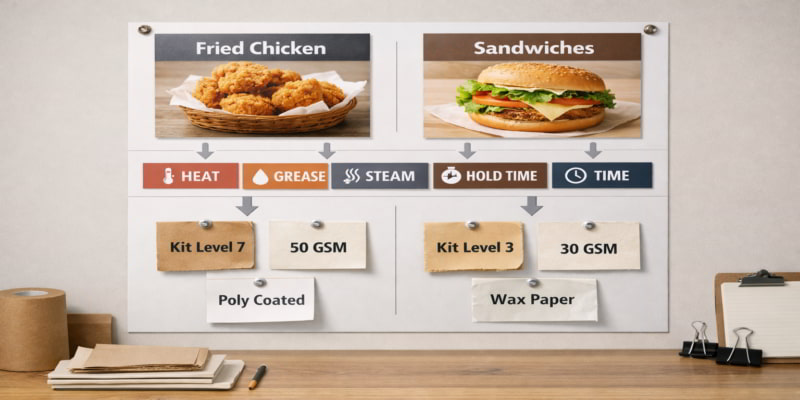
📌 Key Takeaways
Fried chicken and sandwiches fail packaging for opposite reasons—matching the wrapper to the menu stops surprises during service.
- Different Foods, Different Failures: Fried chicken leaks grease and loses crispness; sandwiches get soggy from trapped steam—one wrapper can’t fix both problems.
- Test Four Things First: Check heat level, grease load, steam release, and hold time before ordering any paper to find the right spec.
- Grease Resistance Isn’t Everything: A higher Kit Level blocks oil but may trap steam—fried food stays crisp only when moisture can escape.
- Steam Wrecks Sandwiches More Than Grease: Hot sandwiches often fail because steam softens bread, not because the wrapper lacks oil protection.
- Verify Before Buying in Bulk: Request a technical data sheet, confirm the test method used, and run a quick kitchen trial with real food before scaling any order.
Right wrapper + right menu item = no more soggy bread or greasy fingers.
Food service operators and food packaging paper buyers sourcing wrappers for mixed menus will gain a clear decision framework here, preparing them for the detailed spec table and verification steps that follow.
~ ~ ~ ~ ~ ~ ~ ~ ~ ~ ~ ~ ~ ~ ~ ~ ~ ~
Food packaging paper failure in high-volume food service is rarely a matter of poor quality; it is a matter of misaligned specifications.. The wrapper looked fine on the shelf, but under real kitchen conditions it fell apart. Customers notice. Staff scramble for napkins. And the same question surfaces: why does our paper work for some items and fail on others?
This performance gap stems from fundamental material science: the physical demands of grease and moisture management are often mutually exclusive. One wrapper specification cannot do two different jobs well. Fried chicken and sandwiches stress packaging in completely different ways, and treating them the same leads to visible failures during service.
Menu-specific specification mapping is the habit of translating what is on the plate—heat, grease, steam, and hold time—into a clear paper specification (GSM, coating type, and Kit Level) before ordering. Just as PPE is task-specific, fried chicken requires a breathable oleophobic barrier, whereas sandwiches demand moisture-vapor regulation. When the wrapper matches the menu, packaging stops being a surprise problem during service.
The Two-Wrapper Problem: Why One Specification Fails Fried Chicken and Sandwiches
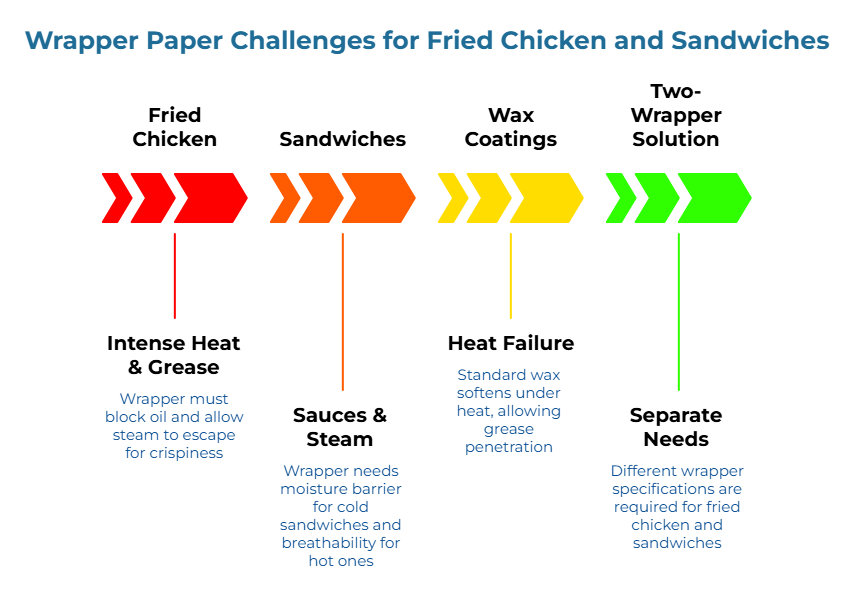
Fried chicken and sandwiches attack wrapper paper in opposite ways.
Fried chicken brings intense heat and heavy grease. The wrapper must block oil penetration without trapping steam—otherwise the crispy coating turns soft. This requires high grease resistance (measured by Kit Level) combined with enough breathability to let moisture escape.
Sandwiches present a different challenge entirely. Sauces, condiments, and steam from hot fillings are often the real culprits—not grease. A cold deli sandwich with mayo needs a moisture barrier to prevent sauce migration. A hot pressed sandwich releases steam that turns bread to mush if the wrapper traps it.
Grease resistance and moisture management are separate jobs. A paper that excels at one may fail at the other. Standard wax coatings soften under high heat, allowing hot oil to penetrate and ruin the customer experience. That is why a single “all-purpose” wrap rarely works across both categories.
A 60-Second Menu Test: Heat, Grease, Steam, and Hold Time
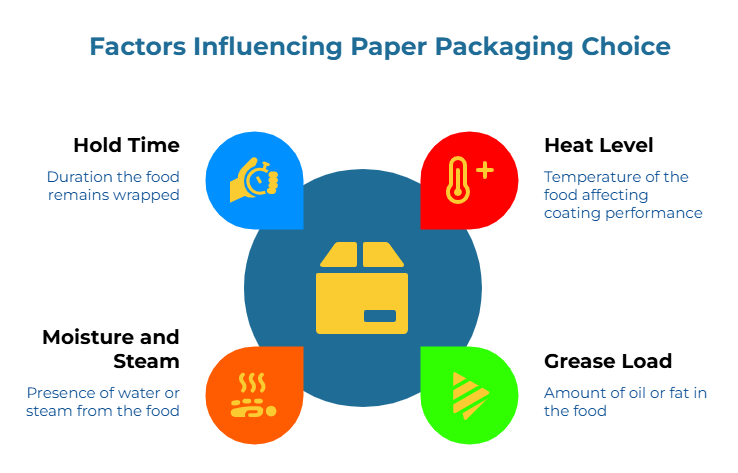
Before contacting any supplier, run your menu items through four variables.
Heat level. Is the food served hot off the fryer (above 70°C) or at room temperature? High heat softens wax coatings and accelerates grease penetration. Hotter items need coatings that maintain performance under thermal stress.
Grease load. How much oil or fat is present? Deep-fried items carry heavy grease loads that demand higher Kit Levels. A dry bagel needs almost none.
Moisture and steam. Does the item release steam or contain wet ingredients? Steam management determines whether you need a breathable structure or a barrier. Sometimes both—in different zones of the wrapper.
Hold time. How long does the item sit wrapped before the customer opens it? Longer hold times amplify every failure mode. A wrapper that survives 3 minutes may leak or soften after 12.
Each variable shifts which coating type, GSM range, and Kit Level makes sense. Use the table below to map common scenarios to starting specifications. These are starting ranges only—exact performance depends on the full structure (paper plus coating), converting quality, sealing technique, and actual menu conditions. Always validate with samples before scaling any order.
Standard Specification Reference: Fried Chicken vs. Sandwiches
| Menu Scenario | Heat | Grease | Moisture/Steam | Paper/Coating Type | Kit Level Range | GSM Range | Validate Like This |
| Fried chicken (eat-now) | High | High | Medium | Grease-resistant paper with breathability | Kit 6–9 | 35–50 g/m² | Wrap 2 pieces, hold 10 min; check stain + crust feel |
| Fried chicken (delivery/held) | High | High | Intense | Higher grease holdout; manage steam with venting or handling | Kit 8–12 | 40–60 g/m² | Hold 20 min; check bag stain + “soft crust” feedback |
| Fried chicken (sauced/glazed) | High | High | High | Grease holdout + added moisture control (watch steam trapping) | Kit 8–12 | 45–65 g/m² | Sauce contact test; inspect folds and seam points |
| Cold sandwich (dry fillings) | Low | Low | Medium | Uncoated or light barrier paper | N/A | 30–45 g/m² | Hold 15 min; check wet-out near cut edge |
| Cold sandwich (saucy) | Low | Low | High | Moisture-first barrier paper | N/A | 35–55 g/m² | Hold 15–20 min; look for wicking and edge bleed-through |
| Hot/steamy sandwich (pressed/grilled) | Medium-high | Light-medium | High | Steam-aware wrap: avoid over-sealing; consider breathability | Kit 4–7 | 35–55 g/m² | Hold 10 min; check condensation + bread softness |
| Hot sandwich (fatty + sauced) | High | High | High | Balance grease holdout + steam control | Kit 6–9 | 40–60 g/m² | Hold 10–15 min; check both oil stain and texture |
Fried Chicken: Choosing High Grease Resistance Without Making Food Soggy
Fried chicken wrappers need grease holdout—the paper’s ability to prevent hot oil from soaking through. The Kit Level scale runs from 1 to 12, with higher numbers indicating stronger resistance per the TAPPI T 559 test method. For deep-fried items, a Kit Level in the 6–9 range provides a reasonable starting point for eat-now service, while delivery or held items may need Kit 8–12.
But grease resistance alone is not enough. If the paper traps steam, the chicken’s crispy skin softens within minutes. Look for greaseproof structures that allow vapor transmission rather than full poly-coated barriers that seal everything inside.
A common mistake is reaching for wax paper when you need a robust grease barrier. Wax coatings soften or melt under high heat, allowing grease to penetrate. Authentic greaseproof paper achieves its barrier through extensive mechanical refining of the pulp to create a naturally dense, pore-free web, whereas modern grease-resistant papers utilize specialized, heat-stable chemical treatments or advanced barrier coatings to maintain performance even when hot. The difference between wax, poly, and true grease-barrier technologies determines whether your wrapper survives contact with a 75°C piece of fried chicken
For a fast screening check before full kitchen trials, an informal operational grease spot test—typically involving wrapping the hot menu item and monitoring it for 15 to 30 minutes—can help quickly identify papers that obviously underperform on grease holdout.
Sandwiches: When to Use Barrier Paper and When Breathability Matters
Sandwiches split into two camps.
Cold sandwiches with sauces and wet ingredients need a moisture barrier to stop liquids from migrating through the paper. Poly-coated sheets or wax-laminate wraps handle this well. Grease resistance matters less because there is minimal fat—the priority is preventing sauce bleed-through onto customer hands.
Hot sandwiches are trickier. A fresh panini releases steam for several minutes after pressing. If the wrapper creates a sealed pocket, that steam condenses on the bread and destroys the texture. For these items, choose a breathable structure that lets vapor escape while still managing light grease from melted cheese.
Here is what most operators miss: sandwich wrappers often fail because of steam management, not because the paper lacks grease resistance. Diagnosing the actual failure mode—moisture versus grease—prevents ordering the wrong fix.
Technical Validation & Compliance Protocol
Before committing to a bulk order, confirm four things.
Request a technical data sheet. The technical data sheet (TDS) lists exact GSM, Kit Level (if tested), coating type, and food-contact certifications. If a supplier cannot provide one, look elsewhere.
Ask which grease resistance test they use. The industry standard is TAPPI T 559, commonly called the Kit test. Confirm the reported Kit Level comes from a recognized test method rather than an internal estimate.
Verify food-contact documentation. For US markets, paper contacting fatty foods should comply with 21 CFR 176.170. For EU markets, Regulation (EC) No 1935/2004 sets the framework—the European Commission food contact materials overview provides helpful context on EU requirements. Third-party testing certificates from bodies like ISEGA add verification. Ask for lot traceability so you can link any future issue to a specific production batch.
Run a quick in-kitchen trial. Conduct a simulated service-window test on samples using your actual menu items. Hold the wrapped food for your typical delivery or holding duration and check for leaks, sogginess, or texture loss before scaling the order.
Critical Failure Modes & Mitigation
The wax-paper trap. Ordering “wax paper” when you need true greaseproof leads to melted coatings and oil penetration under heat. Fix: specify “greaseproof” or “grease-resistant” and confirm Kit Level on the TDS.
The steam blind spot. Blaming the supplier for bad paper when the real problem is trapped steam making bread soggy. Fix: test for steam retention separately from grease resistance. If condensation appears, switch to a more breathable structure.
The “higher GSM fixes everything” myth. A heavier paper adds stiffness and tear resistance, but it does not automatically improve grease holdout. A 60 g/m² sheet with a low Kit Level still leaks oil. Fix: match Kit Level to grease load first, then choose GSM for handling and durability.
Frequently Asked Questions
What Kit Level is a typical starting point for fried chicken?
For deep-fried bone-in chicken served immediately, start in the Kit 6–9 range. Delivery or held items with longer wait times often need Kit 8–12. Tenders and strips with lighter grease loads can work with Kit 6–8. The more useful question is not “what number is correct” but “does this paper hold up at 10–20 minutes without staining through?” A supplier TDS plus a short kitchen trial usually settles it quickly.
Do sandwiches need a Kit Level, a moisture barrier, or both?
It depends on the sandwich. Cold sandwiches with sauces need a moisture barrier more than grease resistance. Hot sandwiches may need moderate grease holdout plus breathability to release steam. Map each item to its dominant stress—moisture, grease, or steam—and specify accordingly.
Can one paper work for both fried chicken and sandwiches?
Rarely without compromise. Fried chicken needs high grease resistance and breathability; many sandwiches need moisture barriers that reduce breathability. Operators who force a single specification across both categories usually see failures in one or the other. Two or three house specifications tailored to menu categories prevent most visible problems. Small sample trials help confirm whether one specification is acceptable across both categories in a specific workflow.
What documents prove food-contact safety?
In the US, compliance with FDA regulations—particularly 21 CFR 176.170 for paper contacting fatty foods—is standard. In the EU, Regulation (EC) No 1935/2004 sets the framework. Third-party testing certificates from recognized bodies add independent verification that the paper meets claimed specifications. Look for documentation that matches the target market and intended conditions of use, plus traceability that links paperwork to the batches shipped.
Aligning substrate properties with specific food chemistry eliminates service-level failures and optimizes the customer experience.
Disclaimer:
This article is for educational purposes only and does not constitute legal or professional advice. Verify all specifications and compliance requirements with qualified professionals before making purchasing decisions.
Our Editorial Process:
Our expert team uses AI tools to help organize and structure our initial drafts. Every piece is then extensively rewritten, fact-checked, and enriched with first-hand insights and experiences by expert humans on our Insights Team to ensure accuracy and clarity.
About the PaperIndex Insights Team:
The PaperIndex Insights Team is our dedicated engine for synthesizing complex topics into clear, helpful guides. While our content is thoroughly reviewed for clarity and accuracy, it is for informational purposes and should not replace professional advice.