
📌 Key Takeaways
A certificate on file doesn’t equal compliance—only verified scope, test evidence, and lot traceability prove your packaging is safe.
- Scope Beats Authenticity: Most imports fail not because certificates are fake, but because they cover a different plant, grade, or use condition than what’s actually shipping.
- Test Reports Are the Real Proof: Certificates summarize conclusions; the lab report shows if testing conditions match how you’ll actually use the packaging.
- Define Your Claim First: Write out exactly what “compliant” means for your situation before reviewing any documents—this prevents collecting useless paperwork.
- Connect Tests to Shipments: A traceability chain linking lab samples to lot numbers to shipping documents is what survives audits—scattered PDFs don’t.
- Verify Issuers in Minutes: Check certification bodies through IAF CertSearch and labs through ILAC directories before trusting any document.
Verified = protected.
Assumed = exposed.
Procurement managers and compliance teams sourcing international food-contact packaging will gain a ready-to-use verification workflow here, preparing them for the detailed checklist that follows.
~ ~ ~ ~ ~ ~ ~ ~ ~ ~ ~ ~ ~ ~ ~ ~ ~ ~
The compliance pack arrives at 7:00 AM: a glossy ISO certificate, a “food contact safe” letter, and a lab report in a format the team hasn’t seen before. The order is already on the water, and the next email is the one no procurement team wants—customs is asking for proof that the exact food packaging paper in the shipment is suitable for its intended food-contact use. The certificates in hand don’t answer those questions. A decision must be made fast.
Certificates arrive as PDFs in unfamiliar formats, with unclear scope, questionable expiry dates, and issuing bodies nobody has heard of. Language barriers complicate interpretation. Third-party agents relay incomplete information across time zones. And the instinct—accepting a certificate at face value without checking scope, issuing-body status, or lot linkage—creates exactly the vulnerability that customs officers and auditors exploit.
When food packaging paper is sourced internationally, “having a certificate” is not the same as “being compliant.” A defensible verification process checks four things: the issuer is real and accredited, the certificate is current and authentic, the scope matches the exact grade, site, and intended food-contact use, and there is supporting test evidence and lot traceability for the shipment. This article turns those checks into a practical workflow and a one-page checklist your team can reuse for every new supplier and every new import lane.
Certificate ≠ Compliance.
Verification = issuer + scope + test evidence + traceability.
Why International Certificates Break at the Border (and in Audits)
While suppliers easily provide official-looking PDFs, “document presence” does not constitute an “evidence stack.
Certificates fail verification for predictable reasons. The document expired months ago. The scope covers a different paper grade or a sister plant in another city. The manufacturing site on the certificate doesn’t match the site on the purchase order. In some cases, the PDF itself has been edited—fonts mismatched, seals cropped, dates altered.
Most “certified” imports fail in practice because the scope doesn’t match the actual product, site, or use conditions—not because a certificate is missing entirely. A supplier may hold a valid certification for a specific grade at one facility, yet paper manufacturers sometimes fulfill orders using coated boards from an unverified sister plant.
The consequences compound quickly. Goods held at customs mean expedited freight costs to meet deadlines. A failed third-party audit means explaining the gap to your customer within 24-48 hours. A food-safety incident traced to food packaging paper triggers recalls, legal exposure, and reputational damage that doesn’t fade quickly.
The primary risk lies in prioritizing the existence of a certificate over its technical applicability—specifically, migration limits and use conditions.
What Counts as a “Safety Certification” for Food Packaging Paper (and What It Doesn’t Prove)
Before verifying authenticity, you need to understand what each document type actually demonstrates. Not all certificates prove the same thing—and three common misconceptions cause most verification failures.
Misconception 1: Any ISO certificate proves the product is food-safe. False. ISO 9001 or ISO 22000 certificates prove management-system controls, not product food-contact safety. A supplier can have excellent quality management processes and still ship packaging paper that fails migration testing for your specific food type and temperature conditions.
Misconception 2: A test certificate is valid for all grades and all plants. False. Certificates are scope-specific. A test report for uncoated kraft paper at Plant A doesn’t cover PE-coated kraft paper from Plant B.
Misconception 3: A certificate PDF is enough without the underlying test report. False. Certificates summarize conclusions. Test reports contain the actual evidence—methods, simulants, conditions, results. Without the test report, you cannot verify that testing conditions match your intended use.
Document Types, What They Prove, and Verification Methods
| Document Type | What It Proves | What It Does NOT Prove | How to Verify |
| ISO 9001/22000 Certificate | Company has quality/food-safety management system | That a specific food packaging grade is compliant for food contact | IAF CertSearch for certification body accreditation |
| Product Certification (ISO/IEC 17065) | Specific product was tested and certified | Universal suitability for all foods, temps, or uses | Confirm scope statement matches your exact order |
| Lab Test Report (ISO/IEC 17025) | Testing performed by accredited lab under stated conditions | That every future batch is identical, or that all use conditions are covered | ILAC Signatory Search for lab accreditation |
| Declaration of Compliance (DoC) | Supplier declares product meets specific regulations | That the statement is accurate without evidence | Cross-check against cited regulation and supporting test evidence |
| COA + Lot Sheet | Specific production lot was tested/inspected | Food-contact compliance by itself | Match lot numbers to shipping documents |
For food-contact paper and paperboard entering the U.S. market, the relevant regulatory framework is 21 CFR Part 176, which covers paper and paperboard components. For the EU market, Regulation (EC) No 1935/2004 establishes the general safety framework. However, unlike plastics, paper is not yet subject to a harmonized EU-wide measure; therefore, compliance is often verified against accepted national standards, most notably German BfR Recommendation XXXVI, in addition to the general framework.² Both frameworks require that materials meet intended-use conditions—not just that a certificate exists. For background on certification types, see The Buyer’s Guide to Paper Certifications: FSC, PEFC, and Beyond.
Establishing the Technical Compliance Claim
Start by writing the compliance claim in plain language before reviewing any documents. This prevents the common trap of collecting certificates without knowing what they need to prove.
Write out what “compliant” means for your specific situation: “This paperboard with PE coating is suitable for direct contact with hot, oily foods for up to 30 minutes at 85°C” or “This finished food packaging paper meets EU food-contact requirements for dry goods at ambient temperature.”
Then list the minimum evidence needed to support that claim. The rest of the verification workflow tests whether the supplier’s documents actually support this specific claim—not just food contact in general.
Step 1 — Verify the Issuer and Accreditation (The Fastest Authenticity Check)
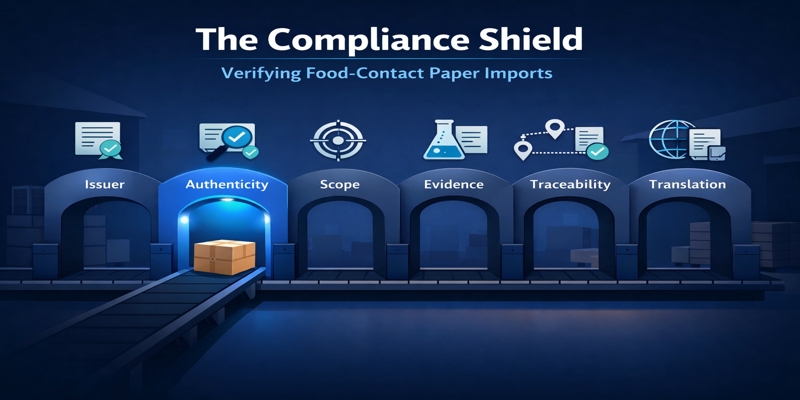
The quickest way to filter out questionable certificates is to verify who issued them. Think of this as the first checkpoint in your document border control: only evidence with a valid issuer gets through.
For ISO management certificates (9001, 22000, etc.): The certification body should be accredited by an IAF (International Accreditation Forum) member. Use IAF CertSearch to search by organization name or certificate number. If the certificate doesn’t appear—or the certification body isn’t recognized—that’s a red flag requiring investigation before proceeding.
For laboratory test reports: The lab should be accredited to ISO/IEC 17025 for the relevant test methods. Accredited labs provide test reports that can be validated via accreditation bodies and scope. Use the ILAC Signatory Search to verify the accreditation body, then check that body’s directory for the specific lab. Accreditation is scope-specific: a lab accredited for tensile strength testing may not be accredited for migration testing.
For ISEGA documents: ISEGA is a recognized German testing institute for food-contact materials. Verify whether you’re looking at a test report from their accredited lab or a product certification. Note that ISEGA’s certification body function operates under specific accreditation scopes; ensure the entity name on the report matches the current accreditation database entry for conformity assessment.
If an issuing body or lab isn’t searchable through recognized accreditation databases, request clarification from the supplier. A legitimate supplier can explain their certification body’s accreditation status without hesitation.
Step 2 — Confirm the Certificate Is Active and Unaltered
Even legitimate certificates expire or get revoked. Before relying on any document, confirm it’s current and hasn’t been modified.
Systematic authenticity checks:
- Certificate number: Does the format match the issuing body’s standard numbering convention?
- Issue and expiry dates: Is the certificate currently valid? Most ISO certificates require annual surveillance audits to remain active.
- Issuing body seal/signature: Is the visual quality consistent throughout? Cropped or pixelated seals suggest editing.
- Supplier legal name: Does it match your purchase order and shipping documents exactly—not a parent company or affiliate?
- Manufacturing site address: Does it match the facility actually producing your order?
Request the original PDF directly from the issuing body when possible, not just from the supplier. Most reputable certification bodies offer online certificate verification or will confirm status via email.
A common failure mode is a valid certificate that belongs to a related company, reseller, or a different site. If the shipment is produced at Plant B, but the certificate covers Plant A, the certificate may be irrelevant to the imported goods.
For visual cues on spotting altered documents, Fake FSC, PEFC, ISO Certificates vs Real Ones: A Visual Spotter’s Guide covers common manipulation patterns including mismatched fonts, cropped seals, and metadata inconsistencies.
Step 3 — Scope Match: Grade, Plant, Process, and Intended Use Conditions
This step catches the failures that valid, authentic certificates still produce. A certificate can be entirely legitimate and still not cover what you’re actually importing.
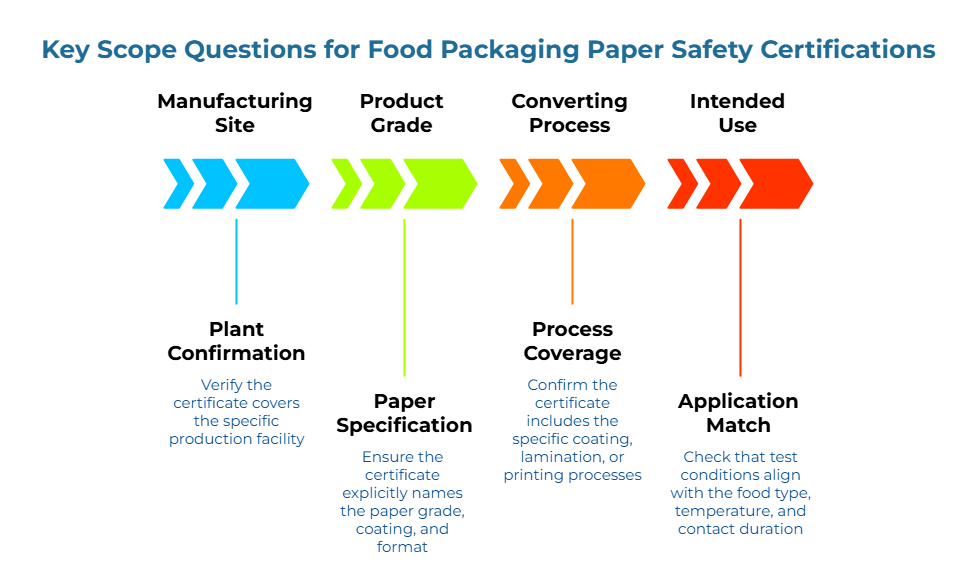
FDA and EU frameworks require intended-use conditions and limitations to be met, not just possession of a certificate. Ask four scope questions:
1. Is the manufacturing site in scope? Multi-site companies, including food packaging paper mills operating across regions, often hold certificates for only some facilities. Confirm the certificate covers the specific plant producing your order—not headquarters or a different production location.
2. Is the product in scope? Does the certificate explicitly name the paper grade, coating type, or food packaging format you’re ordering? A certificate for ‘kraft paper‘ may not cover ‘PE-coated food grade kraft paper‘ or paper with specific ink systems. A scope statement that says “trading and export of paper products” is materially different from “manufacture of coated food packaging paper grades 40–120 gsm.”
3. Is the process in scope? Coating, lamination, and printing processes affect food-contact properties. Confirm the certificate covers the specific converting processes applied to your product.
4. Is the intended use in scope? Food-contact compliance depends on how food packaging paper will actually be used. Check that test conditions match your application for food type (aqueous, acidic, fatty, dry), temperature range (ambient, refrigerated, hot-fill, microwave), and contact duration (brief, extended, repeated use).
A common failure mode: the supplier provides a test report showing compliance at 40°C for 10 days, but your application involves hot-fill at 85°C. The certificate exists and is authentic. The scope simply doesn’t protect you.
For U.S. imports, the FDA Inventory of Effective Food Contact Substance Notifications (FCN) lists proprietary substances authorized for specific manufacturers, while 21 CFR Parts 176 covers generally regulated paper components, and the GRAS Notice Inventory covers generally recognized as safe substances. For EU imports, confirm alignment with the European Commission’s Food Contact Materials framework. For food-service specific requirements, see Food-Grade Certification Standards for Delivery Packaging Bags.
Step 4 — Auditing the Underlying Test Data
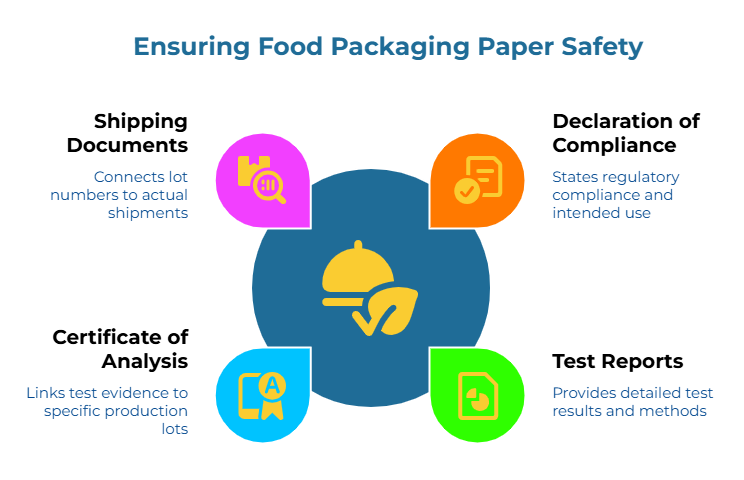
Certificates summarize conclusions. Test reports contain the actual evidence. For defensible compliance, you need both—and a lot traceability connects test evidence and declarations to the actual imported shipment.
The minimum evidence stack for food-contact packaging paper imports:
- Declaration of Compliance (DoC): Names the specific regulation (e.g., “21 CFR 176.170” or “EU 1935/2004”) and intended use conditions
- Original test report(s): Shows test methods, simulants used, time/temperature conditions, sample description, measured results vs. limits, and lab accreditation details
- Certificate of Analysis (COA) or lot sheet: Links the test evidence to specific production lots
- Shipping documents: Connects lot numbers to the actual shipment arriving at your facility
What to examine in test reports: Look for test method citations (e.g., EN 1186 series for migration testing), food simulants used and whether they match your food type, time and temperature conditions tested, sample descriptions matching your product, results compared against regulatory limits, and lab name with accreditation reference.
The lot traceability chain: Create a simple chain connecting documents to cargo:
Tested sample identifier → Declared product/grade → Production lot/batch → Shipment pallet/carton lot code → Invoice/packing list
If the supplier can’t connect the test/declaration to the shipment’s lot information, the evidence pack may be insufficient for fast audit response.
When suppliers resist sharing test reports:
Some suppliers claim test reports are proprietary. Here’s a template for requesting underlying evidence without creating conflict:
Subject: Documentation Request for Compliance Verification — [Product/PO Number]
We need to verify that the certificate scope matches our intended use conditions before we can proceed with [order/shipment approval]. If the full test report cannot be shared due to confidentiality, please provide:
1. A summary showing test methods, simulants, time/temperature conditions, and pass/fail results against stated limits 2. The testing laboratory’s name and accreditation reference 3. Contact information for the lab so we can verify accreditation directly
This documentation is required for our compliance records and potential audit response. Please advise on timing.
If a supplier refuses to provide any underlying test evidence, treat that as a significant risk factor in your qualification process.
Once you’ve verified supplier credentials, you can submit your buying requirements to qualified food packaging paper suppliers through PaperIndex’s RFQ system
Step 5 — Cross-Reference Against Databases and Public Records (Where Possible)
Public databases can validate specific claims, though coverage varies by regulatory framework and document type.
For U.S. imports:
- FDA FCS Inventory: Search for proprietary Food Contact Notifications if the supplier cites an FCN number
- FDA GRAS & SCOGS Databases: Search for generally recognized safe ingredients.
- eCFR 21 CFR Part 176: Verify specific regulatory citations for paper and paperboard components
For accreditation verification:
- IAF CertSearch: Management system certificates issued by accredited bodies
- ILAC Signatory Search: Accreditation bodies and their signatory status for lab accreditations
Red flags when nothing is searchable: Certification body not recognized by any IAF member. Lab accreditation not verifiable through ILAC network. Certificate numbers that don’t match issuing body formats. Supplier routing documents through third-party resellers who can’t trace back to the original manufacturer’s compliance documentation.
When verification attempts fail, escalate to direct contact with the purported issuing body before proceeding.
The Cross-Border Verification Checklist
Use this checklist for every new international food packaging paper supplier and for periodic revalidation. Each gate must pass before proceeding to the next.
Gate 1: Issuer/Accreditation Verified
- Certification body is IAF-accredited (searchable via IAF CertSearch)
- Testing lab is ISO/IEC 17025 accredited for relevant test methods (ILAC network)
- Issuing body contact information is independently verifiable
Gate 2: Certificate Authenticity Confirmed
- Certificate number format matches issuing body’s standard
- Issue and expiry dates are current (check surveillance audit status if applicable)
- Supplier legal name matches purchase order exactly
- Manufacturing site address matches shipping origin
- Seal/signature quality is consistent (no cropping, pixelation, or font mismatches)
Gate 3: Scope Match Verified
- Product grade/type/coating is explicitly named in certificate scope
- Manufacturing site is covered (not just headquarters or sister plant)
- Intended use conditions are covered (food type, temperature, contact time)
- Regulatory framework cited matches importing market requirements (FDA/EU/other)
Gate 4: Evidence Stack Complete
- Declaration of Compliance received with specific regulatory citations
- Original test report received with methods, simulants, conditions, and results
- Test conditions match actual intended use (not just “food contact” generally)
- Lab accreditation details are included and verifiable
Gate 5: Lot Traceability Confirmed
- COA/lot sheet links test evidence to specific production lots
- Lot numbers on documentation match shipping documents
- Chain of custody is documentable from test to shipment
Gate 6: Translation/Equivalence Addressed (for non-English documents)
- Critical fields verified in original language (dates, numbers, regulatory citations)
- Certified translation obtained for DoC and scope statements if needed
- Regulatory equivalence confirmed for importing market
When documents arrive in another language, request both the original-language PDF and an English translation. For high-risk decisions, ask for a certified translation or supplier-issued bilingual version. Confirm that key fields—scope, site, dates, limitations—match exactly across versions. Translation errors often hide scope limitations (“for dry foods only,” “for room temperature only”), and those limitations are usually the point.
Go/No-Go Decision: If any gate has unchecked items, do not proceed until resolved or the risk is formally accepted and documented.
Printable Summary Table
| Gate | Key Question | Pass Criteria |
| 1. Issuer | Is the issuing body recognized? | Searchable via IAF/ILAC |
| 2. Authenticity | Is the certificate current and unaltered? | Valid dates, matching names, intact seals |
| 3. Scope | Does scope cover this exact product and use? | Grade, site, conditions all match |
| 4. Evidence | Is there supporting test evidence? | DoC + test report + verifiable lab |
| 5. Traceability | Can you link the test to shipment? | Lot numbers connect documents to cargo |
| 6. Translation | Can you verify non-English documents? | Critical fields confirmed, equivalence checked |
Red Flags: How Fake or Mis-Scoped Certificates Usually Show Up
Watch for both document-level and behavioral warning signs. Red flags are rarely dramatic—they’re often small inconsistencies that repeat across documents.
Document red flags: Mismatched fonts within the same certificate. Cropped or low-resolution seals and signatures. Certificate numbers returning no results in issuer databases. Dates with inconsistent formatting or alignment suggesting editing. Accreditor marks that don’t match known logos. Generic language like “food safe” without specific regulatory citations or test conditions. Scope statements that are vague (“paper products,” “trading,” “general manufacturing”) with no product specificity. Manufacturing site missing, or only a head-office address appears. Lab report lacks methods/conditions, or the sample description is generic (“paper sample”) with no grade/coating identifiers.
Behavioral red flags: Refusal to share underlying test reports with no alternative offered. Inability or unwillingness to name the actual manufacturing site. Product naming inconsistencies between certificate, quote, and shipping documents. Pressure to accept documents without verification time. Routing documents through intermediaries who can’t answer technical questions about testing conditions. Pressure to “accept what everyone accepts” instead of providing traceable evidence. Frequent switching of document versions with unclear reasons (“updated PDF,” “new logo”) without an auditable trail. Claims of “FDA approved food packaging paper” without clarifying the actual regulatory basis.
What to do when red flags appear: Contact the purported issuing body directly using contact information from their official website—not from the certificate PDF. Request certificate status verification by number. If the issuer can’t confirm, or if the supplier can’t resolve inconsistencies within a reasonable timeframe, treat this as a gate failure.
For additional guidance on evaluating suppliers remotely, see How to Vet Wholesale Paper Bag Suppliers: A Remote Audit Checklist.
Operationalize the Workflow with Limited Resources
Full verification for every shipment isn’t practical. A workable system separates supplier onboarding verification from per-shipment verification.
Supplier onboarding (deeper, less frequent): Apply the complete six-gate checklist before placing orders with any new international supplier, whether sourcing from packaging paper suppliers or specialized food-contact converters. This upfront investment prevents downstream problems. Run the full workflow thoroughly—issuer verification, accreditation checks, scope matching, evidence stack design. Build a standard “compliance pack request” template. Define change triggers: new site, new coating/ink set, new converting process, or new market. Document verification in a supplier file that can be retrieved within hours during audits—not days.
Per-shipment verification (lighter, every time): For approved suppliers with documented compliance history, each shipment needs lighter-touch verification. Confirm lot traceability (COA/lot sheet matches shipping documents). Verify lot numbers fall within the scope of previously verified test evidence. Check for any notifications of process or site changes since qualification. Spot-check that key documents are still valid (expiry dates, scope unchanged). Keep a dated verification log entry.
Revalidation triggers: Run full verification again when certificates approach expiry (check 60-90 days ahead), when the supplier notifies of process or site changes, when product specifications change, when customer complaints or quality issues arise, or when regulatory requirements in your market update.
Record proof of verification: Create a one-page verification log per supplier documenting what was checked (issuer/registry, scope, validity, lab accreditation), when it was checked, who checked it, and screenshots or PDF copies of registry results. This turns verification into an organizational capability, not a one-off scramble.
Streamlining documentation collection: Neutral B2B platforms like PaperIndex can help shortlist food packaging paper suppliers to streamline the initial document collection phase. This doesn’t replace verification, but it makes initial screening more efficient by centralizing document requests when you find suppliers across multiple potential sourcing regions.
Set a revalidation calendar. Track certificate expiry dates. Build verification into your standard supplier onboarding workflow rather than treating it as a one-time event.
To access a curated network of verified food packaging paper suppliers and streamline your compliance documentation collection, join PaperIndex free and connect directly with manufacturers worldwide.
FAQ
Does an ISO 9001 certificate mean the packaging paper is food-safe?
No. ISO 9001 certifies that a company has a quality management system—processes for consistency and improvement. It says nothing about whether specific products meet food-contact safety requirements. You need product-specific test evidence showing compliance with food-contact regulations for your target market.
What’s the difference between ISEGA certification and an ISEGA test report?
ISEGA operates both a testing laboratory and a certification body. A test report from their lab shows specific test results, methods, and conditions for a particular sample. Certification implies ongoing conformity assessment of a product. For import verification, the test report with specific conditions and results often matters more than certification status—because you need to confirm test conditions match your intended use.
How can a lab report be “real” but still unusable?
A report can be legitimate yet fail the decision because the scope doesn’t match: wrong grade from kraft paper suppliers, wrong coating, wrong site, or test conditions that don’t reflect intended use. Verification checks both authenticity and relevance.
How often should we re-verify supplier certifications?
At minimum, before certificate expiry dates. Most ISO management certificates require annual surveillance audits, so annual revalidation is reasonable. Also revalidate after any process change notification, manufacturing site change, product specification change, or quality issue.
What if a supplier won’t share the original test report?
Request a summary document including test methods, simulants, time/temperature conditions, and pass/fail results against stated limits—plus lab contact information for direct verification. If the supplier refuses to provide any underlying evidence, that’s a significant risk factor. Consider whether the supplier relationship is worth the compliance uncertainty.
Can a certificate from one country be valid for imports to another?
It depends on the specific regulatory frameworks involved. Test methods and limits vary by market. A certificate showing compliance with EU regulations may not satisfy FDA requirements, and vice versa. Verify that the regulatory framework cited in the documentation matches your importing market’s requirements—and that test conditions align with your actual use case.
Do US and EU documentation expectations look the same?
Not exactly. Both emphasize safety and intended use, but frameworks and documentation conventions differ. EU food-contact materials are governed by Regulation (EC) No 1935/2004 as a general framework, while the US relies on FDA pathways including 21 CFR Part 176 for paper and paperboard. Verify that supplier documentation cites the correct framework for your importing market.
How do we verify certificates in languages we don’t read?
Focus first on elements that are often standardized or in English: certificate numbers, dates, regulatory citations (e.g., “21 CFR 176” or “EU 1935/2004”), test method codes (e.g., EN 1186), and accreditation body names. Use official databases like IAF CertSearch and ILAC that operate in English regardless of original certificate language. For critical documents like Declarations of Compliance, request certified translations of scope statements and intended use conditions.
What’s the minimum documentation needed for defensible import decisions?
A defensible minimum includes: Declaration of Compliance citing the relevant regulation, supporting test report showing conditions matching your intended use, Certificate of Analysis linking tests to production lots, and shipping documents enabling traceability. Specific requirements vary by product and market; consult your QA or regulatory counsel for guidance on your particular situation.
Where can certificate validity sometimes be checked quickly?
For certain accredited certifications, directories can be used as fast filters—such as IAF CertSearch for participating schemes. For labs and accreditation bodies, ILAC resources help locate signatories and accredited conformity assessment options.
Disclaimer:
This article is for informational purposes only and does not constitute legal or regulatory advice. Food-contact compliance depends on the exact material, inks/adhesives, intended use conditions, and the importing market’s rules. When in doubt, consult qualified regulatory and QA professionals and confirm requirements with the relevant authority.
Our Editorial Process:
Our expert team uses AI tools to help organize and structure our initial drafts. Every piece is then extensively rewritten, fact-checked, and enriched with first-hand insights and experiences by expert humans on our Insights Team to ensure accuracy and clarity.
About the PaperIndex Insights Team:
The PaperIndex Insights Team is our dedicated engine for synthesizing complex topics into clear, helpful guides. While our content is thoroughly reviewed for clarity and accuracy, it is for informational purposes and should not replace professional advice.