
📌 Key Takeaways
PFAS rules are changing fast, and “food safe” labels don’t prove your packaging is compliant—only supplier documentation does.
- Verify by SKU, Not by Label: Ask suppliers to confirm PFAS-free status for each specific product, coating layer, and production date range—generic claims mean nothing.
- “Food Safe” Doesn’t Mean PFAS-Free: Food safety certification addresses contamination risks, not whether PFAS chemicals were added for grease resistance.
- Thickness Won’t Save You: Paper weight (GSM) controls stiffness, not grease blocking—a thin sheet with proper barrier treatment outperforms heavy untreated paper.
- Documentation Beats Promises: Red flags include “everyone uses it,” “trust us,” or silence after follow-ups—pause orders until you get written proof.
- States Are Moving Faster Than Federal Rules: Washington, Minnesota, and California already restrict PFAS in food packaging with specific compliance certificate requirements.
Build a verification habit that survives rule changes, not a one-time compliance fix.
Small business owners and restaurant operators sourcing food packaging will find a ready-to-use supplier verification script here, preparing them for the detailed implementation steps that follow.
~ ~ ~ ~ ~ ~ ~ ~ ~ ~ ~ ~ ~ ~ ~ ~ ~ ~
The rules changed. Again.
Your current inventory of greaseproof liners may have been compliant last month, but evolving government regulations / restrictions mean those same SKUs now represent a regulatory liability. While the packaging remains physically unchanged, its compliance status has likely shifted.
You might be sitting on inventory that no longer meets requirements in certain markets. The reputation risk of non-compliant packaging extends beyond fines—customers associate packaging failures with careless operations.
PFAS are synthetic chemicals historically used in greaseproof paper and other food packaging to repel oil. Regulators across the U.S. and EU are now restricting intentionally added PFAS in food packaging paper and other food-contact materials. Your next step: run a 60-minute inventory triage on greaseproof wraps and liners, then use a supplier verification script to confirm PFAS-free status. Regulations vary by jurisdiction—confirm requirements for your location.
PFAS – Chemical Composition and Functional Utility
These compounds are built around strong carbon-fluorine bonds that repel water and oil but persist indefinitely in the environment – hence ‘forever chemicals.’ Grease resistance is achieved through chemical treatment or mechanical refining; therefore, visual inspection cannot determine PFAS presence. The presence of these chemicals depends on chemical treatment, not the paper’s physical weight or density.
For decades, PFAS treatments offered an efficient grease barrier for burger wrappers, paper bags, microwave popcorn bags, and molded fiber containers. The treatment was lighter and often cheaper than laminating with plastic film.
A useful mental model: GSM (thickness) helps with stiffness and handling, but barrier performance is mostly about the surface treatment or coating. A thicker sheet can still soak through if the barrier chemistry is wrong—or if the supplier can’t prove what was used.
Most regulations now distinguish between ‘intentionally added’ PFAS and trace contamination from environmental sources. This distinction matters especially for food grade kraft paper and other direct food-contact materials. When asking suppliers about PFAS status, the relevant question is whether PFAS was purposefully included in manufacturing to achieve grease resistance.
What’s Changing: The Regulatory Landscape
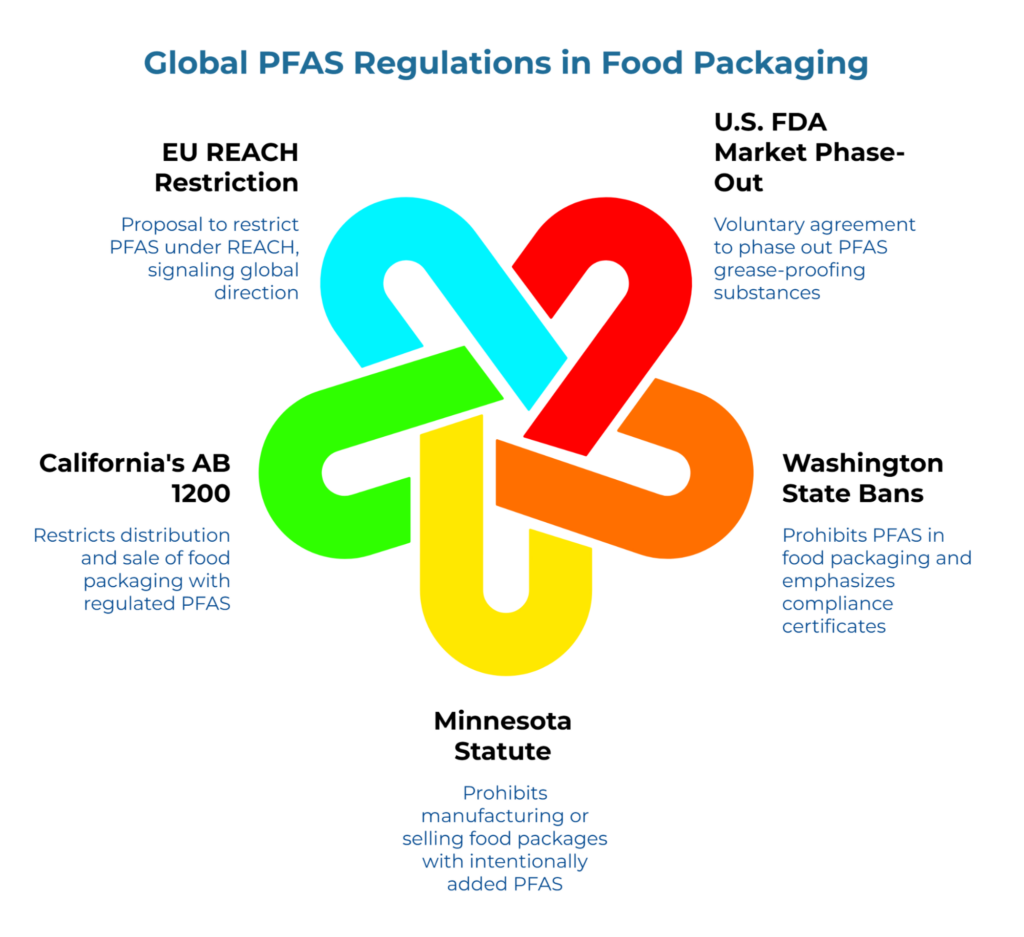
Rules vary by location, but the direction is consistent: regulators are restricting intentionally added PFAS in food-contact packaging and expecting stronger supplier documentation.
U.S. FDA Market Phase-Out
The U.S. FDA has announced manufacturers have voluntarily agreed to phase out PFAS grease-proofing substances. As of February 2024, the FDA announced that grease-proofing substances containing PFAS are no longer being sold by manufacturers for use in food packaging in the U.S. market, tied to voluntary phase-out commitments and related actions.
In early 2025, the FDA formalized the removal of 35 food contact notifications (FCNs) for PFAS-based paper treatments due to industry abandonment.
For official details, see the U.S. Food and Drug Administration announcement: “Market Phase-Out of Grease-Proofing Substances Containing PFAS.”
U.S. State Bans and Documentation Expectations
Washington State is a clear illustration of where enforcement and documentation are headed. The state prohibits PFAS in food packaging and emphasizes manufacturer ‘certificate of compliance’ expectations. The state describes phased category restrictions for plant-fiber food packaging and notes that buyers can request certificates of compliance. For regulatory specifics, see the Washington State Department of Ecology guidance: “PFAS in Food Packaging.”
Minnesota prohibits manufacturing or knowingly selling a food package that contains intentionally added PFAS. The statutory requirements are codified in Minnesota Statute part 325F.075
California’s AB 1200 restricts distribution and sale of food packaging containing ‘regulated PFAS.’ The enforcement advisory defines regulated PFAS to include PFAS intentionally added for a functional or technical effect and PFAS present at or above 100 ppm (measured by total organic fluorine). Enforcement details are available in the California Department of Toxic Substances Control’s “AB 1200 Enforcement Advisory”.
EU: REACH Restriction Direction
The European Chemicals Agency has published an updated proposal to restrict PFAS under REACH, serving as a directional signal for global operators and suppliers. For the current proposal status, see the European Chemicals Agency publication: “Updated PFAS Restriction Proposal Under REACH.”
60-Minute Inventory Triage
This is a fast, practical triage—not a lab exercise. The goal is to identify which SKUs need supplier proof first.
Identify High-Risk SKUs
Focus on items designed to resist grease: greaseproof paper wraps and liners (especially for fried foods), molded fiber containers, microwave-safe paper, and bakery bags with grease resistance claims. Any product purchased before 2023 and labeled ‘grease-resistant’ warrants review.
Additional high-risk categories include bag and sleeve-style packaging used with greasy foods, food liners (basket liners, tray liners), plant-fiber molded items marketed as grease-resistant, and paperboard clamshells, trays, or pizza boxes with grease-resistant claims.
What to Look for on Spec Sheets
Pull spec sheets and look for explicit PFAS status statements. ‘Food safe‘ or ‘FDA compliant’ does not answer the PFAS question. Scan for signals such as ‘grease-resistant,’ ‘greaseproof,’ ‘oil barrier,’ ‘fluoro-,’ ‘C6/C8,’ or ‘fluorotelomer’ language. Also watch for vague compliance statements that do not name the product, SKU, and scope, or claims that sound like labels (‘PFAS-free’) without supporting documentation.
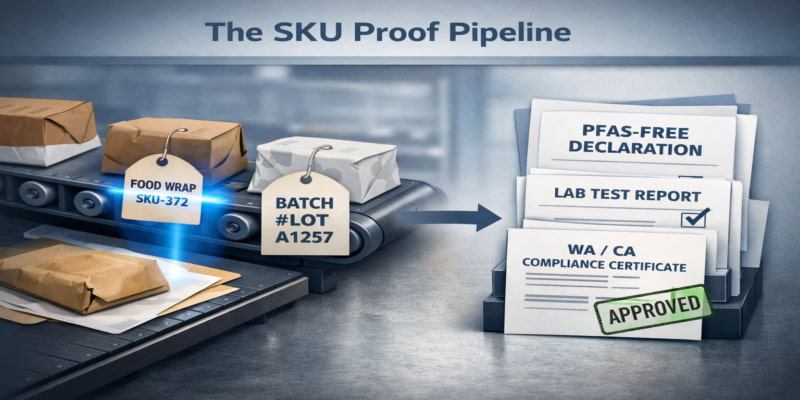
Keep the 3 packaging documents inspectors ask for organized. Prioritize items serving Washington, California, and Minnesota markets first.
How to Prioritize Replacements Without Panic Buying
Rank by grease load and heat (fried foods before burgers before bakery). Rank by customer exposure (direct food contact wraps and liners first). Rank by supplier opacity (weak documentation moves to the top).
The PFAS-Free Verification Script
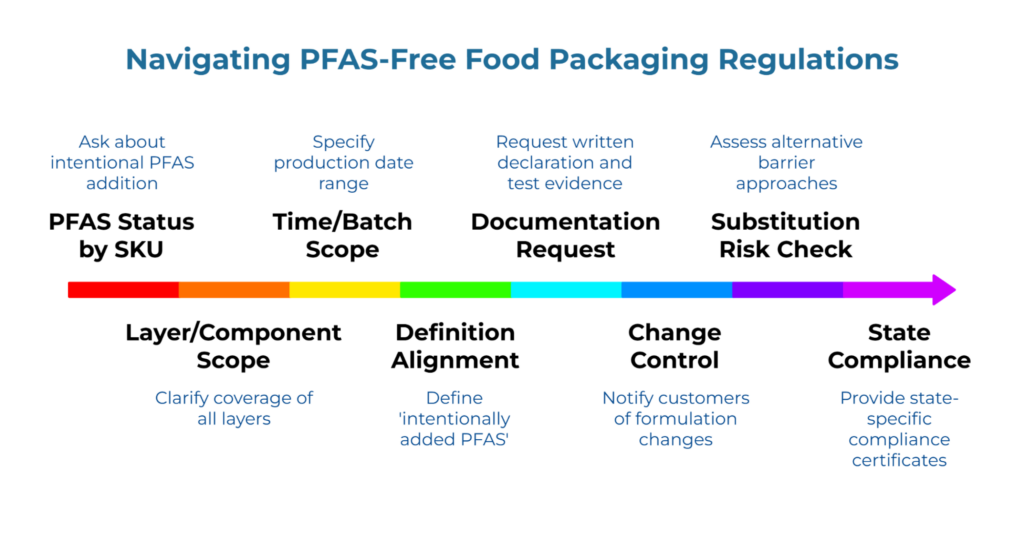
Use this script as-is. It is designed to force scope clarity and proof.
Questions to Ask
- PFAS Status by SKU: “For SKU(s) ____, does manufacturing intentionally add any PFAS compounds?”
- Layer/Component Scope: “Does your answer cover the base paper and any coating, treatment, ink, adhesive, or functional barrier layer?”
- Time/Batch Scope: “Which production date range and/or batch/lot identifiers does your PFAS statement apply to?”
- Definition Alignment: “How do you define ‘intentionally added PFAS’ for this product, and which regulation or definition are you referencing?”
- Documentation Request: “Please provide your written PFAS-free declaration for these SKUs, plus any supporting test evidence you have available.”
- Change Control: “What is your process for notifying customers if formulation or coating chemistry changes?”
- Substitution Risk Check: “If PFAS are not used, what barrier approach is used to achieve grease resistance (at a high level), and has it changed in the last 12 months?”
- 8. State Compliance: “Can you provide state-specific compliance certificates for WA, MN, or CA?”
Documents to Request
Request a written PFAS-free declaration specifying SKUs and date ranges. Ask for a third-party fluorine test report (if available). Obtain an updated Technical Data Sheet describing the barrier method. Request state compliance certificates where applicable. Ask for traceability identifiers (lot/batch/date range) that connect documents to shipments. Request a basic change notification or spec-change policy, even a short written statement.
Red Flags That Mean ‘Pause the Order’
“We don’t have that documentation” — cannot prove compliance.
“Everyone uses it” — deflection.
“It’s food safe, so it’s fine” — food safety certification does not address PFAS.
“No paperwork, but trust us” — disqualifying.
Silence after two follow-ups — disqualifying.
When existing suppliers cannot provide adequate documentation, consider broadening your supplier base. Paper suppliers who prioritize compliance documentation are increasingly differentiated in the market.
Choosing PFAS-Free Alternatives
Switching to PFAS-free packaging does not mean accepting grease failures. Grease resistance is a measurable specification.
Performance Still Matters
Suppliers now offer PFAS-free papers using mechanical refining, silicone treatments, or other barrier technologies that achieve comparable performance. Food packaging paper suppliers can provide documentation on their specific barrier approaches.
A common misconception: thicker paper provides better grease resistance. It does not. Paper weight (GSM) determines stiffness, not grease-blocking ability. A lighter sheet with appropriate Kit Level (grease resistance rating) outperforms a heavy untreated sheet.
When evaluating alternatives, request both compliance documentation and performance specifications.
When to Run a Quick In-Kitchen Stress Test
Before committing to large orders, run a simple hold test: wrap your greasiest menu item, wait through typical hold time (counter plus delivery window), and check for bleed-through. Look for translucency, softening, and seal failure. If two PFAS-free options both have acceptable documentation, the kitchen test is a practical tie-breaker.
What If a Ban Hits While Inventory Is on the Shelf?
This concern is valid and manageable with a short playbook—and the broader principles of supplier verification apply here as well.
Step 1: Scope the exposure. Identify which items are affected and which markets they serve (menu items, locations, channels).
Step 2: Freeze high-risk use first. Prioritize pausing the most direct-contact, high-grease applications until documentation is in hand.
Step 3: Administrative Transition. File supplier confirmations by SKU and lot/date range, then switch to verified alternatives as inventory depletes.
Future-Proof Your Packaging Decisions
PFAS restrictions are not a single event but a regulatory trend. Jurisdictions are moving toward stricter controls and documentation expectations. The stack of wrappers in your storage room may look the same as last year, but the compliance landscape around it has shifted.
Sustainable compliance relies on operational maturity—establishing a repeatable verification protocol that remains robust regardless of legislative shifts. It is operational maturity: a repeatable verification habit that survives rule changes. Operators who treat this as an opportunity to build better supplier governance—documented answers, traceable specifications, audit-ready files—achieve that maturity.
The steps are concrete:
1. Begin by auditing greaseproof inventory using the provided verification script to secure documented supplier affirmations.
2. Build a packaging compliance folder for faster retrieval during audits and inspections. Maintain retrieval-ready compliance files.
3. Sourcing: For new sourcing, greaseproof paper suppliers with documentation capability are available through supplier directories.
Verify the claim. Document the proof. File it where you can find it.
Key Terms
| PFAS | Per- and polyfluoroalkyl substances – synthetic chemicals called ‘forever chemicals’ because they persist in the environment. |
| Intentionally Added PFAS | PFAS deliberately included during manufacturing for grease-proofing. Most regulations target this category. Minnesota’s statute defines this as PFAS deliberately added during the manufacture of a product where the continued presence of PFAS in the product is desired to provide a specific characteristic, appearance, or quality. |
| PFAS-Free Declaration | Written documentation your supplier provides confirming products do not contain intentionally added PFAS – never a ‘magic label.’ |
Disclaimer
This article is for informational purposes only. Packaging regulations and definitions (including what qualifies as ‘intentionally added PFAS’) vary by jurisdiction and can change. Confirm requirements for your location and seek qualified compliance or legal guidance when needed.
Our Editorial Process:
Our expert team uses AI tools to help organize and structure our initial drafts. Every piece is then extensively rewritten, fact-checked, and enriched with first-hand insights and experiences by expert humans on our Insights Team to ensure accuracy and clarity.
About the PaperIndex Insights Team:
The PaperIndex Insights Team is our dedicated engine for synthesizing complex topics into clear, helpful guides. While our content is thoroughly reviewed for clarity and accuracy, it is for informational purposes and should not replace professional advice.