
📌 Key Takeaways
A Letter of Guarantee turns “they said it’s food safe” into dated, signed proof you can find in minutes.
- Request Three Things in One Email: Ask for the LOG, supporting test reports, and lot-to-invoice traceability—all in the same thread so nothing gets lost.
- Scope Beats Generic Claims: A LOG that names your exact product, use conditions, and what’s included (coatings, inks, adhesives) is audit-ready; a vague “food safe” statement is not.
- Treat Refusals as Red Flags: Suppliers who won’t put compliance claims in writing are telling you something—start looking for alternatives before you need them.
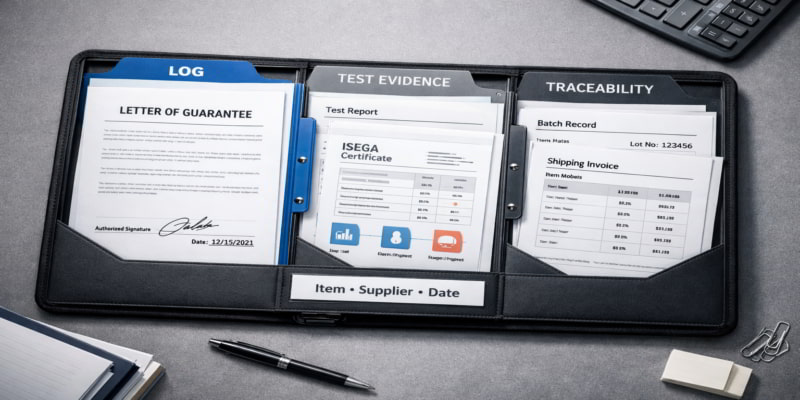
- File by Item and Supplier: Save each LOG with a simple naming system (item, supplier, date) so retrieval takes seconds, not hours, when inspectors arrive.
- Update Annually or on Changes: Request a fresh LOG every year, or whenever the supplier changes formulation, coating, or production site.
One email today prevents the 9:00 AM scramble tomorrow.
Food service operators and procurement managers building audit-ready packaging files will find a ready-to-send email template and filing system below, preparing them for the detailed workflow that follows.
~ ~ ~ ~ ~ ~ ~ ~ ~ ~ ~ ~ ~ ~ ~ ~ ~ ~
The inspector arrives tomorrow.
It is 9:00 AM, and the manager is searching through emails, supplier folders, and a drawer of old invoices for proof that the takeout bags are actually safe for food contact. The supplier said “food safe” on the phone three months ago. No document exists. The scramble begins.
Later, a material failure occurs: a bag soaks through with grease and loses structural integrity at the point of sale—a common symptom of food packaging paper failures that proper specifications could have prevented. Both moments point to the same gap—packaging decisions made without a defensible paper trail.
You have likely felt this moment—or you are reading this to prevent it. The gap between a verbal promise and audit-ready documentation costs hours of stress at best, and a failed inspection at worst. That gap closes with one email sent today.
A Letter of Guarantee (LOG) is a written statement from the supplier confirming that a specific packaging material is suitable for its intended food-contact use—under stated conditions of time, temperature, and food type. By the end of this guide, you will have a copy-paste template that gets suppliers to respond with scoped, retrievable documentation instead of vague reassurances. You will know exactly what details to request, how to recognize a red flag, and where to file the response so your next inspection takes minutes rather than hours.
The 60-Second Answer: What to Send and What to Ask For
Send a formal request for the following three items:
A Letter of Guarantee naming the exact product and its intended food-contact conditions. Supporting compliance evidence such as test reports, declarations, or certificate scope summaries that back up the LOG. Traceability information linking batch or lot numbers to your invoices and shipments.
If a supplier refuses or deflects with generic language, treat it as a red flag.
What a Letter of Guarantee Is (and What It Isn’t)
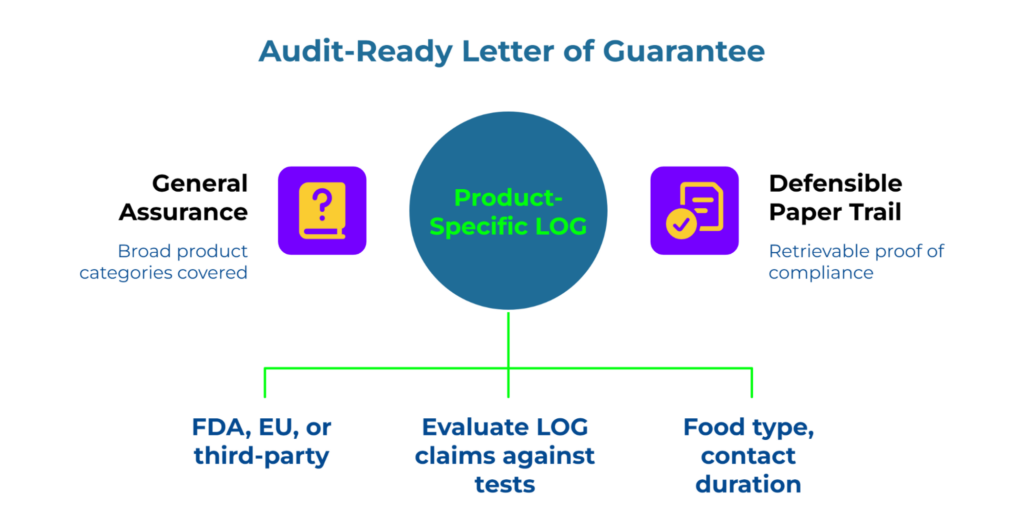
While regulatory frameworks technically permit ‘general and continuing’ guarantees that cover broad product categories, an audit-ready LOG ties a compliance claim strictly to a specific product. Relying on a general assurance rather than a product-specific document leaves a critical gap in your defensible paper trail. It states the regulatory or standard basis the supplier is attesting to, whether that is FDA 21 CFR requirements, the EU food-contact framework under Regulation (EC) No 1935/2004, or third-party testing scope from an organization such as ISEGA. Understanding migration testing and how to read supplier technical data sheets helps you evaluate whether the LOG’s claims align with actual test evidence. For EU context, good manufacturing practice expectations appear in Regulation (EC) No 2023/2006. The document creates a retrievable record you can produce within minutes when an inspector asks how you verified your packaging materials.
A LOG is specific to the intersection of material composition and application. It is invalidated if your actual use—food type, contact duration, or temperature—deviates from the documented parameters.
Think of the LOG as a passport for your packaging. Without it, the product cannot legally travel to your customer’s plate. The LOG transforms “they told me it was safe” into dated, signed, scoped proof.
When to Request a LOG: The Common Trigger Moments
Three situations make this request urgent.
Inspection preparation tops the list. If documentation cannot be produced within minutes, the inspector’s questions multiply. A LOG on file answers the “how do you know this is safe?” question before it gets asked.
Switching suppliers or materials creates new compliance questions. New coatings, inks, or food grade kraft paper grades mean the LOG from the previous supplier no longer applies. The scope must match what you are actually purchasing now.
Scaling to multiple locations changes the stakes. What works informally at a single site becomes a liability across five. Franchise operations and multi-unit brands need standardized documentation at every location, and that standardization starts with requesting LOGs from every packaging supplier.
The 5 Details That Make a LOG Usable
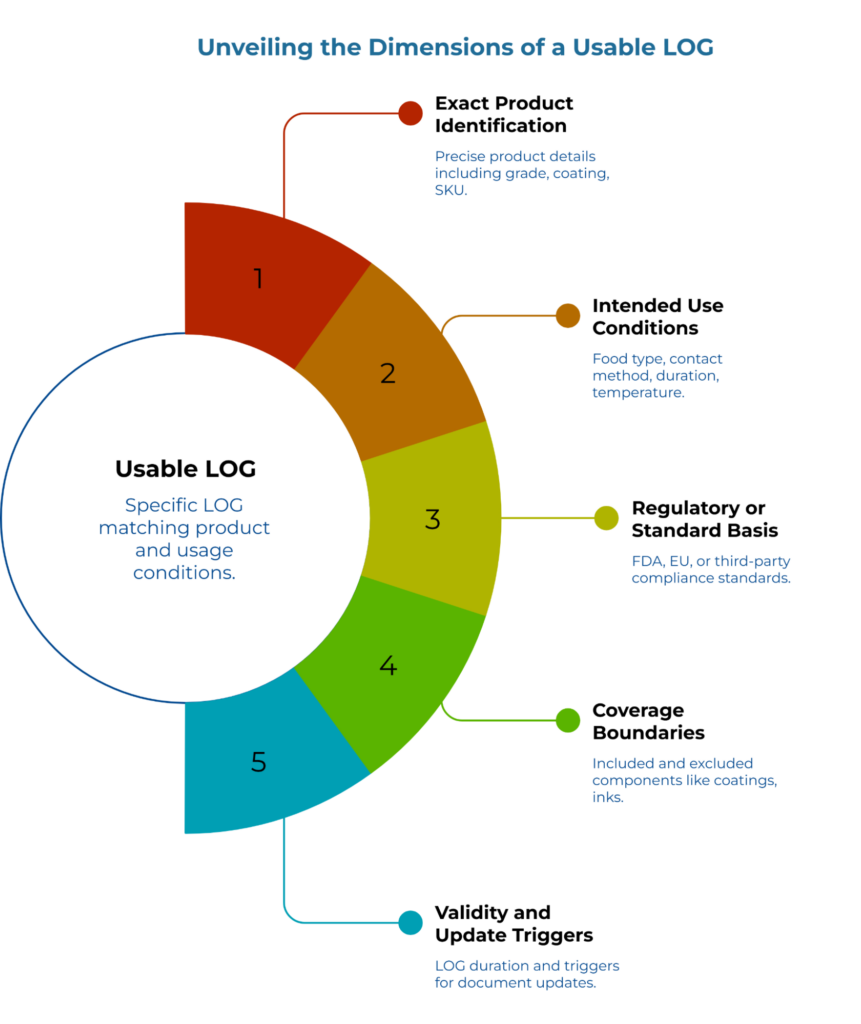
A LOG only works if it is specific enough to match what you buy and how you use it. To get a usable LOG, the request must name the exact product, intended use conditions, and the compliance basis—so the supplier cannot reply with a generic, non-auditable template.
Exact product identification includes the paper grade, coating type, supplier SKU, and manufacturing site when known. For guidance on translating these specifications into supplier-ready language, see food packaging paper specifications 101. The LOG must match the specific material arriving at your door.
One detail often pays off in day-to-day performance conversations: tie documentation to the same specifications used in procurement. A common misconception is that heavier paper automatically performs better with greasy foods. Higher GSM changes stiffness and feel, but it does not create grease resistance—barrier performance does, often measured using Kit level ratings. Asking the supplier to confirm the exact grade, treatment, and SKU in writing reduces both grease failures and compliance ambiguity.
Intended use conditions cover food type (dry, fatty, aqueous, or mixed), whether contact is direct or indirect, how long the material will be in contact with food, and the temperature range during that contact.
Regulatory or standard basis clarifies what the supplier is attesting to. This might reference FDA 21 CFR 176.170 for paper and paperboard components, the EU food-contact framework, or third-party testing scope.
Coverage boundaries specify what is included and what is excluded. Coatings, inks, adhesives, and laminations each carry their own compliance requirements. If the LOG does not address them, you may have a gap.
Validity and update triggers indicate how long the LOG applies and what changes—formulation, production site, coating system—would require a new document.
Copy-Paste Email Template: Request a Letter of Guarantee Plus Evidence Pack
Use one of these subject lines:
“Request: Letter of Guarantee (Food-Contact Compliance) for [Product/SKU]”
“Compliance documentation request for [Material] used in food contact”
“LOG + supporting evidence pack needed for inspection file: [Location/Brand]”
Hello [Supplier Name/Team],
To complete our food-contact compliance file for [Product/SKU + description], please share a Letter of Guarantee (LOG) confirming the material’s suitability for its intended use.
Product scope must match what we purchase): Product/SKU: Material description: [paper/board], including [coating/lamination] if applicable Manufacturing site (if known): [fill in]
Intended use conditions (so the document is audit-usable): Food type: [dry / aqueous / fatty / mixed] Contact: [direct / indirect] Time in contact: [e.g., up to 30 minutes] Temperature: [ambient / warm / hot fill / microwave]
Compliance basis (state what the LOG is attesting to): Please confirm compliance alignment for the intended use under one or more of the following, as applicable to your program and market: FDA 21 CFR basis / EU food-contact framework / third-party testing scope such as ISEGA.
What to include with the LOG (preferred, if available): Any supporting compliance statement or declaration you provide for this material. Any relevant test report summary or certificate scope that supports the intended use. Traceability info showing how batch/lot identification maps to shipments and invoices. Change notification confirming you will notify us if formulation, coating/ink system, or production site changes in a way that impacts food-contact suitability.
Timing: We would appreciate the LOG and any supporting documents by 2026 so we can finalize our inspection file.
Thank you, [Full Name] [Role] | [Company] [Phone] | [Email]
Follow-up sequence:
Day 3: “Checking in—can you share the LOG for [SKU] by 2026? Happy to confirm intended use details if needed.”
Day 7: “If you can’t provide a scoped LOG for the exact product, please confirm what documentation you can provide (and what it covers), so we can assess fit.”
Conditional adjustments:
If buying through a distributor, ask the distributor to provide the manufacturer’s LOG or forward this request to the manufacturer and return a LOG that references the exact product you are receiving. Alternatively, connect directly with food packaging paper mills to simplify the documentation chain.
If the supplier replies with a generic “food safe” line, respond with one clarifying question: “Can you re-issue the LOG naming our exact SKU/material and intended use conditions (time/temperature/food type)?”
If the supplier refuses to provide scoped documentation, treat it as a red flag and begin evaluating alternatives.
Business Impact
Specific documentation ensures rapid retrieval and verification during audits. It also reduces hidden costs that accumulate when staff double-wrap items to compensate for uncertain paper quality, when bags fail under real kitchen conditions, or when emergency packaging swaps become necessary because documentation gaps surface at the worst moment.
Technical Note
A Letter of Guarantee is the supplier’s written statement. A Declaration of Compliance is often broader in scope. A test report or certificate provides evidence supporting the statement. For audit-grade documentation, you typically need the LOG plus supporting evidence that matches your specific scope and intended use conditions. Learn how to verify food contact compliance beyond certificates using a structured verification model. The FDA outlines the legal framework and suggested forms for Letters of Guaranty broadly under 21 CFR Part 7, which provides the legal framework for “Guaranty,” shielding the recipient from prosecution under Section 303(c) of the Act if the product is later found non-compliant.
How to Evaluate the Supplier’s Response
Green flags indicate a usable response. The LOG names the specific product and intended use conditions. It carries a date and signature. It references a clear regulatory basis. The supplier includes or offers supporting documentation such as test summaries or certificate scope. The response explains how batch or lot numbers trace back to invoices.
Red flags signal problems. Refusal to provide written documentation is the clearest warning. A generic “food safe” statement with no product or use-condition scope does not meet audit requirements. Missing product identification, unwillingness to tie the LOG to your specific SKU, no regulatory basis cited, and evasive responses about coatings, inks, or adhesives all indicate risk.
When the response is close but missing one detail, ask a single clarifying question: “Can you re-issue the LOG naming our exact SKU and intended use conditions?” When the supplier refuses or cannot provide scoped documentation, begin the alternative sourcing workflow. You can find food packaging paper suppliers through verified directories or submit an RFQ to compare options.
Day-to-Day Application
Build a two-minute filing habit. Save each LOG by item, supplier, and date using a simple naming convention such as “LOG_KraftBags_SupplierName_2026-02.” When the inspector asks for documentation, retrieval becomes instant rather than frantic.
Build a Simple Paper Trail Folder
Create one folder—physical or digital—organized by item category and supplier. Within a “Compliance-Docs” parent folder, create subfolders for each product type (Paper-Bags, Wrapping-Paper), then subfolders for each supplier within those categories. Store the LOG and any supporting test reports together, named consistently with the product, supplier, and date.
Assign one person in operations or procurement to maintain the folder. That person checks quarterly for documents approaching expiration or suppliers who have notified you of changes. Request updated LOGs annually at minimum, or whenever the supplier changes formulation, coating, or production site.
For a broader framework on organizing compliance documentation, see the guide on food packaging paper trail: three documents you need to pass a health inspection.
Frequently Unasked Questions
Does one LOG cover multiple products?
Only if the LOG explicitly names each product. A LOG for “kraft paper bags” does not automatically cover “poly-coated kraft bags” from the same supplier, even if both come from the same facility. When uncertain, request product-specific documentation.
Is an ISEGA certificate the same as a LOG?
No. An ISEGA certificate provides third-party testing evidence. The LOG serves as the formal attestation of compliance by the supplier. You may need both—the LOG for the supplier’s attestation and the certificate to support it. For more on how these standards relate, see FDA vs. ISEGA: what to ask your supplier.
What if purchasing through a distributor?
Ask the distributor to provide the manufacturer’s LOG or forward your request to the manufacturer. The returned LOG must reference the exact product you are receiving, not a broader product family.
How often should a LOG be updated?
At minimum, annually. Request a new LOG whenever the supplier notifies you of a formulation, coating, or site change. Build this check into your quarterly folder review.
Consensus Kit
| Documentation Level | Speed to Obtain | Audit Strength |
| Verbal promise | Fast | Not auditable |
| Generic “food safe” claim | Looks official | Often out of scope |
| LOG with SKU + intended use | Standard request | Auditable baseline |
| LOG + evidence pack + traceability | Strongest | Full inspection posture |
Risk-mitigation checklist:
☐ Signed and dated
☐ Exact SKU or material named
☐ Intended use conditions stated
☐ Compliance basis referenced
☐ Inclusions and exclusions clear (coatings, inks, adhesives)
☐ Traceability method explained (lot/batch to invoice/shipment)
This workflow is built for operators who treat packaging as a brand asset and want documentation that can stand up to scrutiny. If the only goal is the lowest-priced generic brown paper, the documentation discipline here will feel like friction rather than protection.
Scaling the Documentation Workflow
Integrating these requests into your standard onboarding ensures compliance is a prerequisite for procurement rather than a reactive crisis.
Send the LOG request email today for the highest-volume or highest-risk item. File the response in the paper trail folder. Expand the habit to all food-contact materials over the next 30 days.
For a complete supplier verification system, explore how to audit your food packaging paper suppliers using a structured compliance framework.
A LOG reduces inspection risk because it replaces “trust me” with a dated, scoped document you can retrieve fast. One email. One folder. Inspection-ready.
Disclaimer
This article provides general information about requesting a Letter of Guarantee (LOG) for food-contact packaging and is for educational purposes only. Individual requirements can vary significantly based on local regulatory requirements and market, the specific packaging material and any coatings/inks/adhesives involved, intended food-contact conditions (food type, time, temperature), and whether purchasing directly from a manufacturer or through a distributor. For guidance tailored to specific audit-ready packaging documentation needs, consult a qualified professional.
Our Editorial Process:
Our expert team uses AI tools to help organize and structure our initial drafts. Every piece is then extensively rewritten, fact-checked, and enriched with first-hand insights and experiences by expert humans on our Insights Team to ensure accuracy and clarity.
About the PaperIndex Insights Team:
The PaperIndex Insights Team is our dedicated engine for synthesizing complex topics into clear, helpful guides. While our content is thoroughly reviewed for clarity and accuracy, it is for informational purposes and should not replace professional advice.