
📌 Key Takeaways
The right kraft paper grade comes from matching the paper to its job — not from picking a name off a supplier’s list.
- Start with the Job, Not the Grade: Define what the paper must do — carry weight, resist moisture, survive a fast machine — before you ever ask for a product name.
- GSM Alone Misleads: Two papers at the same weight can perform very differently because grams per square meter doesn’t measure strength, tear resistance, or how well paper runs on your equipment.
- Spell Out Failure Risks in Your RFQ: Tell suppliers what can go wrong — tearing, curling, machine stops — so they recommend a grade based on evidence, not guesswork.
- Match Test Methods Before Comparing Prices: Supplier numbers only line up when both used the same test, the same conditions, and the same way of reporting results.
- Run Trials Before You Commit Volume: A sample that looks good on a desk can still break on your production line — trial data under real conditions is the only reliable proof.
Name the function first, and the right grade follows.
Technical buyers and procurement teams sourcing kraft paper will gain a clear, step-by-step path from application needs to a supplier-ready RFQ, preparing them for the detailed overview that follows.
~ ~ ~ ~ ~ ~ ~ ~ ~ ~ ~ ~ ~ ~ ~ ~ ~ ~
A request lands on your desk: “We need strong kraft paper for the new packaging line.” That sounds simple enough, until you try to turn it into a purchase order.
The roll sample feels firm in your hand. The supplier’s datasheet looks complete. Then the paper snaps 17 minutes into a converting trial, and the operator points at the web path like the answer should have been obvious all along.
“Strong” is not a specification. It could mean resistance to tearing during manual handling, higher tensile performance on a high-speed converting line, or better moisture control for humid storage. Each points to a different set of paper properties, different test methods, and potentially a different kraft paper grade entirely.
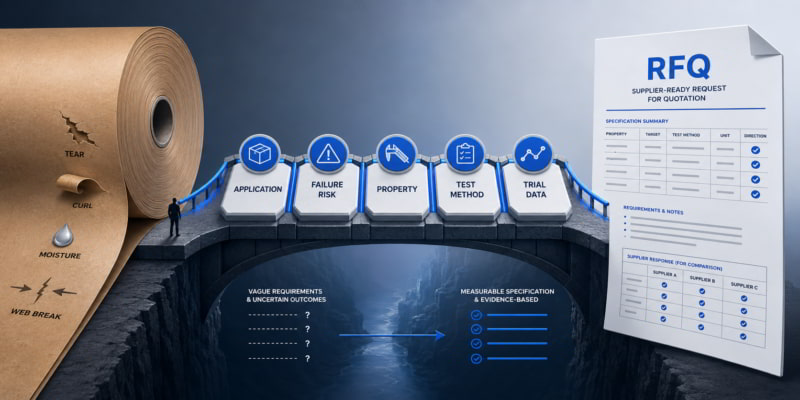
This gap between what stakeholders say they need and what a supplier can quote against is where most buying mistakes begin. Good kraft paper grade selection works backward: start with the application, map failure risks, translate those risks into measurable paper properties, and only then build supplier-facing questions. The payoff is an RFQ that gives kraft paper suppliers enough context to recommend the right grade — and gives you enough data to compare their answers.
Why Kraft Paper Grade Names Are Not Enough
Grade names serve as useful shorthand inside a single mill or supplier relationship. They become unreliable the moment you step outside that relationship.
Two suppliers may both offer “heavy-duty kraft,” yet the paper behind each label can differ significantly in tear resistance, tensile behavior, or moisture performance — a gap explored in depth in beyond grade names: how to compare kraft paper parent roll offers for better converting performance. Grade names are commercial labels assigned by individual mills based on their own product families, regional conventions, or marketing history. A name like “industrial sack kraft” tells you the intended category, but it does not guarantee a specific burst strength, Cobb value range, or machine-direction tear performance.
A supplier may use “heavy-duty kraft” to describe grammage. A converter may prioritize tear resistance, while a production manager focuses on runnability and winding tension. These divergent interpretations of ‘heavy-duty’ highlight the danger of relying on commercial shorthand rather than empirical data.
The practical takeaway: start with the function. Is the paper wrapping a product, carrying load, separating layers, cushioning surfaces, lining packaging, taking ink, forming bags, or protecting goods in transit? Each use points to a different set of properties. Evaluate a grade through four lenses — application fit, measurable properties, test methods, and operational performance — before a name enters the discussion.
Start with the Application Before Asking for a Grade
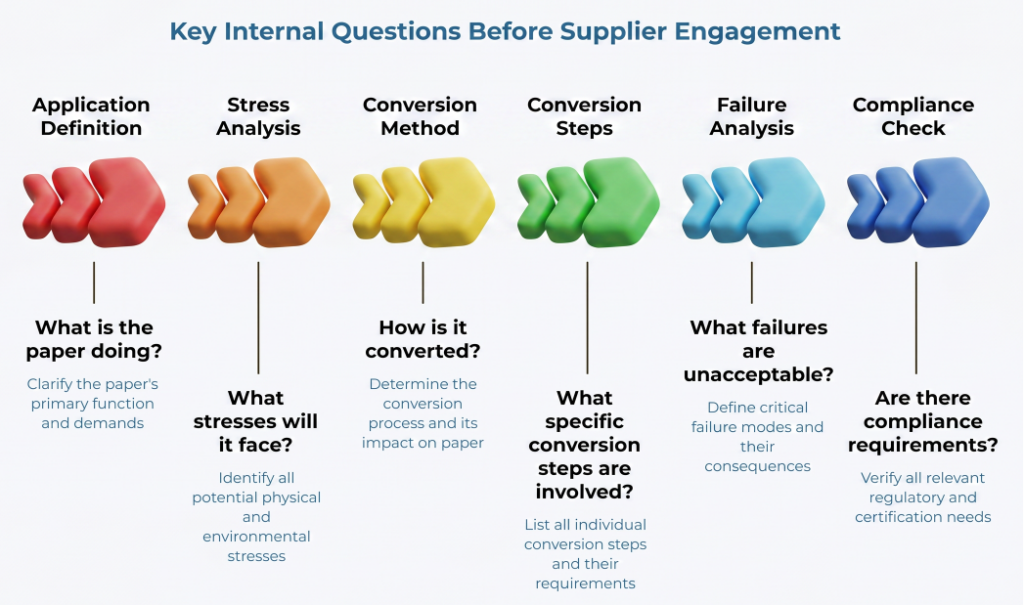
Before contacting a single supplier, the buying team should answer a short set of internal questions. These form the foundation of every specification and supplier comparison that follows. Skipping them is the most common reason buyers end up over-specifying, under-specifying, or comparing non-equivalent grades.
- What is the paper doing? Wrapping, carrying load, separating layers, cushioning, lining, printing, laminating, bag-making, and protecting are all different jobs with different demands.
- What stresses will it face? Pulling, folding, puncture, abrasion, compression, moisture, grease, heat, cold, and repeated handling each call for different property priorities.
- How is it converted? Manual, semi-automatic, and high-speed automated lines impose different demands on runnability, dimensional stability, moisture consistency, and roll quality. Runnability and surface behavior can be just as important as raw strength numbers.
- What specific conversion steps are involved? Printing, coating, gluing, sealing, die-cutting, creping, laminating, slitting, and rewinding each impose distinct demands on the paper. A grade that performs well through a printing step may behave differently under die-cutting or heat-sealing. Separating process type from conversion steps helps buyers pinpoint where property requirements originate.
- What failures are unacceptable? Tearing, bursting, dusting, curling, delamination, poor print adhesion, moisture uptake, machine stops, weak seams, failed sealing, or customer-facing damage — each maps to different paper properties.
- Are there compliance requirements? Food contact, recycled content, FSC or PEFC chain-of-custody certification, restricted substances, or regional regulations each add documentation requirements. For food-contact applications in the U.S., FDA’s 21 CFR Part 176 is a relevant regulatory reference point, but final suitability depends on the intended use, food type, contact conditions, formulation, and supplier documentation.
This check prevents one of the most expensive specification mistakes: treating grammage as the answer to every problem. If paper tears during high-speed conversion, increasing GSM may help in some cases — but it may also miss the real cause entirely. The problem could involve tear resistance, tensile properties, moisture variation, roll hardness, poor winding, damaged edges, splice quality, or machine-direction and cross-direction behavior. The first question is not “Which heavier grade is available?” The better question is, “What exactly failed, under which condition, and which property explains that failure?”
Answering these questions ensures the specification reflects the real operating environment. For buyers working through grade selection for bag manufacturing or wrapping paper conversion, this logic remains the primary safeguard against procurement errors.
Translate Application Needs into Kraft Paper Properties
Once application requirements are clear, the next step is mapping each need to measurable paper properties and the test methods used to verify them. This is the deepest and most actionable part of the specification process — where “what we need the paper to do” becomes “what numbers and test results we should ask for.”
The matrix below provides a practical starting framework.
| Application Need | Likely Failure Risk | Relevant Property | Key Test Method | What to Ask the Supplier |
| Load-bearing or pulling resistance | Web breaks, stretch failure, weak bag performance | Tensile strength, TEA, stretch, MD/CD behavior | TAPPI T 494 — tensile strength, stretch, TEA, tensile stiffness; ASTM D828 — tensile properties using constant-rate-of-elongation apparatus | MD and CD tensile, stretch, TEA. State method and conditioning. Specify whether values are guaranteed or typical. |
| Tearing during handling or converting | Fold-line tears, slitting damage, edge tears | Tear resistance (internal tearing) | TAPPI T 414 — internal tearing resistance (Elmendorf-type); does not measure edge-tear | MD and CD tear. Note whether edge-tear data is available separately. |
| Rupture or pressure resistance | Burst failure in bags, pressure damage during filling or compression | Burst strength | TAPPI/ANSI T 403 — bursting strength within a defined thickness range | Burst in kPa. Confirm method covers your thickness range. Specify guaranteed minimum or range. |
| Water exposure or humidity | Moisture uptake, warping, adhesive failure, curl, storage instability | Cobb value (water absorptiveness), moisture content, sizing | TAPPI T 441 — water absorbed under standardized conditions; ISO 535 — Cobb method for water absorptiveness | Cobb60 value (g/m²). Specify test side and conditioning. Request moisture range and storage guidance. |
| Weight, yield, or cost-per-area | Overpaying per unit area, yield inconsistency, quote mismatch | Grammage / basis weight | TAPPI/ANSI T 410 — U.S. practice uses basis weight alongside metric g/m² | Report in g/m². Clarify basis weight convention and tolerance. |
| Converting performance | Machine stops, wrinkles, edge breaks, splice trouble | Roll quality, winding, caliper, surface, porosity, stiffness | Equipment and application-specific evaluation | Roll specifications, splice limits, trial data, production feedback, edge condition. |
| Printability or surface consistency | Poor ink adhesion, uneven print, shade inconsistency, scuffing | Surface smoothness, porosity, sizing, shade | ASTM and ISO surface testing standards | Surface test results. Specify felt side, wire side, or both. Request print trial data or approved sample reference. |
| Food-contact or food-adjacent use | Compliance gaps, rejected paperwork | Declaration, intended-use scope, component suitability | Regulatory and application-specific | Food-contact documentation tied to specific use case and shipment. |
| Sustainability requirement | Unsupported environmental claim | FSC, PEFC, recycled-content or chain-of-custody documentation | Certification-specific | Certificate scope, license details, invoice wording. |
| Cross-supplier comparison | Mismatched data, false equivalence | All relevant properties | Method-specific | Test method, units, tolerances, conditioning, and whether values are typical or guaranteed. |
Several points in this matrix deserve focused technical scrutiny.
Machine direction (MD) and cross direction (CD) results often differ substantially for tensile, tear, and stiffness. A supplier reporting only one direction is providing an incomplete picture. Tensile properties matter whenever the paper must withstand pulling, tension, or web stress, and ASTM identifies tensile properties as fundamental to manufacture, end use, or both.
Tear resistance measured by TAPPI T 414 uses an Elmendorf-type method, but it does not measure edge-tear resistance. That limitation is important when the visible failure begins at a damaged edge or slit rather than within the sheet body.
The difference between “typical” and “guaranteed minimum” values matters enormously — a typical value reflects what the mill usually achieves, while a guaranteed minimum defines what they will replace or credit if the paper falls short. When comparing across kraft paper producers, insisting on this distinction prevents surprises after volume commitments.
Grammage is a core specification, but it should not stand alone. TAPPI notes that U.S. commercial terminology often uses basis weight, ream weight, or substance while other markets commonly use grams per square meter. That difference matters when buyers compare international quotations.
Avoid giving suppliers a generic list of every property. Over-specifying drives up cost and may force mills to quote specialty products when a standard grade would perform well. For a deeper look at how quality specs shape real cost, that relationship deserves careful attention. The rule is straightforward: Ask for the property that explains the risk.
Convert Requirements into Supplier-Facing RFQ Questions
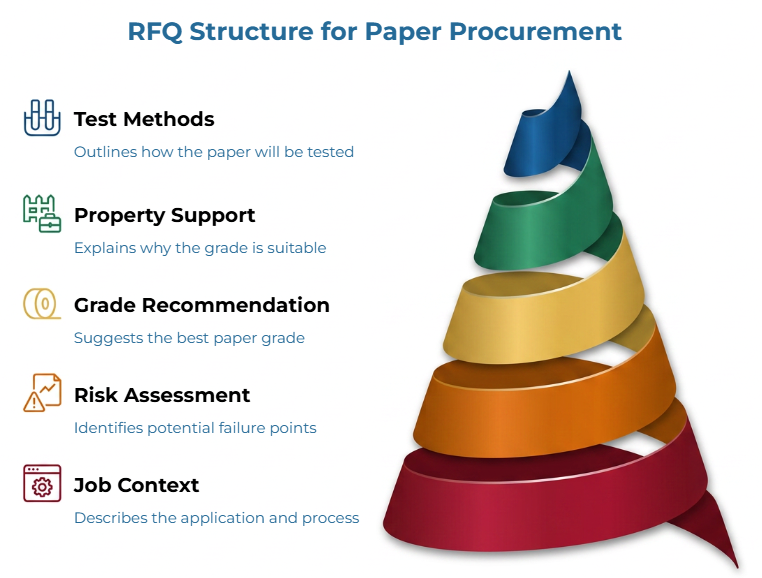
A well-structured RFQ gives the supplier enough context to recommend the right grade and gives you enough data to compare responses fairly.
A weak RFQ asks, “Can you quote 80 GSM kraft paper?” A stronger version gives the supplier the job, the process, and the failure risk: “We need kraft paper for protective wrapping on a semi-automatic line. The paper will be folded, slit, and stored before use in warehouse conditions. The main risks are tearing during wrapping, moisture-related curl, and customer-visible scuffing. Which grade do you recommend, what properties support that recommendation, and which test methods are used?”
That framing forces the supplier to explain the fit. It also gives your team a fair basis for comparison. Include these areas in the RFQ:
- Grade recommendation and reasoning: Which grade do you recommend for this end use, and what application assumptions are you making about line speed, handling, storage, load, and conversion?
- Property guarantees versus typical values: Which properties are guaranteed versus typical? What tolerances apply by lot, roll, or shipment?
- Test methods and reporting: What test methods are used for grammage, tensile, tear, burst, Cobb, moisture, caliper, stiffness, porosity, and other relevant properties? Are results reported for both MD and CD where applicable?
- Converting performance: What converting conditions has this grade successfully run under? What tolerance applies by lot, roll, sheet, or shipment?
- Roll specifications and packaging: What roll dimensions, sheet format, core type, winding, splice limits, edge condition, and packaging options are available?
- Documentation: What accompanies each shipment — technical datasheet, certificate of analysis, food-contact declaration, FSC/PEFC certificate, recycled-content documentation, or customer-specific compliance evidence?
- Substitution policy: What alternatives are available if lead time, cost, or availability changes?
- Technical support: What support is available during sampling, converting trials, or complaint review?
Food-contact language needs extra discipline. A supplier’s “food grade” claim should be treated as a starting point, not proof — buyers sourcing food grade kraft paper should verify declarations against the specific intended use, food type, and contact conditions. For U.S.-related food-contact paper and paperboard components, 21 CFR Part 176 is a relevant regulatory reference point, but final suitability depends on the intended use, food type, contact conditions, formulation, and supplier documentation.
Sustainability claims need the same evidence mindset. FSC describes chain-of-custody certification as a way to verify that forest-based materials are credibly tracked from forest to finished goods, while PEFC offers chain-of-custody certification for companies that manufacture, process, trade, or sell forest-based products. Ask for documents that match the product, legal entity, shipment, and invoice — a process covered in detail in our guide to verifying kraft paper manufacturer certifications. A certificate that cannot be tied to the supplied material has limited value.
Buyers preparing to submit an RFQ will find that application-framed requests draw more comparable supplier responses than generic grade-and-GSM inquiries.
Compare Suppliers Without Over-Specifying
Good supplier comparison depends on comparable evidence, not bigger spreadsheets.
The most common comparison trap: comparing numbers across suppliers without confirming both used the same test method and conditioning standard. A burst result under TAPPI/ANSI T 403 and one under ISO 2758 may not be directly comparable. Do not compare prices until the technical basis is aligned — two suppliers quoting the same GSM may still be quoting different materials if test methods, tolerances, moisture ranges, roll formats, and delivery assumptions differ.
Separate “must-have” requirements from “nice-to-have” preferences. Must-haves are tied to failure risk, equipment limits, customer requirements, compliance, or safety. Preferences may improve confidence, but they should not drive the award if they do not affect the application. A customer-facing printed wrapper may need surface consistency, shade control, printability, scuff resistance, and suitable folding behavior. An internal separator sheet may not need the same print-related scrutiny. Asking both suppliers for the same unnecessary fields slows the process and raises cost without reducing risk.
Validate critical applications with samples, converting trials, and production feedback before committing to volume. Record the roll ID, batch, machine speed, web breaks, reject rate, curl, dusting, splice performance, print result, glue or seal performance, and operator notes. A clean desk sample cannot reproduce your actual line tension, warehouse conditions, or handling routine. Include production managers or converters early — they see runnability problems that datasheets cannot reveal.
This is where cross-functional input matters. Procurement sees the quote. Production sees the stoppage. Quality sees the evidence gap. Finance sees the total cost of use. A slightly higher roll price may be commercially stronger if it reduces waste, downtime, claims, or rework.
Weigh your final comparison across application fit, test-backed performance, consistency, converting performance, documentation, lead time, technical support, and total cost of use. For buyers evaluating kraft paper suppliers for the first time, structuring the evaluation around these criteria prevents costly trial-and-error. Buyers exploring options for avoiding over-specification can also refine their internal buying checks before contacting suppliers.
Common Pitfalls That Undermine Grade Selection
Buying by grade name alone remains the most widespread mistake. A grade name can guide the conversation, but it cannot replace application fit, test evidence, and trial feedback.
Close behind is treating grammage as a proxy for performance. A 70 g/m² paper with the right fiber composition can outperform a 90 g/m² paper designed for a different application. GSM helps define mass per unit area, but it does not fully define strength, tear resistance, burst performance, Cobb value, stiffness, porosity, surface behavior, moisture consistency, or runnability.
Comparing datasheets without verifying test methods leads to false conclusions. Supplier numbers are only comparable when the test method, unit, conditioning, reporting basis, and guarantee status are clear. So does ignoring MD/CD differences — if paper tears during high-speed converting, simply increasing basis weight rarely solves it. The root cause may involve tear resistance, tensile properties, moisture, roll quality, or splice quality. A troubleshooting guide for parent roll buyers can help distinguish grade mismatch from process problems.
Underestimating converting conditions catches buyers who focus only on end-use strength. Over-specifying is equally damaging — paying for unneeded performance shrinks your supplier pool without adding value. Assuming sustainability or food-contact claims are valid without documentation is a compliance risk that surfaces at the worst moment.
Common objection: “Our supplier already knows what grade we need.” They may — but even a long-standing supplier relationship benefits from documented application context. It ensures alignment and creates a troubleshooting basis if problems arise. Good suppliers should be able to connect the grade to your process, risk, and evidence.
Another objection: “We only need the cheapest grade that works.” Valid goal, but “works” must be defined. In kraft paper sourcing, “works” should mean the paper runs, converts, stores, documents, and performs in the customer’s hands. Sometimes the cheaper roll becomes more expensive in production.
Frequently Asked Questions
What is the best kraft paper grade for packaging?
Performance is contingent on application parameters. The right grade depends on the application, load conditions, converting process, moisture exposure, printing requirements, documentation needs, and acceptable failure risk. Start with the package’s job, then match the grade to that job.
Is GSM enough to specify kraft paper?
No. GSM describes mass per unit area but does not describe tensile strength, tear resistance, burst performance, water absorptiveness, stiffness, porosity, surface behavior, moisture consistency, or runnability. Two papers at the same GSM can behave very differently. Use GSM as one field in the specification, not the whole specification.
What properties should a technical buyer ask for?
Focus on properties relevant to your application: grammage, caliper, tensile (MD and CD), tear (MD and CD), burst, Cobb value, moisture content, stiffness, porosity, surface characteristics, plus the test methods and tolerances for each. For converting applications, add roll quality, winding, splice limits, edge condition, and packaging.
How should buyers compare kraft paper suppliers?
Compare using equivalent test methods, clear tolerances, application fit, converting trial results, sample performance, compliance documentation, lead time reliability, technical support, and total cost of use. Price comparison should come after the specifications are aligned.
What should be included in a kraft paper RFQ?
A strong RFQ describes the end use, converting process, performance risks, required dimensions, roll or sheet format, relevant test requirements, compliance documentation needs, packaging requirements, order volumes, delivery assumptions, and expected supplier support.
From Specification Clarity to Sourcing Confidence
The difference between a smooth production run and a costly quality dispute often traces back to the RFQ. Buyers who translate application needs into measurable, test-backed specifications give suppliers the information needed to recommend the right grade — and give themselves the data needed to hold that recommendation accountable.
Define the functional objective first. By quantifying failure risks and the corresponding technical metrics, the appropriate grade specification emerges as a logical byproduct of the data.
Technical buyers can useour kraft paper raw material listings to explore available options, review kraft paper jumbo roll suppliers, or submit a brown paper RFQ when supplier discovery is the next step. Related PaperIndex Academy resources on comparing kraft paper parent roll offers and avoiding over-specification can help teams refine internal buying checks before contacting suppliers.
Disclaimer:
The information provided is for educational purposes only and does not constitute professional procurement, legal, or technical advice. Test methods, standards, and regulatory requirements may vary by region and application. Always verify specifications, compliance requirements, and test data directly with qualified suppliers and relevant standards bodies before making purchasing decisions.
Our Editorial Process:
Our expert team uses AI tools to help organize and structure our initial drafts. Every piece is then extensively rewritten, fact-checked, and enriched with first-hand insights and experiences by expert humans on our Insights Team to ensure accuracy and clarity.
About the PaperIndex Insights Team:
The PaperIndex Insights Team is our dedicated engine for synthesizing complex topics into clear, helpful guides. While our content is thoroughly reviewed for clarity and accuracy, it is for informational purposes and should not replace professional advice.