
📌 Key Takeaways
Kraft paper doesn’t expire on a set date. Its real shelf life depends on how it was stored, handled, and protected.
- Storage Matters More Than Age: A roll stored in a humid warehouse for six months can cause more problems than one stored properly for two years.
- Check Before You Run It: A quick visual and hands-on check for waviness, edge damage, odor, or torn wrapping can catch issues before they stall the production line.
- Ask Suppliers Specific Questions: Asking “Is this still good?” gets vague answers—asking about storage conditions, retesting needs, and documentation for your exact grade gets useful ones.
- FIFO Alone Isn’t Enough: Rotating stock by age helps, but if the oldest roll sat near a loading dock all summer, you’re just moving a problem to the front of the line.
- Unknown History Means Escalate: When storage records, supplier data, or handling details are missing, send the material to your quality team before committing it to a full production run.
Good storage records today prevent bad supplier conversations tomorrow.
Procurement teams, warehouse managers, and packaging operations staff responsible for kraft paper inventory will gain a clear inspect-or-escalate framework here, preparing them for the detailed guidance that follows.
~ ~ ~ ~ ~ ~ ~ ~ ~ ~ ~ ~ ~ ~ ~ ~ ~ ~
Kraft paper that has been sitting in storage may not be a problem—but procurement teams should not judge it by age alone.
A roll can look acceptable on the rack and still produce inconsistent results on the converting line. When that happens, the operations team raises concerns, quality assurance asks for documentation, and procurement is left explaining a purchase that seemed sound at the time. The root issue is often not the material itself but what happened to it during storage—and whether anyone checked before it reached production.
Understanding storage changes, pre-use checks, and supplier inquiries separates preventable inconsistency from informed confidence. Storage conditions, handling history, grade, and supplier guidance matter more than any date on a receiving slip.
Key Terms for This Decision
Shelf life means the period during which kraft paper is expected to remain usable under suitable storage and handling conditions. It should not be treated as a universal expiry date.
Storage-aged stock means material that has been held for a meaningful period before production use. The concern is not age by itself; the concern is what happened during storage.
Conditioning means allowing paper to stabilize under controlled environmental conditions before evaluation or testing. Standards such as TAPPI T 402 and ISO 187 show why controlled atmosphere matters when testing paper, board, pulp handsheets, and related products. They should be used as technical context, not as universal kraft paper storage rules.
Moisture balance refers to how paper interacts with moisture in the surrounding air. Kraft paper may respond differently after exposure to changing humidity.
FIFO means first-in, first-out stock rotation. It helps older stock move first, but it does not prove that the stock remained protected.
Packaging consistency means the material behaves predictably during handling, converting, printing, folding, wrapping, or finishing.
Does Kraft Paper Really Have a Shelf Life?
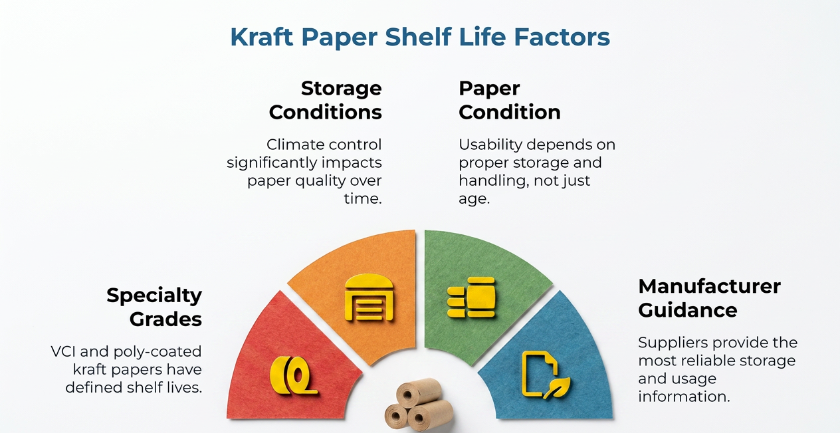
While natural, untreated kraft paper does not come with a universal expiry date, specialty grades—such as VCI (Volatile Corrosion Inhibitor) or poly-coated kraft—often have strict manufacturer-defined shelf lives, typically ranging from one to three years. For untreated grades, shelf life generally refers to how long the paper can maintain its intended properties when stored according to the supplier’s guidance, rather than a fixed countdown.
Two rolls of the same grade, manufactured on the same day, can behave very differently after months in storage if one was kept in a climate-controlled warehouse while the other sat in a facility exposed to seasonal humidity changes.
A common mistake is treating “old” and “bad” as synonymous.. Stored kraft paper may still be usable if it has been protected, rotated, and inspected properly. Newer stock can also create problems if it was exposed to moisture, damaged during handling, or received with compromised wrapping. The better question is not only how old the paper is—it is whether enough is known about the material to release it for the intended packaging job, a decision that depends on how the specific paper grade and packaging dictate shelf-life.
The manufacturer or supplier who produced the material is the most reliable source for storage recommendations and usable-life expectations for a particular grade. Without requesting that guidance, procurement teams make storage and reorder decisions based on incomplete information.
Hypothetical example: A procurement team inherits 14 pallets of kraft paper from a facility consolidation. The material arrived with shipping documents, but there is no storage history, no supplier data sheet, and no record of how long the rolls sat before transfer. The receiving date is known; the manufacturing date is not. The date alone provides almost no insight into whether the material will convert consistently.
What Can Change When Kraft Paper Is Stored Too Long or Stored Poorly?
Kraft paper is hygroscopic, meaning it naturally absorbs and releases moisture in response to its surrounding environment. When storage conditions are uncontrolled, this behavior can shift the paper’s moisture balance—the equilibrium between its internal moisture content and ambient conditions—away from the range where it was designed to perform.
Humidity fluctuation is the most common storage risk factor. Repeated cycles of high and low relative humidity can cause uneven moisture absorption, which may contribute to waviness, curling, or dimensional changes in rolls and sheets. Even warehouses that feel dry can present condensation risks during seasonal temperature swings, particularly on concrete floors or near exterior walls. Our article, ‘How humidity and moisture can affect kraft paper shelf life,’ explores this relationship in more detail.
Handling and physical stacking geometry introduce structural load risks. Stacking rolls beyond manufacturer height limits exerts excessive vertical compression force, causing roll out-of-roundness (ovality). Sheets without rigid, flat pallet support suffer cantilever sagging, leading to permanent edge set and localized creasing over time. Forklift clamp marks, crushed cores, torn wrapping, dust accumulation, and prolonged heat exposure can further compromise surface quality. Once wrapping is damaged or removed, the primary defense against environmental exposure is gone.
Storage contamination is a practical concern as well. Dust, odor transfer, staining, or contact with unsuitable materials may make kraft paper questionable for certain packaging applications. A dry-looking warehouse is helpful, but it is not proof of suitability. Good storage also needs traceability, intact protection, careful handling, and clear release checks.
Testing and conditioning standards reinforce the point. TAPPI T 402 and ISO 187:2022 establish standard atmospheres for conditioning and testing paper, board, and pulp. These standards exist because paper properties are measurably sensitive to temperature and humidity—a principle that applies in the warehouse just as it does in the lab. These standards establish empirical baselines for material stabilization—specifically requiring an environment of 23°C ± 1°C and 50% ± 2% relative humidity—making them critical operational frameworks rather than mere context.
How Shelf-Life Risk Shows Up in Packaging Operations
Storage-related changes in kraft paper condition rarely appear on a data sheet. They surface on the production floor—often as symptoms attributed to machine settings, operator technique, or supplier quality before anyone considers storage history.
Hypothetical example: A packaging facility runs two lots of the same kraft grade in one week. Lot A, received recently and stored in a temperature-stable area, converts without issue. Lot B, pulled from older inventory near an exterior loading dock during a humid season, shows uneven tension and different fold behavior. Operations reports inconsistency; procurement records show both lots came from the same supplier with identical specifications. Neither procurement nor the supplier is at fault—the storage environment introduced a variable no one accounted for.
Potential signs of storage-related condition changes include converting variability such as uneven tension or feed inconsistency, surface or edge changes not noted at receiving, print or adhesion concerns on previously reliable material, and higher-than-usual rejection rates on runs using older stock.
These signals warrant investigation, not automatic rejection. Root cause may involve storage, handling, machine calibration, or some combination. When inconsistency appears and the material came from aged or poorly documented inventory, storage conditions should enter the diagnostic conversation early.
That distinction protects procurement from the wrong conversation. A supplier may have shipped acceptable stock, but the warehouse may have stored it poorly. The warehouse may have rotated material correctly, but supplier guidance may have been vague. Operations may report a real problem, but the cause may involve grade fit, machine settings, storage exposure, or handling damage. Start with the evidence pack: receiving date, batch or roll identity, supplier reference, wrapping condition, storage location, movement history, visible damage, production job details, and any historical performance issues. The approach outlined in how to document kraft paper problems before you call the supplier provides a structured method for assembling this kind of supplier-ready record. If the same grade, supplier, or warehouse zone has caused concerns before, that pattern should influence the release decision.
Kraft Paper Shelf-Life Risk Check
The following table maps common shelf-life risk factors to procurement questions, operational checks, and escalation triggers.
| Risk Factor | What Procurement Should Ask | What Operations Should Inspect | Escalate When |
| Unknown receiving date | Request batch or delivery documentation from the supplier | Check labeling, stock rotation records, and receiving logs | Batch or origin documentation is unavailable |
| Humidity exposure | Ask for the supplier’s recommended storage conditions for this grade | Look for waviness, dampness, odor, or staining on rolls or sheets | Surface waviness, staining, or dampness exceeds tolerable thresholds |
| Damaged wrapping or edges | Ask about packaging and handling expectations during transit and storage | Inspect for tears, crushed edges, core damage, or deformation | Structural roll deformation limits automated feed mechanisms |
| Long storage before production | Ask whether the supplier recommends conditioning or retesting before use | Run a small pre-use trial or sample check where appropriate | Stock age exceeds 12 months without verified conditioning data |
| Unclear grade or end-use suitability | Confirm the grade designation and intended application with the supplier | Compare material specifications against the production requirement | Physical properties deviate from required converting specifications |
General corrugated packaging industry guidance supports practical storage discipline: store in cool, dry conditions, minimize storage time through FIFO, avoid overstacking, handle loads carefully, and inspect before use. This offers useful operational context, though it is not kraft-specific proof.
Use, Inspect, or Escalate
A simple release path keeps decisions consistent across shifts and team members.
Use the stock when the receiving date, grade, supplier documentation, wrapping condition, and storage history are clear enough for the intended job.
Inspect the stock when age, handling history, wrapping condition, or storage exposure is uncertain—using the approach described in warning signs kraft paper may have lost durability during storage as a practical inspection reference. Inspection should include both visible condition and production-readiness concerns.
Escalate the stock when storage history is unknown, visible damage exists, supplier guidance is missing, the job is critical, or similar material has caused previous issues.
This process prevents two costly mistakes. It reduces the chance of releasing questionable stock too quickly. It also prevents teams from rejecting usable stock without evidence.
Supplier Questions Procurement Should Ask Before Buying or Using Aged Stock
The difference between a productive supplier conversation and a frustrating one often comes down to specificity. “Is this material still good?” invites a vague answer. Targeted questions produce documentation that procurement, operations, and quality can all act on.
Before purchasing or releasing aged kraft paper for production—and particularly before buying in bulk—consider asking:
- What storage conditions—including temperature and humidity ranges—does the supplier recommend for this specific grade?
- Does the technical data sheet include grade-specific shelf-life or usable-life guidance?
- What packaging or wrapping should remain intact during storage, and how does the recommendation change if wrapping is compromised?
- Does the supplier recommend conditioning, retesting, or trial runs for material stored beyond a certain period?
- What documentation—such as certificates of analysis, batch records, or storage handling notes—should accompany older stock?
- What visible warning signs should trigger inspection or review before use?
- Are there application-specific cautions for printing, converting, wrapping, bag making, or other packaging uses?
Practical example: Rather than asking, “Can we still use the kraft paper from last quarter?” try: “We have 14 pallets of your 80 GSM kraft liner stored since January without climate control. Can you advise whether conditioning or retesting is recommended before converting?” That version gives the supplier enough context to respond with actionable guidance and creates a documented exchange that protects procurement if issues arise.
This is also where repeat-purchase confidence starts. A supplier that gives clear storage, handling, and documentation guidance is easier to evaluate for future orders. A supplier that leaves these details unclear may still be viable, but procurement should close the information gap before the next reorder.
When evaluating or sourcing kraft paper parent roll suppliers, the quality of storage and handling documentation a supplier provides can be as informative as the material specifications themselves. For broader sourcing research, PaperIndex also lists kraft paper mills, kraft paper mother rolls, and kraft paper buyers as part of its global paper industry marketplace.
How to Reduce Avoidable Inconsistency in Stored Kraft Paper
Start with receiving discipline. Every roll or stack should have an identifiable receiving date, supplier reference, grade, and storage location. Without that trail, even a clean warehouse becomes a guessing exercise when production needs material fast.
FIFO—first in, first out—is a sound inventory rotation principle, but not a complete storage risk strategy, as the article on, why ‘First-In, First-Out’ (FIFO) fails for food-grade packaging paper storage, illustrates in a related packaging context. Rotating stock by age prevents material from sitting indefinitely, yet if the oldest stock was stored in poor conditions, FIFO moves a potential problem to the front of the queue rather than catching it. Use FIFO, but do not let FIFO replace judgment. Pair rotation with condition awareness. The oldest stock should also be the most closely inspected stock.
Keep material in cool, dry, stable conditions. Avoid areas near loading docks, exterior walls, or overhead pipes where temperature and humidity can fluctuate—risks examined in detail in how to protect kraft paper parent rolls from warehouse moisture and temperature risks before converting. General packaging-industry handling guidance supports similar principles: minimizing storage time, avoiding overstacking, careful handling, and inspection before use.
Maintain wrapping integrity throughout the storage period. Kraft paper wrapping is not just transit packaging—it serves as the primary environmental barrier during warehouse storage. Damaged or removed wrapping accelerates moisture exchange and contamination exposure. Once wrapping is torn, loose, or missing, inspection becomes more important. That does not require automatic rejection—it requires a better release decision. Review the kraft paper storage conditions your warehouse currently maintains, particularly before increasing order volume or extending storage periods.
Handling discipline matters too. Avoid unnecessary re-handling, poor stacking, dragging, clamp damage, and edge impact—the kind of cumulative damage detailed in kraft paper parent roll handling: how to prevent damage before production starts. The more often material moves, the more chances it has to pick up damage that only becomes obvious at production speed.
Inspect before production use. A brief visual and tactile check—looking for waviness, edge damage, odor, discoloration, or wrapping compromise—can flag condition concerns before they become converting problems. For parent rolls, receiving controls at receiving and before release add a practical checkpoint.
The hard part is timing. Procurement may be under availability pressure. Operations may resist inspection delays when a machine is waiting. That is exactly why the release rule should be agreed in advance. A brief check before production is easier than a line stoppage, rejected output, or supplier dispute later.
When Old Kraft Paper Needs Quality Review Before Use
Not every roll of aged kraft paper needs a formal quality review. But certain conditions should prompt escalation beyond a standard visual check.
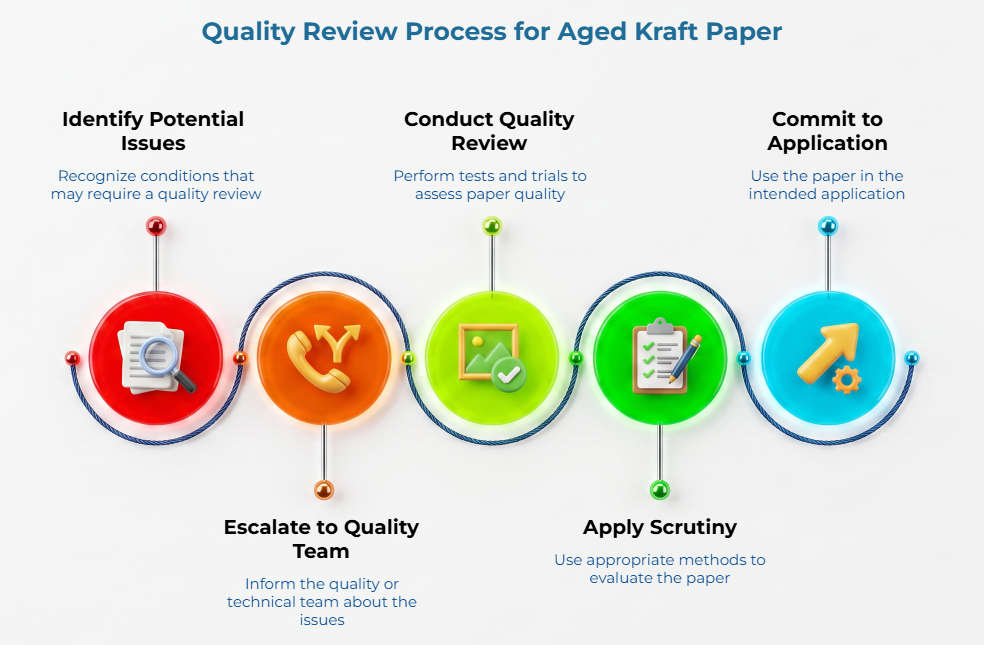
Escalate to your quality or technical team when storage history is unknown or undocumented—especially if material changed facilities or arrived without a certificate of analysis. Escalate when visible damage goes beyond cosmetic: significant edge crush, core deformation, widespread waviness, staining, or odor suggesting moisture exposure. Escalate when the material is destined for a critical application with tight converting tolerances or high-volume runs. And escalate when supplier guidance for the grade and application is missing, or when operations have already reported inconsistency from similar stock.
Quality review does not mean automatic rejection. It means applying appropriate scrutiny—sample testing, a conditioning trial, or a short production run—before committing aged material to a full job.
Certificates and supplier documents help, but they do not remove storage risk after arrival. Once material enters your warehouse, internal records, handling discipline, storage controls, and release checks become part of the quality chain. That shared responsibility is the point.
Treat Shelf Life as a Quality Conversation, Not Just a Date
Kraft paper shelf-life risk is manageable when procurement, operations, quality, and suppliers share a common understanding of what “usable condition” means for a specific grade and application.
Review supplier storage guidance before material sits for extended periods. Inspect aged stock before releasing it to the line. Document what you find—so the next purchasing decision, the next supplier conversation, and the next quality review all start from a stronger foundation.
Before using aged stock, confirm the kraft paper grade, storage history, and supplier handling guidance with your quality or sourcing team.
Frequently Asked Questions
Does kraft paper expire?
Kraft paper does not have a fixed expiration date that applies across all grades and applications. Usability after storage depends on supplier guidance, the specific grade, storage conditions, handling practices, and the intended packaging application. Rather than relying on a single timeline, ask the supplier for grade-specific storage recommendations.
Can stored kraft paper still be used for packaging?
In many cases, kraft paper that has been properly stored and handled can still perform consistently. The more useful question is not how old the material is but what conditions it experienced and whether it was inspected before use. Material with unknown storage history or visible signs of environmental exposure should be reviewed by quality or technical teams before critical production use.
What should procurement ask suppliers about kraft paper shelf life?
Ask about recommended storage conditions, grade-specific usable-life guidance, packaging and wrapping requirements during storage, conditioning or retesting recommendations for older stock, and what documentation should accompany aged material. Specific, targeted questions produce specific, actionable answers—and a documented trail that supports better procurement and quality decisions.
Disclaimer:
This article is for educational and informational purposes only. Storage conditions, shelf-life expectations, and inspection criteria may vary by kraft paper grade, supplier, and intended application. Always consult your supplier’s technical documentation and your internal quality team before making procurement or production decisions based on material age or storage history.
Our Editorial Process:
Our expert team uses AI tools to help organize and structure our initial drafts. Every piece is then extensively rewritten, fact-checked, and enriched with first-hand insights and experiences by expert humans on our Insights Team to ensure accuracy and clarity.
About the PaperIndex Insights Team:
The PaperIndex Insights Team is our dedicated engine for synthesizing complex topics into clear, helpful guides. While our content is thoroughly reviewed for clarity and accuracy, it is for informational purposes and should not replace professional advice.