
📌 Key Takeaways
Moisture tolerance must be locked into your purchase order before comparing suppliers—not tested after rolls arrive.
- Specification Beats Inspection: Receiving checks are too late; by the time you find moisture problems, the shipment has cleared customs and invoices are paid.
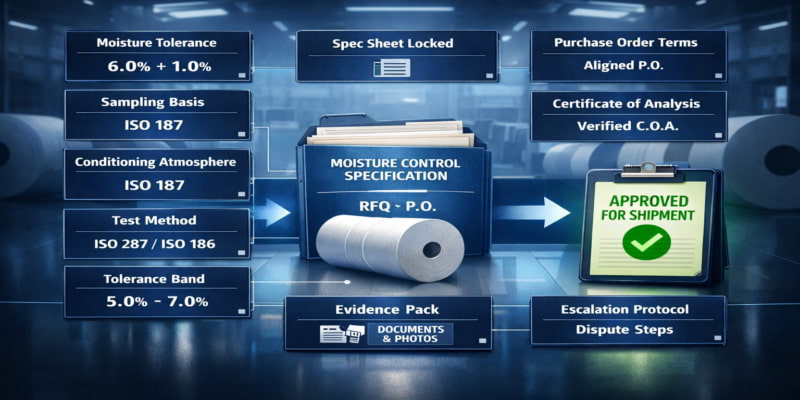
- Lock Ten Fields Before Quoting: Define the test method, conditioning atmosphere, sampling rules, tolerance band, and escalation logic before any supplier comparison begins.
- Choose the Right Test Method: Cobb tests measure water resistance in coated papers—they don’t predict how absorbent toilet tissue will run on your converting line.
- Separate Common from SKU-Specific Rules: Build one master template for test method language and reporting cadence, then add grade-specific targets for each product family.
- Require Evidence Before Shipping: Suppliers should prove compliance before the container loads, not explain problems after it arrives.
Control moisture in the contract, not the complaint.
Senior toilet tissue converting teams will find a ready-to-use specification framework here, preparing them for the detailed field-by-field guidance that follows.
~ ~ ~ ~ ~ ~ ~ ~ ~ ~ ~ ~ ~ ~ ~ ~ ~ ~
The toilet tissue parent rolls passed every visual check. The supplier’s documentation looked clean. But three hours into converting, the embossing rollers started catching. Edge cracks appeared. The moisture reading registered 2.3 percentage points above the contractual limit.
Post-delivery inspections are an autopsy. Pre-PO specification locking is preventive medicine.
For toilet tissue converters navigating the minefield of cross-border transit, moisture tolerance alignment is a critical operational parameter. It determines whether parent rolls remain stable from mill release through converting. Moisture-related variation can distort how other quality values are read, especially when test method language, conditioning atmosphere, or lot sampling are left open to supplier interpretation. Other articles explain moisture risk. This article guides a senior toilet tissue converting team in establishing moisture tolerance as a baseline operational requirement.
Why Moisture Tolerance Is the Deciding QA Variable in Toilet Tissue Parent Rolls
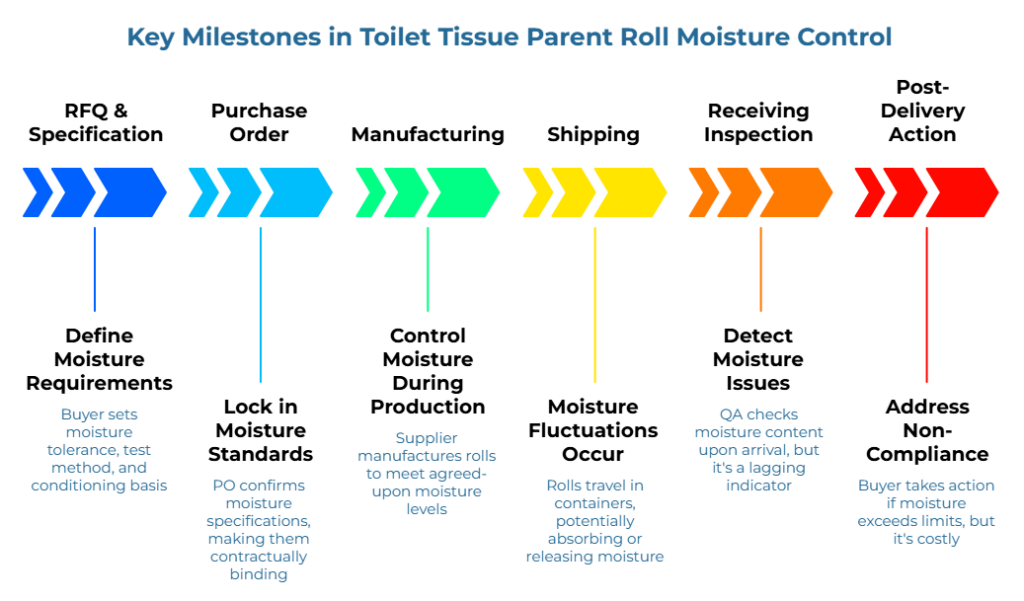
Toilet tissue parent rolls are hygroscopic—they absorb and release moisture based on the environment. A roll manufactured at one moisture level will not arrive at that level after weeks in a shipping container.
Moisture content directly affects line stability. Rolls arriving too dry become brittle, causing edge cracking. Rolls arriving too wet create tension instability. For private-label toilet tissue operations, these failures result in immediate supply chain liability: retailer rejections, production downtime, and contractual non-compliance. The buyer-owned specification matters more than the supplier’s generic data sheet.
Why Post-Delivery Inspection Fails: Moisture Must Be Locked Before the PO
Receiving inspection is a lagging indicator. By the time QA confirms that toilet tissue parent rolls exceed your moisture limit, the container has cleared customs and accounts payable has processed the invoice. Specification language must be the leading control.
The real control point is earlier: the RFQ, specification sheet, and purchase order. If the named test method, conditioning basis, tolerance band, and escalation triggers are not fixed before quote comparison, they cannot be enforced after delivery. Without those points fixed in advance, receiving turns into a fact-finding exercise rather than a control system. For test method language guidance, see ISO 287 wording for toilet tissue RFQs.
The Toilet Tissue QA Blueprint: The Fields You Must Lock Before Comparing Suppliers
Before comparing suppliers or issuing a PO, define these fields in your buyer-owned specification:
| Field | Why It Matters | Owner | Where It Appears | Evidence Expected | Action If Misaligned |
| Moisture or absorbency property being controlled | Prevents vague “moisture performance” language | QA | Specification sheet, RFQ | Defined property language | Hold clarification before quote comparison |
| Named test method | Eliminates ambiguity and stops supplier-side test method substitution | QA with Procurement | RFQ, Specification Sheet, PO | COA citing method | Reject comparability until aligned |
| Conditioning atmosphere | Ensures comparable readings | QA | Specification Sheet, PO, COA | ISO 187 reference | Do not treat unmatched results as equivalent |
| Lot sampling basis | Prevents cherry-picked samples and makes results dispute-resistant | QA | Specification Sheet, RFQ, PO | Sample count per lot with lot definition | Request resubmission or hold shipment |
| Target value and tolerance band | Defines pass/fail boundary and converts measurement into a usable decision | QA with Procurement | RFQ, PO, COA | Numeric range stated with acceptance logic acknowledged by supplier | Hold, reject, or escalate per rule |
| Reporting cadence | Creates variation visibility and defines when data must appear | Procurement with QA | PO, RFQ | Per-lot or per-shipment reporting | Stop progression to next operation |
| COA requirements | Documents evidence pack and connects results to delivered material | QA | Specification Sheet | Complete format with lot ID, test method, date, result | Hold receipt pending correction |
| Pre-shipment approval | Creates checkpoint and moves control upstream | Procurement with QA | PO | Written acknowledgment and evidence pack before dispatch | Do not approve shipment release |
| Receiving controls | Defines inbound protocol and preserves continuity after arrival | QA | Internal SOP | Test results logged with acclimatization notes and disposition status | Hold, inspect, or quarantine |
| Escalation logic | Specifies disposition | QA with Procurement | PO, SOP | Hold documentation | Escalate before release if missing |
Adherence to ISO 287 (oven-drying), ISO 187 (conditioning), and ISO 186 (sampling) establishes the technical framework for moisture control.
Test Method Discipline: Choosing the Right Moisture or Absorbency Test Language
Test method discipline is where many toilet tissue parent roll moisture specifications break down. Not all water-related test methods are interchangeable.
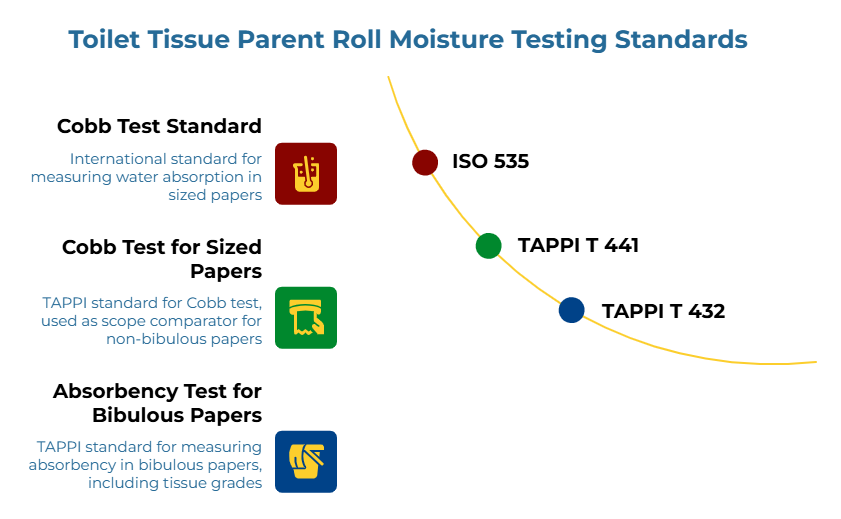
The Cobb test—governed by ISO 535 and TAPPI T 441 — measures water absorption in sized, low-absorbency papers. T 441 serves as a scope comparator for sized, non-bibulous papers, and should not be substituted for absorbency-specific metrics in tissue grades. Toilet tissue parent rolls are absorbent by design. Applying Cobb values to absorbent grades produces a number that does not predict converting performance.
For absorbent grades, use the absorptiveness or absorbency method appropriate to the product. TAPPI T 432 addresses bibulous papers including tissue grades. Name the test method. Verify it applies to the grade. Test method choice varies by grade and end-use conditions.
How to Write Moisture Tolerance Clauses Everyone Interprets the Same Way
A moisture clause fails when each party thinks it means something slightly different.
Procurement cannot own the wording alone. QA cannot own it only at receipt. Technical specifications must be decoupled from commercial terms to ensure engineering clarity. Consensus on these metrics must be documented prior to finalizing the RFQ stage.
Specification language fails when it leaves room for interpretation. Be specific about the baseline—”acceptable industry limits” invites dispute. The clause should state the named test method, the lot basis, the conditioning basis, the required result or reporting value, the tolerance band, the reporting frequency, the certificate of analysis requirement, and the action trigger if misaligned. Define the measurement point explicitly. Specify reference atmosphere per ISO 187. Include lot and sample language preventing cherry-picking. Legal drafting style is secondary. Interpretive clarity is the priority.
Pre-Shipment and Receiving Controls for Toilet Tissue Parent Rolls
The blueprint continues beyond RFQ language. Require certificate of analysis data before container loading. Review results against your tolerance band. If the evidence pack is incomplete before dispatch, the shipment should not move forward as though the control is already satisfied.
At receiving, allow acclimatization—typically 24 to 72 hours—before running inbound QA checks under conditioned atmosphere. If the COA cannot be tied cleanly to the lot received, receiving controls are already weakened. Log every lot with supplier identification, COA data, and internal test results.
How to Standardize the Blueprint Across Suppliers and Toilet Tissue SKUs
Create a buyer-owned master specification template containing all fields above. Assign ownership: Procurement owns RFQ wording; QA owns test method selection; Supply Chain owns receiving controls.
A strong toilet tissue converting QA blueprint separates common controls from SKU-specific controls. The common layer holds test method language, reporting cadence, evidence-pack requirements, receiving controls, and disposition rules. The SKU layer holds grade-specific targets, tolerance logic, and any absorbency-method differences that vary by product family. This bifurcation transforms ad-hoc corrections into a repeatable operating standard and makes supplier comparison cleaner because each supplier is reacting to the same buyer-owned structure.
The broader framework for standardizing toilet tissue parent roll specifications for runnability shows how moisture integrates with other parameters. For pre-evaluation alignment, see normalizing absorbency and moisture tolerances before evaluating suppliers.
Audit annually. Specifications drift.
Frequently Asked Questions
What moisture specifications should a toilet tissue parent roll RFQ include?
At minimum: the named test method (ISO 287), conditioning atmosphere (ISO 187), sampling basis (ISO 186), target value, tolerance band, COA requirements, reporting frequency, pre-shipment QA requirement, and escalation logic.
Is ISO 287 enough for toilet tissue moisture control?
ISO 287 supports moisture-content determination of a lot, but it does not replace the need for explicit conditioning language, representative lot sampling, and acceptance logic. Combine ISO 287 with ISO 187 for conditioning and ISO 186 for sampling to create a complete framework.
When is Cobb relevant for toilet tissue?
Cobb should be handled cautiously. It applies to sized, non-absorbent papers. T 441 serves as a scope comparator for sized, non-bibulous papers, not as a universal toilet tissue method. For absorbent toilet tissue grades, use TAPPI T 432.
How should QA and procurement divide responsibility?
Procurement owns commercial terms. QA owns test method selection and disposition authority. Both align before RFQs go out. Supplier technical contacts cannot be left to infer the real requirement from a commercial line item.
What evidence should suppliers provide before shipment?
Pre-PO and pre-shipment evidence including certificate of analysis with test method, conditioning conditions, sample count, lot identification, and a clear evidence pack tied to the agreed control fields. The shipment should be supported before release, not explained after arrival.
Explore PaperIndex Academy for guides on toilet tissue parent roll moisture control. Browse toilet tissue parent roll suppliers on PaperIndex.
Disclaimer:
This article is for educational purposes only. It is not a substitute for product-specific QA validation, supplier qualification, or legal contract review.
Our Editorial Process:
Our expert team uses AI tools to help organize and structure our initial drafts. Every piece is then extensively rewritten, fact-checked, and enriched with first-hand insights and experiences by expert humans on our Insights Team to ensure accuracy and clarity.
About the PaperIndex Insights Team:
The PaperIndex Insights Team is our dedicated engine for synthesizing complex topics into clear, helpful guides. While our content is thoroughly reviewed for clarity and accuracy, it is for informational purposes and should not replace professional advice.