

📌 Key Takeaways
Toilet tissue converting lines run on measurable specifications — not visual approval or supplier shorthand.
- Specifications Beat Samples: Visual inspection cannot detect GSM variation, moisture gradients, or bulk differences that cause real line jams.
- Three Numbers Work Together: GSM, bulk, and moisture must all be specified together — each one affects how the other two perform at speed.
- Name the Test Method: Without a named standard (like ISO 287 for moisture), two suppliers can measure the same roll and report different numbers.
- Tolerances Are Not Optional: A target without a tolerance band (e.g., 18 GSM ± 0.5) leaves suppliers free to interpret — and quote — differently.
- Moisture Moves After Shipping: A roll can leave the mill within specification and arrive outside it; specification must state when and how moisture is measured.
A buyer-owned specification baseline is an operational control tool, not a purchasing formality.
Procurement managers, converting plant managers, and private-label product teams will build a shared, enforceable baseline here, preparing them for the detailed supplier comparison guide that follows.
~ ~ ~ ~ ~ ~ ~ ~ ~ ~ ~ ~ ~ ~ ~ ~ ~ ~
Toilet tissue converting depends on exact physical parameters, not supplier shorthand or visual approval. This guide explains how GSM, bulk, and moisture work together to control runnability, and how to build a buyer-owned specification baseline that eliminates ambiguity before supplier comparison begins.
Why Toilet Tissue Parent Roll Specifications Decide Whether a Converting Line Runs Smoothly
Vague specifications break good lines.
A parent roll may appear visually pristine at receiving yet harbor internal physical inconsistencies that compromise runnability under high-speed tension. What matters is whether the roll’s measurable properties fall within the tolerances your equipment requires.
This is an operational-control issue, not a purchasing shortcut.
When a parent roll arrives with properties that deviate from what your line expects, the consequences appear immediately. Web breaks. Tension failures. Uneven perforation. Finished rolls that fail downstream quality checks. By that point, the damage is already built into your production day.
The specification sheet is the control point. It establishes the mechanical boundaries within which the converting line must operate. If that specification is vague, incomplete, or left to the supplier’s interpretation, you have no reliable way to predict how the roll will behave.
High-speed lines amplify small variations. A moisture shift that seems trivial on paper can translate into tension instability at 600 meters per minute. A bulk variation that falls within range by one supplier’s standards may fall outside the range your equipment tolerates.
Treat the toilet tissue specification sheet like an architectural blueprint. If the dimensions are vague, the build fails.
This matters most for the teams carrying real production risk: procurement managers, converting plant managers, and product-development managers working on private-label toilet tissue programs—teams that depend on reliable tissue paper raw material suppliers to maintain production continuity. Their problem is not abstract paper theory. It is the operational drag of line jams, rejected shipments, weak quote comparability, and the uncertainty of not knowing whether a roll that looks right will actually run right.
Standardizing toilet tissue parent roll specifications establishes the measurable baseline that separates a roll that will run from one that will cause problems. Without that baseline, every shipment becomes a gamble.
The Three Core Measurements Behind Toilet Tissue Runnability: GSM, Bulk, and Moisture
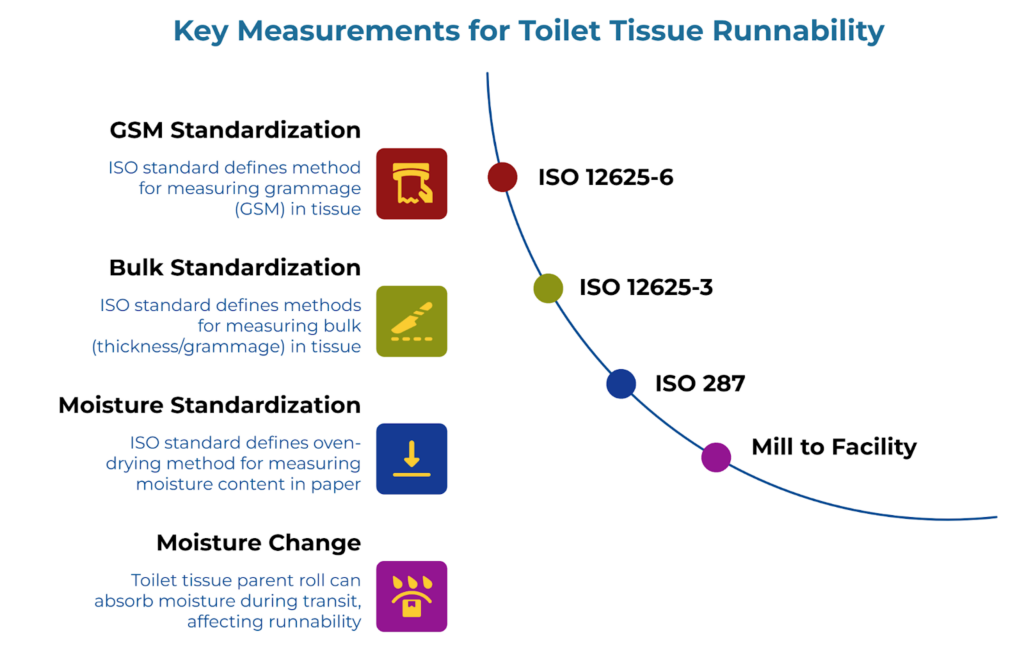
Toilet tissue runnability depends on three measurable properties: grammage (GSM), bulk, and moisture content. Each one controls a different aspect of how the roll behaves on the converting line.
None of them can be interpreted in isolation. They function as an interdependent system.
What GSM Actually Tells You in Toilet Tissue Parent Rolls
GSM, grams per square meter, describes the mass of the tissue sheet per unit area. It is the baseline density measurement. ISO 12625-6 provides the standardized test method for determining grammage in tissue paper and tissue products.
In toilet tissue, GSM influences tensile strength, opacity, and the amount of material in each finished roll. A lower GSM typically means a lighter, softer sheet. A higher GSM typically means a denser sheet with more fiber per unit area.
However, GSM alone does not tell you how the sheet will feel, how it will convert, or how it will perform at high speed. Two toilet tissue parent rolls can share the same GSM and behave completely differently on the same line. The GSM number captures mass per unit area, not structural behavior.
Why Bulk Cannot Be Inferred from GSM Alone
Bulk describes the volume a tissue sheet occupies relative to its weight. It is calculated as thickness divided by grammage and typically expressed in cm³/g. ISO 12625-3 defines the test methods for determining thickness, bulking thickness, apparent bulk density, and bulk for tissue paper and tissue products.
A high-bulk toilet tissue sheet has more air trapped within its structure. This affects softness, absorbency, and how the sheet compresses under tension. A low-bulk sheet may have the same GSM but feel denser and convert differently.
The practical consequence is significant. You cannot assume bulk from GSM. A 17 GSM parent roll with high bulk will not behave the same as a 17 GSM parent roll with low bulk. Your equipment settings, tension profiles, and perforation parameters may need to differ for each.
Omitting bulk from the specification allows for structural variance that impacts softness perception and caliper-related line response, even when the GSM target is met.
Why Moisture Control Matters Before and After Shipping
Moisture content measures the percentage of water in the tissue sheet at a given point in time. ISO 287 defines the oven-drying method for determining moisture content in paper and board products.
Moisture affects dimensional stability, tensile behavior, and converting performance. A toilet tissue sheet that absorbs moisture during transit will behave differently from the same sheet measured at the mill. It may stretch, swell, or lose tensile strength.
The challenge is that moisture is not static.
A parent roll can leave the mill within specification and arrive at your facility outside specification due to transit conditions, storage humidity, or climate exposure. If your specification does not account for moisture measurement timing and test method, disputes become difficult to resolve.
Moisture belongs in the specification baseline, not in an after-the-fact investigation when something goes wrong.
How GSM, Bulk, and Moisture Interact on High-Speed Toilet Tissue Converting Lines
These variables form an interdependent matrix; a shift in one parameter fundamentally alters the operational significance of the others.
When a Toilet Tissue Roll Hits GSM but Still Converts Poorly
A parent roll that meets the GSM specification can still fail to convert well if bulk or moisture deviates. Consider two rolls, both at 18 GSM. One has high bulk from aggressive creping; the other has lower bulk from a different process. On the same converting line, these rolls will respond differently to tension, compression, and winding.
GSM compliance is necessary. It is not sufficient.
How Bulk Affects Structure, Feel, and Converting Behavior
Bulk determines how the sheet compresses under the pressures applied during converting. High-bulk tissue compresses more under nip pressure and may require different tension profiles.
Bulk also affects feel. Retailers and private-label buyers often specify softness expectations that correlate with bulk. A shift in bulk can move the finished product outside the perceptual range the customer expects, even if GSM and moisture remain on target.
How Moisture Can Shift Performance Before the Roll Reaches Production
A parent roll that leaves the mill at one moisture level may arrive at your facility at a different level due to transit conditions or warehouse storage.
Higher moisture reduces tensile strength and increases dimensional instability. On a high-speed line, these changes translate into web breaks, tracking problems, or inconsistent finished rolls. Moisture specification must include not only the target value but also the point at which measurement occurs.
Why Small Inconsistencies Compound at High Speed
At low converting speeds, the equipment has more time to compensate for variation. Tension adjustments and operator interventions can absorb modest inconsistencies.
At high speed, the window for compensation shrinks dramatically. A tension instability that would self-correct at 200 meters per minute may escalate into a web break at 600 meters per minute.
This is why specification discipline matters more as line speed increases.
A useful mental shortcut: GSM tells you how much material is present, bulk helps explain how that material is structured, and moisture influences how that structure behaves in the real world. None of those three values should be read alone. They belong together.
Structural Vulnerabilities in Pre-Comparison Specifications
Specification gaps often emerge before the first quote request ever goes out. The problems are structural, built into how the specification is written, communicated, or interpreted.
The Problem with Visual-Sample Approval
Visual samples are not a reliable control system for high-speed toilet tissue converting.
A sample roll can look acceptable and still contain variations that cause problems in production. Visual inspection cannot detect GSM variation across the roll width. It cannot detect moisture gradients inside the roll. It cannot detect bulk variation between layers. These variations affect converting behavior, but they are invisible to the eye.
When buyers approve suppliers based on visual samples, they inherit specification ambiguity. The sample may have been carefully selected. The production run may vary.
For a deeper explanation of this issue, see the related guide, ‘why visual samples cause toilet tissue line jams’.
Missing Tolerance Bands
A specification that names a target value without a tolerance band is incomplete. 18 GSM is not a specification. 18 GSM ± 0.5 GSM is a specification.
Without tolerance bands, suppliers interpret the target differently. Both can claim compliance. Neither may perform adequately on your line.
Unnamed Test Methods
Two suppliers testing moisture content using different test methods will report different numbers for the same roll.
ISO 287 specifies oven-drying at 105°C ± 2°C. If your specification fails to define the test method, you lose the ability to compare results, as alternative testing protocols can yield divergent data for the same roll.
The same problem applies to bulk, caliper, and tensile measurements. ISO 12625-3 defines specific procedures for tissue thickness and bulk. If your specification references bulk but not the test method, the number becomes ambiguous.
Named test methods are not optional. They are the mechanism that makes specification numbers comparable across suppliers and shipments.
Supplier-Led Shorthand
When buyers rely on supplier-provided specifications instead of defining their own, they inherit the supplier’s assumptions.
A supplier may describe a roll as standard, premium, or close to your last order without defining what those terms mean in measurable terms. Terms like standard export quality or usual premium softness may be commercially familiar, but they are not reliable technical language. Supplier shorthand is efficient for the supplier. But it transfers interpretive control away from the buyer.
A buyer-owned specification baseline returns that control, ensuring that when you find suppliers through any channel, you evaluate them against your requirements rather than theirs.
Recycled-Fiber Variation
Toilet tissue parent rolls made from recycled fiber introduce additional challenges. Recycled furnish varies by source. If your specification does not address recycled content—whether it is permitted, what percentage is allowed, and what quality controls apply—you may receive rolls with unpredictable fiber characteristics.
Transit and Climate Exposure Assumptions
A specification that assumes stable conditions from mill to facility is incomplete. Moisture can shift during ocean transit. Temperature swings can affect roll integrity. If these factors are not addressed, disputes become difficult to resolve.
How to Build a Buyer-Owned Toilet Tissue House Specification
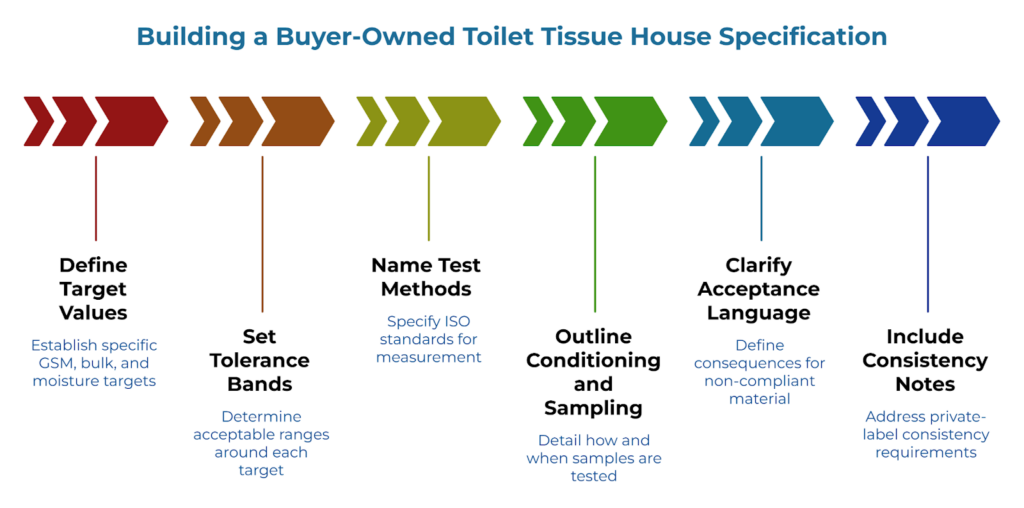
A buyer-owned house specification is a document that defines exactly what your facility requires from a toilet tissue parent roll. It is your baseline, the standard against which all supplier offers are evaluated.
A strong toilet tissue house specification should let procurement, plant, and product teams work from one shared baseline instead of three different interpretations. A useful toilet tissue specification blueprint has six parts:
1. Target values: Define the requested GSM, bulk, and moisture targets in clear metric terms. Begin with the target values for each critical parameter. These are the numbers your converting line expects to see. For toilet tissue parent rolls, critical parameters typically include grammage (GSM), bulk expressed in cm³/g, moisture content at measurement, and caliper expressed in micrometers or millimeters. Each target should reflect your actual production requirements, not a generic industry norm.
2. Tolerance bands: State what range is acceptable around each target. Tolerance bands must be realistic. Tolerances that are too tight may disqualify capable suppliers. Tolerances that are too loose may permit variation that causes converting problems. The appropriate tolerance depends on your specific equipment, line speed, and end-product requirements. What works for one converter may not work for another.
3. Named test methods: Tie each value to a defined test method, not just a metric label. This ensures that measurements are comparable. Generally accepted standards for toilet tissue include ISO 12625-6 for grammage, ISO 12625-3 for bulk and thickness, and ISO 287 for moisture content. ISO 12625-1 establishes the standardized terminology used throughout the tissue industry to ensure technical alignment, which helps maintain terminology discipline across specifications. When the test method is named, all parties are measuring the same property in the same way. This eliminates one of the most common sources of quote incomparability.
4. Conditioning and sampling expectations: State how and when measurement should occur. Test results depend on how samples are conditioned before measurement. ISO standards typically require samples to equilibrate at standard atmospheric conditions (23°C ± 1°C, 50% ± 2% RH, as defined by ISO 187) before testing. Your specification should state whether samples must be conditioned according to the standard, how many samples must be tested, and from which positions in the roll samples should be drawn.
5. Acceptance language: Clarify what counts as conforming material. Define what happens when a measurement falls outside the tolerance band. Is the shipment rejected? Is it subject to review? Is there a concession process? Clear acceptance language prevents disputes. It establishes the consequences of non-compliance before any material ships.
6. Private-label consistency notes: Capture any repeatability needs tied to finished-roll performance or retailer expectations. Private-label contracts often require tighter consistency than generic supply agreements. Retailers expect the finished toilet tissue product to look and feel the same from shipment to shipment. Small specification drift can become visible on the store shelf, even if every individual shipment technically met a loosely defined specification. If you are converting for private-label customers, your house specification should reflect their tolerance expectations, not just your converting-line tolerances.
The most common mistake is stopping after target values. That leaves too much room for guesswork. The stronger practice is to write the target, the allowed window, the named test method, and the acceptance basis together.
How to Turn Toilet Tissue Specifications into Comparable Supplier Inputs
Once your house specification is defined, the next step is translating it into a format that makes supplier quotes directly comparable.
What to Name in the RFQ So Suppliers Cannot Guess Differently
When your RFQ includes named test methods and defined tolerances, suppliers must respond to the same baseline—a principle that applies whether you submit your buying requirements through a marketplace or directly to individual mills. This makes quotes comparable on a like-for-like basis.
A supplier who quotes 18-GSM toilet tissue parent rolls may be using a different test method, different tolerance assumptions, or different conditioning procedures than another supplier quoting the same number. If your RFQ does not specify these details, quotes are not directly comparable.
For a detailed methodology on achieving quote comparability, see the guide on normalizing toilet tissue parent roll quotes.
Why Quote Comparability Only Begins After Specification Comparability
Procurement teams often compare quotes before confirming that all quotes are based on the same specification interpretation. This leads to false conclusions.
Quote gaps that previously looked like price differences may reveal themselves as specification differences. A supplier whose quote seems high may actually be quoting to a tighter tolerance. A supplier whose quote seems low may be interpreting the specification more loosely.
The lowest quote is not necessarily the best value if the specification assumptions differ.
Synchronizing Procurement Requirements with Operational Realities
If procurement owns the specification and the plant operates the converting line, both must agree on what the specification means.
A disconnect between the two creates internal friction. Procurement may award business based on specification compliance. The plant may reject shipments based on converting performance. If the specification does not capture what the plant actually needs, this conflict is predictable.
A shared house specification, reviewed and accepted by both procurement and plant operations, prevents this misalignment.
A Practical Test for Distinguishing Specification Gaps from Supplier Gaps
A short internal test helps distinguish a true specification gap from a supplier-performance gap. If two capable suppliers can read the same RFQ and reasonably quote different physical assumptions, the problem is probably still in the specification. If the requirement is already precise and named, then any later variation is more likely to be a performance or compliance issue.
That distinction saves time and prevents the wrong argument.
Common Toilet Tissue Failure Modes This Specification Blueprint Helps Prevent
Standardized specifications do not eliminate all production problems. They eliminate the problems that originate from specification ambiguity.
How to Distinguish Specification Gaps from Supplier-Performance Gaps
When a toilet tissue parent roll causes problems on the converting line, the root cause typically falls into one of two categories: a specification gap (the house specification did not capture a parameter that matters) or a supplier-performance gap (the supplier failed to meet an adequate specification).
A well-constructed specification baseline makes this distinction clear.
Line Jams and Weak Runnability
Line jams often trace back to material inconsistency. When specifications are standardized, the incoming material is predictable. The line can be set up with confidence because the expected material actually arrives.
Transit-Related Drift
Moisture changes during transit affect converting performance. When the specification addresses moisture measurement timing and test method, transit drift becomes detectable and can be resolved before the roll reaches the converting line.
Shipment Rejection and Retailer Quality Complaints
Rejecting a shipment after it arrives disrupts production schedules and strains supplier relationships. Standardized specifications reduce rejection rates by ensuring that suppliers understand acceptance criteria before they ship.
For private-label converters, a tightly defined house specification prevents variation that would otherwise reach the store shelf.
Internal Finger-Pointing
When a converting line underperforms, blame often shifts between procurement and plant operations. A shared, measurable specification baseline eliminates this ambiguity. Either the material met the specification or it did not.
What to Standardize First if Your Team Needs a Practical Starting Point
Building a complete house specification takes time. If your team needs to start somewhere practical, prioritize moisture first. It has the most immediate impact on runnability and is often the most common source of specification-related problems.
Establish the moisture target, tolerance range, and the specific ISO 287 testing protocol, including the exact sampling point in the supply chain (e.g., at mill exit vs. at port of entry).
Then define GSM and bulk together as a pair, not as isolated parameters. Your specification should state target values and tolerances for each using named ISO test methods.
If you are converting for private-label customers, add tolerance discipline that reflects retailer expectations. This may mean tighter bands than your converting line technically requires.
Finally, document the house baseline and share it with procurement, plant operations, and suppliers. A specification that exists only in one person’s head is not a specification.
That sequence stays educational and practical. It does not tell a team how to award business. It gives them a cleaner mental model for how to stop ambiguity from entering the process in the first place.
Implementation Strategy
Standardizing toilet tissue parent roll specifications is foundational work. It establishes the operational baseline that makes supplier comparison meaningful and production predictable.
This is about operational control before supplier comparison, not after.
For more methodology-first sourcing guidance, explore the PaperIndex Academy.
Once your toilet tissue specification baseline is locked, you can begin reviewing toilet tissue parent roll suppliers or toilet tissue mills with confidence that your requirements are clear, measurable, and enforceable.
Toilet tissue parent rolls do not become more reliable because they look familiar. They become more reliable when the specification is clear enough that every serious supplier is quoting the same physical reality. That is the blueprint. And on a converting line, a real blueprint beats a good-looking guess every time.
Disclaimer:
This content is educational and does not constitute operational, engineering, or procurement advice. Specifications, tolerances, and test methods discussed are illustrative; actual requirements depend on specific equipment, end-product standards, and supplier capabilities. Verify all technical parameters with qualified professionals before implementation.
Our Editorial Process:
Our expert team uses AI tools to help organize and structure our initial drafts. Every piece is then extensively rewritten, fact-checked, and enriched with first-hand insights and experiences by expert humans on our Insights Team to ensure accuracy and clarity.
About the PaperIndex Insights Team:
The PaperIndex Insights Team is our dedicated engine for synthesizing complex topics into clear, helpful guides. While our content is thoroughly reviewed for clarity and accuracy, it is for informational purposes and should not replace professional advice.