

📌 Key Takeaways
A polished supplier profile is not proof of a real toilet tissue mill — layered checks across five areas catch risks that surface polish hides.
- Profiles Prove Nothing Alone: A clean logo and fast quote can mask a broker; consistency across website, registry, and product claims matters more.
- Phone Checks Are Just One Layer: A verified phone number shows the business is reachable, but it does not prove anyone there owns a mill.
- Match the Legal Name First: Compare the company name on quotes, certificates, and public registries — mismatches are an immediate red flag.
- Real Mills Talk Specifics: A genuine factory contact discusses GSM ranges, production windows, and trade terms without delay; a broker forwards or stalls.
- Stop Early, Save Later: Catching identity problems before samples or quotes protects lead times, converting schedules, and plant continuity down the line.
Five layers of checking before one purchase order beats one impressive profile before five problems.
Procurement managers and QA leads vetting new overseas toilet tissue parent roll suppliers will gain a practical first-pass framework here, preparing them for the detailed verification walkthrough that follows.
~ ~ ~ ~ ~ ~ ~ ~ ~ ~ ~ ~ ~ ~ ~ ~ ~ ~
Fourteen open tabs. Every profile is polished.
You are scanning an overseas supplier directory for bathroom tissue parent rolls, and each listing looks equally credible — logos sharp, product lists long, reply buttons green. Which one is a real mill, and which is a broker with borrowed certificates?
The conventional approach—trusting manufacturer websites and basic certificates—is generally reliable for domestic sourcing. However, it frequently proves insufficient during international scaling, where increased broker density means surface-level checks often struggle to distinguish a genuine bath tissue mill from an unlicensed intermediary. Profile quality is a signal to check further, not a reason to trust immediately. Skip verification, and the cost compounds: lead-time slips stall the converting line, stock-outs force emergency buys, factory downtime bleeds margin, and GSM drift gets accepted under supply pressure because there is no qualified alternative. Multi-layer bathroom tissue supplier verification builds a safer foundation — not just for avoiding one bad supplier, but for protecting future lead-time reliability across the entire bulk substrate supply chain.
What the 5-Layer Shield Is and Why a Digital Profile Is Not Enough
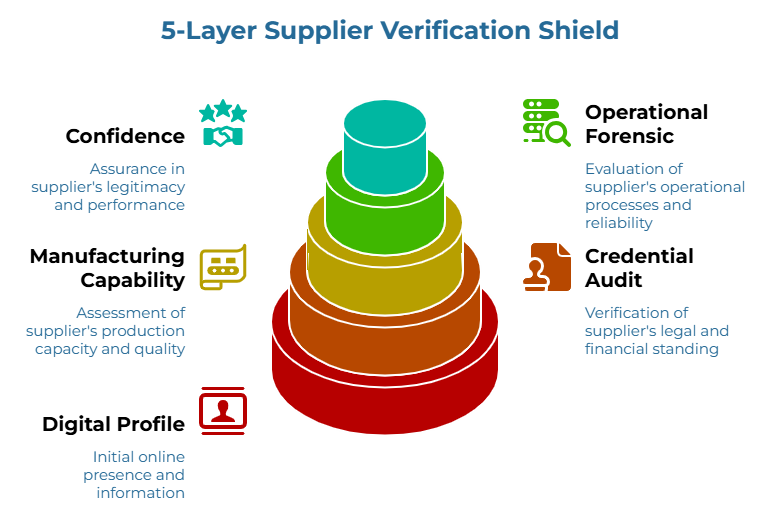
A supplier’s digital profile is only layer one — not the whole decision. The 5-Layer Shield is a structured bulk substrate supplier authentication method for growing converters who need to separate legitimate mills from weakly verified or broker-led options before profile polish or quote quality creates false confidence.
Neutral supplier verification is a multi-layered process of auditing supplier credentials and manufacturing capability before engaging in lead-time agreements. For a toilet tissue converter committing to a 6-month ordering cadence, the goal is confidence that the supplier behind the profile is a legitimate mill before operational dependence begins. This sequence—moving from digital footprint to legal and operational forensic reality—matters because standard digital checks are not enough in cross-border sourcing, especially in markets where broker density is high and a polished online presence can hide weak manufacturing reality. Use a five-layer verification scorecard for every new toilet tissue raw material supplier.
The Fastest First Pass: A 10–15 Minute Toilet Tissue Supplier Screen
Toilet Tissue Supplier Verification Quick-Win Card
| Layer | What to Check | Signal |
| 1. Digital Consistency | Does the profile match the website? Are “raw material roll” a stated primary product? | Match = Proceed. Mismatch = Pause. |
| 2. Live Contact | Is the supplier Phone Verified? | Verified = Proceed with caution. Evasive = Pause. |
| 3. Legal Entity | Does the company name match a public business registry? | Match = Proceed. No record = Escalate. |
| 4. Manufacturing Reality | Can the contact discuss raw material roll scope, mill production windows, and specs directly? A mill speaks; an intermediary forwards. | Fluent = Proceed. Vague = Escalate. |
| 5. Document Alignment | Do certificates, registration, and communication all name the same legal entity? | Aligned = Proceed to samples. Mismatched = Stop. |
Phone Verified generally means a directory authentication check—typically via an automated SMS, OTP, or basic call—was completed to confirm the supplier’s listed number is active and reachable. While a meaningful signal, it does not substitute for manufacturing verification.
Quality quotes are marketing; registry matching is evidence.
Layer 1: Check for Consistency, Not Just a Good-Looking Profile
Compare the supplier’s stated company role on the directory listing against their website. Do both say “manufacturer”? Manufacturing in one place and generic traders in another is a problem. Check whether toilet tissue jumbo rolls appear as a primary product category — not buried in a broad trading catalog. A real toilet tissue mill’s profile reflects production-level specificity: GSM ranges, reel widths, and converting-grade references aligned to technical baselines. A broker-led profile stays vague and uses language that reads more like a trading company than a factory.
A common pitfall here is mistaking polish for proof. Clean language. Sharp logos. Weak substance.
Layer 2: Why Live Phone Verification Matters
A Phone Verified supplier has passed a platform’s telecom check, confirming the listed number is active. That moves raw material supplier vetting beyond what someone typed into a form.
What it does not prove: that the person who answered owns a parent roll mill. Phone verification strengthens a profile, but it should sit inside a layered process rather than replace one. Treat it as “proceed with caution,” not “proceed to purchase order.”
Layer 3: Cross-Check the Legal Entity Before You Trust the Quote
Before acting on any quote, verify the legal entity behind it. Search the company name in a national registry — for UK entities, the Companies House register search is a practical example; for EU suppliers, the EU VIES VAT number validation tool confirms whether a VAT number is active.
Verify the alignment of three pillars: the legal entity name, the registered business scope, and the physical headquarters against the supplier’s public claims. A name mismatch is a red flag. So is a registered classification that does not align with bath tissue manufacturing. Entity verification moves trust from profile-level to registry-level evidence.
If the quote comes from one entity, the certificate names another, and the website footer shows a third, stop there. Entity mismatch is not a detail to tidy up later. It is a red flag now.
Layer 4: Verify You Are Speaking to a Real Toilet Tissue Mill
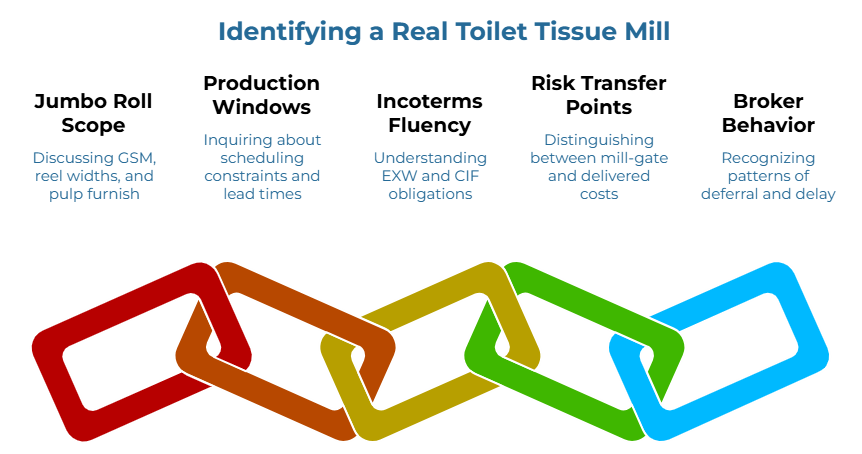
A direct-to-mill conversation usually sounds different from a broker conversation. In toilet tissue parent roll sourcing, that difference often shows up fast.
Ask about jumbo roll scope: GSM range, reel widths, pulp furnish. A genuine toilet tissue jumbo roll mill answers directly. Ask about mill production windows and current lead times. A factory-direct conversation sounds specific — scheduling constraints, minimum order quantities tied to machine runs, and fluency in Incoterms like EXW and CIF. This technical fluency identifies the seller’s grasp of risk transfer points—specifically distinguishing between mill-gate (EXW) and delivered (CIF) obligations, a distinction that directly affects landed cost calculations. A contact who can discuss practical differences in Incoterms is not automatically a mill, but weak fluency during a supposedly direct factory conversation should raise caution. A broker typically defers to “the factory,” forwards generic spec sheets, or relays answers with a day’s delay—a pattern that introduces specification misalignment risk long before samples arrive.
For a deeper mill-versus-broker framework, consult established supply chain auditing standards or see beyond the broker: three steps to direct toilet tissue raw materials supplier authentication.
Layer 5: Match Documents, Communication, and Ownership Signals
Documents should support trust, not create it from scratch. An ISO 9001 certificate confirms a quality management system at a named entity; it does not confirm that entity is the one conducting the conversation, or that the certificate has not been shared. Certificates are supporting evidence — not proof by themselves.
Check document-name consistency: does the legal name on the certificate match the registry record, the profile, and the email signature? If documents, communication, and ownership signals all point to the same entity, move forward to samples. If anything mismatches, escalate before investing further.
Red Flags That Mean Stop Before Samples or Quotes
- The legal name on the profile does not match any public registry record.
- The supplier cannot state whether they are a manufacturer, trader, or agent.
- Live phone verification was evasive or routed to a generic answering service.
- Certificates name a different entity than the profile or email communication.
- Manufacturing ownership is unclear — the contact cannot confirm who owns the production facility.
- The profile is polished, but the contact cannot discuss toilet tissue parent roll specifications or production windows coherently.
Any single red flag is enough to pause. Two or more mean a hard stop. Early bathroom tissue parent roll supplier verification protects later procurement cadence, lead-time planning, and plant continuity. Samples can charm. Quotes can be distracting. Identity problems remain identity problems.
For a structured audit of an existing vetting workflow, review standardized vendor qualification protocols or use the first 72 hours: how to audit your current cross-border toilet tissue parent rolls supplier vetting process.
Frequently Asked Question
What Should Be Verified Before Asking for Samples or Quotes?
Verify profile consistency, live contact, legal entity, mill-side communication, and document alignment first. Skipping these steps means a sample may come from an intermediary, and the risk surfaces later as a lead-time slip, a transshipment delay, or a specification problem invisible at the quoting stage.
If that routine feels helpful but still too light for a live supplier decision, continue with the multi-layer verification blueprint or use the first 72 hours: how to audit your current cross-border toilet tissue parent rolls supplier vetting process to pressure-test your current routine.
Your Next Step
A stronger supplier shortlist usually starts with fewer assumptions, not more paperwork. Start every new bath tissue parent roll supplier search with the five-layer scorecard, and find toilet tissue mills that pass the consistency, entity, and manufacturing-reality checks before trusting a profile, a quote, or a sample.
Profile confidence is not factory proof. Verification is.
Disclaimer:
This content is for informational purposes only and does not constitute legal, due diligence, or professional procurement advice. Supplier legitimacy, registry data, and verification outcomes vary by jurisdiction and market conditions. Consult qualified legal and trade compliance professionals before making supplier commitments. This framework is a practical vetting tool, not a legally exhaustive checklist.
Our Editorial Process:
Our expert team uses AI tools to help organize and structure our initial drafts. Every piece is then extensively rewritten, fact-checked, and enriched with first-hand insights and experiences by expert humans on our Insights Team to ensure accuracy and clarity.
About the PaperIndex Insights Team:
The PaperIndex Insights Team is our dedicated engine for synthesizing complex topics into clear, helpful guides. While our content is thoroughly reviewed for clarity and accuracy, it is for informational purposes and should not replace professional advice.