
📌 Key Takeaways
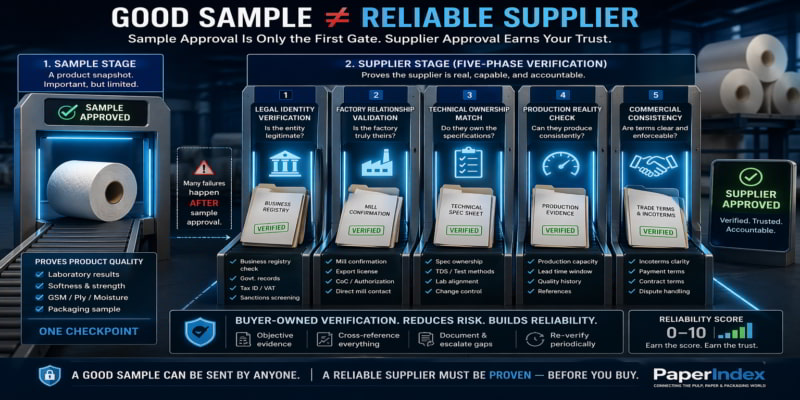
A good toilet tissue sample only proves the product looked right once—it says nothing about whether the supplier can deliver that same quality again and again.
- Samples Show a Snapshot, Not a Pattern: One acceptable roll does not prove the factory can repeat that result across real orders and shipments.
- Polished Quotes Hide Weak Supply Chains: A professional-looking quote and borrowed certificates can mask a broker with no control over production.
- Score Every Supplier Before You Commit: A simple five-phase check—covering legal identity, factory ties, technical knowledge, production proof, and trade terms—turns gut feel into a structured decision.
- Cross-Border Sourcing Raises the Stakes: Surface-level online checks grow weaker as distance increases, especially in markets with high broker density.
- Separate Sample Approval From Supplier Approval: Treating a good sample as proof of a good supplier is the core mistake—each needs its own distinct sign-off process.
Good verification protects the supply chain; good samples alone never will.
Toilet tissue converters and procurement teams evaluating new parent roll suppliers will gain a clearer vetting framework here, preparing them for the detailed scorecard and checklist that follows.
~ ~ ~ ~ ~ ~ ~ ~ ~ ~ ~ ~ ~ ~ ~ ~ ~ ~
In bath tissue procurement, relying on initial quality metrics creates a veneer of security. Reliability is a function of verification rigor, not presentation quality—and the operational risk of choosing the wrong supplier typically surfaces only after commercial commitment has already been made, when production downtime and stock-outs have already begun.
If that pattern sounds familiar, it should. The gap between a promising toilet tissue sample and actual factory reality catches even experienced operators, because the skill that makes someone good at judging a sample is not the same skill needed to verify the organization behind it. Sample confidence, on its own, is incomplete confidence.
Verification involves a multi-layered audit of credentials and manufacturing capacity. For a practical operator who wants dependable toilet tissue supply—not presentation-quality supplier theater—the confidence worth building isn’t “this sample roll looks acceptable.” It’s knowing the supplier is a legitimate mill, not a broker-led facade, before committing to a container order or repeat cadence. The buyer-owned method: a five-phase parent roll verification framework, applied before any supplier moves past toilet tissue sample approval.
Beyond the Sample: The Limits of Physical Proof
A toilet tissue sample answers one narrow question: does this product snapshot meet expectations right now?
That’s necessary, but not sufficient for supplier approval. When approving a supplier, you are also evaluating their repeatable production capability, consistent specification control, documentation integrity, shipment consistency, fulfillment discipline, and problem-resolution behavior. A sample proves none of those. Toilet tissue sample approval asks: “Is this sample test acceptable?” Bathroom tissue supplier qualification asks: “Can this exact organization repeatedly manufacture, document, ship, and support the same grade under real commercial conditions?” A specification-true procurement approach ensures each of those dimensions is testable before commitment.
Myth vs. Reality: What a Bathroom Tissue Sample Can Prove and What It Cannot
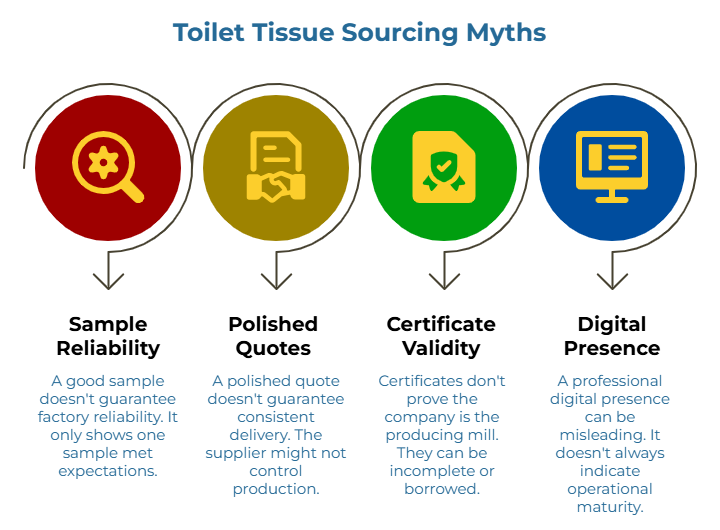
Myth: A good toilet tissue sample means the factory is reliable.
Reality: It means one sample met expectations at one point in time. Factory ownership, consistency, and capacity remain unproven.
Myth: A polished quote means the supplier can deliver the grade repeatedly. Reality: The commercial front end may be polished while control over production is indirect or absent. A factory-direct toilet tissue supplier authentication check separates genuine mills from intermediaries whose quotes look identical.
Myth: Certificates attached to a quote prove the quoting company is the producing mill.
Reality: Certificates can be incomplete, unrelated, outdated, or borrowed. Brokers can present a mill’s certificates as their own—implying production capability they don’t control. The International Trade Administration recommends verifying business identity through independent channels, not supplier-selected documents alone.
Digital presence—including professional profiles and responsive interfaces—often functions as a false signal of operational maturity. Surface-level digital checks, like trusting manufacturer websites and basic certificates, fail to distinguish between mills and unlicensed intermediaries. This gap widens as supplier proximity decreases: when parent roll sourcing moves from domestic to cross-border procurement in regions with high broker density, standard digital vetting alone can lead to unrecoverable lead-time slips and partner risk. Surface-level checks that may feel adequate in a simpler domestic context become much weaker when the order depends on cross-border documentation, trade-term interpretation, and remote production control. At that point, multi-layer factory authentication is the only safeguard.
The Mechanism of Failure in Bath Tissue Supplier Selection
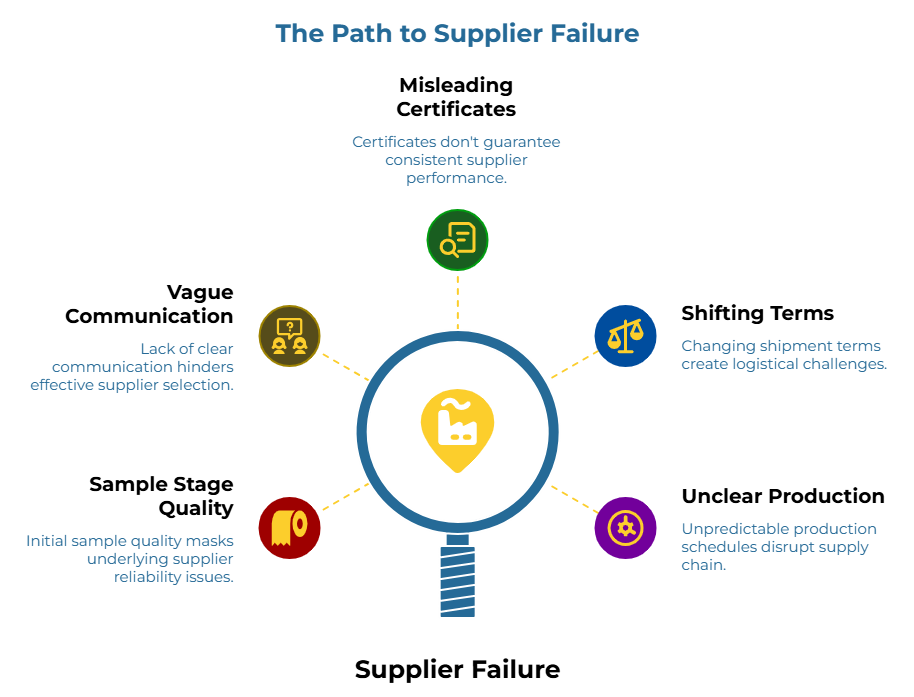
A founder running a growing toilet paper converting operation approves a promising parent roll sample. The sheet feels right, the quote is responsive, the certificate packet looks complete, and the supplier profile appears credible. Two weeks later, the commercial discussion exposes vague answers on mill identity, shipment terms, and repeatability.
The lesson is not that samples are useless. It’s that the buyer promoted a sample-stage signal into a supplier-stage decision too early—and now faces factory floor silence, operational embarrassment, and the task of explaining to internal stakeholders why a supplier that looked credible at sample stage cannot hold up under real procurement scrutiny.
The mechanism: A broker sources a convincing toilet tissue sample from a mill they don’t own. Certificates are shown without proving the same legal entity will produce the live order. What follows is predictable—mismatch between quoted bath tissue parent rolls and shipped batches, weak technical communication on GSM, moisture, bulk, tensile, or test method naming, shifting assumptions around CIF vs. EXW responsibility, unclear mill production windows, undisclosed transshipment, and an inconsistent documentation chain.
The strongest-looking toilet tissue sample can demand the most skepticism, because sample-stage quality is often easier to stage than shipment-stage reliability.
The Buyer-Owned Toilet Tissue Supplier Reliability Scorecard
Before promoting any supplier past toilet tissue sample approval, apply these five toilet paper supplier vetting checks. Every step uses existing resources—no paid services required. Score each check on a simple 0–1–2 scale: 0 for a weak signal, 1 for an unclear signal, 2 for a strong signal. Five checks, ten possible points, clearer decisions.
Phase 1: Legal Identity.
Ask: Does the quoted company name match official business registration and export identity? Good signal: Names match when cross-referenced through an independent registry such as BRIS. EU business registers are interconnected and searchable, making registry verification a practical checkpoint when the quoted company is based in the EU. Weak signal: Names don’t align, or the supplier deflects. Why it matters: Without legal identity confirmation, no downstream commitment is enforceable. The zero-trust sourcing model treats identity verification as the first of five evidence gates for exactly this reason.
Phase 2: Factory Relationship.
Ask: Is the supplier the actual toilet tissue mill, a disclosed partner, or an opaque intermediary? Good signal: Mill named, relationship verifiable. Weak signal: Vague references without specifics. Why it matters: The bath tissue broker risk is not that brokers exist—it’s that the buyer may not know one is involved. Beyond the Broker covers this authentication process.
Phase 3: Technical Ownership.
Ask: Can the supplier discuss specifications using appropriately named test methods—specifically ISO 12625-6 for tissue grammage and ISO 287 for moisture—with stated tolerances? Good signal: Consistent standards and measurable ranges. Weak signal: ‘Standard quality’ with no measurement backing. Why it matters: Technical ownership separates a manufacturing partner from a middleman relaying data. Naming a recognized test method such as ISO 12625-6 for basis weight or ISO 287 for moisture testing is a stronger sign of technical ownership than broad reassurance alone.
Phase 4: Production Reality.
Ask: Can the organization explain mill production windows, order-handling logic, and deviation protocols? Good signal: Clear scheduling and defined lead-time logic. Weak signal: Vague timelines and reassurances. Why it matters: Production reality confirms the supplier controls what they’re selling.
Phase 5: Commercial Consistency.
Ask: Are Incoterms stated explicitly, and is there a named escalation owner? Good signal: Written terms, defined problem-resolution path. Weak signal: Trade terms assumed, no dispute process. Why it matters: If delivered rolls don’t match the approved sample, someone must own the problem.
What to Verify Before You Move From Sample Roll to Container Order
This is where interest becomes discipline. Before signing, confirm: legal entity match, mill vs. intermediary clarity, named toilet tissue specifications with test methods and tolerances, Incoterm clarity explicitly agreed, batch traceability expectations, production window discussion, and a named fallback or escalation owner. The supplier vetting audit provides a structured method for testing whether a current procurement workflow already covers these—or relies on sample-stage confidence alone.
If the technical side still feels thin after the commercial review, How to Verify Parent Roll Mill Specifications Remotely Before Buying gives a stronger method for checking specification ownership, and Stop Guessing: Why Visual Samples Fail High-Speed Tissue Converting Lines reinforces why surface approval is not the same as operational proof.
Frequently Asked Questions
Can a good toilet tissue sample still come from an unreliable supplier?
Yes. A sample proves a product snapshot existed—not factory ownership, repeatable capability, or shipment consistency. Stop Guessing: Why Visual Samples Fail High-Speed Bath Tissue Converting Lines explores the specific limits of visual and tactile sample checks.
Do certificates guarantee source qualification?
No. Certificates can support a review, but on their own they do not prove that the quoted company, the producing mill, and the live order path are the same entity. Certificates may be incomplete, borrowed, or disconnected from the actual supply chain being proposed. A comprehensive audit validates the intersection of corporate identity, manufacturing assets, and technical documentation.
What is the difference between verifying a bath tissue sample and verifying a bath tissue supplier?
Sample verification checks whether the physical product meets specifications. Supplier verification checks whether the organization can produce it repeatedly, honor the quoted trade terms, maintain batch consistency across shipments, and resolve problems. Neither replaces the other.
How is a broker-led quote different from a factory-direct toilet tissue quote?
The difference is not always visible at the sample stage. It becomes apparent when the buyer asks who controls production, who owns the documents, and who is accountable when the shipped batch differs from the sample. The practical gap shows up in technical fluency, documentation chains, and problem-resolution behavior—not in the polish of the initial quote.
When should a bathroom tissue converter treat a quote as high-risk even if the sample is good?
When any scorecard check returns a weak signal—particularly around mill identity, test method fluency, or shifting trade terms. Verifying supplier certificates alone is not enough; a complete tissue mill verification checklist covers the company, the mill, the technical communication, and the repeatability behind the sample.
Toilet tissue supplier reliability comes from disciplined, buyer-owned verification of the company, the mill, the technical communication, and the repeatability behind the sample—not from quote volume or sample polish. Neutral authentication is the security shield that makes any longer-term tissue raw material sourcing system safe to run. Once the difference between sample approval and supplier approval is clear, the next step is to deepen the verification process and compare suppliers on facts that survive beyond the sample stage.
Explore PaperIndex Academy for structured guides on toilet tissue parent roll supplier due diligence. Use Beyond The Broker: Three Steps To Direct Toilet Tissue Raw Materials Supplier Authentication and The Multi-Layer Verification Blueprint: Advanced Risk Mitigation For Bath Tissue Parent Roll Procurement to deepen the method. Find bathroom tissue parent roll suppliers, review toilet tissue mills, or browse the broader supplier discovery marketplace.
Good samples deserve good verification. Not the other way around.
Disclaimer:
This content is for informational purposes only and does not constitute legal, due diligence, or professional procurement advice. Sample quality, supplier reliability, and verification outcomes vary by supplier, jurisdiction, and market conditions. Consult qualified legal and trade professionals before making supplier commitments. This scorecard supports vetting discipline, not legal certification.
Our Editorial Process:
Our expert team uses AI tools to help organize and structure our initial drafts. Every piece is then extensively rewritten, fact-checked, and enriched with first-hand insights and experiences by expert humans on our Insights Team to ensure accuracy and clarity.
About the PaperIndex Insights Team:
The PaperIndex Insights Team is our dedicated engine for synthesizing complex topics into clear, helpful guides. While our content is thoroughly reviewed for clarity and accuracy, it is for informational purposes and should not replace professional advice.