
📌 Key Takeaways
The real problem in global toilet tissue sourcing isn’t brokers—it’s hidden gaps between what you need and what suppliers actually deliver.
- Specification Drift Hides Until It Hurts: A roll can look fine and still jam your line because visual checks miss tiny but critical variations in weight, moisture, or thickness.
- Brokers Simplify Your Requirements: Your precise specifications often get shortened or changed as they pass through middlemen, so suppliers quote against different standards than you intended.
- Quotes Only Compare When Specifications Match: Two suppliers quoting the same price may be offering completely different materials if their test methods and delivery terms aren’t aligned first.
- Lock Your Baseline Before You Shop: Define your exact targets—weight tolerances, moisture limits, test methods—and make every supplier quote against that same standard.
- Verify Factories, Not Just Samples: Confirm that mills can actually hold your specifications consistently by checking their legal status, production records, and process capability before awarding business.
Specification clarity before price comparison prevents the failures that samples and quotes alone cannot predict.
Procurement managers and QA leads at toilet tissue converting operations will gain a clearer sourcing framework here, preparing them for the detailed specification audit guide that follows.
~ ~ ~ ~ ~ ~ ~ ~ ~ ~ ~ ~ ~ ~ ~ ~ ~ ~
The debate over brokers in global toilet tissue parent roll sourcing usually centers on the wrong question. Procurement teams argue about commission structures, middleman markups, and the loss of direct supplier relationships. These concerns are legitimate. But they obscure the technical opacity that broker-mediated communication creates between a converting line’s requirements and the factory floor. This gap—specification misalignment—is the structural risk that renders brokerage problematic.
For toilet tissue converters, that distinction matters. The practical fear is not abstract procurement inefficiency. It is the next overseas shipment that runs poorly, fails QA, creates softness drift, triggers retailer rejection, or throws a converting line off rhythm. That concern is rational. In an opaque sourcing model, the communication chain itself may be hiding the real failure point.
The Real Sourcing Failure Is Not The Broker Alone. It Is What The Broker Keeps You From Seeing.
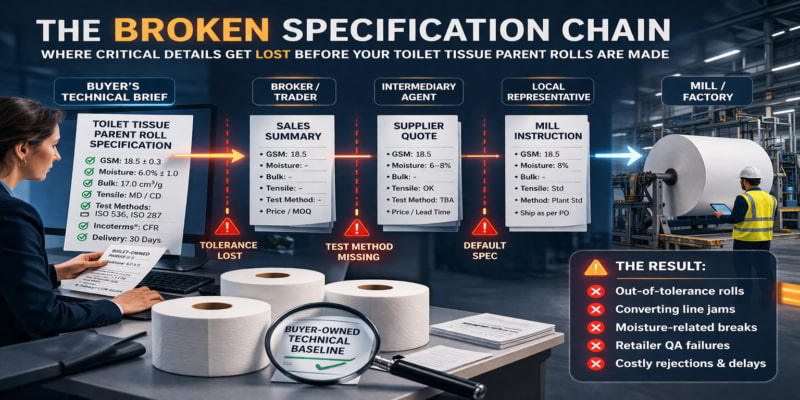
A broker-led sourcing chain can create a broken-telephone problem.
The buyer describes the required toilet raw material in operational terms. Procurement may be thinking about quote structure and delivery terms. QA may be thinking about GSM range, moisture window, bulk consistency, absorbency, and test methods. Aligning these two functions is essential before supplier outreach begins. The broker then summarizes those needs for a supplier. The toilet tissue parent roll supplier responds to the summary, not always to the full technical reality behind it.
At each step, the message can become cleaner, shorter, and less precise. Your specification for 18.5 GSM plus or minus 0.5, tested per ISO 536, becomes “approximately 18–19 GSM” by the time it reaches the toilet tissue mill’s factory floor. The tolerance band disappears. The test method reference vanishes. That may help the commercial conversation move faster. It does not make the technical truth clearer.
In toilet tissue converting, performance lives in those missing details. A requirement is not fully defined because a GSM number appears on a quote. It becomes meaningful only when the tolerance band, the measurement method, the moisture basis, and the conditioning logic are also clear. That is why named standards matter. If the sourcing conversation refers to moisture, the relevant test method should be explicit, such as ISO 287. If the conversation refers to grammage, the test method should be named as well, such as ISO 536. And if two suppliers are quoting on different delivery terms, quote comparison becomes distorted unless the terms are normalized under Incoterms® 2020.
A perfect visual sample is meaningless if the broker obscures the factory’s technical capabilities to protect their commission.
Why A Toilet Tissue Parent Rolls Can Look Acceptable And Still Be Strategically Unbuyable
Visual approval is not specification alignment.
A toilet roll can look clean, soft, and commercially acceptable while still being strategically unbuyable for a specific converting line. The reason is simple: appearance does not tell the buyer whether the shipped material will repeatedly hold the required GSM range, moisture tolerance, bulk profile, absorbency behavior, and runnability under real plant conditions.
That gap is where false confidence grows. A sample can arrive at your facility looking exactly right. The hand feel suggests adequate softness. The sheet thickness appears consistent. The roll winds cleanly. Your team approves it, and the purchase order moves forward.
Six weeks later, the full container arrives. The parent rolls jam your high-speed converting line within the first hour of production. The softness that looked acceptable in sample form now varies enough across the shipment that your finished toilet tissue fails retailer QA specifications. A hand-feel check cannot identify a 0.5 GSM drift that accumulates across a 20-metric-ton shipment. It cannot reveal that the supplier tested bulk using a test method incompatible with your own QA protocols. It cannot confirm that the moisture content measured at the mill will remain stable after weeks in a container crossing humid shipping lanes.
In practical terms, a visually acceptable roll can still cause:
- Machine jams during high-speed converting,
- Softness or caliper drift in the finished toilet tissue,
- Bulk inconsistency that affects embossing behavior,
- QA disputes after transit exposure,
- Private-label rejection when upstream variability reaches the finished shelf product.
Transit exposure makes this worse, not better. A toilet tissue parent roll that looked stable at origin may behave differently after humidity exposure, handling changes, or longer-than-expected dwell time. That does not automatically mean the supplier is weak. It does mean the original sourcing model failed if it treated sample approval as proof of shipment-level fitness.
The broader principle is straightforward: sample approval can support a sourcing decision, but it cannot replace a buyer-owned technical baseline.
The Three Hidden Risks Of Broker Opacity In Toilet Tissue Global Sourcing
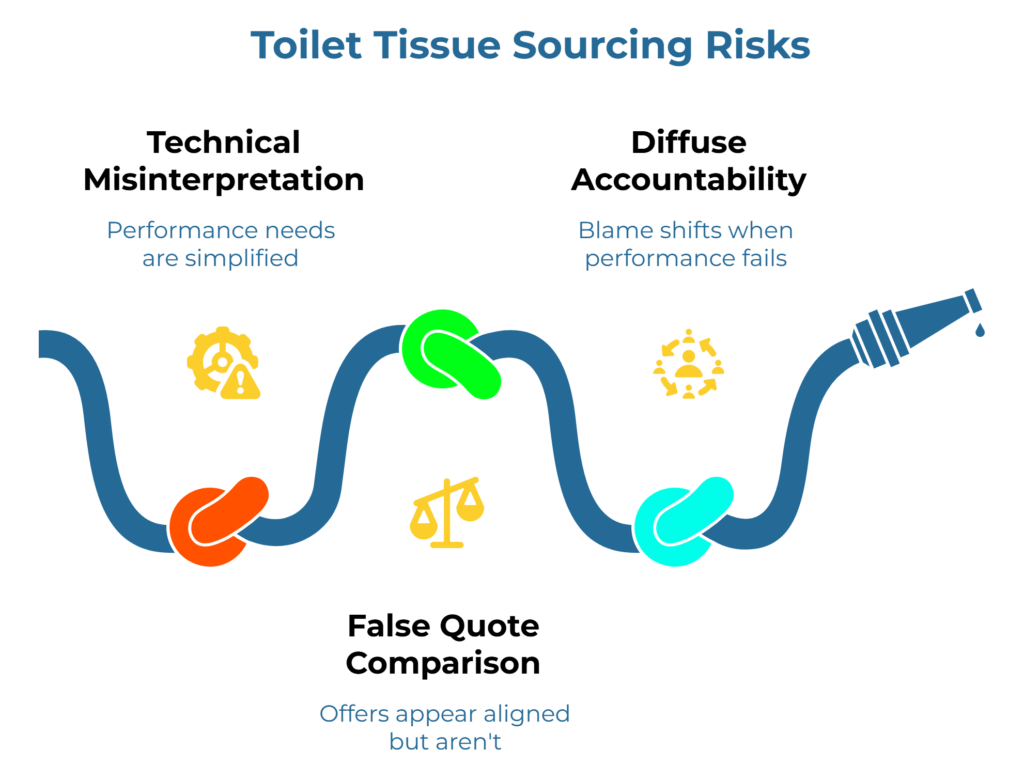
Broker opacity usually creates three risks at the same time:
Technical requirements get translated badly or selectively. A toilet tissue converter may specify performance needs in plant language, but the supplier receives a simplified commercial version. The broker, whose expertise is commercial rather than technical, may not understand why tolerance bands and test method references matter—or may simplify them to speed the deal along. The factory quotes against a different baseline than you intended, and neither party realizes the gap until material arrives.
Quotes look comparable when they are not. Two suppliers may quote the same GSM while assuming different moisture conditions, bulk expectations, absorbency profiles, or delivery terms. One supplier may have tested using ISO 536, another using a house test method with different conditioning parameters, and a third may not have specified a test method at all. One quote arrives EXW, another CIF, and a third FOB with ambiguous insurance terms. On paper, the offers look aligned. In reality, the buyer is comparing unlike material under unlike commercial terms.
Accountability becomes diffuse when performance fails. Once a shipment underperforms, the broker can point to the sample, the supplier can point to the quote, and the buyer can point to the converting outcome. If the baseline specification was never clearly locked, the problem turns into an argument rather than a diagnosis.
This is why opacity matters. It does not just hide who is involved. It hides how truth degrades between requirement and supply.
Why Specification Misalignment Does More Damage Than A Bad Quote
A bad quote is visible. Specification misalignment is often invisible until operations feel it.
A quote that is too high simply does not get accepted. It creates no downstream consequences. A quote that is too low might erode margin, but it keeps your production line running. Specification drift operates differently. It embeds itself in the supply relationship collusively, then surfaces as operational disruption weeks or months later.
If a toilet tissue roll quote is commercially weak, that weakness usually appears early. The number is too high. The trade terms are unattractive. The lead time does not work. Those are visible issues. They can be challenged before the award decision.
Specification misalignment behaves differently. It can sit inside normal-looking commercial progress. A buyer receives a sample, a quote, a few specification words, and a reassuring conversation. Nothing looks obviously broken. Then the shipment lands, or the run starts, and the hidden assumptions surface.
That is why price-first thinking is dangerous in this category.
A “cheap” quote is only meaningful after specification comparability exists. If two toilet tissue raw material suppliers are not quoting against the same technical baseline, the price comparison is an illusion. The same applies to delivery terms. A quote is not truly comparable until the buyer has normalized the commercial basis as well. True comparability requires a normalized commercial basis, specifically regarding absorbency and moisture tolerances, before the RFQ process begins. For further reading, we recommend our guides on normalizing parent roll quotes before RFQ chaos and standardizing absorbency and moisture tolerances
Comparability must come before price. Not after it.
What A Specification-True Toilet Tissue Sourcing Model Looks Like
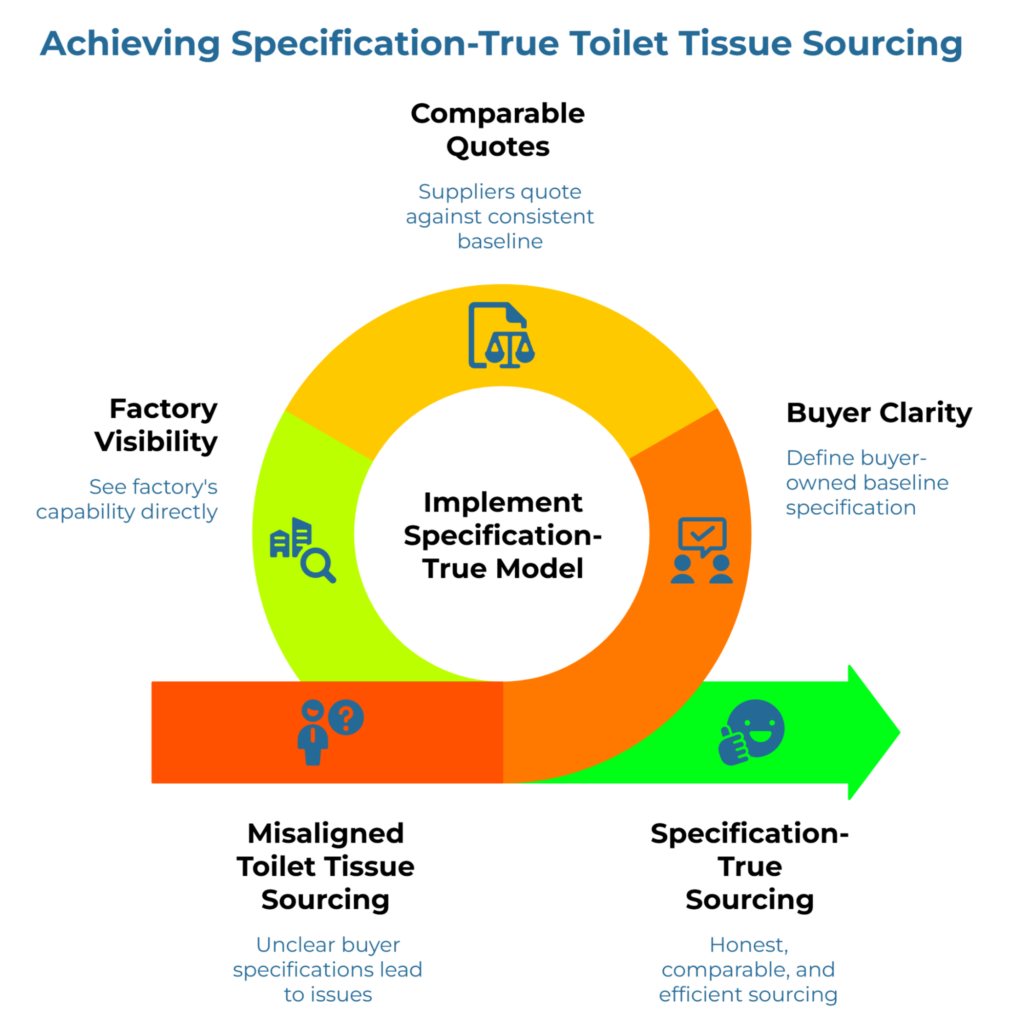
A specification-true toilet tissue sourcing model does not begin with supplier persuasion. It begins with buyer clarity.
As a general sourcing principle, the buyer needs a buyer-owned baseline specification that suppliers can quote against consistently. In toilet tissue parent roll sourcing, that typically means defining the required GSM target and tolerance, moisture tolerance, bulk expectation, absorbency requirement where relevant, test methods, and the commercial basis on which each supplier must quote.
That does not make sourcing slower. It makes it more honest.
When suppliers receive this baseline, their quotes become comparable by definition. Any supplier who cannot commit to the specified tolerances is surfaced immediately, rather than discovered after material fails at your facility. Any supplier who uses incompatible test methods must either adopt your standards or disclose the delta explicitly.
A stronger model also increases factory capability visibility. The buyer should be able to see, directly or through verifiable evidence, whether the supplying factory can repeatedly hold the required baseline. In practice, that may include clearer technical communication, tighter documentation, government registry cross-referencing to confirm legal identity, and third-party audit reports to confirm process capability. The point is not procedural theater. The point is to reduce the distance between the requirement and the factory that must actually meet it.
For toilet tissue converters managing private-label contracts, this visibility is not optional. Retailer specifications are non-negotiable. If your upstream supplier cannot prove capability alignment to your downstream commitments, the risk is entirely yours. The time to discover that misalignment is before the contract is signed, not when the retailer rejects the finished product.
From Transactional Sourcing To Neutral Verification Sourcing
The mindset shift is simple: stop asking only who can quote. Start asking who can prove.
This transition hinges on three pillars:
Technical visibility into the mill’s baseline. Transactional sourcing often accepts indirect communication and limited technical visibility. Neutral verification sourcing prioritizes direct clarity on the factory, the specification baseline, and the proof behind the quote.
Forced comparability across normalized requirements. Transactional sourcing often compares offers before the requirements are normalized. Neutral verification sourcing forces all suppliers to quote against the same toilet tissue parent roll baseline and the same commercial frame.
Direct accountability for performance failures. Transactional sourcing can blur responsibility across intermediaries, samples, and loosely worded specifications. Neutral verification sourcing makes it easier to trace performance back to a named requirement, a named test method, and a verifiable source.
That is where neutrality becomes valuable. Not as a slogan. As a discipline.
The neutral element refers to the absence of transaction-driven incentives in the verification process. A broker earns commission when deals close, which creates structural pressure to minimize friction—including the friction of rigorous specification alignment. A neutral verification model separates the technical due diligence from the commercial transaction, ensuring that capability questions are answered before commercial pressure enters the relationship.
Within that worldview, a neutral connector supports the search for verified suppliers without becoming a broker, agent, or transaction layer. That is also why the supporting trust context matters. PaperIndex positions itself as a connector, not an intermediary, and its educational content is designed to help industry participants think more clearly before they act. This approach prioritizes neutral verification over transaction-driven speed, acting as a technical buffer between buyer requirements and mill output.
The Next Question Serious Toilet Tissue Converters Should Ask
The next serious question is not, “Should brokerage disappear?”
It is this: Can every sample, quote, and sourcing conversation in this toilet tissue parent roll chain be traced back to one clear technical baseline and one verifiable manufacturing capability?
That question changes the entire sourcing posture. It moves the conversation away from appearances and toward proof. It shifts focus from supplier hunting to specification discipline. And it reduces the chance that normal-looking commercial activity will hide an avoidable technical failure.
Start with your current supplier base. Audit your existing toilet tissue parent roll specifications. Identify where tolerance bands are missing, where test methods are unnamed, where capability claims have never been independently verified. The audit process often reveals that the root cause of chronic quality issues is not supplier incompetence—it is specification drift that accumulated over years of transactional renewals.
Once the gaps are visible, the path forward is straightforward: build a buyer-owned baseline, normalize your RFQ process around that baseline, and require direct capability verification before awarding new business. A practical next step is to read our guide, the first 72 hours: auditing your current toilet tissue parent roll supplier specifications to test whether the current sourcing model is built on samples and summaries, or on locked specifications and verifiable truth.
The broker question may resolve itself along the way. When your specifications are explicit and your verification standards are clear, intermediaries that cannot add value to that process naturally fall away. The ones that remain do so because they genuinely facilitate technical alignment rather than obscure it.
Ultimately, opacity serves as a veil for technical drift. When misalignment is eliminated through rigorous specification, the risks to runnability and accountability are mitigated at the source.
Disclaimer:
This article is for educational purposes only.
Our Editorial Process:
Our expert team uses AI tools to help organize and structure our initial drafts. Every piece is then extensively rewritten, fact-checked, and enriched with first-hand insights and experiences by expert humans on our Insights Team to ensure accuracy and clarity.
About the PaperIndex Insights Team:
The PaperIndex Insights Team is our dedicated engine for synthesizing complex topics into clear, helpful guides. While our content is thoroughly reviewed for clarity and accuracy, it is for informational purposes and should not replace professional advice.