
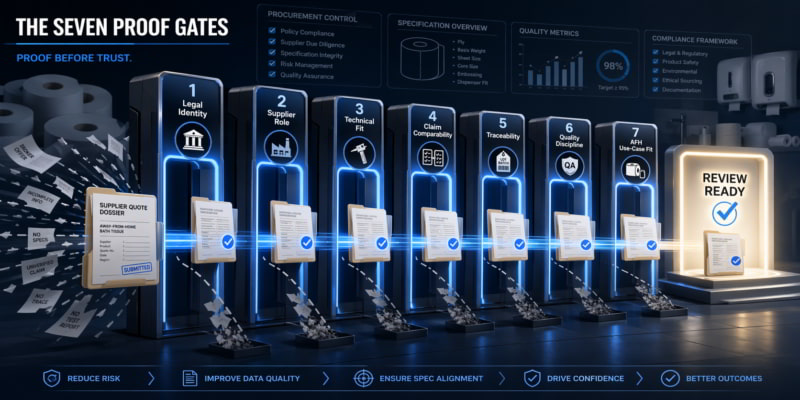
📌 Key Takeaways
Trust the quote only after the proof shows clear ownership, clear product fit, and claims you can actually verify.
- Start With Proof: Check legal identity, supplier role, and product fit before a polished quote shapes the decision.
- Match Claims To Standards: Test methods and conditions make supplier claims easier to compare and much harder to misread.
- Group By Buyer Risk: Sort proof by fit, accountability, consistency, and comparability to keep reviews clear and fast.
- Ignore False Comfort: Samples, certificates, and polished layouts can support review, but they do not prove supplier fit alone.
- Escalate Only When Needed: Go deeper when proof stays vague, roles stay unclear, or service risk becomes harder to control.
Short proof lists beat long document chases when the goal is a clean, defensible first-pass decision.
AFH procurement leads, category buyers, and QA managers will gain a simpler review lens here, guiding them into the supplier-verification details that follow.
~ ~ ~ ~ ~ ~ ~ ~ ~ ~ ~ ~ ~ ~ ~ ~ ~ ~
A credible first-pass review starts with a short proof list, and is not an exhaustive document chase. Before trusting quotes from AFH bathroom tissue suppliers, ask for evidence that confirms who stands behind the quote, what exactly is being offered against the requirement set, how the claims were measured, and whether the proof can be traced back to real production and real Away-From-Home (AFH) use. Establishing these parameters ensures a baseline for verification. While documentation formats vary by region and supplier, the underlying evaluative criteria remain constant, converting aesthetic quote presentation into objective data.
What Counts as “Proof” in AFH Toilet Tissue Supplier Verification?
Proof is not just any file attached to an email.
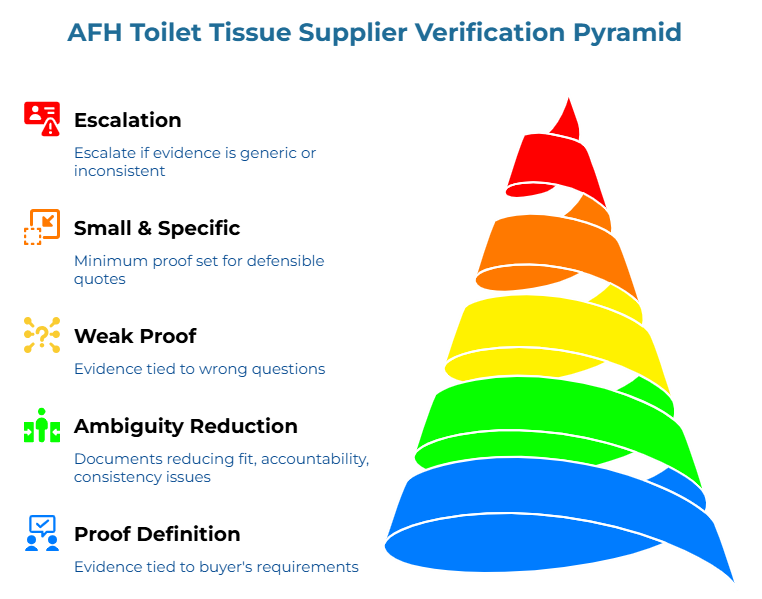
In a first-pass review, proof means evidence tied to the buyer’s requirement set and intended AFH use. A document is useful only when it reduces ambiguity around fit, accountability, comparability, or consistency. A polished quote may look complete. A certificate may look reassuring. A sample may look acceptable. None of those items, by themselves, proves that the offered AFH toilet tissue rolls are right for the intended channel, dispenser environment, and service conditions.
That distinction matters because early-stage mistakes are usually not caused by missing paperwork alone. They are caused by weak proof tied to the wrong question. A buyer does not need more paper for its own sake. A buyer needs evidence that explains why the offer should be trusted.
As a general procurement principle, the safest starting point is small and specific. Ask for the minimum proof set that makes the quote defensible. Escalate only when the evidence stays generic, inconsistent, or hard to map to the requirement set.
The First Proof Requests to Make Before You Trust a Quote
Use the starter list below as a first-pass buyer safety tool. It is not a legal demand stack, and it is not a full audit.
| Buyer concern | Proof to request | What it validates | Review Ownership | Red flag if missing |
| Identity and accountability | Official company registration and the exact legal entity behind the quote | The buyer knows who is legally standing behind the offer | Procurement | The quote is persuasive, but accountability is still fuzzy |
| Manufacturing role | Clear statement of supplier role — mill, converter, trader, or distributor — plus the production site tied to the quote | The team can tell whether the supplier controls production or is presenting an intermediary offer | Procurement + QA | The team cannot tell who actually controls production or quality |
| Technical fit | Quote-linked specification sheet that mirrors the AFH requirement set | The supplier is responding to the right requirement framework, not a generic product label | QA + category owner | The offer looks complete but does not map cleanly to end-use needs |
| Claim comparability | Named test methods, sampling basis, and testing conditions for each performance claim | Supplier data can be compared on a like-for-like basis | QA | Claims sound precise but were produced under unknown conditions |
| Consistency and traceability | Sample COA, batch-record format, or lot-traceability example | Claims can be tied back to real production lots | QA | There is no practical way to connect claims to shipped material |
| System discipline | Quality management evidence relevant to consistency claims, such as ISO 9001 if claimed, plus a short complaint/corrective-action summary | The supplier has a repeatable control process, not just polished language | QA + Procurement | Generic quality language appears without a usable control process |
| AFH use-case fit | A short written explanation of why the offered product fits the intended AFH channel, dispenser environment, and service conditions | The supplier understands the use case rather than selling a broad tissue category | Category owner / operations | The evidence is generic and not tied to hospitality, healthcare, education, jan-san, or public-institution realities |
Technical data—specifically grammage (ISO 536) and moisture content (ISO 287)—must be verified against recognized standards. Adherence to ISO 12625-1 establishes the required vocabulary for standardized AFH terminology, ensuring that performance claims are comparable across the procurement set. These are not automatic proof of fit. They simply make the language around proof more reliable.
How to Group Proof Requests by Buyer Concern Instead of Paperwork Type
Effective categorization shifts focus from document types to risk mitigation. Grouping requests by Comparability (standardized benchmarking), Fit (requirement alignment), Accountability (entity verification), and Consistency (repeatability) allows Procurement and QA to align on a single evaluative framework.”
That shift helps Procurement and QA speak the same language. It also addresses a common concern in fast-moving sourcing cycles: not every supplier has the same document format. That is acceptable at this stage. What matters is whether the evidence answers the right question.
What Not to Mistake for Real Verification
A polished quote is not proof.
A generic certificate is not proof of use-case fit.
A sample alone is not proof of ongoing consistency.
Those items may still have value. They just should not be treated as decision-ready evidence on their own. The same logic applies to sustainability or chain-of-custody claims. If those claims matter in the review, do not rely on a logo alone; use tools such as the FSC Public Certificate Search to check whether the claim can be validated. That is a useful supporting check, not a substitute for fit evidence.
How to Run a Light First-Pass Review Without Slowing Procurement
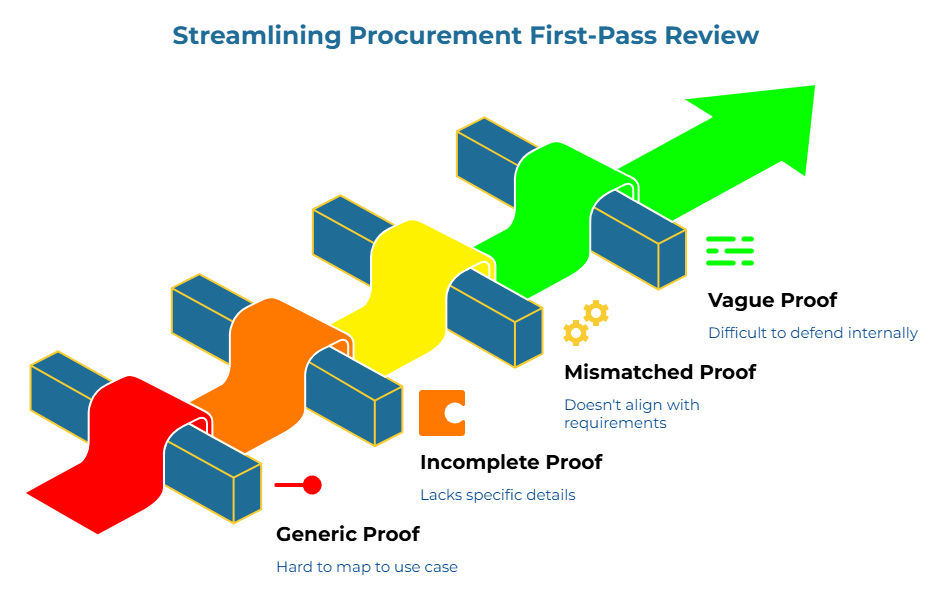
A simple red-amber-green workflow is enough for the first screen.
Green means the core proof is present, specific, and tied to the requirement set.
Amber means proof exists, but it is generic, incomplete, or hard to map to the use case.
Red means the proof is missing, mismatched, or too vague to defend internally.
This is also where a calm rule helps: the article should not imply that every supplier must provide every document at the same stage. A first-pass review is meant to stay role-safe and practical. If the evidence is specific enough to support the next checkpoint, move forward. If it stays generic, escalate. Simple.
When to Escalate to a Deeper Verification Process
A deeper workflow is usually warranted when the use case becomes more exposed.
That includes multi-site or multi-channel buying, high-risk dispenser environments, service continuity concerns, supplier-role ambiguity, or repeated proof-to-claim mismatch. In those cases, the starter list has done its job. It has surfaced as the reason to go deeper.
For broader category context, see AFH bath tissue rolls. For the next step in the cluster, readers can continue with Beyond the Digital Profile: A 5-Layer Shield for Bath Tissue Parent Roll Supplier Verification, Beyond the Broker: Three Steps to Direct Toilet Tissue Raw Materials Supplier Authentication, and The First 72 Hours: How to Audit Your Current Cross-Border Toilet Tissue Parent Rolls Supplier Vetting Process.
Frequently Asked Questions
What proof should be requested before trusting a toilet tissue supplier quote?
Start with proof of legal identity, supplier role, quote-linked technical fit, named test methods, traceability, quality-system discipline, and AFH use-case fit. That is the shortest defensible starter list.
Are certificates enough to verify an AFH toilet tissue supplier?
No. Certificates may support one part of the review, but they do not prove use-case fit on their own. Fit still has to be tied back to the buyer’s requirement set, the offered product, and the intended AFH environment.
How can supplier proof be checked against the requirement set?
Compare each document to a specific buyer concern: accountability, fit, comparability, or consistency. If the document does not answer one of those questions clearly, it is probably the wrong proof for that stage.
What is the difference between a polished quote and a verified supplier fit?
A polished quote presents an offer well. Verified supplier fit shows why that offer should be trusted for the intended AFH use, under a clear requirement set, with traceable and comparable evidence behind it.
Early proof requests reduce later approval friction because they make the first review cycle easier to explain. They also make it easier to decide when not to go deeper. That is the real value of AFH toilet tissue supplier verification basics: a bounded starting point that improves confidence without turning early review into paperwork theater. For more guidance, explore the PaperIndex Academy.
Browse AFH toilet tissue raw material suppliers.
Disclaimer:
This content is for general educational guidance only. It outlines a first-pass approach to supplier proof review and does not replace product-specific testing, formal qualification, contractual review, or legal, regulatory, or compliance advice. Verification requirements may vary by use case, buyer standards, and jurisdiction.
Our Editorial Process:
Our expert team uses AI tools to help organize and structure our initial drafts. Every piece is then extensively rewritten, fact-checked, and enriched with first-hand insights and experiences by expert humans on our Insights Team to ensure accuracy and clarity.
About the PaperIndex Insights Team:
The PaperIndex Insights Team is our dedicated engine for synthesizing complex topics into clear, helpful guides. While our content is thoroughly reviewed for clarity and accuracy, it is for informational purposes and should not replace professional advice.