
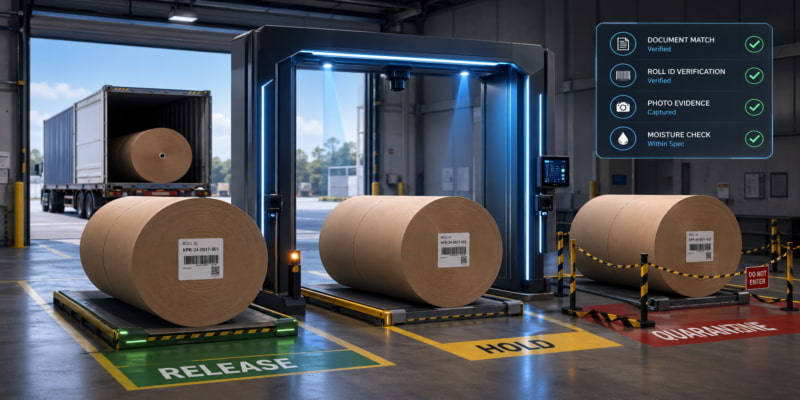
📌 Key Takeaways
A short, repeatable receiving checklist stops damaged or mystery rolls from reaching production and killing your claims later.
- Match Papers Before Unloading: Confirm roll IDs, grade, weight, and count against the purchase order so mismatches get flagged before rolls hit inventory.
- Photograph Everything With Labels Visible: Photos without the roll ID in frame are nearly useless — always capture the label, the damage, and the trailer condition together.
- Looking Dry Doesn’t Mean It Is: A roll can appear fine on the surface while hiding moisture inside, so visible water signs should trigger quarantine and testing, not assumptions.
- Assign a Clear Status at the Dock: Every roll should leave receiving marked as released, held, or quarantined — vague labels like “OK” or “check later” create confusion downstream.
- Separate Who Caused the Damage: If you can’t tell whether the supplier, carrier, or your own team caused a problem, the claim becomes an argument nobody wins.
A few disciplined minutes at the dock are the difference between a clean claim and an unresolvable dispute.
Warehouse supervisors, receiving teams, and QA managers at paper converting operations will find a ready-made inspection framework here, preparing them for the detailed checklist that follows.
~ ~ ~ ~ ~ ~ ~ ~ ~ ~ ~ ~ ~ ~ ~ ~ ~ ~
Rolls look fine from the dock.
You have seen what happens next. A roll with soft edges jams the unwind station. A moisture complaint surfaces three days after the carrier left. Procurement asks for photos, and all anyone can find is a blurry shot of the trailer with no roll label in frame. This is where verifiable evidence should replace supplier promises — without timestamped data and specific roll IDs, inspections remain anecdotal. Internal claims often fail due to this lack of objective documentation.
With a short, repeatable receiving gate, your team can separate production-ready rolls from rolls that need review before they ever touch inventory. The objective is to integrate visual screening and documentation into the standard unloading window (approximately 30–45 minutes per trailer) to ensure all stock is assigned a clear status before entering inventory.
Why Kraft Paper Parent Roll Receiving Needs Its Own Checklist
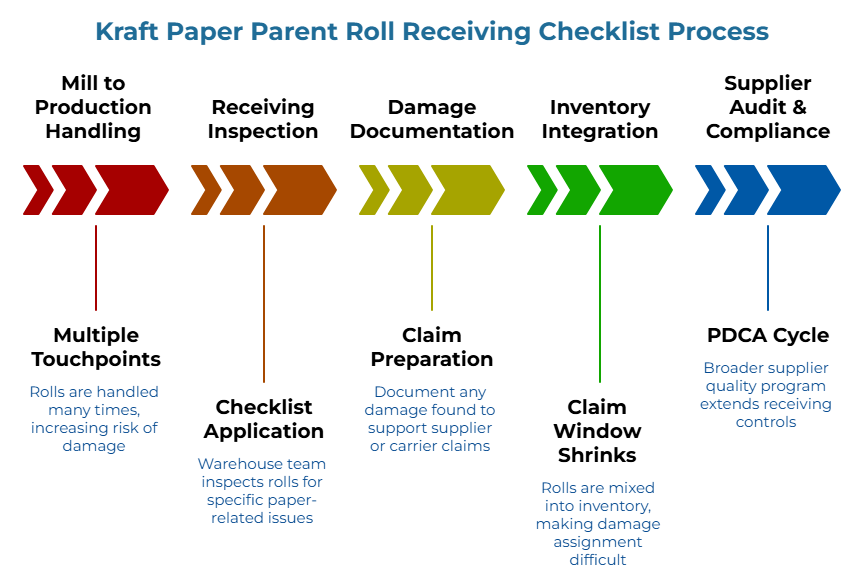
Parent rolls are not ordinary palletized freight. Their weight, exposed edges, wrap condition, core integrity, and sensitivity to moisture make receiving more complex than scanning a barcode and signing a bill of lading. Paper rolls and pallets are handled many times from mill to production, and each handling point creates a risk of accident or damage — a reality that reinforces why receiving control deserves its own process.
Generic warehouse checklists miss paper-specific risks. They rarely prompt for wrap tear severity, core shift, out-of-round deformation, or label legibility — all of which affect whether a roll can run on a converting line without waste or downtime. Damage found after unloading is harder to assign to the supplier, the carrier, or internal handling. Once rolls are mixed into available inventory, the window for a clean claim shrinks fast.
A practical receiving checklist protects three things at once: production readiness, traceability, and supplier or carrier accountability. For teams building a broader supplier quality program, a kraft paper supplier audit and compliance framework extends these receiving controls into a PDCA-based assurance cycle. But it only works if the checklist is short enough that warehouse teams complete it every time.
Define Acceptance Criteria Before the Truck Arrives
Receiving teams should not invent acceptance decisions at the dock. The buyer, QA team, and supplier should agree on what “acceptable” means before a single roll is loaded.
Pre-arrival criteria should cover the purchase order number, supplier name, product grade, basis weight or grammage, roll width, roll diameter if specified, core size, roll count, roll IDs, lot or batch numbers, packaging requirements, required documents, agreed test methods, damage tolerance rules, and quarantine triggers. TAPPI T 410 covers grammage and basis weight terminology and measurement, which supports specification alignment when physical testing is needed.
Acceptance thresholds must come from the buyer’s specification, the supplier agreement, or the QA plan. For a template-based approach to defining these thresholds, see creating your mill spec sheet: a guide for converting operations managers. These criteria should not be improvised at the loading dock. For broader sourcing and supplier-verification context, buyers can review kraft paper parent roll suppliers and brown paper mills on PaperIndex.
Step 1 — Check Shipment Documents Before Unloading
Match the purchase order against the supplier’s shipping documents. Compare the bill of lading against the delivered roll count. Cross-reference roll IDs against the packing list. Verify grade, GSM or basis weight, width, and core size against the order. Confirm the certificate of analysis or certificate of conformance is included, if required. For a deeper look at how COAs fit into an incoming inspection evidence chain, see COAs, Samples, and Incoming Inspection: a simple evidence chain for packaging converter QA. Check the seal number on the trailer or container and compare it with the shipping papers where applicable. Flag evidence of mixed lots, unexplained substitutions, or missing labels.
If two roll IDs are missing from the packing list, those rolls should be unloaded into a controlled status — not released directly to production inventory. Create a “paperwork mismatch” status in your WMS or ERP that prevents automatic inventory release until procurement or QA reviews the discrepancy. That status allows unloading to continue while keeping questionable rolls out of available stock.
Mixed lots, roll IDs that do not match the packing list, and missing labels are not clerical details. They are traceability risks that compound when rolls reach the converting floor without resolution.
Step 2 — Inspect the Trailer or Container Condition
Before handling any rolls, look for external risk signals: a wet trailer floor, condensation on walls, torn tarpaulin or roof leak signs, water staining, loose dunnage, a shifted load, crushed or leaning rolls, broken restraints, and debris or contamination.
Photograph the trailer or container condition before unloading if there are signs of impact, water, shifting, or poor load securement. These photos become critical evidence if a claim follows — a principle reinforced in the ‘pristine arrival’ checklist: what to verify before your container closes, which covers photo-based verification from the shipper’s side. Once unloading begins, the evidence timeline changes — responsibility for damage becomes harder to assign when you cannot distinguish between supplier packaging failures, carrier transit damage, and internal handling problems.
Safety considerations around docks, forklifts, and terminal employees are addressed by OSHA’s loading and unloading guidance. For U.S. road transport, 49 CFR part 393.122 includes specific securement requirements for paper rolls, covering blocking, bracing, and tiedown criteria that can inform both your carrier expectations and your assessment of load condition at the dock.
Step 3 — Inspect Each Roll for Visible Damage
This is the most operationally valuable step. Every roll should receive a fast visual and ID check. Exceptions should trigger deeper QA review.
For each roll, check the outer wrap for tears, punctures, missing sections, and wet spots — exposure to moisture, dirt, or abrasion means the roll should be documented and held if severe. Examine the roll ends for crushed edges, dents, edge cracks, and contamination, since these affect unwind and converting waste. Inspect the core for crushing, shifting, breakage, moisture, and oval distortion; quarantine any roll where core integrity is questionable.
Check roll roundness for flat spots, oval shape, or deformation that may cause handling or runnability issues. Look at the roll surface for cuts, gouges, scuffs, and embedded debris. Check for soft spots on the roll body, which may indicate impact, pressure, or moisture risk and warrant QA review before release. Verify that the label is present, readable, and shows the correct roll ID — a missing or unreadable label is a traceability failure that requires a hold until the roll is identified. For a companion arrival-inspection protocol, see testing protocols: how to verify kraft paper quality upon arrival. Screen for moisture indicators: wet wrap, water stains, condensation, and musty odor all represent potential quality and runnability risk and should trigger quarantine and testing if required.
Visual inspection identifies moisture-risk indicators. It does not confirm moisture content. That distinction prevents overclaiming — a roll may look dry on the exposed surface while the wrapped areas, core area, or inner layers still require review if transit evidence suggests moisture exposure.
Step 4 — Screen for Moisture Risk Without Guesswork
Visible water exposure, condensation, damaged wrap, wet dunnage or floor contact, and temperature swings after transit all create moisture risk. Surface appearance alone is unreliable — a roll can look dry on the outside and carry elevated moisture internally.
Define your moisture decision path before rolls arrive. Rolls with no visible moisture risk and matching documents should be released. Rolls with damaged wrap but no confirmed paper exposure may qualify for conditional release or hold under site policy. Wet wrap, stained dunnage, or a damp trailer floor should trigger quarantine with QA notification. Where the moisture result affects acceptance or a potential claim, sample or test under an agreed method. Confirmed nonconformance against specification leads to rejection or escalation under the supplier or carrier process.
TAPPI T 412 covers the determination of moisture in pulp, paper, and paperboard, and notes moisture’s relevance to properties including printability, tensile strength, and dimensional stability. For guidance on specifying moisture-related COBB values in procurement documents, see the “spec-true mindset”: how to specify Cobb values for dry arrival of paper shipments. ISO 287 specifies an oven-drying method for determining the moisture content of a lot. When sampling is needed to determine whether a lot meets specifications or to resolve a buyer-seller dispute, ISO 186 addresses representative sampling from a lot of paper or board.
If your site names acceptable moisture ranges, those ranges must come from the buyer’s specification, the product grade, the supplier’s certificate of analysis, or an applicable technical standard. Do not use a generic number pulled from memory.
Step 5 — Assign a Receiving Decision
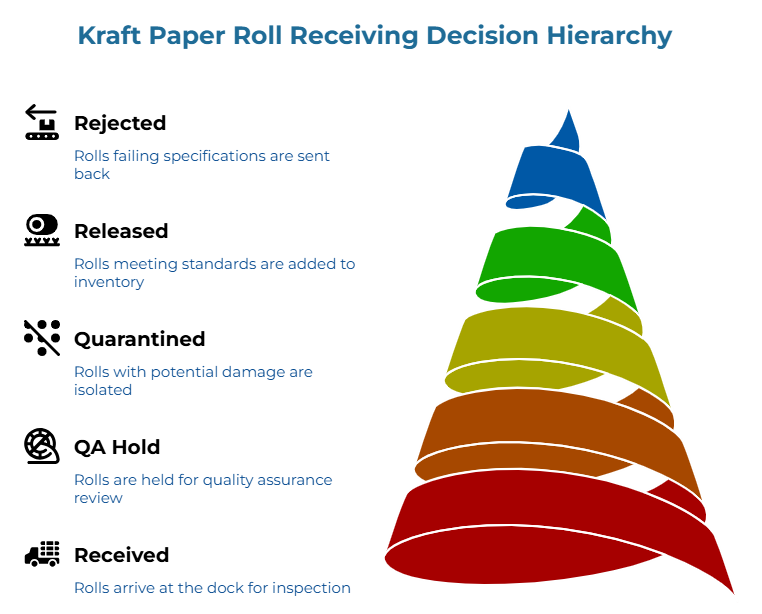
Every roll should leave the dock with a clear status. A roll should not drift into production inventory because its disposition is ambiguous.
Documents match and no visible damage — release to available inventory. Minor wrap scuff with no paper exposure — conditional release or monitor, with a photo if site policy requires it. Missing roll label — hold until inventory control or QA restores traceability. Mixed lots or roll ID mismatch — hold and reconcile with procurement or supplier quality before release. Wet wrap or water staining — quarantine and do not release until QA has assessed. Crushed core or severe end damage — quarantine and escalate to QA and operations, since these may affect handling and unwind. Confirmed specification nonconformance — reject or move to supplier/carrier claim review. Shifted load, water ingress, or broken restraints — escalate to logistics, QA, and carrier claims, and photograph everything before unloading. Roll count mismatch — hold the receiving transaction and reconcile with procurement before inventory release.
If the issue may affect unwind, runnability, or trim waste, QA should involve the converting supervisor before release. That step prevents rolls from reaching the line and creating waste that could have been caught at the dock.
Recommended WMS/ERP status labels: Received—Pending Inspection, QA Hold, Quarantined, Released, Rejected, and Supplier/Carrier Claim Review. Where possible, make ‘Disposition Status’ a mandatory WMS entry before rolls can move into available inventory.
Step 6 — Document Damage So It Holds Up Later
Write condition notes as if someone outside the dock will need to understand them later — because they will.
Record the date and time of receipt, supplier, carrier, trailer or container number, seal number if applicable, PO number, BOL number, roll ID, lot number, exact damage location on the roll, damage type, and number of affected rolls. For a field-by-field guide to matching these elements against shipping documents, see export documentation for kraft paper: a field-by-field evaluation checklist for BL, COO, Fumigation & Supporting Certificates. Capture photos before unloading, during unloading, and after segregation. Note damage on delivery paperwork if it is visible at the time of delivery. Record the names or roles of people who inspected.
Photo guidance: take a wide shot of the overall load condition, a close-up of the damage, the roll label in the same photo set, a shot showing scale or location on the roll, images of wet floors, wrap, or dunnage if moisture is suspected, and packaging condition details. Add a scale or location reference where safe and site-approved.
For U.S. motor carrier claims, 49 CFR Part 370 governs processing of loss, damage, injury, or delay claims for property transported in interstate or foreign commerce. Align your claim procedures with your carrier terms, jurisdiction, and internal legal or procurement policy.
Step 7 — Build a Checklist Warehouse Teams Will Actually Use
Design a one-page or mobile form — not a quality manual. Include fields for shipment information, document verification, trailer or container condition, roll count and ID check, visible damage check, moisture-risk check, a yes/no flag for required photos, status assigned, escalation contact, and inspector name and timestamp.
Use checkboxes instead of long free-text fields. Separate “must check” items from QA-only detail. Receiving should capture count, ID, visible damage, trailer condition, photos, and status. QA should own sampling decisions, test methods, final release authority, and technical disposition. Include clear hold triggers. Make photo capture mandatory for any damage. Make the final disposition obvious. Integrate with your WMS or ERP where possible.
Practical checklist questions: “Are all roll IDs present and legible?” “Does roll count match the BOL and packing list?” “Is any wrap torn enough to expose paper?” “Is there visible water, staining, condensation, or wet dunnage?” “Is any core crushed, shifted, wet, or visibly distorted?” “Has damage been photographed with the roll ID visible?” “Disposition: release / hold / quarantine / escalate.”
For broader product-category context, teams can reference kraft paper parent rolls and related educational resources through PaperIndex Academy.
Practical Receiving Scenarios
A torn outer wrap with no visible paper damage should be photographed and recorded. If paper is not exposed and site policy permits it, the roll may be conditionally released or monitored.
A wet trailer floor with stained roll wrap should trigger photos before unloading. Quarantine affected rolls, notify QA and procurement, and assess whether sampling or moisture testing is required.
Correct roll count with missing labels is a traceability failure. Hold the rolls until the roll ID and lot number are restored.
A crushed roll edge found after unloading needs immediate documentation. Record the roll ID, handling timeline, unloading photos, and who handled the roll before assigning supplier or carrier responsibility.
A COA showing the correct grade while the physical label shows a different basis weight should trigger hold status. Reconcile the PO, packing list, COA, and roll label before release.
Common Mistakes to Avoid
Releasing rolls before paperwork is matched invites traceability failures. Recording “damaged” without describing the specific damage weakens every future claim. Taking photos without the roll ID visible makes them nearly useless for documentation. Failing to photograph the trailer or container condition removes your best evidence of carrier responsibility. Treating wet wrap as a minor cosmetic issue ignores that moisture can compromise paper performance, including structural integrity, ink receptivity, and moisture-driven curl. Letting production consume questionable rolls before QA review eliminates your ability to hold or return them. A structured approach to acceptance sampling plans with kraft paper manufacturers helps define what gets held and at what defect threshold. Using vague disposition statuses — “OK” or “check later” — creates confusion at every handoff. Depending on one experienced receiver instead of a repeatable checklist means the process breaks when that person is absent, when shifts change, or when production pressure overrides judgment. Not separating supplier damage from carrier damage from internal handling damage turns every claim into an argument. Inventing quality thresholds at the dock introduces inconsistency that suppliers and carriers will challenge. Defining contract clauses that protect against off-spec kraft paper deliveries before the first shipment arrives eliminates improvisation.
Frequently Asked Questions
What should be checked when receiving kraft paper parent rolls?
Check shipment documents, roll count, roll IDs, labels, wrap condition, roll ends, core condition, visible deformation, soft spots, moisture-risk indicators, and trailer condition. Match everything against the purchase order.
Should warehouse teams reject every damaged roll?
No. Assign a status. Minor cosmetic issues may be documented and released if site policy allows. Wet, crushed, or unidentified rolls should be reviewed before production use.
What visible signs suggest moisture risk?
Wet wrap, water staining, condensation, wet dunnage, musty odor, damp trailer floors, and damaged protective packaging.
Can visual inspection confirm moisture content?
No. Visual inspection flags risk. Moisture content should be confirmed using agreed test methods if the result affects acceptance, claims, or production release.
When should a parent roll be quarantined?
Quarantine when there is wet packaging, crushed cores, severe edge damage, missing identification, major deformation, documentation mismatch, or any condition that could affect production or traceability.
Who should own the receiving checklist?
Receiving usually completes the checklist at the dock. QA, procurement, logistics, operations, supplier quality, and any third-party warehouse provider should agree on hold triggers, escalation rules, record storage, and release authority.
Your receiving dock is the first and fastest quality gate in the entire converting operation. Every roll that passes through it without a clear status, a matched document, and a photo of any anomaly is a future dispute waiting to happen. Build the checklist. Train the team. Run it every time.
The difference between a clean claim and an unresolvable argument is those few minutes of consistent discipline at the dock.
Disclaimer:
The information provided in this article is for educational and operational guidance purposes only. It does not constitute legal, regulatory, or professional compliance advice. Teams should align their receiving procedures, claim processes, and quality thresholds with their own specifications, supplier agreements, applicable regulations, and internal legal or procurement policies. Referenced standards (TAPPI, ISO, CFR) are cited for informational context; always consult the current published versions for authoritative requirements.
Our Editorial Process:
Our expert team uses AI tools to help organize and structure our initial drafts. Every piece is then extensively rewritten, fact-checked, and enriched with first-hand insights and experiences by expert humans on our Insights Team to ensure accuracy and clarity.
About the PaperIndex Insights Team:
The PaperIndex Insights Team is our dedicated engine for synthesizing complex topics into clear, helpful guides. While our content is thoroughly reviewed for clarity and accuracy, it is for informational purposes and should not replace professional advice.