

📌 Key Takeaways
Writing COBB values into RFQs and contracts transforms moisture protection from vague promises into measurable, enforceable standards.
- Numbers Replace Adjectives: Specifying a COBB value band (such as ≤30 g/m² for high-risk routes) eliminates disputes over subjective terms like “seaworthy packing.”
- Comparability Comes Before Price: Fixing the moisture specification first allows true like-for-like comparison of supplier quotes, revealing actual cost differences.
- Match Specs to Route Risk: Low-risk temperate voyages tolerate higher COBB values, while equator-crossing monsoon routes demand stricter moisture barriers combined with desiccants.
- Agree on Verification Upfront: Defining the test method, sampling plan, and non-conformance remedy in the contract prevents finger-pointing when damage occurs.
- COBB Complements, Not Replaces: Barrier specifications work alongside desiccants, container inspections, and proper stowage as part of a complete moisture defence system.
One testable number stops the blame game before it starts.
Small-to-mid-sized paper importers and purchasing managers seeking to eliminate moisture-related disputes will find actionable clause templates and risk-based specifications here, preparing them for the step-by-step implementation guide that follows.
The container doors swing open. The outer rolls look fine. But peel back a layer, and the damage reveals itself: wavy edges, a faint musty smell, paper weakened beyond use. The supplier insists the packing was “seaworthy.” The insurer wants proof of fault. And somewhere in the middle, a purchasing manager is left wondering why three different quotes, all promising “good moisture protection,” delivered such different results.
This scenario plays out across global paper supply chains more often than it should. Paper is hygroscopic, meaning it actively absorbs moisture from the surrounding air. Once humidity penetrates the outer layers, it travels into the reel, causing waviness, loss of tensile strength, and eventually mould. The root cause of most disputes is rarely negligence. It is ambiguous.
“Significant price variances in kraft paper quotes often reflect specification misalignment rather than true differences in material costs.” — Comparability Before Price: The Spec-True Mindset That Reduces RFQ Chaos
The Spec-True Mindset offers a way out. It means replacing vague quality language with objective, testable metrics. For defense against liquid water and condensation, the critical metric is the COBB value: a number that quantifies how much liquid water your packaging material will absorb over a set time. Specify it correctly, and you transform moisture defence from hope into a measurable standard.
Why Moisture Specs Feel Like Guesswork Today
Most RFQs for paper products mention “moisture-resistant packaging” or “suitable for sea freight.” These phrases sound reassuring but mean almost nothing. One supplier interprets them as basic plastic wrap. Another adds kraft liners. A third includes desiccants. All three call their approach “seaworthy.”
The result? Quotes that cannot be compared. When damage occurs, neither party can point to a clear, agreed standard that was breached.
The Spec-True Mindset flips this dynamic through three simple shifts:
- Comparability before price: Fix the technical spec first, then compare quotes within that spec.
- Measured performance, not adjectives: Use a COBB value band instead of “good” or “premium.”
- Shared test method: Agree in advance how COBB will be tested and what happens if it fails.
Once every supplier quotes against the same moisture specification, the fog around “which supplier is better” begins to clear. COBB value is the anchor that makes this possible.
COBB Value 101: The Moisture Number Behind “Dry Arrival”
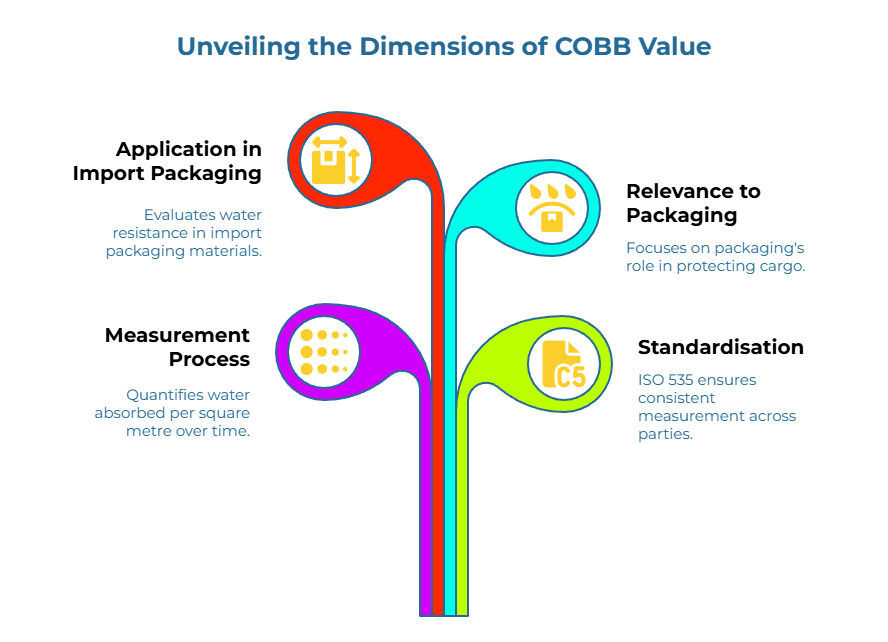
COBB value measures water absorption. Specifically, it quantifies how many grams of water one square metre of paper or board absorbs over a defined time, typically 60 seconds. The test itself is straightforward: a metal ring confines water on the sample surface for the test period, and the weight gain shows how much water was taken up. The result is expressed as g/m².
The internationally recognised method for this test is ISO 535, which provides the standardised procedure for paper and board. When specifying COBB in contracts, referencing this standard ensures both parties use the same measurement approach.
For import packaging, the relevant COBB measurement applies to the outer barrier materials: the kraft liners, carton facings, or protective wraps that shield your cargo from container rain and humidity swings. A lower COBB value indicates higher resistance to water penetration and surface wetting.
This is not about the paper product itself. A printing substrate might have its own COBB specification for ink absorption. What matters here is the packaging layer that sits between your cargo and the humid air inside a shipping container.
What COBB is NOT:
COBB value does not replace good stowage, desiccants, or correct Incoterms. It complements them. Think of Moisture & Humidity Control as a climate shield for your cargo. COBB specification addresses one critical layer of that shield: the barrier material’s inherent resistance to water penetration.
Decide What “Dry Enough” Means for Your Route and Product
Not every shipment faces the same moisture risk. A 12-day voyage across temperate waters differs fundamentally from a 30-day journey crossing the equator twice.
The core threat is container rain. This occurs when warm, humid air inside the container cools and water condenses on the ceiling and walls, then drips back onto the cargo. Paper products are particularly vulnerable to condensed water droplets: without adequate sizing, this water does not just sit on the surface but actively migrates into the material.
The table below provides a starting framework. Actual specifications should reflect your specific cargo sensitivity, container condition, and historical experience with particular routes.
| Risk Level | Example Conditions | COBB Guideline (Outer Packaging) | Notes |
| Low | Temperate routes, under 15 days at sea | 40–50 g/m² (COBB60) | Adequate for standard grades where minor surface dampness is acceptable |
| Medium | Seasonal humidity swings, 15–25 days, some tropics | 30–40 g/m² (COBB60) | Reduces risk of wavy edges and strength loss in shoulder seasons |
| High | Tropics, equator-crossing, over 25 days, monsoon periods | ≤30 g/m² (COBB60) | Combine with desiccants and kraft liners for full protection |
These ranges represent recommended benchmarks for barrier performance in containerised paper shipments. Your optimal specification may differ based on the specific grade being shipped, warehouse conditions at origin and destination, and the reliability of your container supply.
The critical point: choose a band and document it. A number you can test beats a promise you cannot verify.
Translate Your Choice into a COBB Clause for RFQs and Contracts
This is the heart of the Spec-True approach. Your RFQ and purchase order must contain identical, unambiguous language about moisture barrier requirements. No hidden lab standards. No assumptions about what “good packing” means.
COBB Value Specification Clause Template
The following template can be adapted for purchase orders and supply contracts:
“Packaging for all products supplied under this contract shall use outer liners and/or barrier materials with a COBB60 value not exceeding [X] g/m² when tested on the outer-facing surface, in accordance with ISO 535 or equivalent recognised method. Any shipment where packaging materials exceed this limit, based on agreed sampling and testing procedures, shall be considered non-conforming and subject to [credit/replacement/rejection terms as agreed].”
Key fields to specify:
- Material application: Outer liner, top sheet, carton facing, or barrier wrap
- COBB band: Maximum acceptable value in g/m²
- Test duration: COBB60 (60 seconds) is standard; specify if different
- Test surface: Outer-facing side of the barrier material
- Test method: ISO 535 or equivalent
- Acceptance tolerance: Whether minor deviations trigger rejection or retest
- Remedy for non-conformance: Credit, replacement, or full rejection rights
Short RFQ Spec Line
For initial quote requests, a condensed version works well:
“Outer packaging must achieve COBB60 ≤ [X] g/m² per ISO 535. Please confirm compliance and include packaging specification in your quote.”
Once COBB is fixed, suppliers can include the cost of higher-performance barriers transparently, and buyers can compare quotes on a like-for-like basis. The negotiation shifts to price, lead time, and service. For a deeper view on how packaging costs factor into supplier comparisons, see the guide on factoring packaging costs into supplier quotes.
Agree on How COBB Will Be Tested and Verified
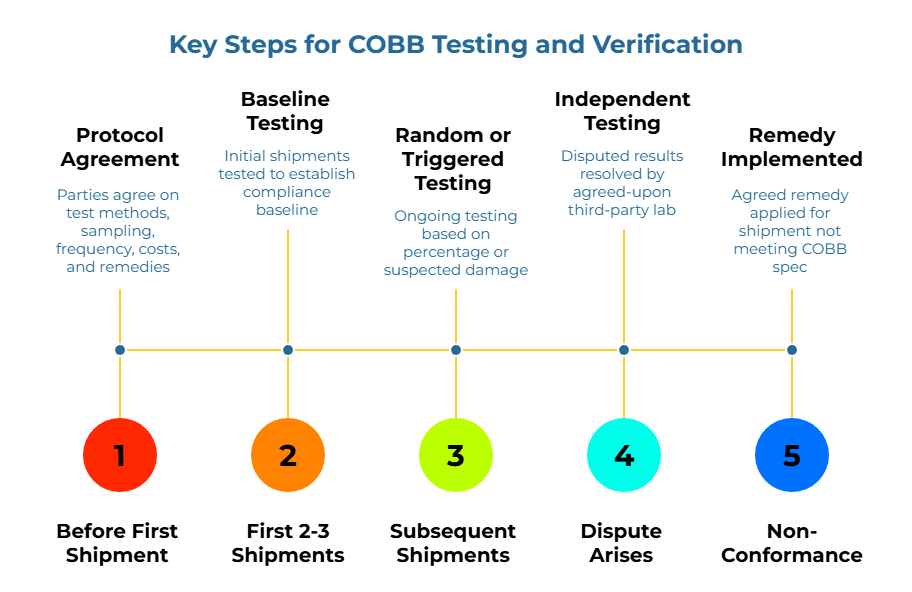
A specification only matters if both parties agree on verification. Before the first shipment, establish a clear protocol covering these elements.
Test method and laboratory: Which standard applies (ISO 535 is the common reference), and which laboratories are acceptable for independent testing if disputes arise.
Sample selection and surface: Which component will be tested (outer carton, top liner, barrier wrap) and which surface (the outer-facing side that contacts humid air). Also specify how many samples per lot and from which pallets or positions within the container.
Testing frequency: Options include testing the first two or three shipments to establish baseline compliance, random sampling on a percentage of subsequent orders, or testing triggered only when damage is suspected. Many importers find that upfront verification builds confidence and reduces disputes later.
Cost allocation: Common arrangements include supplier-provided certificates of analysis for each shipment, buyer-funded third-party testing on arrival, or shared costs for dispute-related testing. Document this in the contract to avoid arguments when a test becomes necessary.
Non-conformance remedy: Define the remedy clearly. Will the buyer reject the shipment outright? Accept at a discount? Require replacement packaging for future orders? Ambiguity here recreates the exact problem the specification was meant to solve.
Arrival verification ties into broader cargo inspection practices. Timestamped photographs, humidity data loggers, and structured container-closing checklists all support your position if a dispute arises. For a complete verification procedure, see the “pristine arrival” checklist: what to verify before your container closes.
Avoid the Most Common COBB Spec Mistakes
Even buyers who understand COBB value often undermine their own specifications through incomplete implementation.
- Asking for “seaworthy packing” without stating COBB or specific barrier materials. This phrase has no universal definition. Suppliers interpret it however suits their cost structure, and insurers see only a grey zone when claims arise.
- Specifying only plastic wrap. Plastic film alone can trap existing moisture around the roll, accelerating damage rather than preventing it. Without a defined COBB level for the paper-based layers underneath, the barrier system remains unbalanced.
- Setting COBB requirements for the inner product but not the outer protection. Container rain affects outer layers first. If your barrier wrap has poor moisture resistance, it fails before the inner product specification ever matters.
- Assuming Incoterms handle packaging. CIF or DDP terms allocate risk and cost, not packaging quality. A supplier meeting their Incoterms obligations can still deliver inadequately protected cargo if no COBB standard was specified. COBB sits alongside Incoterms, not under them.
- Using the same COBB spec for all routes. A value suitable for a short temperate voyage may prove entirely inadequate for an equator-crossing journey during monsoon season. Match your specification to your actual shipping lanes.
Each of these mistakes can be corrected by returning to the Spec-True principle: compare suppliers only after aligning on measurable specs.
Connect COBB to the Wider Moisture Defence Playbook
COBB specification addresses barrier material performance. It works best as part of a systematic approach to Moisture & Humidity Control, the climate shield that protects your cargo across multiple climate zones.
The complete playbook includes several complementary elements. Desiccants actively absorb moisture from the container atmosphere. Kraft liners provide physical separation between cargo and container walls where condensation forms. Container inspection before loading identifies rust, holes, or residual moisture that no amount of barrier material can overcome. Proper stowage and load-securing prevent physical damage that compromises packaging integrity.
Within this survival suit for your paper, COBB is the component that says: the paper-based armour must absorb no more than this much water under defined conditions.
For the full methodology on moisture-free shipments, see defeating container rain: a methodology for moisture-free paper shipments. For guidance on choosing between desiccants and kraft liners based on your specific route, see the comparison guide on barrier material selection.
A Simple Number That Stops Moisture Chaos Before It Starts
When moisture control is left to adjectives, every wet shipment becomes a blame game. When COBB values are written into RFQs and contracts, moisture control becomes a shared, measurable responsibility.
The distance between “we keep getting wet stock” and “our containers arrive dry” often comes down to a single missing element: a testable specification that both buyer and supplier agree to upfront.
COBB value provides that specification for moisture barrier performance. Write it into your RFQ. Confirm it in the purchase order. Verify it on arrival when needed. The chaos of subjective quality claims gives way to clear, comparable, enforceable standards.
Take your last three packaging-related quotes. Add a COBB line using the clause template above. Watch how quickly the conversation shifts from vague promises to concrete performance, and how clearly pricing differences emerge once comparability comes before price.
For more standards-first guidance on building specifications that protect your supply chain, explore the PaperIndex Academy.
Disclaimer: This article provides general educational guidance on moisture specifications for paper packaging. Specific COBB values and testing protocols should be determined based on your particular products, routes, and risk tolerance. All specifications and contract terms should be reviewed with appropriate technical and legal advisors.
Our Editorial Process
Our expert team uses AI tools to help organize and structure our initial drafts. Every piece is then extensively rewritten, fact-checked, and enriched with first-hand insights and experiences by expert humans on our Insights Team to ensure accuracy and clarity.
About the PaperIndex Insights Team
The PaperIndex Insights Team is our dedicated engine for synthesizing complex topics into clear, helpful guides. While our content is thoroughly reviewed for clarity and accuracy, it is for informational purposes and should not replace professional advice.