
📌 Key Takeaways
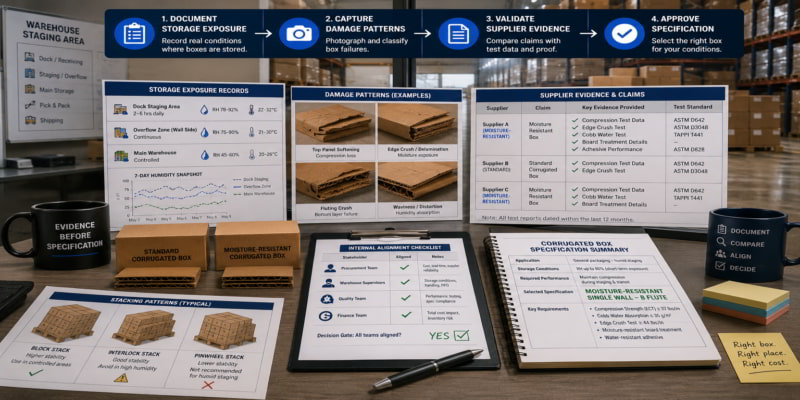
Choosing between standard and moisture-resistant corrugated boxes starts with documenting what your boxes actually face — not assuming “stronger” means better.
- Document Exposure First: Record storage time, staging humidity, stacking height, and damage history before changing any box specification.
- Standard May Still Work: If storage is short, climate-controlled, and damage traces back to handling rather than humidity, upgrading wastes money.
- “Moisture-Resistant” Varies Widely: Suppliers use the term to mean different things — coatings, treated board, better adhesives — so ask which property actually improves.
- Align Teams Before Suppliers: Have procurement, warehouse, and quality review the same photos, inspection notes, and storage records so everyone agrees on the real problem.
- Match Evidence to the Upgrade: Request test data, samples, and trial runs under conditions that mirror your actual warehouse and transit route before committing.
Specification decisions backed by evidence prevent both overbuying and repeated damage.
Procurement managers, warehouse supervisors, and quality teams evaluating corrugated packaging for humidity-sensitive storage will gain a clear comparison framework here, preparing them for the detailed exposure-to-supplier guide that follows.
~ ~ ~ ~ ~ ~ ~ ~ ~ ~ ~ ~ ~ ~ ~ ~ ~ ~
Humidity-sensitive storage can turn a normal packaging decision into a difficult internal debate. Procurement may hear that the box is “too weak.” Warehouse teams may point to soft panels, crushed corners, or boxes that changed shape after storage. Quality teams may want proof before approving a specification change. Suppliers may describe an option as “moisture-resistant,” but the term can mean different things depending on the material, treatment, testing, and intended use.
This article is not a product ranking. It is a practical method for comparing standard and moisture-resistant corrugated boxes without overbuying or ignoring real moisture risk.
The direct answer is this: Moisture-resistant corrugated options may deserve review when storage, handling, stacking, or route exposure creates recurring risk. Standard corrugated may still fit when exposure is controlled and supplier evidence matches the use case. The decision should begin with documented exposure, not with the assumption that “stronger” automatically means better.
Start With The Exposure, Not The Label
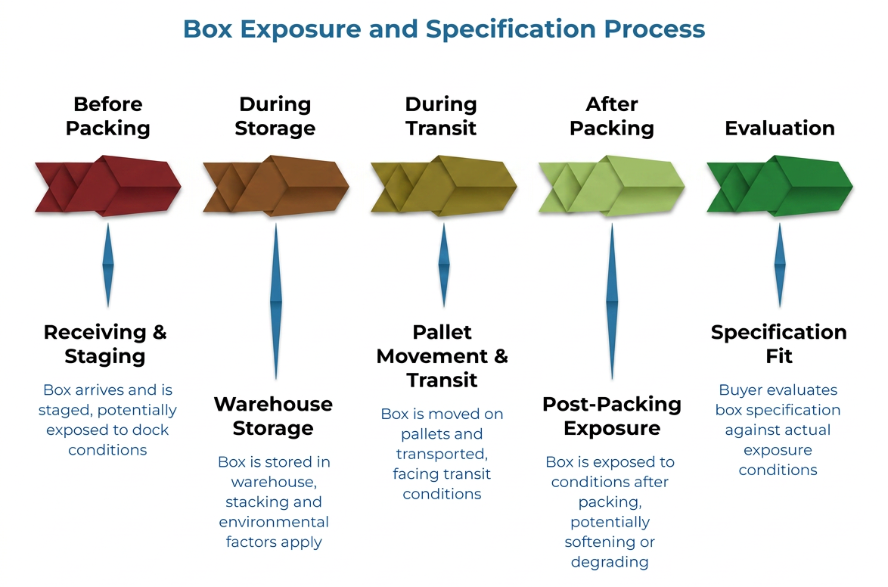
“Standard corrugated” generally refers to a corrugated box specification intended for normal storage, handling, and distribution conditions defined by the buyer and supplier. “Moisture-resistant corrugated” is broader. It may refer to a box designed, treated, coated, or documented for improved performance under certain moisture exposure conditions. The exact meaning can vary by supplier, board construction, converting process, and test evidence.
That variation is why buyers should start with storage exposure. In this context, storage exposure means the real conditions a box experiences before and after packing: receiving, staging, warehouse storage, stacking, pallet movement, and transit. A box may face limited risk in one route and much higher risk in another — dock staging, cross-docking, open-air loading, and transit through humid climates all contribute.
Useful exposure variables include storage duration, dock exposure, staging location, stacking pattern, product weight, pallet configuration, and visible damage history. A box may arrive in acceptable condition, then soften near a humid staging area. Or the issue may appear only after filled boxes are stacked longer than expected. Seasonal changes in warehouse conditions can shift the risk profile without any change in the box itself.
The practical question is not “standard or moisture-resistant?” The better question is: “What conditions must this box tolerate, and what evidence shows that the specification fits those conditions?”
When Standard Corrugated May Still Be the Right Discussion
Standard corrugated packaging is used across a wide range of applications for good reason. It is cost-effective, widely available, printable, recyclable, and well understood by converters, warehouses, and logistics teams worldwide.
Standard corrugated may still be suitable when exposure is short, storage is controlled, product load is modest, handling is predictable, and damage history is low or not clearly moisture-related. This is a general packaging principle, not a guarantee. Buyers should avoid treating every humidity concern as a reason to upgrade. If boxes are stored off the floor, protected from direct moisture, rotated consistently, and used within a known storage window, a standard option may remain appropriate. The same may be true when visible damage points more toward poor pallet handling, excessive re-handling, unsuitable stacking, or a changed load pattern.
Standard corrugated does not need to be replaced simply because someone reports a problem. If the damage pattern points to handling, stacking, or storage issues rather than board performance under humidity, the specification may not be the root cause — and a structured triage of whether damage comes from storage, suppliers, or handling can clarify the source before any specification change is considered. Buyers should confirm with the supplier and the internal team before assuming the box needs to change.
Compression strength — the ability of a box or board structure to resist crushing under load — matters when filled boxes are stacked, stored, palletized, or moved through distribution. A flute profile refers to the wave-like medium inside corrugated board; it influences cushioning, thickness, and stacking behavior. Standard edge crush resistance and structural integrity depend heavily on these geometric factors. Unplanned structural failures typically happen when dynamic warehouse forces exceed static design limits.
Before changing the box type, procurement should confirm whether anything changed: product weight, pack count, pallet pattern, storage duration, seasonal conditions, or fulfillment route. If the route changed but the packaging specification did not, the issue may be a mismatch rather than a simple failure of standard corrugated.
When Moisture-Resistant Options Deserve Closer Review
Moisture-resistant options deserve closer review when the risk pattern is recurring, visible, and connected to real exposure. Examples may include repeated softening after storage, boxes losing shape near staging areas, complaints linked to humid routes, longer-than-planned warehouse dwell time, or quality concerns after stacked storage.
Use these signs as review triggers, not automatic upgrade instructions.
It helps to recognize that “moisture-resistant” is not a single, uniform property. In supplier language, the term can refer to different improvements: surface water resistance through coatings, compression retention under sustained humidity, adhesive performance in wet conditions, board treatment, or treated board construction. A specification tolerance is the acceptable range around a stated requirement — not a vague label such as “premium” or “heavy-duty.” Knowing which property a supplier means when they say “moisture-resistant” is essential before any comparison can be meaningful.
Moisture-resistant options may deserve discussion when softening or compression loss recurs across multiple shipments; boxes sit in extended storage without consistent climate control; staging areas are exposed to outside humidity, rain splash, or condensation; heavy products are stacked for long durations; transit routes pass through high-humidity regions or involve condensation risk; seasonal warehouse conditions change significantly and damage follows that cycle, or quality complaints explicitly reference moisture-related signs.
Technical teams may also verify test language against current official sources before adding named methods to purchase documents. FEFCO publishes testing methods for corrugated board and corrugated packaging, including methods related to compression resistance and water absorptiveness. TAPPI publishes paper and paperboard test methods and conditioning practices. ISTA provides packaging test procedures for distribution and transit validation.
Even when these triggers apply, the next step is evidence — documenting the storage environment, gathering supplier information, and aligning internal teams around the actual problem.
Document Storage Conditions Before Changing Specifications
The buyer’s strongest position is a documented one. Before any specification discussion with suppliers, buyers should have a clear internal picture of what their boxes actually experience. Without storage notes, photographs, receiving checks, and route details, the conversation can become opinion-based: procurement thinks the supplier underperformed, warehouse thinks the boxes were already weak, and the supplier thinks the specification was used outside its intended conditions.
An illustrative example: a buyer sees softening after boxes sit near a humid staging area for several days. Instead of immediately specifying a moisture-resistant board, the team documents where the boxes were stored, checks whether damage appeared before or after receiving, and asks the supplier what evidence supports performance under similar exposure.
The following matrix connects common storage and handling factors to what should be documented and what to ask the supplier.
| Storage / Handling Factor | Why It Matters | What to Document Internally | What to Ask the Supplier |
| Time in storage before use | Longer storage increases cumulative moisture exposure and compression load. | Average and maximum storage duration; slow-moving stock areas; seasonal variation and rotation practice. | What storage duration and conditions is this specification designed to tolerate? Is it suitable for the expected storage window and rotation pattern? |
| Dock or staging exposure | Open areas expose boxes to ambient humidity and temperature shifts before they reach main storage. | Dock layout; whether staging is covered; time in staging; visible dampness and put-away delay. | Does the specification account for uncontrolled staging exposure? What exposure limitations should be observed before storage or use? |
| Stacking height and duration | Higher stacks over longer periods multiply compression demand under humidity. | Maximum stacking height; duration at full stack; pallet configuration and how long stacks remain loaded. | What stacking load and duration does the compression rating support? What stacking conditions was this specification designed for? |
| Product weight and load distribution | Heavier, unevenly distributed loads stress box walls differently under moisture. | Gross weight per box; weight distribution; inner packaging type; void fill, internal fit, and load concentration points. | How does product weight interact with the board grade under documented conditions? Does the box design match the actual product load and distribution? |
| Transit humidity or route exposure | Containers and intermodal transport can create condensation or sustained humidity after warehouse dispatch. | Transit routes; container type; climate zones; transit duration; seasonal exposure concerns and handling stages. | What transit conditions has this specification been evaluated against? Are the supplier’s claims comparable to the expected route? |
| Packaging damage history | Repeated patterns help separate moisture-related, handling-related, and specification issues. | Damage type and frequency; receiving condition vs. post-storage condition; photos, lot references, and where damage was first observed. | Can the supplier review documented damage patterns and advise on specification fit? What evidence would help identify the likely failure mode? |
| Receiving inspection results | Separating damage that arrives with the shipment from damage that develops in storage clarifies where the failure actually occurs. | Condition at receiving vs. condition after storage; panel condition, crushed areas, stains, soft corners; photographs or inspection records. | Does the supplier have guidance on receiving-stage inspection that would help isolate specification issues from handling issues? What receiving checks confirm boxes arrived within expected condition? |
This matrix is a preparation tool, not a testing protocol. Completing it before contacting suppliers means the conversation starts with evidence, not assumptions.
Supplier Questions That Make the Comparison Fair
A fair supplier discussion starts with a clear use case. When buyers engage suppliers about standard versus moisture-resistant options, the quality of the comparison depends on the quality of the questions.
Ask what storage and transit conditions the recommended specification is designed to tolerate. A companion guide on supplier questions regarding humid storage conditions provides a structured approach to framing these conversations with specific liner and flute details rather than vague claims. A supplier should be able to describe the intended use environment, not just the product label. Then ask where the supplier sees practical limitations. This prevents a common mistake: comparing supplier labels instead of comparable evidence.
Ask which properties are being improved. Compression retention, surface resistance, adhesive performance, board treatment, and coating each address different aspects of moisture exposure. Knowing which property changes helps buyers compare options that are actually comparable.
Ask which test methods or documented performance evidence supports the claim. Buyers do not need to become testing experts, but they should expect suppliers to reference relevant documentation — and understanding how to define and enforce corrugated box specs can help frame those expectations. For further context on evaluating corrugated supplier technical competence, the technical team must review internal testing protocols and calibration records before committing to formal validation cycles.
Ask whether the test conditions are comparable to the buyer’s actual storage and handling route, and what handling or storage limitations still apply. Moisture-resistant does not mean moisture-proof.
Ask whether samples or trial quantities are available for the actual product, stacking pattern, and handling route. Real-world validation under operational conditions is more informative than any product description.
Ask what changes if the box is printed, stacked, palletized, stored longer than originally expected, or moved through a different fulfillment channel. Specifications may perform differently when real-world conditions shift beyond the original design assumptions, and this question surfaces those limits before they become problems. Supplier evidence should support the buyer’s real operating conditions, not only a generic product description.
How Procurement, Warehouse, and Quality Teams Should Align
Specification decisions rarely sit with one team. Procurement sees cost and supplier options. Warehouse teams see physical damage. Quality managers need documentation and escalation criteria. Packaging engineers may need to validate whether the box design fits the actual load, stacking pattern, and route. When these groups are not aligned, each may draw different conclusions from the same box failure.
A useful alignment step is to separate observations from conclusions. “Boxes softened near the staging area” is an observation. “The supplier sent bad boxes” is a conclusion. “We need moisture-resistant boxes” is also a conclusion. Procurement teams that align operations and procurement priorities through a shared framework before engaging suppliers can avoid the cost leakage that comes from acting on competing assumptions. The better process is to collect observations first, then compare them against supplier documentation and handling history before deciding.
Before changing specifications, have procurement, warehouse, and quality review the same documented evidence — receiving inspection results, storage condition records, and damage photographs — so the supplier conversation is backed by a shared understanding of the problem.
This is especially important when environmental records are incomplete, receiving photos are missing, or product teams have changed pack weight or fulfillment channels without updating packaging requirements. In those cases, the issue may not be one person’s mistake. It may be a documentation gap that the team can close together.
How to Avoid Overbuying While Still Controlling Risk
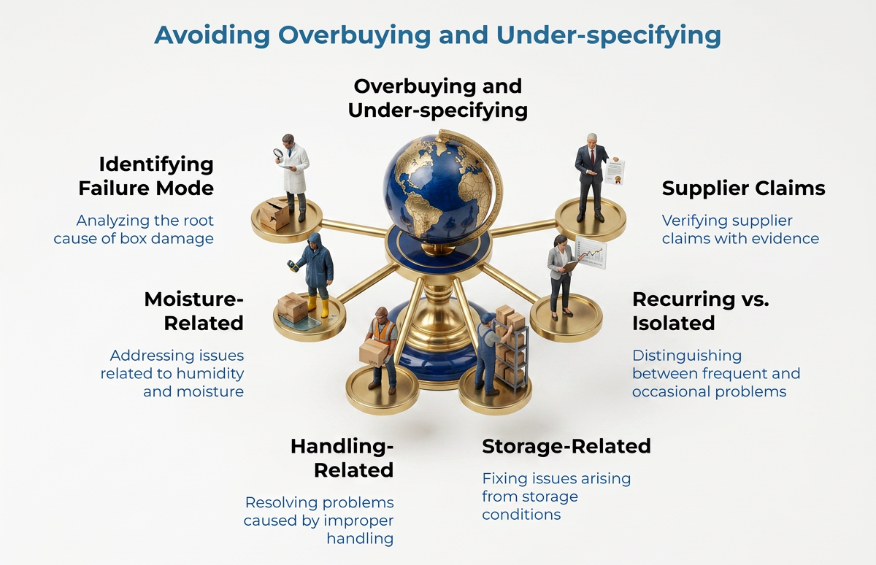
Overbuying happens when procurement teams upgrade a specification without first identifying the failure mode. The box softened, so the team requested a moisture-resistant board — but the softening was caused by a dock staging problem or a stacking configuration that exceeded the compression rating. Under-specifying carries its own risk. Buyers who dismiss recurring moisture signs or skip documentation because “standard boxes worked before” may continue absorbing preventable damage. Both problems come from the same source: weak evidence. The process of translating box damage into specifications helps buyers separate symptoms from cause.
Do not upgrade before identifying the failure mode. A heavier box is not automatically more moisture-resistant, and a moisture-resistant claim does not automatically solve poor staging, excessive handling, or unsuitable stacking.
Use three checks before changing specifications.
First, decide whether the problem appears moisture-related, handling-related, storage-related, or mixed. If boxes are crushed but not soft, the issue may be stacking or load distribution rather than humidity.
Second, decide whether the exposure is recurring or isolated. A single incident during unusual weather is different from a pattern that repeats every season.
Third, decide whether the supplier’s claim is supported by comparable documentation, test reports, or trial evidence. If the proposed upgrade has not been tested under conditions similar to the buyer’s environment, the upgrade is speculative.
The goal is not to default in either direction but to match the specification to the documented exposure.
A Simple Decision Path for Buyers
Low exposure, no moisture-linked damage: The current standard specification may remain appropriate. Continue monitoring, confirm storage, handling, and receiving controls, and verify with the supplier that the board grade fits the documented use case.
Moderate or recurring exposure: Document storage conditions, gather damage evidence, and ask suppliers for comparative documentation and samples. This is where the Storage Exposure-to-Supplier Question Matrix is most useful.
High exposure or repeated moisture-linked damage: Discuss moisture-resistant specifications with suppliers, request performance evidence under comparable conditions, and consider a controlled trial before full-scale changes.
Food-adjacent, pharmaceutical, export-sensitive, or regulated product: Avoid assumptions. Seek review from a qualified packaging engineer, compliance professional, or relevant authority before changing specifications or relying on any suitability claim. Moisture-resistance requirements in regulated applications may involve additional documentation and approval.
After this review, buyers who are ready to continue supplier conversations can review corrugated box suppliers, but only after documenting storage exposure and preparing evidence-based questions.
Frequently Asked Questions
Are moisture-resistant corrugated boxes always worth the upgrade?
Not necessarily. Moisture-resistant options may be appropriate when storage or handling conditions create sustained humidity exposure, but they are not a universal improvement. The decision should depend on documented exposure, product requirements, stacking, handling, route conditions, and supplier evidence.
What should buyers check before asking suppliers for moisture-resistant boxes?
Buyers should document storage duration, humidity exposure, staging conditions, stacking height, product weight, damage history, and receiving condition. Reviewing receiving inspection records to determine whether damage appears before or after storage gives the supplier conversation a factual basis.
Can warehouse humidity damage standard corrugated boxes?
Humidity can affect corrugated packaging performance over time, particularly compression strength and surface integrity. However, the severity depends on the level and duration of exposure, the board grade, the stacking load, and the handling environment. Avoid fixed assumptions unless supported by verified technical evidence. The practical question is whether documented exposure exceeds what the current specification is designed to handle.
Should buyers change suppliers if boxes soften in storage?
Not automatically. Softening may result from the storage environment, handling practices, or a mismatch between the specification and the use case. A constructive first step is to document the receiving condition, storage exposure, handling route, and whether the specification matches the current use case before considering a change. Supplier review may be appropriate if documentation remains unclear or evidence does not support the application.
Are moisture-resistant boxes needed for food-adjacent packaging?
Not as a blanket rule. Food-adjacent applications may involve additional requirements related to moisture, hygiene, or regulatory compliance that go beyond standard corrugated specifications. Rather than assuming a moisture-resistant upgrade addresses those requirements, buyers should seek review from a qualified packaging engineer or compliance professional who can assess applicable standards and documentation needs.
Conclusion
The choice between standard and moisture-resistant corrugated packaging is a fit-for-exposure question, not a binary upgrade decision. Standard corrugated may still fit when exposure is controlled and the specification matches the product, stacking, and handling route. Moisture-resistant options may deserve review when exposure is recurring, storage is humid, stacking is prolonged, or damage patterns suggest moisture involvement. Buyers who document their storage environment, align procurement, warehouse, and quality teams, and ask suppliers targeted questions are far better positioned than those who react to damage with a specification change alone.
Compare your storage notes with supplier documentation before discussing corrugated box options. Once that groundwork is in place, reviewing corrugated box suppliers becomes a more focused and effective next step.
Disclaimer:
This article is for general informational purposes only. It is not a substitute for advice from a qualified packaging engineer, supplier, testing laboratory, compliance professional, or other relevant professional. Storage conditions, product requirements, and packaging performance can vary by application, supplier, route, and handling environment. Always verify important specifications and decisions with the appropriate expert, authority, or service provider.
Our Editorial Process:
Our expert team uses AI tools to help organize and structure our initial drafts. Every piece is then extensively rewritten, fact-checked, and enriched with first-hand insights and experiences by expert humans on our Insights Team to ensure accuracy and clarity.
About the PaperIndex Insights Team:
The PaperIndex Insights Team is our dedicated engine for synthesizing complex topics into clear, helpful guides. While our content is thoroughly reviewed for clarity and accuracy, it is for informational purposes and should not replace professional advice.