

📌 Key Takeaways
Operations and procurement share the same goal—fulfillment reliability—but reach it through different decision lenses that must be aligned before RFQs go out.
- Align Before You Quote: Standardizing lead time thresholds, landed-cost calculations, and evidence requirements before requesting supplier quotes prevents post-award finger-pointing when failures occur.
- Evidence Beats Promises: Requiring test reports tied to recognized standards like ASTM D5276 or ISO 2248 transforms supplier claims into verifiable proof that protects both teams.
- Comparability Trumps Testing Volume: When specs behave differently across suppliers, the fix is locking test methods and acceptance criteria—not simply adding more inspections.
- Use the Break-Even Test: Comparing unit-cost savings against avoided failure costs using internal incident data reveals whether “cheaper” boxes actually cost more downstream.
- Governance Sustains Alignment: Monthly check-ins reviewing damage rates, lead-time performance, and evidence compliance catch drift before the next RFQ cycle arrives without updated guardrails.
Forty-five minutes of structured alignment prevents months of inherited failures.
Operations managers and procurement officers navigating corrugated box sourcing will gain a shared decision framework here, preparing them for the detailed matrix and huddle guide that follows.
~ ~ ~ ~ ~ ~ ~ ~ ~ ~ ~ ~ ~ ~ ~ ~ ~ ~
Operations need reliability. Procurement is measured on cost savings. When these incentives collide, fulfillment suffers—and both teams inherit the blame.
The path forward isn’t choosing sides. It’s building shared decision criteria before RFQs leave the building. The Friction-to-Function Matrix serves as a tactical roadmap for converting departmental tension into aligned specification, protecting both operational control and cost predictability.
The Common Ground: Shared Goals for Operations and Procurement
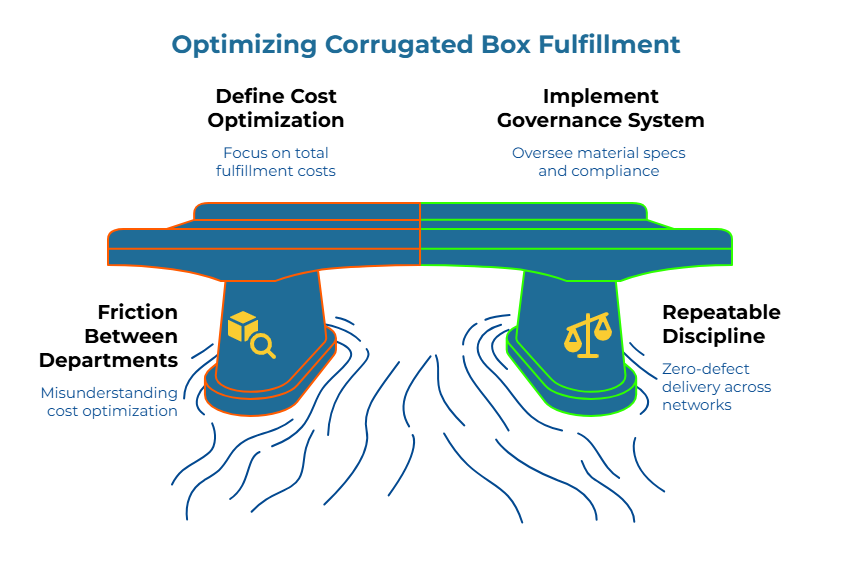
The friction between operations and procurement often stems from a misunderstanding about what “cost optimization” actually means.
Corrugated Box Cost Optimization is a technical competency focused on reducing total fulfillment costs by matching structural integrity to actual load stress. It is not simply price negotiation. Consider it the structural reinforcement of the supply chain; deploying inadequate packaging is equivalent to utilizing substandard materials in critical infrastructure.
When individual decisions are made well but the overall system still fails, the problem is usually governance. Industrial Packaging Governance is the systematic oversight of material specs and vendor compliance to support zero-defect delivery across fulfillment networks. It transforms ad-hoc alignment into repeatable discipline.
Consider a scenario that shows up regularly in growth-stage e-commerce. The carrier scan says “delivered,” but the customer photo shows a crushed corner. Returns spike. A retailer flags a packaging nonconformance. Operations tightens receiving checks; procurement pushes back on “gold-plating.” The argument repeats because the decision inputs were never standardized.
Three months earlier, procurement had secured a supplier offering boxes at 12% below the current vendor’s price. The specs looked comparable on paper. But without aligned verification criteria, the ‘savings’ evaporated into hidden costs that cheap boxes create — returns processing, replacement inventory, expedited reshipping, and the harder-to-quantify erosion of customer trust.
The misalignment usually comes from what each team treats as the “truth” in a decision. Operations anchors on failure modes: What breaks? Where does it break—pick/pack, sortation, last-mile, returns? What happens downstream when it breaks? Procurement anchors on comparability: Are suppliers quoting the same spec, the same lead time, the same landed-cost basis? Are claims verified with test reports and change control, or just promised?
The shared goal that unites both functions is fulfillment reliability, sometimes called zero-defect delivery. For operations, this means shipments arrive intact, audits pass without findings, and the fulfillment line runs without firefighting. For procurement, it means cost predictability—no surprise claims, no emergency supplier switches, no explaining budget overruns caused by “savings” that backfired.
When both teams recognize that reliability is the foundation of true cost optimization, the conversation shifts from adversarial to collaborative.
Stakeholder Alignment Matrix
The Friction-to-Function Matrix below translates common points of departmental tension into shared decision rules. Use this matrix during a cross-functional alignment session to establish aligned criteria before requesting supplier quotes.
| Friction Point (What’s Happening) | Operational Risk (Ops Lens) | Procurement Constraint (What They’re Optimizing) | Shared Decision Rule (Pre-RFQ) | Evidence/Inputs Needed | Owner & Meeting |
| “These boxes keep collapsing in transit” | Disruption, rework, rejected shipments | Unit price per box | Set maximum acceptable damage threshold before comparing prices | 90-day damage/rejection log; carrier claim history | Ops provides data |
| “Box failures seem random” | Hidden repeatability issue causing unpredictable disruptions | “Anecdotes” can’t justify spec changes | Define top 1–2 failure modes and where they occur (handling, stacking, moisture) before changing spec | Damage/failure tags with photos; SKU and pack-out profile | Ops + Warehouse lead |
| “We can’t wait 6 weeks for boxes” | Stockouts, expedited freight, missed SLAs | Supplier lead time vs. price trade-off | Agree on maximum acceptable lead time based on inventory carrying capacity | Current inventory levels; demand forecast; warehouse constraints | Joint review |
| “RFQ responses are hard to compare” | Incorrect awards due to apples-to-oranges quotes | “Cheapest” may be cheapest only on paper | Normalize quotes to the same landed-cost basis using Incoterms normalization for true door-to-door pricing | Cost breakdown template; Incoterms rule plus named delivery place | Procurement |
| “I don’t trust the new supplier’s specs” | Quality uncertainty creating operational anxiety | Cost savings from switching vendors | Require material compliance certificates (ECT/BCT) and performance drop-test reports from corrugated box suppliers before awarding volume | Material verification per TAPPI T 811 or ISO 3037 for ECT; Performance certificates per ASTM D5276 or ISO 2248; sample shipment results | Procurement sources; Ops validates |
| “Same spec behaves differently across suppliers” | Quality drift requiring unplanned requalification | Spec language may be incomplete or ambiguous | Lock test method, configuration, and acceptance criteria as part of the spec | Test reports referencing ISTA procedures; test plan documentation | Ops/QA + Procurement |
| “Our audits flagged inconsistent box weights” | Compliance exposure and audit findings | Specification flexibility for better pricing | Lock specifications with tolerances; no substitutions without approval | Agreed spec sheet with tolerances; incoming inspection protocol | Joint sign-off |
| “Changes happen after award (paper grade, flute, adhesive)” | Sudden failure rate shift; audit anxiety | Supplier “equivalents” reduce cost but add risk | Define change-control: what changes require re-approval and re-testing | Change log requirement; pre-approval workflow; versioned spec | Ops/QA |
| “We’re too dependent on one supplier” | Continuity failure when capacity or quality dips | Volume consolidation for better pricing | Maintain at least one qualified backup source | Backup supplier qualification records; staged allocation plan | Procurement owns; Ops approves |
| “Ops adds inspection steps late in the process” | Throughput slowdown; team morale impact | Cost creep without visibility | Decide inspection triggers and sampling plan upfront based on risk, not reactively | Incoming QC checklist; defect thresholds; escalation contacts | Ops |
Key Principles for Using the Matrix
Evidence beats promises. Procurement skepticism is healthy here—verification protects both teams. When packaging tests are part of supplier verification, referencing recognized standards prevents vague claims from becoming post-award disputes.
Comparability matters more than testing volume. The instinct when failures occur is to add more testing. But the real fix is often more comparability. The same test method means little if the pack-out configuration, drop orientation, and acceptance criteria vary between suppliers.
Prioritize the decision rule in every row. Start each discussion with the shared decision rule, then debate details. If the rule isn’t agreed upon, supplier quotes are noise.
If the RFQ leaves the building before operations signs off on failure modes and procurement signs off on quote comparability, the negotiation will happen internally—after the damage occurs.
How to Use This Matrix: The 45-Minute Huddle Guide
Participants: Operations Manager and Procurement Officer (required). Finance or Quality representatives may attend as observers.
Inputs to Bring:
- Recent shipment rejection or damage signals (last 90 days)
- Current lead-time constraints and inventory buffer status
- Quote basis alignment needs (landed cost calculations, Incoterms used)
- Any pending RFQs or supplier reviews
Huddle Agenda:
- Minutes 1–10: Operations present current pain points using the “Friction Point” column. No solutions yet—just documenting the operational reality.
- Minutes 11–20: Procurement explains the constraints they’re working within for each friction point. The goal is mutual understanding, not defensiveness.
- Minutes 21–35: Together, complete the “Shared Decision Rule” and “Evidence/Inputs Needed” columns for each relevant row. These become your RFQ guardrails.
- Minutes 36–45: Assign owners and agree on what documentation suppliers must provide. Confirm that quotes will be evaluated on comparable inputs—same Incoterms basis, same delivery location, same specification tolerances.
Output Artifacts:
- Shared RFQ guardrails document
- Evidence expectations checklist for suppliers
- RACI clarity on who owns what in the evaluation process
This approach mirrors the shared checklist methodology used to align procurement and engineering teams—adapted here for operations and procurement alignment.
The Business Case: Justifying the Investment
Forty-five minutes of structured alignment might feel like a luxury when both teams are busy. It isn’t. The business case is not “spend more on boxes.” It is “spend with rules” so that unit-price wins don’t create systemic cost leakage.
The investment is designed to mitigate exposure across four risk categories.
Reduced shipment rejection risk. When specifications are set collaboratively based on actual load stress and transit conditions, boxes perform as expected. Operations stops inheriting failures from decisions made without their input. The quiet dread of opening another rejection email becomes less frequent.
Lower audit anxiety. Regulatory and customer audits increasingly scrutinize packaging governance. When operations and procurement can demonstrate aligned specifications, documented decision criteria, and supplier verification protocols, audit findings decrease. The conference room tension of explaining yet another compliance gap fades.
Decreased supplier risk exposure. Aligned teams naturally build in backup supplier requirements and verification steps. This prevents the scramble that follows when a single-source supplier fails to deliver—a scramble that typically costs far more than the volume discount that justified the concentration.
Controlled landed cost. Hidden cost creep happens when procurement evaluates quotes on unit price while operations absorb the downstream expenses of failures. By agreeing on total landed cost as the evaluation metric—including damage allowances, lead-time buffers, and verification costs—both teams see the same number. Surprises diminish.
A Simple Break-Even Framework
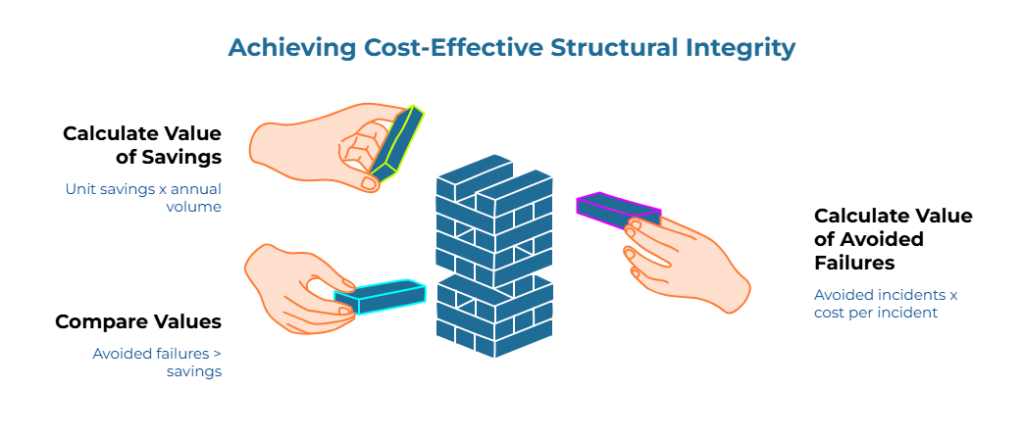
Instead of arguing whether a stronger spec is “worth it,” agree on a threshold using internal data.
Value of unit-cost savings equals annual volume multiplied by unit savings in your currency.
Value of avoided failure cost equals expected failure incidents avoided multiplied by cost per incident.
No industry-average numbers are required. Use internal incident logs and a conservative incident cost covering returns handling, reship labor, and inventory reconciliation. If the avoided failure value exceeds the savings, the “cheaper” option is not cheaper. This demonstrates the methodology in practice: prioritizing structural integrity to mitigate downstream losses rather than pursuing nominal unit-price reductions.
The specific magnitude of these benefits varies by organization, product mix, and current baseline. What remains consistent is the principle: alignment before RFQs prevents finger-pointing after failures.
Sustainable Alignment and Drift Prevention
Initial alignment is valuable. Sustained alignment is transformational.
After the first huddle, schedule a brief monthly check-in to review whether the shared decision rules are holding. Are damage rates trending in the right direction? Are lead times meeting the agreed thresholds? Has procurement encountered supplier pushback on the evidence requirements?
These check-ins need not be lengthy. Fifteen minutes with a shared dashboard showing the agreed metrics is often sufficient. The goal is catching drift before it becomes a crisis—and before the next RFQ cycle arrives without updated guardrails.
For organizations ready to formalize this approach, the enterprise corrugated box sourcing framework provides a more comprehensive governance structure.
Your Next Step: Apply the Friction-to-Function Matrix to your next RFQ cycle. Before requesting quotes, convene the 45-minute huddle to standardize shared decision rules—lead time thresholds, landed cost calculation basis, and reliability requirements. When suppliers are evaluated on comparable, pre-aligned inputs, both operations and procurement can defend the final decision.
When ready to source, find corrugated box suppliers or submit RFQs and receive quotes free from verified suppliers.
Here are additional resources on corrugated packaging sourcing.
Disclaimer:
This content is for informational purposes only and should not replace professional advice tailored to your specific operational and procurement context.
Our Editorial Process:
Our expert team uses AI tools to help organize and structure our initial drafts. Every piece is then extensively rewritten, fact-checked, and enriched with first-hand insights and experiences by expert humans on our Insights Team to ensure accuracy and clarity.
About the PaperIndex Insights Team:
The PaperIndex Insights Team is our dedicated engine for synthesizing complex topics into clear, helpful guides. While our content is thoroughly reviewed for clarity and accuracy, it is for informational purposes and should not replace professional advice.