

📌 Key Takeaways
Comparing toilet tissue parent roll quotes means putting every supplier on the same technical and commercial basis before you decide.
- Lock Your Baseline First: Define your own GSM, moisture, and bulk targets before asking suppliers to quote—your equipment’s needs set the standard, not industry averages.
- Name the Test Methods: A moisture target without a named test method (like ISO 287) lets suppliers measure differently, so you can’t compare results fairly.
- Normalize the Delivery Terms: EXW, FOB, and CIF quotes describe different cost and risk boundaries—convert all offers to your door before ranking them.
- Model Transit Exposure: A 35-day tropical sea voyage affects rolls differently than a 12-day temperate route, so document routing and container conditions upfront.
- Match Receiving to Quoting: Test incoming rolls using the same test methods and tolerances you required in the quote, or “passing” at the mill means nothing at your dock.
Same test methods + same delivery basis + same transit assumptions = true quote comparability.
Procurement managers and QA leads sourcing toilet tissue parent rolls will find a clear framework here, preparing them for the detailed normalization guides that follow.
~ ~ ~ ~ ~ ~ ~ ~ ~ ~ ~ ~ ~ ~ ~ ~ ~ ~
The quote looked safe.
Then the container doors opened, the wrap felt damp at the edges, and a toilet tissue parent roll that seemed acceptable at the mill no longer looked so dependable at the receiving dock.
Consider two supplier offers sitting on the same desk. Both show 18.5 GSM at comparable prices. Both provided samples that looked and felt acceptable. But one mill conditioned its samples at 50% relative humidity, the other at 65%. Same number, different material, incomparable decision. When the moisture meter at receiving reads 2% above tolerance, the production schedule unravels—and the quote that looked safe becomes the quote that cost the quarter.
That is the real sourcing problem. For toilet tissue parent rolls, the question is not only what belongs on the quote. The harder question is how to stop a technically acceptable quote from turning into a receiving-stage failure or a production-stage disruption after transit, handling, and delivery conditions have changed.
Quote-to-door specification standardization means converting every toilet tissue parent roll supplier offer to the same technical and commercial basis: the same named test methods, the same tolerance bands, the same Incoterm logic, the same transit assumptions, and the same receiving logic, so quotes can be compared on a true to-door comparability basis.
At a minimum, that means keeping five things aligned:
- The same technical fields
- The same named test methods
- The same delivery basis
- The same transit exposure assumptions
- The same acceptance logic at receiving
A 5-Stage Quote-to-Door Normalization Workflow for Toilet Tissue Parent Rolls
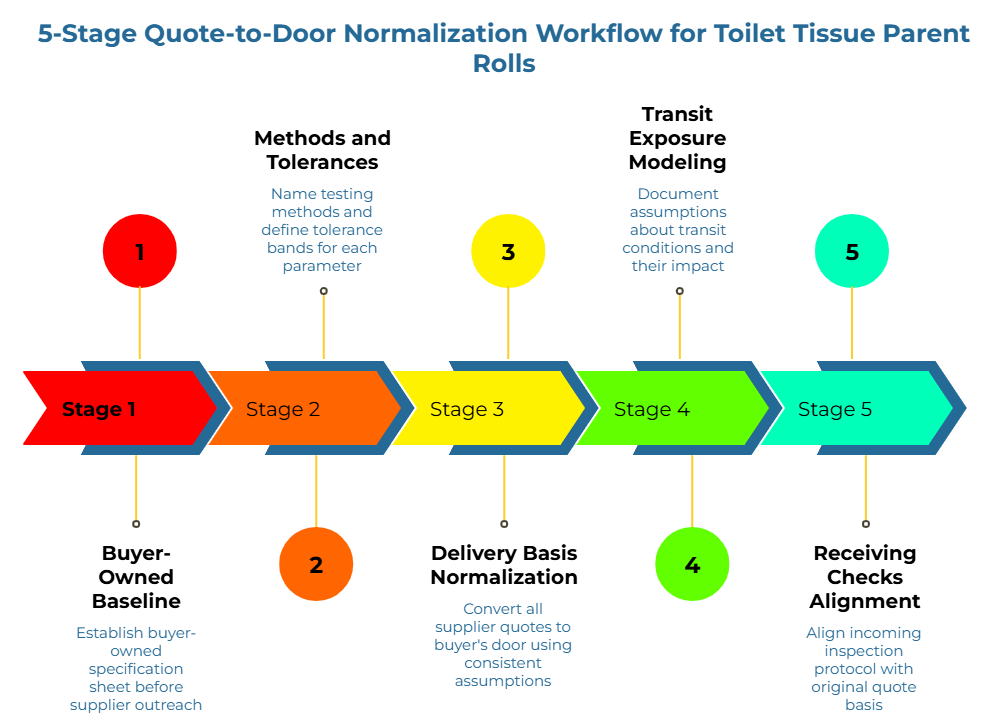
The simplest way to understand technical specification normalization is to treat it as a universal translator. It converts supplier language into buyer-owned operational reality. A supplier may describe a toilet tissue parent roll as acceptable, but that description only matters if it matches what the converter’s line, warehouse, and receiving process can actually tolerate.
Stage 1: Lock the buyer-owned baseline. Start with a buyer-owned specification sheet before toilet tissue parent roll supplier outreach. That baseline should define the toilet tissue parent roll fields that matter to runnability and receiving control—not a generic industry range, but the specific GSM, moisture, bulk, and absorbency parameters your equipment needs to run without jams or waste. This document becomes the foundation against which every incoming quote is measured. This is the core logic behind specification-true toilet tissue parent roll quotes.
Stage 2: Name the test methods and tolerance bands. A GSM target without a GSM tolerance is incomplete. A moisture target without a named test method is incomplete. Across the industry, naming the field alone is not enough; the test method and allowed range must travel with it. Specify the most current active version of ISO 287 for moisture content determination. Specify the latest active version of ISO 187 for conditioning and testing atmosphere. Define tolerance bands as absolute values—if your line tolerates ±0.5 GSM, write that explicitly.
Stage 3: Force all offers onto the same delivery basis. If one supplier quotes EXW, another quotes FOB, and another quotes CIF, the offers are not directly comparable. They describe different responsibility boundaries, different exposure points, and different cost-risk visibility. Convert all offers to your door using consistent freight, insurance, and handling assumptions. Quote normalization fails when the commercial basis and material risk are reviewed in separate silos.
Stage 4: Transit Exposure Modeling. Long transit exposure is part of the material story. Humidity, temperature swings, dwell time, and handling conditions all affect what finally arrives. Document assumptions about container climate, port dwell time, and inland transport conditions. A 35-day sea voyage through tropical humidity affects toilet tissue parent rolls differently than a 12-day shipment on a temperate route.
Stage 5: Align receiving checks to the original basis. The same assumptions used to compare suppliers should also govern receiving. Your incoming inspection protocol must test the same parameters, using the same test methods, against the same tolerances that governed the quote. Otherwise, a roll can “pass” the quote logic and still fail the plant logic.
The Specification Fields That Must Travel With The Quote
For toilet tissue parent rolls, the non-negotiable fields are straightforward even if the exact values vary by line, product, and converter.
- GSM target and GSM tolerance. GSM is the headline number, but it means nothing without a tolerance band. Specify the target and the acceptable range. A toilet tissue parent roll quoted at 18.5 GSM with ±1.0 tolerance delivers a different material than one quoted at 18.5 GSM with ±0.3 tolerance.
- Moisture target, moisture tolerance, and named test method. A 6% moisture target tested via ISO 287 oven-drying produces a verifiable, repeatable result. A 6% target with no test method named invites interpretation differences that surface only at receiving.
- Conditioning and testing atmosphere. Paper properties shift with humidity. ISO 187 defines the standard atmosphere for conditioning as 23 ± 1°C (74 ± 2°F) and 50 ± 2 % relative humidity. If a supplier conditions samples at 65% RH, the GSM and bulk readings will differ from samples conditioned at 50% RH—even if the underlying material is identical.
- Bulk and absorbency. Specific volume (cm3/g) and water absorption capacity must be quantified to ensure compatibility with high-speed embossing or winding parameters. A toilet tissue parent roll destined for a high-speed embossing line needs tighter bulk control than one destined for a slower converting process.
- Lot reference and reporting format. Define how the supplier identifies production lots, what test results accompany each shipment, and what acceptance window applies.
Those elements keep quote language tied to operational reality.
Why Incoterms And Toilet Tissue Specifications Cannot Be Separated
Incoterms are not just commercial shorthand. According to the International Chamber of Commerce (ICC), the Incoterms rules are a set of standard trade terms used in contracts for the delivery of goods, and they define important responsibilities of buyers and sellers, including cost and risk allocation. That is why EXW, FOB, and CIF change more than freight accounting. They change who controls loading, exposure, timing, and handoff visibility. These distinctions are governed by ICC Incoterms® 2020.
Under EXW (Ex Works), the buyer assumes responsibility for the goods before they are even loaded onto the collecting vehicle at the supplier’s facility. Every subsequent handling event—including the initial loading, trucking, port transfer, ocean transit, destination clearance, and inland delivery—happens entirely under the buyer’s risk and coordination. If the buyer prefers the supplier to control and bear the risk of the initial loading process to prevent careless edge damage, the correct term to normalize against is generally FCA (Free Carrier) rather than EXW, as strict EXW dictates the buyer must manage the loading.
Under CIF (Cost, Insurance, and Freight), the supplier arranges and pays for freight and insurance to the named destination port. But risk transfers to the buyer once the goods are loaded on board the vessel at the origin port. The supplier controls loading and initial handling; the buyer owns the exposure during transit even though the supplier arranged the logistics. A shipment arranged under CIF on the cheapest available vessel may spend extra days in humid holds.
For toilet tissue parent rolls, that matters because material exposure does not stop at the mill gate. If the commercial term changes, the risk map changes too. Price comparison without Incoterm alignment is noise. Two suppliers quoting USD 1,180 per MT—one EXW and one CIF—are not offering the same thing. That is why normalizing EXW and CIF toilet tissue raw material specifications is part of technical specification normalization, not a separate finance exercise.
Where Toilet Tissue Parent Rolls Drift Between Quote And Arrival
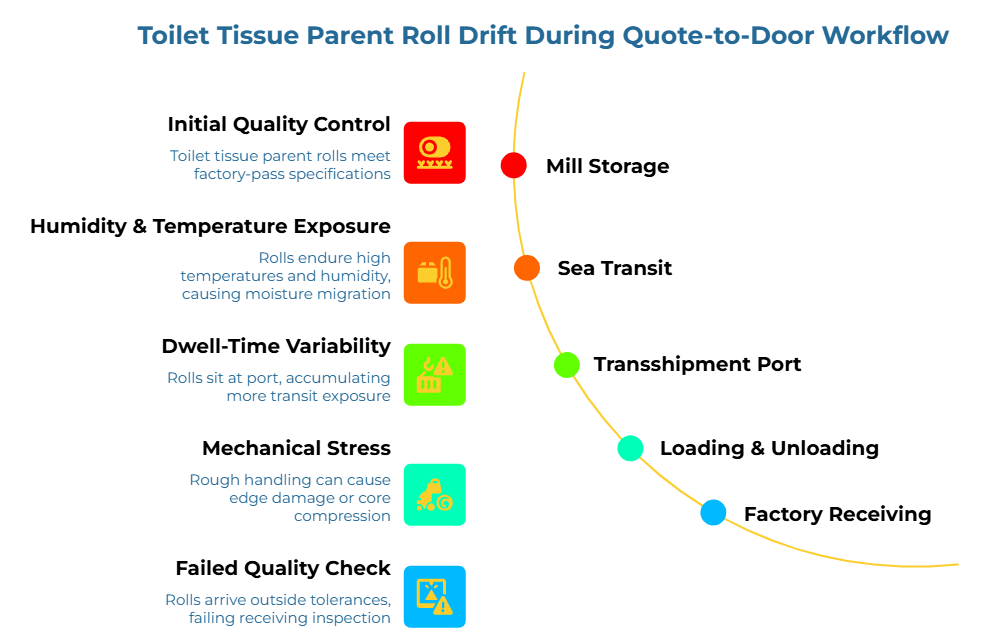
The drift usually happens in plain sight.
Sea transit exposes toilet tissue parent rolls to humidity and temperature conditions that differ from mill storage. A standard dry container crossing the equator encounters internal temperatures that can typically exceed 122°F to 140°F (50°C to 60°C) during the day and drop sharply at night. This thermal cycling drives moisture migration within the roll. Paper near the outer layers absorbs ambient humidity while the core remains drier, creating uneven moisture profiles that affect converting performance.
Storage and dwell-time variability compound the problem. A container sitting at a transshipment port for an extra week accumulates more exposure than one that moves directly. Port congestion, customs delays, and scheduling gaps add uncontrolled dwell time.
Loading and unloading handling adds mechanical stress. Toilet tissue parent rolls handled roughly during port transfer can sustain edge damage or core compression that will cause jams or waste on the converting line.
The result: a factory-pass specification can still fail at receiving. Material that met every tolerance at the mill can arrive outside those tolerances after a long, humid voyage. This also explains why visual samples are weak controls. A visually acceptable sample does not lock down moisture tolerance, named test methods, or transit exposure assumptions. Moisture damage in toilet tissue parent rolls during transit is not a side issue. It is part of the quote-to-door logic.
What “To-Door Comparability” Means In A Toilet Tissue Rfq
A toilet tissue parent roll RFQ reaches to-door comparability only when every supplier is being measured against the same control frame:
- Same Incoterm basis, with all quotes converted to a single delivery point
- Same technical fields, including GSM, moisture, bulk, and absorbency
- Same named test methods, such as ISO 287 for moisture and ISO 187 for conditioning
- Same transit assumptions, with transit time, routing, and packaging requirements documented consistently
- Same acceptance logic, with tolerance bands defined identically
When all five dimensions align, the numbers on competing quotes mean the same thing. Procurement can rank suppliers on a true-to-door basis. QA can predict receiving outcomes. Operations can plan production schedules with confidence. That mental model is simple on purpose. It gives procurement and QA a shared vocabulary. It also makes it easier to spot the hidden variables in the next toilet tissue RFQ before supplier comparison starts.
A Pre-Award Checklist For Toilet Tissue Parent Roll Supplier Comparison
Before moving any supplier into final comparison, apply these gates.
- Reject quotes missing named test methods. If a supplier quotes GSM without specifying how it was measured, the number is unreliable.
- Reject quotes missing tolerance bands. A target value without a tolerance is a hope, not a specification.
- Reject quotes on mixed delivery basis. Do not compare EXW to CIF without normalization.
- Document transit assumptions explicitly. Write down the expected routing, transit time, and container type. Note any special packaging requirements.
- Move only quote-ready suppliers into final comparison. A supplier who cannot provide named test methods, tolerance bands, and delivery-basis clarity is not quote-ready.
A toilet tissue parent roll quote is only as strong as the chain of meaning behind it. When technical specification normalization holds that chain together—from test method to Incoterm to transit exposure to receiving logic—the quote transitions from a manufacturer’s projection to a validated operational asset.
For next steps, read the related toilet tissue parent roll normalization guides in PaperIndex Academy.
Disclaimer: This article is for educational purposes only. Nothing in this article should be treated as legal, contractual, or market-intelligence advice.
Our Editorial Process:
Our expert team uses AI tools to help organize and structure our initial drafts. Every piece is then extensively rewritten, fact-checked, and enriched with first-hand insights and experiences by expert humans on our Insights Team to ensure accuracy and clarity.
About the PaperIndex Insights Team:
The PaperIndex Insights Team is our dedicated engine for synthesizing complex topics into clear, helpful guides. While our content is thoroughly reviewed for clarity and accuracy, it is for informational purposes and should not replace professional advice.