
📌 Key Takeaways
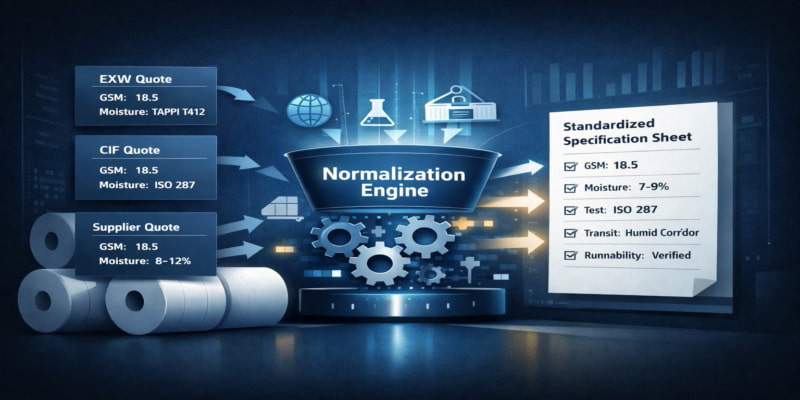
Comparing toilet tissue raw material quotes from different trade terms only works after you translate them into the same technical baseline.
- Trade Terms Change the Test: EXW specifications show mill-gate conditions, while CIF specifications hide transit exposure—same numbers, different products arriving at your plant.
- Own Your Baseline: Build a buyer-controlled specification sheet with GSM, moisture, and test methods before comparing any supplier quotes.
- Name the Test Method: Two suppliers quoting identical moisture can mean different things if one uses ISO 287 and another uses TAPPI T 412.
- Log Every Assumption: Compare quotes only after documenting packaging, transit time, and corridor humidity for each supplier.
- Align Your Teams First: Procurement, plant, and quality must agree on the comparison sheet before supplier evaluation starts.
Normalize specifications before shortlisting—not after the line jams.
Toilet tissue converters evaluating global parent roll suppliers will find a ready-to-use framework here, preparing them for the detailed specification guide that follows.
~ ~ ~ ~ ~ ~ ~ ~ ~ ~ ~ ~ ~ ~ ~ ~ ~ ~
A global toilet tissue quote set may look orderly on paper. Three suppliers, three prices, three stated GSM values. This apparent parity masks the divergent points of measurement and risk transfer inherent in global trade.
When one supplier quotes EXW and another quotes CIF, the apparent comparability dissolves. These trade terms do not merely shift freight responsibility. They change the context in which every technical specification is evaluated. The GSM tested at the mill gate under controlled conditions is not the same GSM that arrives at a humid port after three weeks at sea. Without normalization, those hidden assumption gaps reveal themselves as slower line speeds, handling failures, or retailer-quality problems weeks after the purchase order is signed.
The solution is normalization: aligning disparate supplier offers to one standardized technical baseline before any evaluation begins. Think of it as translating different currencies into a single benchmark. Without this translation, every comparison contains hidden variables that procurement cannot see until converting begins.
Why EXW and CIF Make Toilet Tissue Specifications Look Comparable When They Are Not
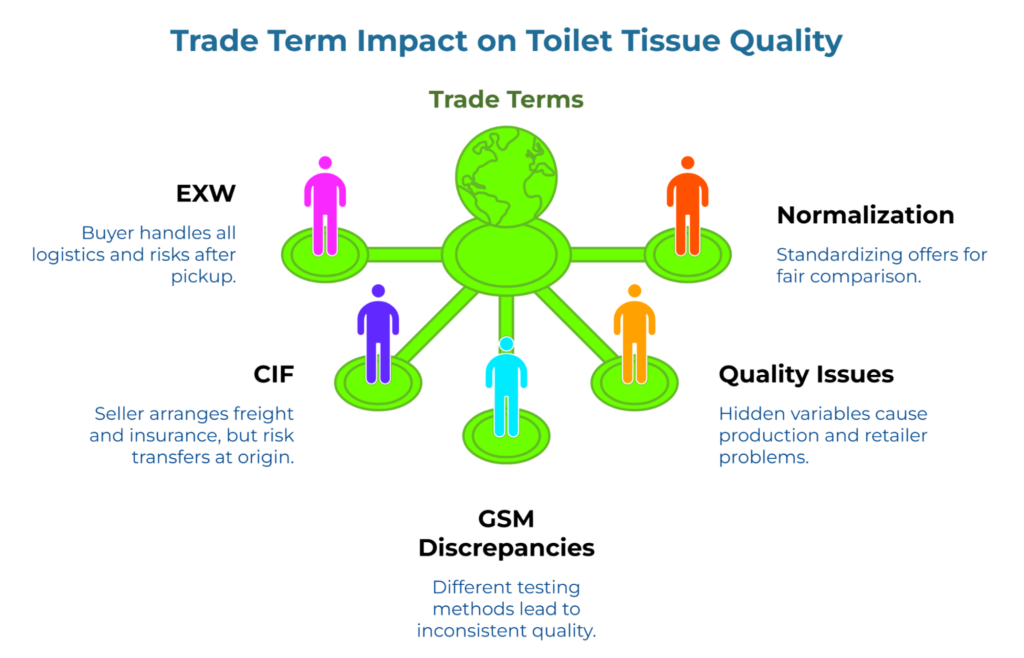
Under Incoterms 2020 rules published by the International Chamber of Commerce, EXW (Ex Works) places responsibility for loading, freight, insurance, and handling entirely on the buyer from the moment the goods are placed at their disposal at the seller’s facility. CIF (Cost, Insurance, and Freight) requires the seller to arrange and pay for freight and minimum insurance to the destination port, but the critical risk of loss or damage actually transfers to the buyer the moment the goods are loaded onto the vessel at the port of origin.
This distinction matters beyond logistics cost allocation. When a toilet tissue parent roll is tested at the mill under EXW terms—often directly at tissue paper mills—that test captures the product in its pre-transit state. Controlled humidity. Stable temperature. Fresh from production. While CIF requires the seller to manage the ocean freight, the fact that risk transfers at origin creates a ‘specification vacuum’ during transit; the seller fulfills their obligation at the loading port, often leaving the buyer to absorb moisture-related degradation occurring at sea.
Stated GSM alone does not create apples-to-apples comparability. Two suppliers quoting 18.5 GSM may have used different test methods—a discrepancy thoroughly examined in The specification-true guide to normalizing toilet tissue parent roll quotes before RFQ chaos starts. One may reference ISO 287 for moisture content determination. Another may follow TAPPI T 412 protocols. Both are valid standards. They are not interchangeable.
The Baseline First Rule
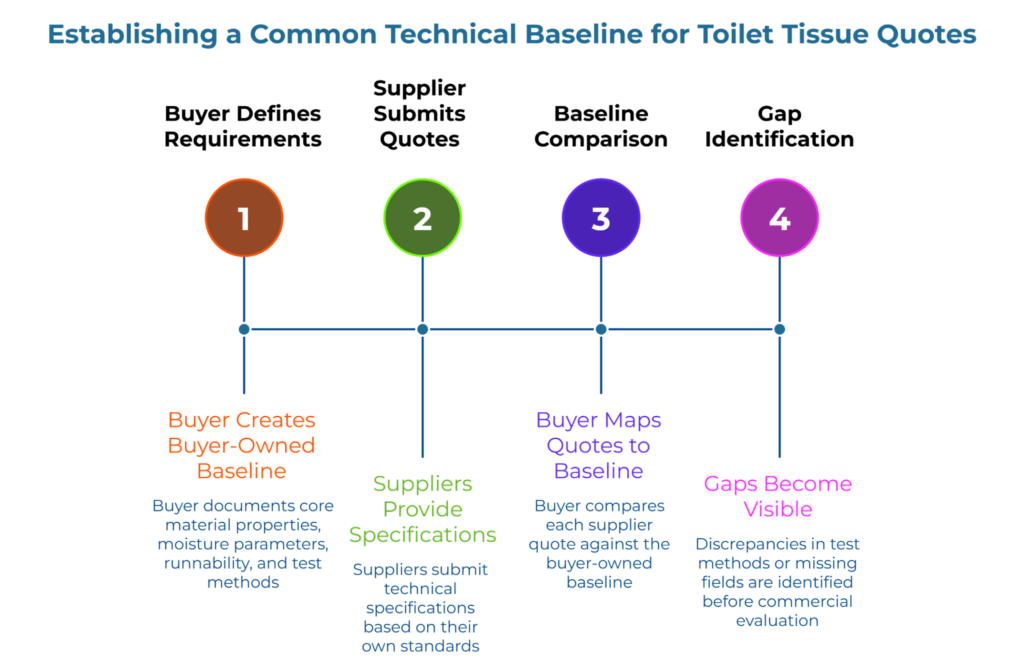
Before comparing any supplier quotes, the buyer must establish a common technical baseline. This baseline is not the supplier’s specification sheet. It is the buyer’s own requirement document, written in terms the buyer controls.
The baseline should lock a few categories.
Core material properties: GSM with explicit tolerance bands (for example, 18.5 GSM ±3%), bulk targets, and tensile minimums.
Moisture parameters: target percentage, tolerance window, and specific test method. For a deeper dive into these critical variables, see 4 steps to normalize absorbency and moisture tolerances before evaluating toilet tissue paper parent roll suppliers.
Runnability language: what constitutes acceptable performance on converting equipment—whether the material must unwind cleanly, hold an emboss response, or remain stable at target speeds.
Test method alignment: explicit naming of ISO or TAPPI standards for each property. Establish rigorous packaging and shipment standards, including moisture-barrier specifications and maximum transit-exposure durations.
This buyer-owned baseline becomes the translation key. Every supplier quote is mapped against it. Where specifications use different test methods or omit required fields, those gaps become visible before any commercial evaluation begins.
A Practical 4-Part Framework for Normalizing Specifications
Build one common technical specification sheet. Start with your house specification, not the supplier’s data sheet. Document every material property, test method, and tolerance band that affects converting performance.
Separate seller-responsibility variables from buyer-added variables. For EXW quotes, the buyer must add freight, insurance, handling, and transit-related quality risk. For CIF quotes, these elements are embedded but may not be reflected in technical specifications. Create two columns: what the supplier controls and what the buyer must add. For a detailed methodology on identifying and eliminating these gaps, review how to strip hidden variables from your next toilet tissue parent rolls (raw material) RFQ.
Normalize corridor-sensitive variables. A shipment from Southeast Asia to Northern Europe experiences different humidity exposure than one from South America to the U.S. Gulf Coast. Voyage duration and port dwell times affect moisture content at arrival. If supplier A quotes EXW with 25-day transit and supplier B quotes CIF with 12-day transit, their moisture tolerances cannot be compared directly.
Compare only after all assumptions are logged. Confirm that every comparison field has been normalized. Each supplier should be evaluated against the same baseline, with the same test methods, under the same transit assumptions. If one supplier names the moisture method and another does not, the comparison sheet is incomplete. Similarly, vague packaging protections or mixed assumptions regarding transit conditions render the comparison sheet—and any subsequent shortlist—premature.
Building a Supplier-Ready Comparison Sheet
A useful toilet tissue normalization sheet should include buyer-owned product description, GSM target and tolerance, bulk target and tolerance, moisture target and tolerance, named test methods, sample state and acceptance window, packaging expectation, trade term and named place, corridor or exposure assumptions, and runnability notes tied to plant reality. For a ready-to-use template, refer to understanding the toilet tissue paper specification-to-normalization checklist: linking product specifications to procurement requirements.
That sheet should not belong to procurement alone. Procurement, plant, and product teams each need to align before supplier evaluation starts. Procurement controls comparability. The plant protects runnability. The product or quality assurance team owns the acceptance logic. When those roles stay aligned, the sheet becomes a control tool rather than a convenience file.
Where Global Toilet Tissue Comparisons Break Down
Comparisons fail in four areas. Different testing standards create the first breakdown. A supplier reporting moisture per ISO 287 and another using TAPPI T 412 may show the same number but represent different actual moisture levels.
Recycled fiber variance creates the second breakdown. Parent rolls with varying recycled content behave differently under identical GSM specifications. A roll with 30% recycled fiber may have different bulk characteristics than one with 80% recycled content—differences that become apparent only when comparing offerings from multiple tissue paper raw material suppliers.
Humid corridors create the third breakdown. A toilet tissue parent roll is hygroscopic. A CIF quote from a humid origin with a three-week ocean transit delivers a materially different product than an EXW quote collected at the mill gate.
Packaging assumptions create the fourth breakdown. Does the supplier use moisture-barrier wrapping? What about wrap quality, storage expectations, and loading discipline? These variables rarely appear in initial quotes but determine whether specifications survive transit.
What Good Looks Like Before You Shortlist
A technically comparable quote set meets three criteria. The supplier has confirmed alignment with your named test methods. The quote explicitly addresses transit-related variables, including moisture tolerance at arrival. The supplier has provided evidence for each critical specification field.
Signs that you are still comparing assumption gaps include suppliers quoting different test methods, missing fields in responses, CIF quotes with no arrival-condition guarantees, and quotes where the Incoterm basis has not been normalized.
A weak quote set forces interpretation. This often happens when buyers rely on visual samples rather than locked specifications—a practice explored in why visual samples cause toilet tissue line jams (and what to do instead). One quote leans on stated GSM. Another hides packaging assumptions. A third leaves moisture logic vague. That is not a supplier ranking problem. It is an assumption-gap problem.
The PaperIndex Academy offers educational resources on specification normalization and supplier evaluation for toilet tissue converters. For supplier discovery, the toilet tissue parent roll suppliers directory and toilet tissue mills listings provide access to verified global suppliers.
Normalization is the difference between comparing actual supplier capability and comparing hidden assumptions. The work happens before the shortlist, not after the line jam.
Disclaimer: This article is for educational purposes only. Buyers and suppliers should verify commercial terms, technical standards, and contract language against the applicable source documents and their own operating requirements.
Our Editorial Process:
Our expert team uses AI tools to help organize and structure our initial drafts. Every piece is then extensively rewritten, fact-checked, and enriched with first-hand insights and experiences by expert humans on our Insights Team to ensure accuracy and clarity.
About the PaperIndex Insights Team:
The PaperIndex Insights Team is our dedicated engine for synthesizing complex topics into clear, helpful guides. While our content is thoroughly reviewed for clarity and accuracy, it is for informational purposes and should not replace professional advice.