
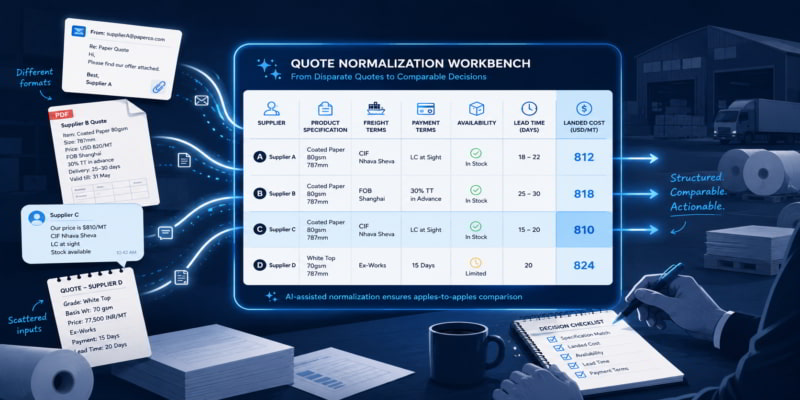
📌 Key Takeaways
Comparing paper quotes by price alone hides the real costs buried in freight terms, specs, and payment conditions.
- Standardize Before You Send: A detailed RFQ with exact specs, tolerances, and freight terms forces suppliers to respond in ways you can actually compare side by side.
- Normalize, Then Rank: Convert every quote to the same format — same currency, same delivery basis, same units — so price differences reflect real differences, not just different assumptions.
- Flag What’s Missing: Empty fields for freight terms, tolerances, or availability aren’t minor gaps — they can flip which supplier is actually cheapest once you fill them in.
- Landed Cost Beats Unit Price: A lower price per ton means nothing if you’re also paying all the shipping, insurance, and customs costs the other supplier already included.
- AI Organizes, You Decide: AI tools can pull quotes into one view and spot gaps fast, but choosing the right supplier still needs human judgment about risk, reliability, and relationships.
Structure your comparison first — then the right questions surface before costly mistakes do.
Paper buyers and sourcing teams managing multi-supplier quotes will gain a repeatable comparison method here, preparing them for the detailed overview that follows.
~ ~ ~ ~ ~ ~ ~ ~ ~ ~ ~ ~ ~ ~ ~ ~ ~ ~
Five quotes. Three emails, a PDF, and a WhatsApp message.
The spreadsheet’s open, the cursor blinking. One supplier’s unit price sits noticeably below the rest — but the freight terms field is blank. Another lists “80 GSM” without a tolerance. A third expires in four days, and internal approval typically takes an estimated seven days. Which of these are actually comparable?
You already know that picking the cheapest number on the screen isn’t how good sourcing decisions get made. The challenge isn’t recognizing that — it’s building a repeatable method to surface hidden differences across specifications, freight terms, payment conditions, availability, and delivery before you commit. With that method in place, you can move from quote chaos to a structured shortlist where every offer sits on the same commercial basis.
The Fastest Quote Isn’t Always the Most Comparable
Speed matters. Customers need commitments, approvals have deadlines, and market prices shift. But speed without structure creates risk.
When five supplier responses sit in different formats across separate inboxes, the instinct is to sort by unit price and work downward. That treats every quote as equivalent. In paper trading, they rarely are. A lower price per metric ton on kraft linerboard may assume EXW terms — meaning you carry all freight costs and bear the entire risk of loss or damage from the supplier’s loading dock, which generally necessitates arranging your own insurance. Another supplier’s higher unit price might already include cost, insurance, and freight to your nearest port. Until both sit on the same commercial basis — a principle explored in detail in ‘why to-door comparability beats “cheapest quote” thinking’ — ranking by price creates a misleading picture.
Specifications compound the problem. Two suppliers quoting “80 GSM” may be offering paper with different moisture tolerances, brightness levels, or packaging formats. One may quote from confirmed stock; the other against a production run that hasn’t started.
Faster comparison doesn’t mean skipping these variables. It means surfacing them early enough to act on — before problems appear after order placement.
Start Before the Quotes Arrive: Standardize the RFQ
The most effective way to speed up comparison is improving what suppliers send back. That starts with a well-structured RFQ.
When an RFQ is vague, suppliers fill in their own assumptions. One includes freight; another doesn’t. One quotes a 20 metric ton minimum; another quotes full volume. These inconsistencies multiply across every response.
Instead of requesting “80 GSM paper,” define what you need: grade, grammage with tolerance (80 GSM ±3%), sheet size or roll width, brightness range, moisture range, packaging format, quantity, delivery location, delivery window, and freight basis. For a field-by-field breakdown of the parameters that change the quote, see 12 measurable parameters buyers must specify. Add fields for payment terms, price validity, and available quantity. Ask suppliers to state exceptions clearly — if they quote a different tolerance, alternate packaging, partial quantity, or a revised delivery date, that difference should be visible in a separate line before anyone compares price.
Paper specifications deserve particular attention. Properties like grammage, caliper, moisture content, brightness, and burst strength each affect end-use performance. ISO 536 provides the standard method for determining grammage of paper and board, and TAPPI test methods cover basis weight, opacity, porosity, and related measurements. A practical guide to which TAPPI and ISO test methods to require in an RFQ can help translate these standards into supplier-facing language.
Using these in your RFQ forces suppliers to respond in terms you can directly compare. Detailed technical breakdowns of these variables are available through specialized sourcing modules. Buyers looking for a structured starting point can also review the Anatomy of a perfect kraft paper RFQ and the spec-driven kraft paper RFQ template as general process references.
A standardized RFQ doesn’t eliminate judgment. It reduces avoidable confusion.
Normalize Each Response Before Comparing Price
Quote normalization converts each supplier response into a consistent structure so differences become visible before ranking begins. It doesn’t change what suppliers offer — it organizes their answers so you’re evaluating equivalent fields side by side.
Map each quote against the same fields: product specification, unit price and currency, quantity, minimum order quantity, freight terms, delivery location, lead time, availability, payment terms, price validity (the period during which the supplier’s quoted price remains open for acceptance), and packaging or conversion requirements. Mark anything missing or ambiguous rather than assuming it matches your requirement.
The critical separation is between visible unit price and landed cost — the total expense once goods reach your location, including freight, insurance, duties, customs charges, and handling. Two quotes with similar unit prices can produce very different landed costs depending on who carries freight responsibility and which Incoterms rule applies. Comparing an EXW offer against CIF without adjusting for that difference means comparing fundamentally different commercial commitments. A step-by-step method for comparing quotes across Incoterms can make these adjustments systematic rather than ad hoc. The exact landed-cost calculation varies by route, contract, internal accounting policy, and applicable trade responsibilities. Buyers working with corrugated or bag products can refer to the Incoterms normalization guide for corrugated boxes and the landed-cost calculator for paper bags for product-specific frameworks.
Avoid using placeholder estimates for unknown variables. Flag these gaps for supplier clarification to ensure the final ranking remains data-driven.
The Hidden Differences Paper Buyers Should Flag
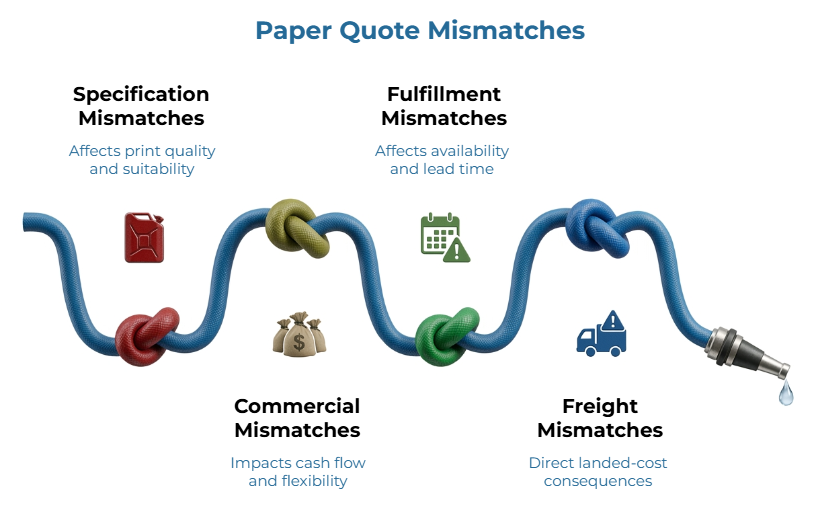
Paper quotes contain categories of mismatch that are easy to overlook under time pressure.
- Specification mismatches are the most frequent. Two suppliers may both quote “offset paper,” but one offers 78 GSM within ±5% tolerance while the other offers 80 GSM within ±2%. This kind of specification misalignment is why a spec-true mindset that normalizes before pricing consistently reduces RFQ confusion. That gap affects print quality, runnability, and whether the product meets end-use requirements. Other variables to check: brightness, opacity, moisture content, caliper, dimensions, and packaging. TAPPI identifies basis weight, caliper, density, and moisture content among common paper and board property measurements — useful references when determining whether two “similar” quotes describe the same product. As an illustrative example: two suppliers quote the same GSM, but one includes a tighter tolerance and the other uses packaging that may be less suitable for extended handling or storage. The price difference is visible. The suitability difference is easier to miss.
- Commercial mismatches appear in minimum order quantities, price validity windows, and payment terms. One supplier may require 25 metric tons minimum while another quotes for 10. Payment terms ranging from advance payment to 30-day credit affect cash flow, flexibility, and risk — effects that compound over time, as explored in how payment term shifts change the cash flow gap. A quote with a lower unit price but a higher MOQ may tie up more working capital than a slightly pricier offer with smaller commitments.
- Fulfillment mismatches involve available quantity, lead time, and delivery reliability. A supplier may offer an attractive price but note “subject to availability,” or propose a six-week lead time when you need three. “Available” should be clarified — it may mean in stock now, available after mill confirmation, available in partial quantity, or subject to allocation.
- Freight and delivery mismatches carry the most direct landed-cost consequences. Different Incoterms rules allocate freight, insurance, documentation, and customs responsibilities differently. The International Trade Administration describes Incoterms as internationally recognized rules defining buyer and seller responsibilities for shipment, insurance, documentation, customs clearance, and related logistics. The ICC describes Incoterms® rules as standards used in domestic and international contracts for the delivery of goods. When suppliers quote on different freight bases, their unit prices aren’t directly comparable, and freight rate volatility can flip supplier rankings entirely when ocean rates shift. Freight terms should be confirmed before award, especially when quotes mix EXW, FOB, CIF, DAP, or other bases.
No single mismatch category is always decisive. Each one changes what the quote actually represents.
How AI Can Support Without Replacing Buyer Judgment
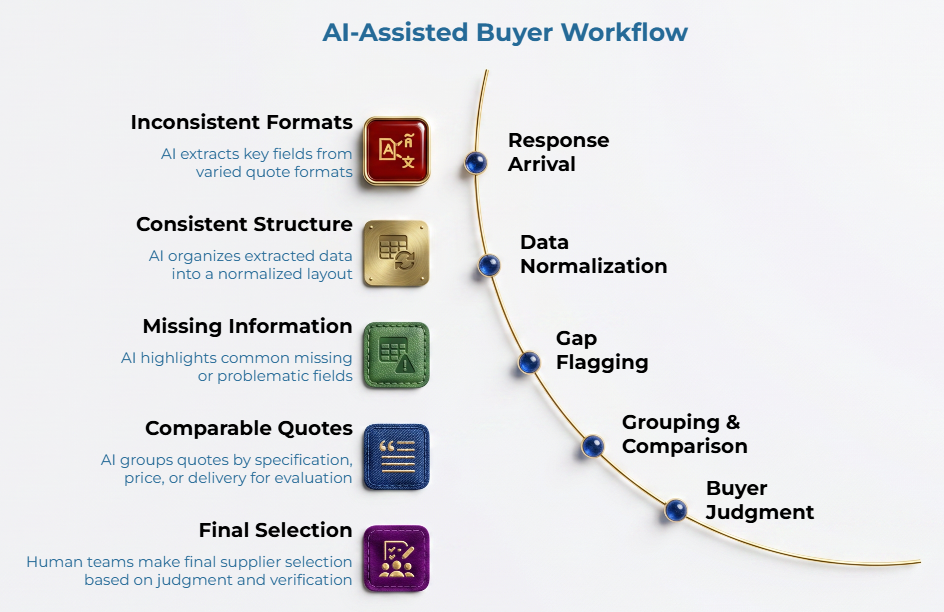
AI-assisted workflows help at specific points in the comparison process. They work best as organizational and flagging tools — not decision-makers.
When responses arrive in inconsistent formats, an AI-assisted workflow can extract key fields and organize them into a normalized structure. Instead of manually copying data from five formats into a comparison sheet, extraction pulls relevant fields into a consistent layout.
AI can flag gaps too. The most common missing or problematic fields include:
- Missing or vague product specification
- Missing tolerance or unit basis
- Missing freight term or named delivery place
- Missing delivery window or lead time
- Missing MOQ or available quantity
- Missing payment term or price-validity date
These can be highlighted automatically rather than requiring line-by-line review. Grouping by specification match, price range, or delivery window tells you which quotes are comparable enough to evaluate together and which need clarification first.
What AI shouldn’t do is make the final selection. Different teams own different parts of the verification. Finance should review payment exposure and working capital impact. Logistics should review freight, documentation, and delivery assumptions. Commercial teams should confirm whether the quote supports the customer commitment. Supplier selection involves judgment about relationship history, market timing, risk tolerance, and customer requirements that don’t appear in structured data. Use AI to organize, flag, and surface questions. Keep commercial judgment where it belongs.
A common mistake is treating AI as a way to avoid the spreadsheet. The better approach is to use it to make the spreadsheet cleaner and the open questions more visible.
Paper RFQ Normalization Matrix
Use this matrix to ensure every response has been normalized before ranking.
| Comparison Field | Why It Matters | What to Normalize | What AI Can Flag | What You Must Verify |
| Supplier name and quote date | Separates current offers from old references | Supplier, date, revision number | Duplicate or outdated entries | Correct version under review |
| Product grade and spec | Confirms quotes describe the same paper | Grade, GSM ±tolerance, brightness, moisture | Spec differences between suppliers | Whether near-match specs meet end-use needs |
| Quantity and MOQ | Affects unit economics and flexibility | Align to same volume basis | MOQ vs. requested volume mismatches | Whether partial orders work |
| Unit price and currency | The visible cost anchor | Convert to same currency and unit basis | Price outliers across quotes | Whether pricing reflects the correct spec |
| Freight terms | Determines who pays transport and insurance | Map to same Incoterms basis | Mixed Incoterms across suppliers | Actual freight costs and responsibility splits |
| Delivery and lead time | Affects fulfillment reliability | Align delivery point and timeline | Lead time gaps vs. your requirement | Supplier’s production and shipping schedule |
| Availability | Confirms stock or production readiness | Note confirmed stock vs. production-dependent | “Subject to availability” clauses | Whether firm quantities are committed |
| Payment terms | Affects cash flow and credit exposure | Compare days, method, deposits | Missing or inconsistent terms | Whether terms pass finance approval |
| Price validity | Protects against mid-decision expiry | Record expiry date per quote | Short or missing validity | Whether you can decide before expiry |
| Missing fields | Highlights incomplete data | Mark gaps — don’t assume defaults | Any empty required field | Confirm directly with the supplier |
| Buyer follow-up question | Turns gaps into action items | One question per open issue | Drafted clarification prompts | Final wording and priority |
While this matrix doesn’t score quotes, it makes differences visible so that ranking reflects real commercial equivalence.
When to Pause Before Awarding
Certain conditions should trigger a pause before confirming an order.
Pause if freight terms differ and you haven’t calculated landed-cost impact. An EXW quote that looks cheaper may cost more once freight, insurance, port handling, and customs are added — a pattern detailed in common pitfalls in landed-cost estimates. Incoterms® 2020 rules govern these splits. Confirm specific obligations with your logistics or trade compliance team.
A discrepancy in freight terms requires a landed-cost impact calculation before proceeding. Similarly, if specifications are close but not identical, the 2 GSM variance may introduce rejection risks. Further scrutiny is mandatory when availability remains unconfirmed or when delivery windows hinge on unverified mill schedules.
Each is a follow-up question, not a rejection. The pause keeps you from committing to a quote carrying a hidden cost.
Faster Comparison Makes Better Questions Visible
The real value of structured quote comparison isn’t speed alone. It’s clear.
Standardize your RFQs. Normalize responses into a consistent format. Flag the differences hiding in specifications, freight terms, payment conditions, and availability. The result isn’t just a faster workflow — it’s better questions, asked earlier, before the cost of rework makes them expensive.
AI-assisted tools can reduce the manual effort of mapping different formats into one view. That’s a meaningful improvement. The final decision still depends on you. No tool can weigh the trade-off between a slightly higher landed cost from a proven supplier and a lower price from an unproven one — a judgment call that becomes clearer with a driver-based benchmarking framework grounding the comparison.
Build the process to make those trade-offs visible. The judgment is yours. Make it an informed one.
For broader paper sourcing education, explore the PaperIndex Academy. If supplier discovery is the next step after quote review, buyers can also use PaperIndex to find paper suppliers or submit an RFQ.
Frequently Asked Questions
What should paper buyers compare besides unit price?
Specifications (grade, GSM, tolerances, brightness, moisture), quantity and minimum order requirements, availability, lead time, freight terms, delivery location, payment terms, price validity, and landed-cost inputs. Unit price should be reviewed only after the quotes are commercially comparable.
Can AI choose the best supplier quote?
AI can organize responses, flag missing fields, and highlight inconsistencies. Supplier selection should remain a human decision — it involves judgment about reliability, risk tolerance, freight responsibility, payment terms, and customer requirements beyond structured data.
What is quote normalization?
Quote normalization converts each supplier response into a consistent structure so you can evaluate equivalent fields side by side. It keeps confirmed information separate from assumptions, exceptions, and missing fields — it doesn’t change what suppliers offer, it makes differences visible before ranking.
Why do freight terms matter in quote comparison?
Freight terms determine who’s responsible for transport, insurance, documentation, and customs. When suppliers quote on different Incoterms bases, unit prices aren’t directly comparable without adjusting for the costs each party carries. Specific responsibilities should be confirmed through official guidance and qualified advisors where appropriate.
What should you do when quotes are incomplete?
Mark missing fields in your matrix and send targeted follow-up questions. Don’t assume missing data matches your requirement. Gaps in price validity, availability, or freight terms mean the quote shouldn’t be ranked as equivalent until resolved.
Disclaimer:
This article is for general educational purposes and does not constitute legal, financial, logistics, or trade-compliance advice. Buyers should confirm contract terms, Incoterms responsibilities, duties, taxes, and payment obligations with qualified internal or external advisors before awarding an order.
Our Editorial Process:
Our expert team uses AI tools to help organize and structure our initial drafts. Every piece is then extensively rewritten, fact-checked, and enriched with first-hand insights and experiences by expert humans on our Insights Team to ensure accuracy and clarity.
About the PaperIndex Insights Team:
The PaperIndex Insights Team is our dedicated engine for synthesizing complex topics into clear, helpful guides. While our content is thoroughly reviewed for clarity and accuracy, it is for informational purposes and should not replace professional advice.