
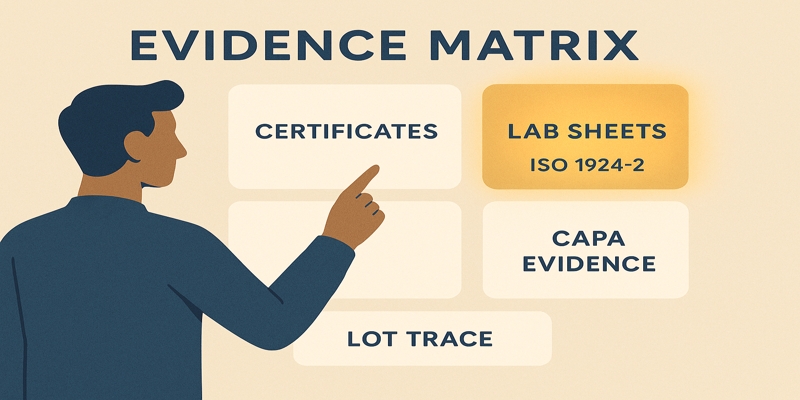
📌 Key Takeaways
Audit reports turn supplier approval from subjective guesswork into a fast, defensible decision backed by structured proof.
- Four Questions Define Completeness: A reliable audit report answers who was audited, how compliance was verified, what the results showed, and what corrective actions follow—eliminating the need to chase down missing evidence through email threads.
- Method References Are Non-Negotiable: Lab results mean nothing without test method citations like ISO 536 for grammage or ISO 1924-2 for tensile strength, plus conditioning protocols and sample sizes that prove results are reproducible.
- Traceability Links Paper to Production: Every test result must trace back to specific lot numbers, sample IDs, and production dates so you can connect audit evidence directly to the reels that arrive at your facility.
- CAPA Closure Requires Objective Proof: Statements like “training completed” don’t close nonconformities—you need documented evidence such as updated work instructions, follow-up test results, or signed training records that confirm problems won’t recur.
- Common Pitfalls Reveal Weak Audits: Unverifiable claims, method mismatches between specs and testing, single-reel sampling, and findings without owners expose suppliers who lack the process controls to prevent off-spec deliveries and line stops.
A structured checklist transforms audit evaluation from hours of review into minutes of verification. Procurement and quality managers evaluating kraft paper suppliers will find the evidence requirements and verification criteria here, preparing them for the detailed section-by-section breakdown that follows.
An audit report isn’t just paperwork—it’s the difference between confident supplier approval and costly production delays. When procurement and quality teams evaluate kraft paper suppliers, the audit report serves as structured proof that a mill can consistently deliver to specification. Without the right evidence in the right format, you’re left making subjective judgments that expose your supply chain to off-spec lots, line stops, and compliance failures.

A good audit report is structured proof: documents, test data, traceability, and corrective action evidence aligned to the purchased grade and specification. This article walks you through the exact sections and evidence types your kraft paper supplier audit reports must include, so you can evaluate vendors quickly and defensively.
Why the Report Format Matters

The format of an audit report determines how quickly you can extract decision-critical information. A well-structured report lets procurement teams verify compliance in minutes rather than hours, reducing the risk of approving suppliers who lack the process controls to prevent downtime.
A complete audit report should allow you to answer four questions without digging through email threads or side notes:
Who and what was audited? The legal entity, facility locations, specific product grades, and order volumes under review.
How was compliance verified? The documents examined, personnel interviewed, production lines observed, and laboratory tests performed.
What were the results? Measured values against thresholds, conformities identified, and nonconformities flagged.
What happens next? Corrective actions defined, responsible owners assigned, due dates set, and re-audit triggers established.
Each section of a comprehensive audit report serves a specific verification purpose. The cover sheet establishes scope and accountability. Certificate blocks prove regulatory compliance. Test results demonstrate capability. Traceability links paper quality back to production lots. CAPA logs show that the supplier doesn’t just identify problems—they fix them and prevent recurrence.
When these elements are present and properly formatted, you can make supplier decisions that are both fast and defensible to internal stakeholders.
Audit Report Cover Sheet & Metadata (Must-Haves)
The cover sheet is your first checkpoint. It should clearly identify the supplier name, facility address, and the specific production lines or grades that were audited. Without this basic metadata, you can’t confirm that the audit scope matches what you’re actually buying.
Look for the audit date range, the name and credentials of the auditor, and the audit methodology used (on-site, remote, hybrid). The report should also reference your company’s purchase order number or technical specification document, creating a direct link between the audit and your procurement requirements.
Version control matters more than most teams realize. If the supplier submits a revised report, you need to know what changed and why. Require a version number, revision date, and a brief change log on the cover sheet.
Certificates & Chain-of-Custody (Verification Block)
Certificates prove regulatory and market compliance, but only if they’re valid and in scope. This section of the audit report should include complete copies—not just certificate numbers—of all relevant management system certifications.
For most kraft paper applications, you’ll verify ISO 9001 for quality management. If the supplier claims environmental credentials, check for ISO 14001. Food-contact grades require ISO 22000 or equivalent, and suppliers should reference the regulatory basis such as FDA 21 CFR 176.170 for U.S. applications. Each certificate should display the expiry date, the issuing body, and the covered sites. If your purchase order specifies a particular mill location, confirm that the certificate scope includes that facility.
Chain-of-custody documentation becomes critical when you’re sourcing certified fiber. FSC or PEFC certificates must show that the supplier can legally label the product as certified. Check the certificate ID, confirm the scope matches the grade you’re buying, and verify that the certificate hasn’t expired. The kraft paper supplier audit & compliance program provides additional guidance on managing these verification workflows.
Product Specification Mapping (What Was Audited vs. What You Buy)
This section answers a simple but essential question: did the auditor actually evaluate the product you’re purchasing?
The report should list the purchased grade by name, the grammage range, and the tolerance bands from your specification. If you’ve defined critical-to-quality attributes—such as minimum burst strength or maximum moisture content—those should be mapped directly to the test results in the next section.
Specification misalignment is a common cause of audit report failures. If the auditor tested 80 GSM bleached kraft but you’re buying 120 GSM unbleached, the report doesn’t provide the evidence you need.
Laboratory Test Results (Evidence Block)
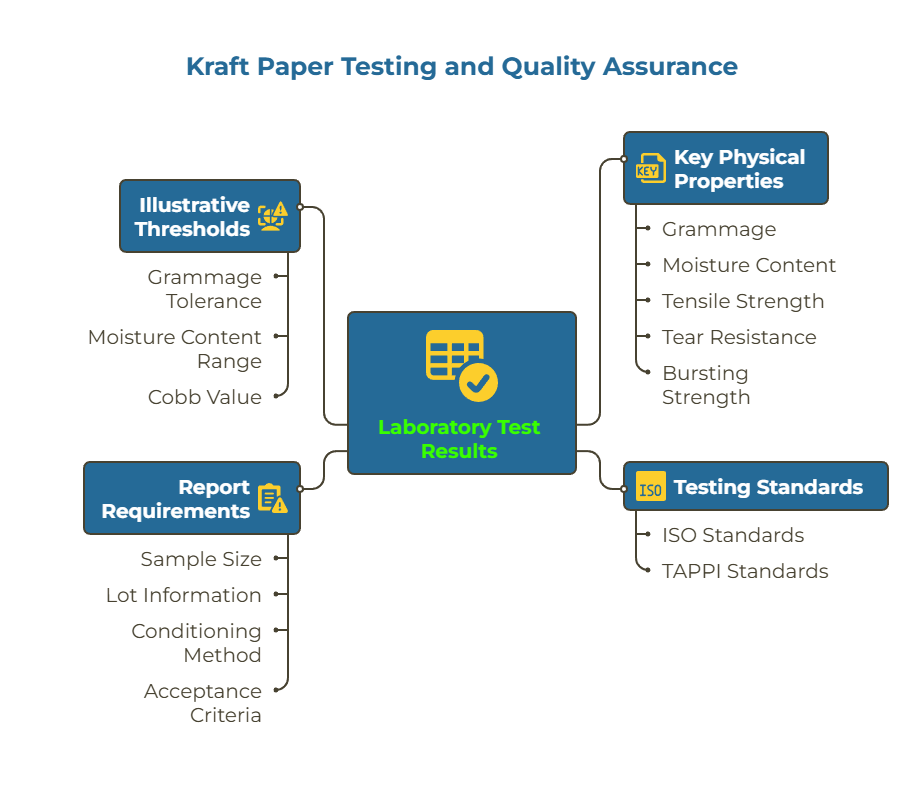
The lab results section is where you verify process capability. A compliant report will include test data for the key physical properties: basis weight (grammage), tensile strength, burst strength, and moisture content. Depending on your application, you may also require Cobb value, tear resistance, or surface smoothness.
Each test result should reference the method used. Common standards for kraft paper testing include:
- Grammage (basis weight): ISO 536 or TAPPI T 410 equivalent, reported in g/m²
- Moisture content: ISO 287
- Tensile strength: ISO 1924-2 using constant rate of elongation, with values for both machine direction (MD) and cross direction (CD)
- Tear resistance: ISO 1974 using the Elmendorf method
- Bursting strength: ISO 2758 for paper or ISO 2759 for board
- Cobb water absorptiveness: ISO 535, an indicator of sizing and wet-end control
- Edge Crush Test (ECT): ISO 3037 for corrugated applications
The report should state the sample size, the lot or production run from which samples were drawn, the conditioning method (typically ISO 187 at 23°C/50% RH), and the acceptance criteria applied. When results fall close to specification limits, look for test uncertainty statements and proposals for re-testing.
Signed lab sheets or certified test reports should be attached as appendices. This gives you confidence that the data isn’t just summarized—it’s traceable back to the actual testing process. For more detail on interpreting these results, see how to interpret lab test reports for kraft paper.
Illustrative threshold examples (replace with your specifications):
- Grammage tolerance: ±3% from nominal for many kraft grades
- Moisture content: 6-8% at 23°C/50% RH
- Cobb (60s): ≤30 g/m² for sack kraft requiring high sizing
These are illustrative only. Always confirm against your internal specifications and the specific grade requirements for your application.
Sampling & Traceability (From Report to Reel)
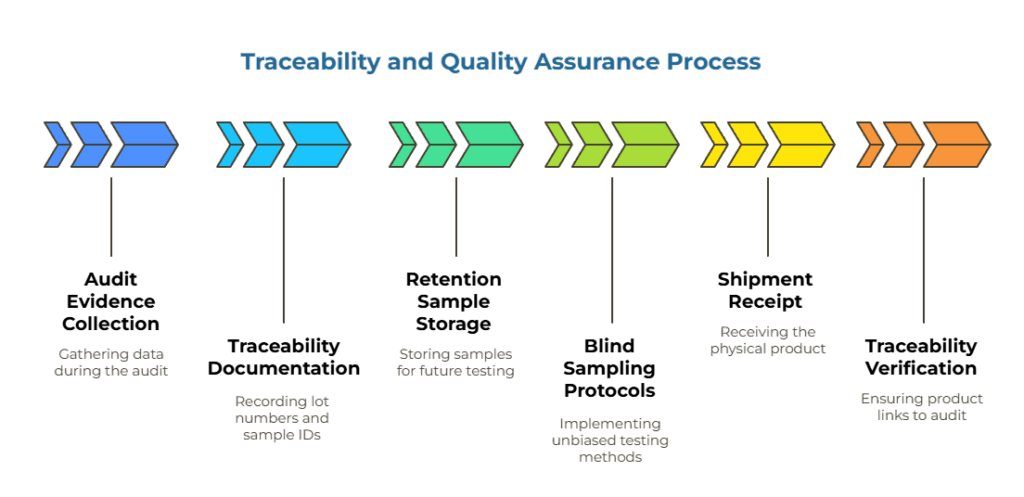
Traceability links the audit evidence back to the physical product you’ll receive. This section should document lot numbers, sample IDs, and production dates for every tested batch.
Strong traceability systems maintain retention samples that can be re-tested if a quality dispute arises after shipment. The audit report should confirm that retention samples are stored, labeled with unique IDs, and linked to shipping documents. Where feasible, blind sampling protocols strengthen the objectivity of test results.
When you receive a shipment, you should be able to trace each reel back to a specific production lot that was covered in the audit. If that linkage is missing, the audit loses much of its value.
Process Controls & Environment (On-Site/Remote Evidence)
Process controls determine whether a supplier can consistently reproduce the quality shown in lab results. This section should provide evidence that the mill maintains stable production conditions across the complete manufacturing sequence: pulping, stock preparation, forming, pressing, drying, calendering, winding, and converting.
For paper quality, humidity and temperature control are critical. The audit report should include excerpts from environmental monitoring logs showing that storage and production areas stay within specification. Note machine set-points, reel mapping systems, splice integrity checks, and the statistical process control (SPC) practices used at in-process quality checkpoints.
Handling practices matter too—improper reel stacking or exposure to moisture can degrade paper before it ever ships. Calibration records for key instruments (scales, moisture meters, tensile testers, burst testers) demonstrate that the mill’s measurements are reliable. For remote audits, photo or video stills can substitute for in-person observation, though they provide less assurance than direct verification.
Nonconformities, CAPA & Verification (Close-the-Loop Proof)
The CAPA (Corrective and Preventive Action) section reveals how a supplier handles problems. Every audit uncovers at least minor nonconformities—the question is whether the supplier closes them effectively.
The report should list each nonconformity with a root cause analysis, the corrective actions taken, the responsible person, and the due date for completion. More importantly, you need objective evidence that the actions were actually implemented and verified.
A statement like “training was provided” isn’t enough. You want to see training records, updated work instructions, or follow-up test results that confirm the issue won’t recur. The designing CAPA workflows for kraft paper suppliers guide provides a framework for evaluating CAPA quality.
Change Control & Document Control
Change control prevents unapproved modifications to materials or processes that could affect product quality. This section should document any recent changes—new raw material sources, equipment upgrades, process adjustments—and confirm that you were notified per your supply agreement.
Document control ensures that mill operators are working from current, approved procedures. The audit report should reference the version numbers of relevant standard operating procedures and work instructions, along with excerpts from training records showing that staff have been trained on the latest revisions.
Logistics Readiness & Shipment Controls
Quality can degrade during transport if packaging and handling aren’t controlled. This section should describe the supplier’s packaging specifications, moisture protection measures, and loading practices.
Pre-dispatch checks—such as visual inspection of reels, verification of labels, and confirmation that shipment documentation is complete—reduce the risk of receiving damaged or mislabeled products. For guidance on coordinating these controls, see remote vs. on-site supplier audits.
Sign-off, Validity Window & Next Steps
The final section of the audit report should include formal sign-offs from both the auditor and the supplier. The auditor’s signature confirms that the findings are accurate. The supplier’s acknowledgment signals their commitment to maintaining compliance.
Audit reports aren’t valid indefinitely. The report should state a validity period—typically 12 to 24 months—and define the conditions that would trigger a re-audit before that period expires. Major process changes, customer complaints, or shifts in regulatory requirements are common triggers.
Common Pitfalls and How to Avoid Them
Even well-intentioned audit reports can fail to provide the evidence you need. Watch for these four recurring problems:
Unverifiable claims. Suppliers state recycled content percentages or “food safe” designations without traceable evidence. Require chain-of-custody certificates for recycled fiber, supplier declarations with lab support, or specific regulatory citations rather than generic claims.
Method mismatch. The supplier reports Edge Crush Test results when your specification calls for Mullen burst strength, or conditioning doesn’t match the standard. Always verify that the test method name, reference number, and conditioning protocol (temperature, humidity) align with your requirements.
Single-reel sampling. One test from one reel rarely represents an entire production run. Insist on statistically sound sampling plans that match your risk tolerance and lot sizes. Multiple samples across different production times provide far more confidence.
No closure on actions. Findings listed without assigned owners, due dates, or verification methods remain open risks. Every nonconformity should include a clear path to closure with objective evidence that corrective actions were completed and verified effective.
Printable Mini-Checklist
Use this checklist to quickly evaluate whether a kraft paper supplier audit report meets minimum evidence standards:
- Metadata complete: Supplier name, site, audited lines/grades, audit date, auditor name, reference to your PO/spec
- Certificates attached: ISO 9001/14001/22000 (as applicable), FSC/PEFC CoC (if relevant), with expiry dates and scope verification
- Specification mapping: Purchased grade, grammage range, tolerance bands, and CTQ attributes clearly documented
- Lab results with method references: Grammage (ISO 536), moisture (ISO 287), tensile (ISO 1924-2), tear (ISO 1974), burst (ISO 2758/2759), Cobb (ISO 535), or ECT (ISO 3037) as applicable
- Directional data: Test results reported for both machine direction (MD) and cross direction (CD) where relevant
- Sample documentation: Lot IDs, sample IDs, production dates, conditioning method (e.g., ISO 187), and linkage to shipping docs confirmed
- Traceability: Retention sample program documented; blind sampling used where feasible
- Environmental controls: Storage humidity/temperature logs, reel handling practices, and calibration records included
- Process flow evidence: Production sequence from pulping through converting documented with SPC checkpoints noted
- Test uncertainty: Statements of measurement uncertainty included for results near specification limits
- CAPA closure: Each nonconformity has root cause, corrective action, owner, due date, and objective evidence of completion
- Change control: Recent material or process changes documented and customer notification confirmed
- Logistics controls: Packaging specs, moisture protection, loading practices, and pre-dispatch checks described
- Sign-offs: Auditor and supplier signatures present
- Validity period: Report states validity window and re-audit triggers
- Attachment completeness: Lab sheets, certificates, photos (for remote audits), and CAPA evidence attached as appendices
If any item is missing or incomplete, flag it for supplier clarification before proceeding with approval. For a more detailed supplier evaluation framework, download the PQQ template: minimum evidence required.
When you’re ready to connect with verified kraft paper suppliers, explore the supplier directory or access additional procurement resources through the PaperIndex Academy.
Our Editorial Process
Our expert team uses AI tools to help organize and structure our initial drafts. Every piece is then extensively rewritten, fact-checked, and enriched with first-hand insights and experiences by expert humans on our Insights Team to ensure accuracy and clarity.
About the PaperIndex Insights Team
The PaperIndex Insights Team is our dedicated engine for synthesizing complex topics into clear, helpful guides. While our content is thoroughly reviewed for clarity and accuracy, it is for informational purposes and should not replace professional advice.