

📌 Key Takeaways
Containerboard quotes become comparable only when you separate cost drivers, normalize delivery terms, and govern volatility before signing contracts.
- Five Drivers, Five Governance Rules: Base paper price, fiber, freight, energy, and surcharges each move independently and require distinct contractual controls—caps, floors, triggers, and review cadence.
- Normalize to Your Door First: Raw quotes under different Incoterms (EXW, FOB, CIF, DDP) cannot be compared directly; add missing cost components until every offer reflects the same to-door basis.
- Freight Scenarios Prevent Surprises: Testing baseline, surge (+30-40%), and relief scenarios for PSS, GRI, and BAF before awarding volume reveals which supplier stays competitive when ocean rates shift.
- Driver-Clean Math Builds Budget Confidence: Separating landed cost into transparent line items—rather than accepting a blended price—allows finance teams to stress-test scenarios and defend forecasts even when external conditions change.
- Audit Trails Stop Invoice Disputes: Date-stamped assumption logs that capture Incoterms, freight rates, included surcharges, and pass-through formulas transform subjective negotiations into objective reconciliations.
Prepared procurement = comparable quotes, governed volatility, and defensible renewals.
Procurement professionals, finance teams, and supply chain managers evaluating containerboard suppliers will find this framework essential, preparing them for the detailed cost-stack breakdown and governance tactics that follow.
A quote arrives. The base price looks competitive, but then the invoice tells a different story. Freight surcharges appear. Energy adjustments surface. By the time the material reaches your door, the economics have shifted. This isn’t a pricing problem; it’s a visibility problem.
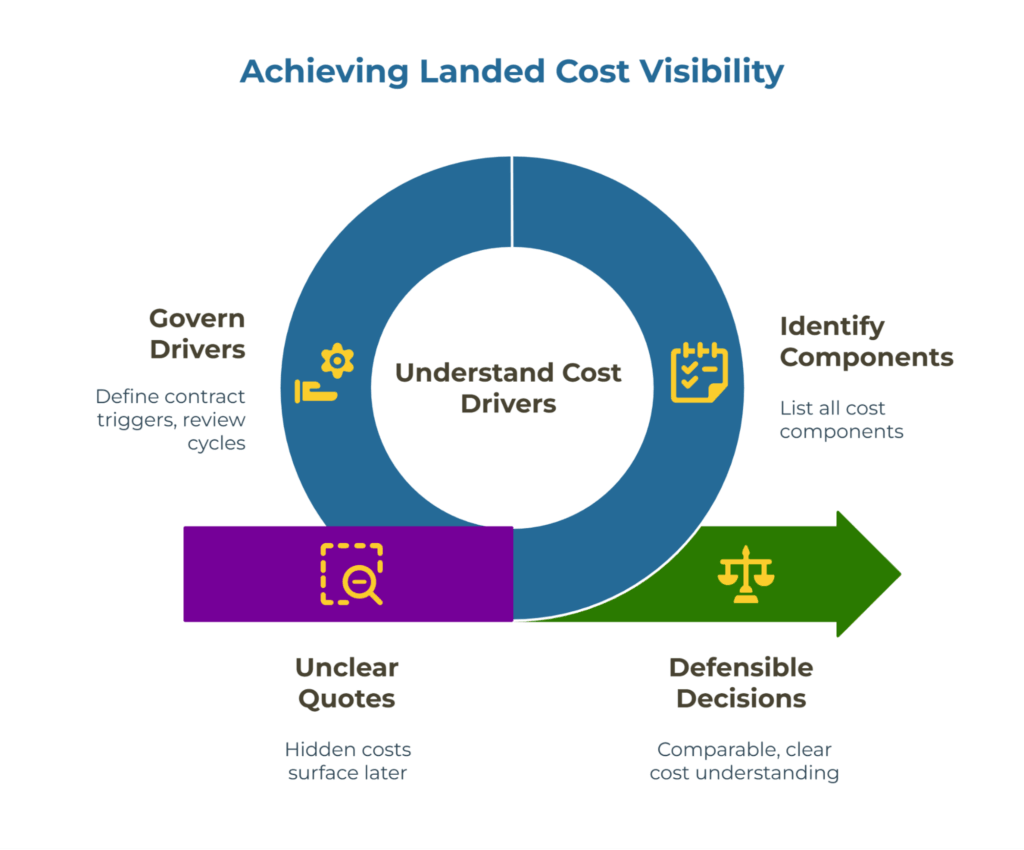
Containerboard landed cost is driven by variable drivers: fiber, freight, energy, and surcharges. Each driver can move independently, governed by different contract triggers and review cycles. Some appear in your initial quote; others surface only on the final invoice. Understanding where each component sits—and how it’s governed—transforms unclear quotes into comparable, defensible decisions.
The Landed-Cost Stack = Base Price + Fiber, Freight, Energy, Surcharges
The containerboard cost stack contains five primary components. The base paper price establishes the foundation, while four variable drivers—fiber, freight, energy, and surcharges—move independently above it. Each operates differently, appears at different points in the contracting process, and requires distinct management approaches.
Cost Stack Card
| Driver | How It Moves | Where It Appears | What to Ask Now |
| Base Paper Price | Changes with grade specifications, supplier capacity, and market conditions | Contract line rate and invoice unit price | Which spec applies? What minimum order quantities or validity periods? |
| Fiber | Tracks recycled or virgin input markets; influenced by yield and furnish costs | Contract schedule with index trigger or quarterly adjustment notice | What public proxy governs adjustments? What review cadence? Is there a cap or floor? |
| Freight | Lane-specific rates plus carrier surcharges (PSS, GRI, BAF) and accessorials | Separate freight quote or invoice line item | FOB or CIF? What surcharges are included? Who manages booking? |
| Energy | Pass-through formulas tied to fuel or electricity indices | Contract clause or periodic adjustment memo | Which index? Monthly or quarterly true-up? What activation threshold? |
| Surcharges | Project-specific fees: custom sizes, rush orders, special handling, demurrage | Quote addendum or invoice surprise | Are rush fees capped? What triggers minimum order charges? |
This card provides a quick-reference view of the five cost components and the questions that prevent disputes before contracts are signed. The key insight: each driver has a different governance mechanism, meaning effective cost management requires treating them separately rather than negotiating a single blended price.
Compare Apples-to-Apples: Normalize Every Quote to Your Door

Raw quotes from different suppliers often use different Incoterms, making direct comparison misleading. A lower FOB price can become more expensive than a higher CIF price once all costs are added. The solution is normalizing every offer to a single delivery basis—your door—before evaluating options.
Incoterms are standardized trade terms maintained by the International Chamber of Commerce that define who pays for and handles transport, risk, and insurance along the journey. The normalization process involves mapping what each Incoterm includes and excludes, then adding the missing components to reach a consistent to-door total. This creates a level playing field where the true cost becomes visible.
Quick Check: What’s Included/Excluded Under EXW/FOB/CIF/DDP?
- EXW (Ex Works): The supplier quotes the paper price at their facility. The buyer arranges and pays for everything: inland transport to the port, export documentation, ocean freight, insurance, import duties, and inland delivery to the final destination.
- FOB (Free On Board): The supplier covers inland transport to the port of export and handles export documentation. The buyer pays for ocean freight, insurance, import duties, and inland delivery from the destination port.
- CIF (Cost, Insurance, Freight): The supplier quotes a price that includes ocean freight and basic insurance to the destination port. The buyer still pays import duties and inland delivery from the port to the final facility.
- DDP (Delivered Duty Paid): The supplier quotes a fully landed price that includes all freight, insurance, duties, and inland delivery to the buyer’s specified location. This is the only term where the quote directly reflects the to-door cost, though buyers should verify what “delivered” specifically includes—such as whether waiting time, inside delivery, or tail-lift services are covered.
To compare quotes fairly, take each offer and add the missing cost components until all reach the same DDP-equivalent basis. Only then can pricing differences be attributed to actual material value rather than incomplete scope definitions.
How Driver-Clean Math Builds Budget Confidence (TCO View)
Finance teams require total cost of ownership visibility to build reliable budgets. When quotes arrive with mixed Incoterms and unclear pass-through formulas, creating a defensible forecast becomes difficult. Driver-clean math solves this by breaking the landed cost into transparent, trackable components.
Start by capturing each driver as a separate line item in your cost model. Record the base paper price with its grade specifications and volume qualifiers, then add fiber adjustments as a percentage or fixed amount tied to a named public proxy. Next, add the freight component with clear notes on which surcharges are included and which may vary. Finally, account for energy pass-throughs and any project-specific surcharges.
This structured approach allows finance teams to stress-test scenarios: if fiber indices rise by 10%, what happens to total cost? If freight surcharges spike due to port congestion, where does the budget break? Transparent driver separation transforms a single blended price into a dynamic model that supports confident decision-making even when external conditions shift.
Freight Can Flip the Winner—Plan Baseline/Surge/Relief Scenarios
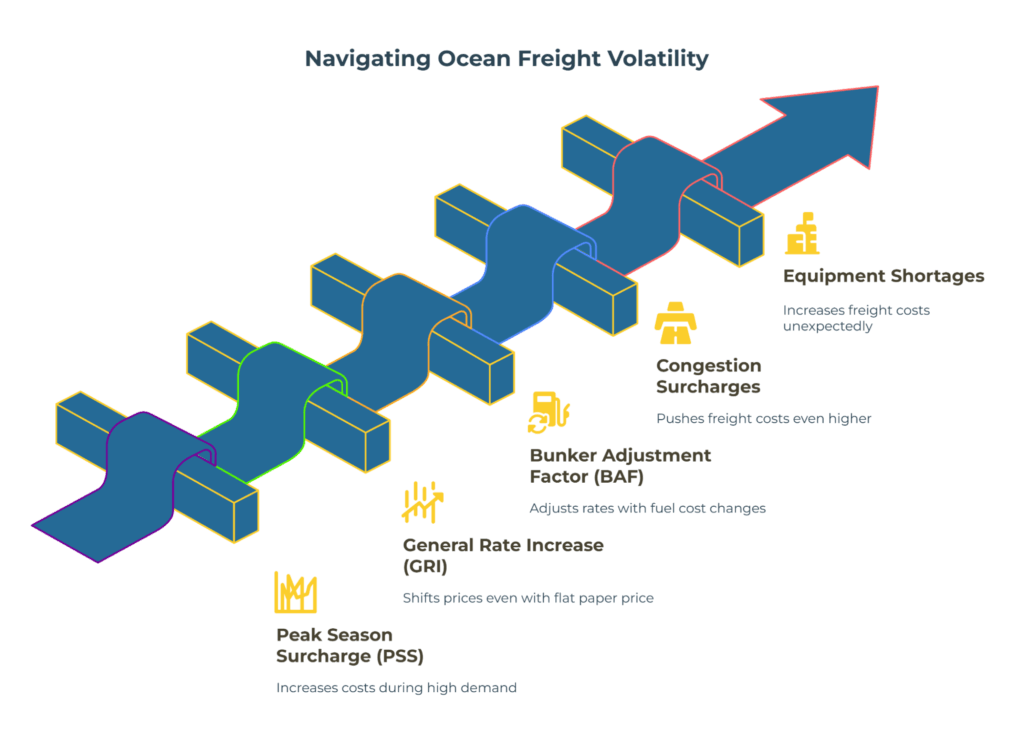
Freight represents one of the most volatile components in the landed-cost stack, often accounting for a significant and highly variable percentage of the delivered price; for example, this might range from 20-35%, but it can shift dramatically based on market conditions. Small changes in ocean rates can reverse supplier rankings, making the lowest quote at the time of award significantly more expensive by the time shipments arrive. Effective procurement planning requires testing multiple freight scenarios before finalizing awards.
Three recurring levers shape ocean freight volatility:
- PSS (Peak Season Surcharge): Carriers apply PSS during periods of high demand and tight capacity, raising costs above the base rate. These surcharges [PSS] typically activate during peak shipping seasons and can add a substantial cost (for example, an additional 15-30% or a significant flat fee) to baseline freight.
- GRI (General Rate Increase): Periodic increases to base freight rates announced by carriers or alliances. GRIs can shift delivered prices even when paper price remains flat, and they often coincide with contract renewal periods.
- BAF (Bunker Adjustment Factor): Adjusts contract rates in line with marine fuel costs. As fuel prices fluctuate, carriers update BAF on a regular schedule—monthly or quarterly depending on the trade lane. This mechanism ensures freight rates reflect current energy market conditions.
Freight Scenario Planning (Baseline / Surge / Relief)
Consider an illustrative example with two suppliers: Supplier A offers a base price of $800 per tonne FOB, while Supplier B offers $850 per tonne FOB. Assume baseline freight is $150 per tonne to reach your facility, making Supplier A’s landed cost $950 and Supplier B’s $1,000.
Now stress-test freight volatility. If ocean carriers implement a PSS that adds 30% to freight and BAF increases push rates higher, Supplier A’s freight rises to $195, bringing total cost to $995. Supplier B’s freight also rises to $195, bringing total cost to $1,045. The ranking holds.
But if Supplier A’s lane experiences additional congestion surcharges or equipment shortages that push freight to $220, while Supplier B’s lane remains at $195, the total costs become $1,020 versus $1,045. The gap has narrowed significantly, and future surges could reverse the winner.
The tactical takeaway: always test at least three freight scenarios (baseline, surge at +30-40%, and relief at -10-15%) before awarding contracts. Document these stress tests in your approval packages so finance teams understand the cost range under different conditions. This prevents the common failure mode where a procurement team celebrates a low quote, only to face budget overruns when freight markets shift.
Fiber, Energy, and Surcharges—Where They Show Up and How to Govern Them
Beyond freight, three additional drivers require active governance: fiber costs, energy costs, and project-specific surcharges. Each has distinct characteristics and requires different contractual controls.
Fiber costs typically link to market indices for recovered fiber or virgin pulp, depending on the grade. For recycled grades, fiber dynamics affect both yield and furnish cost; for virgin grades, wood pulp inputs can move independently of paper market conditions. Suppliers often propose quarterly adjustments tied to a named public proxy—a recognized industry index that both parties can verify. For example, a contract might state: “Fiber adjustments will follow the Official Board Markets index with a 30-day lag, capped at ±5% per quarter.”
The critical questions to negotiate: which public proxy will govern adjustments, what lag period applies, and whether caps or floors will limit volatility. Without these controls, fiber surges can create unlimited exposure. Caps and floors also prevent ratchet effects, where prices rise quickly during market spikes but fail to decrease proportionally when conditions normalize.
Energy costs operate similarly, often tied to fuel oil or electricity indices in the supplier’s region. Mills face electricity and fuel variability, while ocean carriers manage marine fuel costs through the BAF mechanism. Some suppliers propose monthly true-ups based on actual utility costs, while others use fixed escalators. The key is ensuring transparency: the contract should name the specific index, define the calculation formula, establish activation thresholds, and set a review cadence.
Surcharges are the most variable component, triggered by order-specific requirements. Rush fees, custom sizing, small order minimums, and special handling charges can add a widely variable percentage, such as 5-15% or even more, to base pricing. Ocean freight introduces additional surcharges like low-sulphur fuel adders (distinct from standard BAF), port congestion fees, and demurrage or detention charges when containers aren’t returned on schedule. Trucking adds accessories for waiting time, liftgate service, or inside delivery.
The governance approach here is to pre-negotiate caps and thresholds: “Rush fees capped at 10% for orders with less than 7 days lead time” or “No minimum order charges for volumes above 20 tonnes.” Specify which surcharges are included in the delivered rate versus passed through with evidence.
Contract Triggers, Caps/Floors, and Index Adjustments (Plain English)
A well-structured contract separates these drivers into clear clauses with defined triggers. For fiber and energy, specify the public proxy or index name, adjustment frequency (monthly, quarterly, annually), lag period, and any caps or floors. Require suppliers to attach dated index printouts or links with each adjustment to maintain transparency.
For surcharges, list each type, its calculation basis, and maximum percentage or fixed amount. Include start and stop rules—the threshold for activating or deactivating a temporary surcharge—and sunset clauses that automatically expire fees after a defined period.
This structure shifts the conversation from “What’s the price?” to “What’s the base price, and how does each driver adjust?” The result is predictable cost management even in volatile markets.
Audit-Trail Tactics That Reduce Disputes
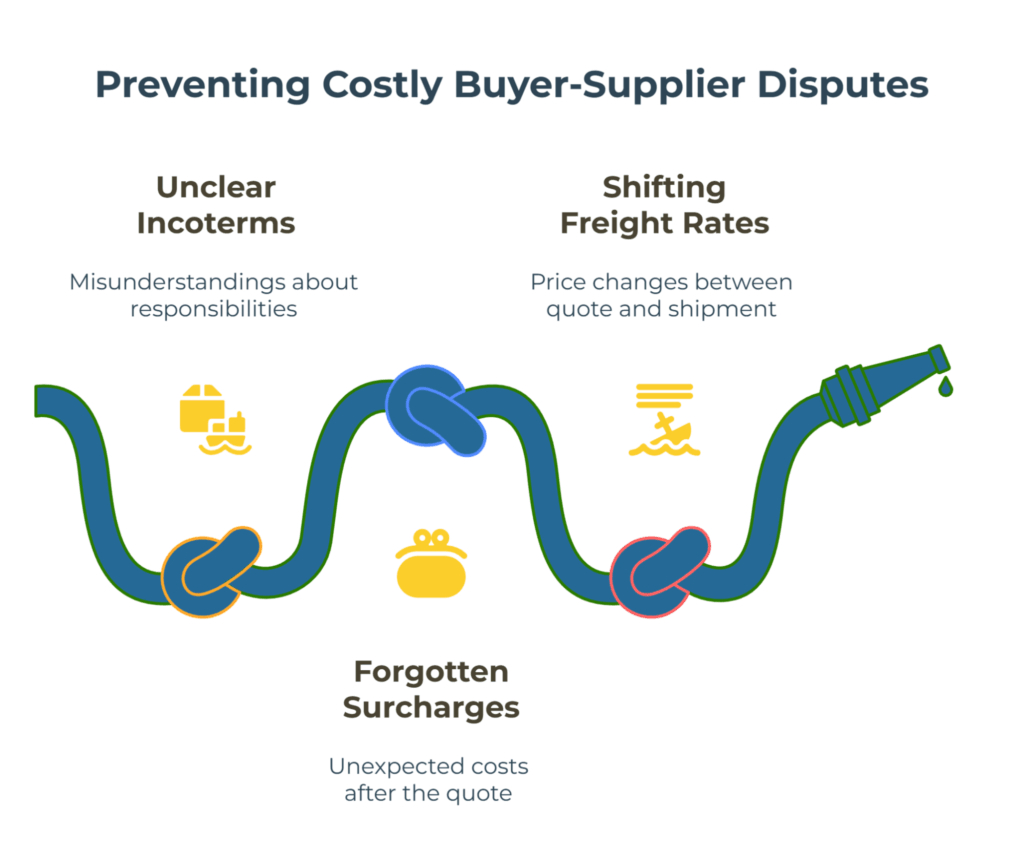
Disputes arise when buyers and suppliers remember different assumptions about what was included in the original quote. The most common failure points: unclear Incoterms, forgotten surcharges, and shifting freight rates between quote and shipment.
Prevention requires documentation discipline. When comparing quotes, create an assumption log that captures the date, Incoterm, freight rate, included surcharges, and any pass-through formulas. Attach this log to your award documentation so future reviewers understand the basis for the decision.
For every PSS, GRI, or BAF change, keep the carrier advisory or schedule as evidence. If an item is estimated—such as terminal handling or customs clearance fees—note the estimation method and await reconciliation when actual costs are known.
At invoice time, cross-check each line item against the assumption log. If discrepancies appear, the documented assumptions provide clear evidence for resolution conversations. This approach transforms subjective negotiations (“I thought freight was included”) into objective reconciliations (“Our documented quote shows FOB, and we agreed to add $150 per tonne freight at baseline rates”).
For buyers managing multiple suppliers, standardized templates for assumption logs prevent information loss during team transitions. For suppliers preparing proposals, pre-filling these templates demonstrates transparency and reduces post-award friction.
What You Can Negotiate Now vs. What You Should Monitor Quarterly
Not every cost driver is negotiable at the time of contract award. Some elements, like freight surcharges or fiber index movements, require ongoing monitoring rather than one-time agreements. Understanding which category each driver falls into shapes effective procurement strategy.
| Driver Component | Negotiate at Award | Monitor Quarterly | Management Approach |
| Base paper price | Yes | Review annually | Lock for contract term with renegotiation clause |
| Fiber pass-through | Define public proxy, lag, caps/floors | Track index movements | Set governance rules, then monitor compliance |
| Freight baseline | Yes (negotiate lane rates) | Track surcharges (PSS/GRI/BAF) | Lock base rates, stress-test surcharge scenarios |
| Energy adjustments | Define formula and index | Track index movements | Set governance rules, then monitor compliance |
| Project surcharges | Negotiate caps and thresholds | Track actual charges vs. caps | Pre-approve fee structure, audit invoices |
The distinction matters because negotiation leverage is highest at award time, when suppliers are competing for business. Once a contract is signed, the focus shifts to compliance monitoring: ensuring adjustments follow the agreed formulas and surcharges stay within negotiated caps.
For drivers governed by external indices, quarterly reviews comparing actual adjustments to index movements prevent drift. For freight, monitoring PSS, GRI, and BAF announcements allows proactive budget adjustments rather than reactive scrambling when invoices arrive.
Frequently Asked Questions
How do PSS and GRI change delivery price?
PSS is a seasonal surcharge carriers apply during peak demand windows when capacity is tight. GRI is a carrier-announced increase to base freight rates that can occur at any time. Both add costs on top of the base rate and can shift supplier rankings even when paper price remains unchanged. Building baseline, surge, and relief scenarios before awarding volume helps buyers understand the full cost range and prevents mid-contract surprises.
Which Incoterms are easiest to compare on a to-door basis?
Any Incoterm can be normalized to a consistent to-door basis, but DDP (Delivered Duty Paid) requires the least adjustment if it truly covers delivery to your dock. For EXW, FOB, or CIF quotes, add the missing cost components—destination port charges, customs duties and taxes, and final inland delivery—to reach comparable to-door totals. The International Chamber of Commerce provides official Incoterms definitions that clarify responsibilities and cost allocation at each point in the journey.
Use the Stack to De-Risk Renewal Decisions
When renewal season approaches, the cost stack framework provides a structured approach to supplier performance evaluation and negotiation planning. Rather than asking “Can you sharpen your price?”, the stack enables specific, evidence-based conversations: “Our fiber costs rose 12% while the index moved 8%—can we align the adjustment mechanism?” or “Freight surcharges exceeded our baseline by 40% on three shipments—how do we stabilize this?”
This specificity benefits both buyers and suppliers. Buyers gain transparency into where costs actually moved versus where contractual governance may have failed. Suppliers gain a neutral way to explain price changes driver-by-driver rather than defending a blended increase that obscures legitimate market pressures.
The tactical workflow: three months before renewal, export your invoice data and break each supplier’s delivered cost into the five stack components. Compare actual movements to contracted formulas. Identify gaps where governance failed or where external conditions exceeded negotiated caps. Use these findings to set renewal priorities: which drivers need tighter controls, which suppliers demonstrated the best compliance, and where market conditions justify revisions.
For organizations managing multiple containerboard suppliers across different regions, the stack creates comparability even when base prices, freight lanes, and energy markets differ. The framework remains consistent: base price plus four governed drivers, normalized to door, stress-tested across scenarios.
To explore verified suppliers and compare options, visit PaperIndex’s supplier directory. For buyers ready to source packaging papers with transparent cost structures, submit your requirements to receive quotes from global manufacturers. Suppliers looking to connect with active buyers can join PaperIndex free and access a network of over 49,000 procurement professionals worldwide.
The containerboard cost stack—base price plus fiber, freight, energy, and surcharges—transforms unclear quotes into governed, comparable decisions. By separating drivers, normalizing to a single delivery basis, and stress-testing freight scenarios, procurement teams build renewal strategies that survive market volatility. The result: budget confidence, fewer disputes, and relationships grounded in transparent cost mechanics rather than opaque blended prices.
Disclaimer: This article provides general information about containerboard landed-cost drivers for educational purposes. Individual circumstances vary significantly based on factors like shipping lane and Incoterms, contract trigger language, freight market conditions, fiber and energy pass-through methods, and local duties/fees. For guidance tailored to your renewal and budget-stability needs, it is recommended to consult with a qualified professional.
Our Editorial Process
Our expert team uses AI tools to help organize and structure our initial drafts. Every piece is then extensively rewritten, fact-checked, and enriched with first-hand insights and experiences by expert humans on our Insights Team to ensure accuracy and clarity.
About the PaperIndex Insights Team
The PaperIndex Insights Team is our dedicated engine for synthesizing complex topics into clear, helpful guides. While our content is thoroughly reviewed for clarity and accuracy, it is for informational purposes and should not replace professional advice.