

📌 Key Takeaways
A cupstock sample needs structured review by procurement, quality, and production together — not separate checks in silos — before any supplier moves forward.
- Match the Sample to the Quote First: Confirm the sample ties back to a specific supplier quote, grade, and documents before anyone else spends time reviewing it.
- Looks Can Fool You: Two samples can look identical on a desk but behave very differently on a converting line due to hidden differences in coating, stiffness, or moisture.
- Document What Was Not Tested: If lab testing or a production trial was not possible, record that gap and label the approval as conditional.
- Use a Shared Review Matrix: A single checklist where procurement, quality, and production each log findings turns scattered opinions into one clear decision record.
- Feed Findings Back Into Future RFQs: Gaps exposed during sample review should update your next RFQ so suppliers are evaluated on stronger, more complete criteria from the start.
One structured review beats three separate opinions every time.
Procurement managers, QA leads, and converting teams evaluating cupstock suppliers will gain a shared framework for sample decisions, preparing them for the detailed checklist and worked example that follows.
~ ~ ~ ~ ~ ~ ~ ~ ~ ~ ~ ~ ~ ~ ~ ~ ~ ~
A cupstock sample is a starting point, not an approval. Before shortlisting a supplier, comparing RFQ responses, or committing to a production-scale order, the sample must be reviewed against the RFQ, the supplier’s technical documentation, and the intended cup application.
The challenge is that sample review often happens in silos. Procurement checks the quote. Quality checks the spec sheet. Production may not see the material until it arrives on the converting line. When these reviews happen separately — or incompletely — teams risk advancing a supplier based on partial evidence. A sample that looks acceptable to procurement may lack the documentation quality needs and may still fail during forming or sealing.
This article provides a shared cupstock sample review checklist that procurement, quality, and production teams can use together before making supplier approval decisions.
Why Cupstock Sample Review Needs More Than a Visual Check
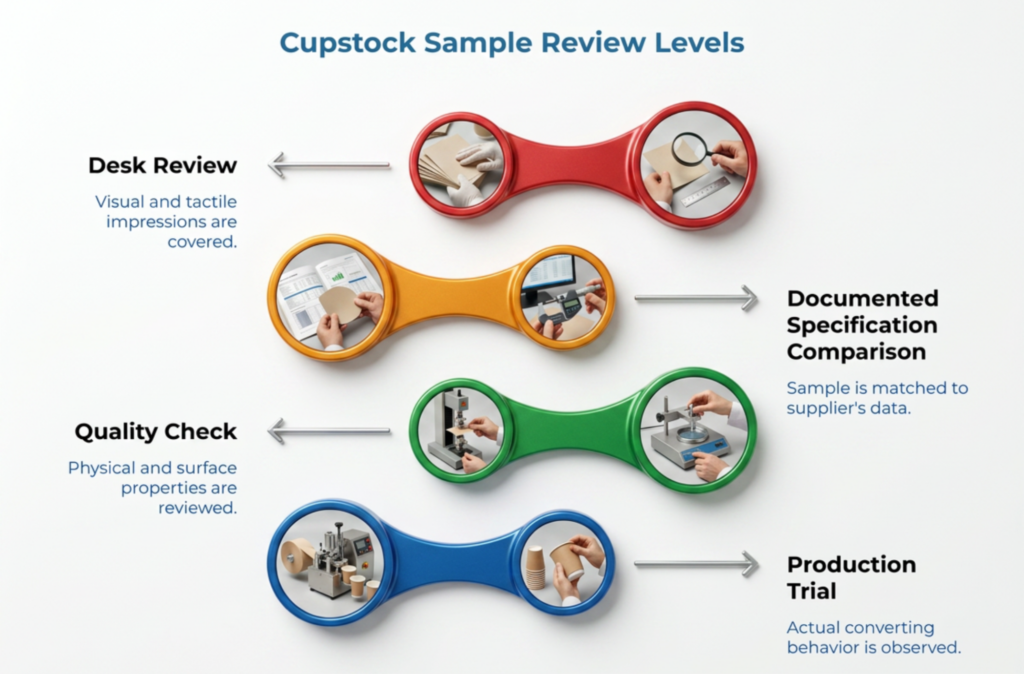
Two cupstock samples can look nearly identical on a desk and behave very differently on a converting line. Visual inspection cannot reliably reveal differences in coating weight, caliper consistency, internal bond strength, moisture content, or stiffness. A sample may feel clean and smooth yet produce sealing failures, curling during forming, or ink adhesion problems under production conditions.
Sample review becomes more reliable when it operates at four levels: a desk review covering visual and tactile impressions, a documented specification comparison matching the sample to the supplier’s data, a quality check reviewing physical and surface properties under the buyer’s own test protocol, and a production trial observing actual converting behavior. Not every organization can run a full lab program or an immediate machine trial for every supplier sample. A repeat order from an existing source, a new cup base paper supplier, and a new PE-coated cupstock source each require a different depth of review. The important point is to document what has been checked, what has not been checked, and what remains open before final approval.
The goal is not to require the same testing program from every buyer. It is to reduce ambiguity before quotes, approvals, and scale-up decisions by making the review process deliberate rather than informal.
Start by Matching the Sample to the RFQ and Supplier Documents
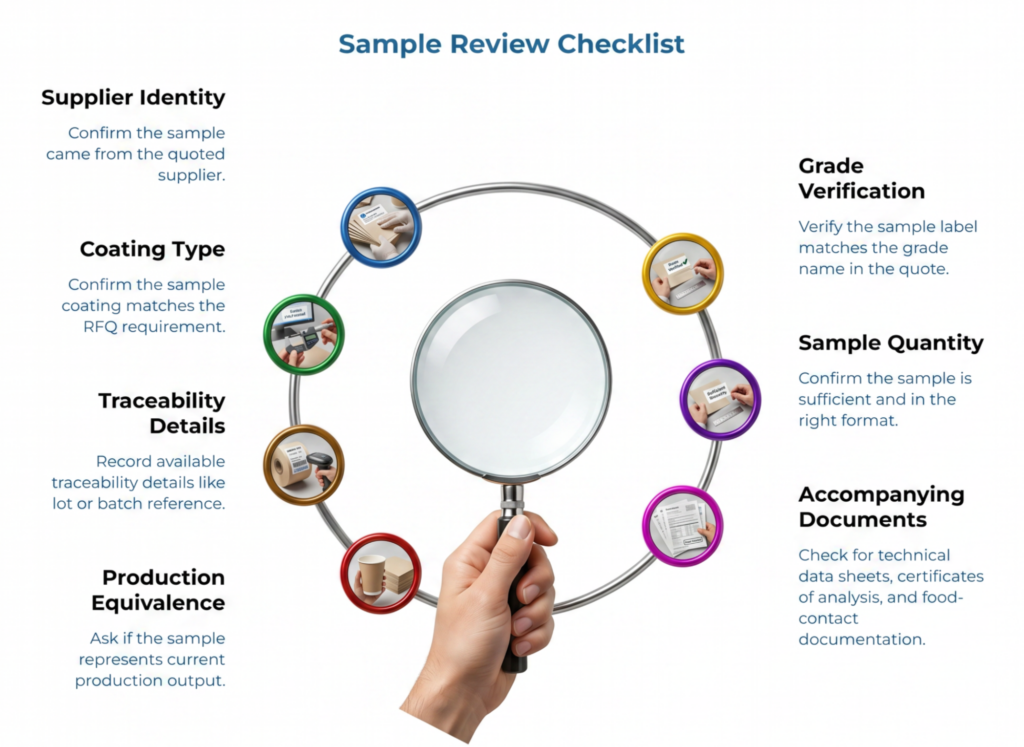
Procurement owns the first layer of review: confirming that the physical sample can be traced back to the supplier’s quote, the stated grade, and the accompanying documentation.
Before passing material to quality or production, check the following:
- Supplier identity and contact — confirm the sample came from the quoted supplier.
- Quoted grade versus sample grade — verify that the sample label or documentation matches the grade name, coating type, and product description in the quote.
- Coating type — confirm whether the sample is PE-coated, water-based coated, uncoated, or another type, and whether this matches the RFQ requirement.
- Sample quantity and format — confirm the sample is sufficient and in the right format (sheets, rolls, blanks, or bottom rolls) for quality and production evaluation. The review may differ by format, so record what was received clearly.
- Lot, batch, or mill reference — record available traceability details.
- Accompanying documents — check whether the supplier included a technical data sheet (TDS), certificate of analysis (COA) if available, food-contact documentation where applicable, and sample identification.
- Production equivalence — ask whether the sample represents current production output or was prepared separately. A hand-prepared or specially selected sample may be useful for early screening, but it should not be treated the same as a sample from normal production unless the supplier confirms its basis.
Terminology drift between supplier documents should be handled carefully. A quote may say “cupstock,” the sample label may say “PE-coated board,” and the TDS may reference a grade code. That does not automatically mean the sample is wrong. It does mean the supplier should clarify whether all three references describe the same material, with the same coating type and specification.
If a sample cannot be tied to a specific quote, grade, or document set, treat it as a clarification item. Do not advance it through the approval process until the gap is resolved.
A short document request list can keep the review organized:
- Supplier technical data sheet
- Certificate of analysis if available
- Sample ID, grade code, lot reference, batch reference, or mill reference where available
- Coating details and coating-side information where relevant
- Food-contact documentation where applicable to the destination market and cup use
Early matching prevents teams from spending time evaluating material that may not represent what the supplier would actually ship. For guidance on reducing ordering errors, refer to the article on paper specification matching.
Quality Checks: What QA Should Review Before Approval
Quality owns the specification and documentation layer. The QA review should compare the sample against buyer-owned acceptance criteria, the supplier’s stated specifications, and applicable documentation requirements.
Visual and surface inspection: Check for visible defects — dirt, coating streaks, pinholes, delamination, edge damage, shade variation, or odor. Assess coating uniformity on both sides if the product is double-coated, and note any surface inconsistencies that could affect printability, sealing, or food contact. If defects are visible, photos and sample labels help preserve the record for supplier discussion.
Physical property checks (where testing capability exists): Basis weight (grammage) is a fundamental measurement. It can be tested following methods such as ISO 536 or TAPPI T 410 under the buyer’s approved test protocol. Caliper (thickness) can be measured using methods referenced in ISO 534 or TAPPI T 411. If stiffness matters for the cup application, bending resistance methods such as ISO 2493-2 or TAPPI T 489 apply. Moisture sensitivity should also be noted — signs of warping, limpness, or conditioning issues can indicate storage or handling problems.
Avoid using universal pass/fail limits unless those limits originate from internal acceptance criteria, supplier-agreed specifications, or an approved technical standard. GSM alone is not enough to validate cupstock specification fit. Two samples can have similar grammage but differ in caliper, stiffness, coating behavior, printability, moisture condition, or runnability.
If the buyer does not have in-house testing capability, document which properties were not tested and flag them for verification before final approval.
Documentation review: Confirm whether the supplier’s TDS matches the sample’s stated properties. Check whether a COA accompanies the sample and references the same lot or batch. Where the cupstock is intended for food or beverage contact, confirm whether food-contact documentation is available. Requirements vary by destination market and applicable regulatory framework. For example, in the United States, 21 CFR Part 176 covers the paper and paperboard components, while 21 CFR Part 177 covers polymer coatings used as the food-contact surface. In the EU, Regulation (EC) No 1935/2004 establishes the general framework for food-contact materials, and specific measures like Regulation (EU) No 10/2011 apply to plastic coating layers. All documentation must be verified against the intended use, cup format, and filling conditions rather than accepted as automatic proof of suitability.
Production Checks: What the Converting Team Should Trial or Observe
Production owns the converting and runnability layer. A sample that passes desk review and documentation checks may still behave unpredictably on the line.
Where a production trial is possible, the converting team should observe:
- Feed behavior and handling — does the material feed consistently without jamming, double-feeding, or slipping?
- Curling or warping — does the sample curl after exposure to ambient conditions, heat, or moisture? Curling affects forming accuracy, stacking, and sealing.
- Die-cutting and creasing — does the material cut cleanly and crease without cracking, delamination, or excessive dust?
- Cup forming — does the sample form to the intended shape without splitting, wrinkling, or dimensional inconsistency?
- Side-seam and bottom-seal observations — does the coating seal properly under the line’s heat and pressure settings? Note adhesion failures, leaks, or inconsistent bonds.
- Printability — if printing is part of the process, does the surface accept ink evenly without bleeding or poor adhesion?
- Waste and machine adjustments — record any unusual waste, jams, or setting changes required during the trial.
Production notes should be specific enough to help procurement ask better supplier questions. A note that reads “sealing issue” is less useful than “bottom seal required pressure adjustment during short trial” or “curling appeared before feeding under ambient conditions.” The goal is not to blame the supplier too early. The goal is to preserve enough evidence to decide whether the issue relates to the sample, storage, conditioning, machine setup, coating, or specification mismatch.
A small desk sample may not reveal full production behavior. If no line trial is possible at the sample stage, label the approval as conditional and document the limitation — specifying what production evidence is still needed before the supplier advances to a larger order.
Use a Shared Sample Review Matrix Before Final Supplier Approval
A shared matrix gives procurement, quality, and production a single place to record findings. Each team fills in its column. Unresolved issues become supplier clarification questions before the approval advances.
| Review Area | Procurement Checks | Quality Checks | Production Checks | Evidence to Request | Decision Trigger |
| Sample identity | Supplier name, grade, quote reference | Lot or batch reference, sample labeling | Trial label and date | TDS, COA, sample ID | Hold if sample cannot be traced to a quote or grade |
| Physical properties | Confirm quoted specification | Grammage, caliper, stiffness (if tested) | Handling and forming feel | Test report if available | Clarify if measured values and supplier specification conflict |
| Coating and surface | Match quoted coating type | Coating uniformity, surface defects, pinholes | Sealing, print, and forming observations | Coating type declaration | Retest if coating behavior differs from stated type |
| Production fit | Confirm sample quantity for trial | Define QA acceptance checks | Trial under relevant line conditions | Trial log or observation record | Conditional approval if trial is limited or incomplete |
| Documentation | Confirm supplier response completeness | Food-contact documentation where applicable | Production feedback record | TDS, COA, compliance documents where required | No final approval if critical documents are missing |
Decision Status After Cross-Functional Review
| Decision Status | When It Fits | Next Action |
| Approve for next stage | Sample is traceable, documentation is adequate for the stage, and QA and production have no unresolved concern | Move to the next sourcing, trial, or approval step |
| Conditionally approve | Sample looks promising, but a document, trial, or production-equivalent sample is still pending | Record the limitation and owner clearly |
| Hold for clarification | Quote, label, TDS, coating details, or sample identity do not align | Ask the supplier to clarify before approval continues |
| Retest or request new sample | The sample may not be production-equivalent, may be damaged, or gives mixed results | Request a production-equivalent sample or repeat review |
| Reject | Critical mismatch against the RFQ, intended cup application, buyer-owned acceptance criteria, or essential documentation | Record reason and close the sample review |
This status structure also helps reduce internal disagreement. Procurement, QA, and production may use different languages for the same issue. A shared decision status turns separate comments into one documented sample approval record.
Red Flags That Should Pause Cupstock Sample Approval
Certain findings should delay the approval process until resolved:
- The sample cannot be linked to a specific quote, grade, or supplier document set.
- Coating type or food-contact documentation is missing where the application requires it.
- The supplier cannot confirm whether the sample is production-equivalent.
- QA test results conflict with the supplier’s technical data sheet.
- Production reports sealing, forming, curling, or die-cutting problems during trial.
- The supplier uses different terminology, grade names, or coating descriptions across the quote, sample label, and TDS without clarifying that they describe the same material.
- The sample performs noticeably differently from a known-good reference material under similar review conditions.
These are not automatic rejection triggers. They signal that the approval decision needs more evidence or supplier clarification before moving forward.
Applying the Checklist: A Worked Example
A supplier sends a cupstock sample that looks clean and matches the quoted GSM. Procurement can match the supplier name and quote reference, but QA cannot connect the sample to a lot or batch reference. During a short production check, the converting team also observes curling before feeding.
The team does not need to reject the supplier immediately. A more disciplined response is to hold approval, ask the supplier for a production-equivalent sample with traceability, request an updated TDS, confirm coating details and coating side, and ask whether storage or conditioning could have affected the sample. The decision record should show that the sample is not fully approved until the traceability and production questions are resolved.
This kind of structured response turns a vague concern into a specific supplier question — and keeps the approval process moving without skipping evidence.
Turn Sample Findings Into Clearer RFQs and Supplier Questions
Sample review should feed back into the RFQ process so that future supplier evaluations start from a stronger position.
After completing a review cycle, consider updating the RFQ to add specification fields that the sample review exposed as missing, include test methods or tolerance expectations where they were previously undefined, request production-equivalent samples rather than hand-prepared material, and require documentation — TDS, COA, coating declaration, food-contact documentation where applicable — with every sample submission. If the buyer needs specific test methods or tolerances, those should be added as buyer-owned requirements rather than assumed after the sample arrives.
Aligning procurement, quality, and production on shared evaluation criteria before the next round of quote comparison makes supplier responses easier to compare. A low quote is difficult to interpret if one supplier sends a traceable production-equivalent sample with documents, while another sends an unlabeled sample with unclear coating details.
For additional guidance, refer to the guide on standardizing paper supplier quotes before comparison.
Frequently Asked Questions
Can procurement approve cupstock samples without a production trial?
A preliminary approval may be possible when procurement and quality checks are satisfactory. However, it should be documented as conditional, with the required production evidence specified before the supplier advances to a larger order.
What documents should come with cupstock samples?
Useful documents include a TDS, COA if available, sample identification and lot or batch reference, coating details, and food-contact documentation where applicable. The exact document set may vary by supplier, application, destination market, and buyer quality system. Missing documents should be requested before final approval.
Is grammage (GSM) enough to compare cupstock samples?
Grammage is one important property, but it does not capture caliper, stiffness, coating behavior, surface quality, or production performance. Two samples with the same grammage can behave very differently on a converting line.
How do you know if a cupstock sample is production-equivalent?
The supplier should confirm whether the sample came from normal production, a selected lot, a hand-prepared batch, or a special sample run. Buyers should compare the sample label, grade code, lot or batch reference, TDS, and trial behavior where possible. If the answer remains unclear, approval should be conditional.
Can a good-looking sample still fail in production?
Yes. Visual review can identify some surface and handling concerns, but it does not prove line performance. Production behavior depends on caliper, stiffness, moisture condition, coating behavior, curl, scoring response, sealing behavior, and the buyer’s own converting conditions.
What should teams do if samples look good but documents are incomplete?
Hold or conditionally advance the review while requesting missing documents. Do not treat the sample as fully approved. Document which items are outstanding and set a timeline for resolution before the supplier moves to the next stage.
Conclusion
Cupstock sample review works best when procurement, quality, and production use a shared process rather than reviewing in isolation. A sample that looks acceptable at a desk may lack the documentation QA needs or perform unexpectedly on the converting line. Structured review — with clear ownership, documented findings, and defined decision outcomes — reduces the risk of advancing a supplier on incomplete evidence and strengthens RFQ clarity over time.
Use the checklist to clarify cupstock requirements before comparing supplier quotes. Buyers ready to source can explore cupstock manufacturers along with suppliers and exporters, or submit an RFQ for cupstock to receive supplier quotes.
Disclaimer:
This article is for general informational purposes only and does not constitute compliance, safety, technical, or professional advice. Cupstock requirements, test methods, food-contact documentation, and approval criteria may vary by application, supplier, destination market, and buyer quality system. Confirm important decisions with the appropriate qualified professional, authority, supplier documentation, or technical expert.
Our Editorial Process:
Our expert team uses AI tools to help organize and structure our initial drafts. Every piece is then extensively rewritten, fact-checked, and enriched with first-hand insights and experiences by expert humans on our Insights Team to ensure accuracy and clarity.
About the PaperIndex Insights Team:
The PaperIndex Insights Team is our dedicated engine for synthesizing complex topics into clear, helpful guides. While our content is thoroughly reviewed for clarity and accuracy, it is for informational purposes and should not replace professional advice.