

📌 Key Takeaways
Quote chaos starts when suppliers guess what you meant—name every field before sending the RFQ.
- Separate Shared From Exception Fields: Universal requirements go in one block; SKU-specific needs go in a clearly labelled exception section so suppliers know what applies where.
- Name Fields, Don’t Describe Folding Cartons: Broad phrases like “standard quality” invite guesswork—named fields with defined scope produce quotes you can actually compare.
- Own the Specification Language: When suppliers fill your gaps, comparison drifts before quotes arrive; buyer-side teams must define fields, meanings, and test methods first.
- Run a 15-Minute Alignment Check: Before sending, confirm procurement, packaging, and brand operations agree on shared fields and exception labels.
- Read It Like a Supplier Would: If any line invites interpretation instead of a direct response, rewrite it before the RFQ leaves your building.
Clear fields = comparable quotes = real decisions.
Procurement managers and packaging teams sourcing folding cartons will gain a ready-to-use field structure here, preparing them for supplier outreach that reduces clarification churn.
~ ~ ~ ~ ~ ~ ~ ~ ~ ~ ~ ~ ~ ~ ~ ~ ~ ~
Loose folding carton descriptions create artificial quote variance because suppliers and internal teams interpret them differently. The fastest correction is naming the specific fields every supplier must respond to before outreach begins. The following five-step process establishes a quote-ready field structure that separates shared requirements from exception-only fields and reduces clarification churn.
Why Broad Folding Carton Requests Create Supplier Guesswork
The RFQ goes out. Three suppliers respond—whether sourced from a curated directory of packaging paper suppliers or through existing relationships. The quotes typically vary by a substantial margin, based on real-time market conditions, material costs, and specific supplier assumptions.
Analysis of quote variance typically reveals divergent interpretations of the same folding carton description.
This point of failure is common but often misdiagnosed. A request like “folding carton for 250g retail product, standard quality” sounds aligned internally. It is not operationally equivalent. “Standard quality” means one thing to procurement, another to packaging engineering, and something else entirely to a supplier quoting from a different mill relationship.
Without standardized fields, one supplier may apply a single material logic to an entire SKU family while another creates unique interpretations for every format. These divergent assumptions mask true price differences behind preventable field ambiguity.
The fix does not require a complete specification overhaul. It requires naming the fields that matter for comparison before the first quote request leaves the building. A quote-ready folding carton definition works more like a blueprint than a shopping list. It does not try to say everything. It makes the most important things unmissable.
Step 1 — Split Shared Fields from Exception Fields
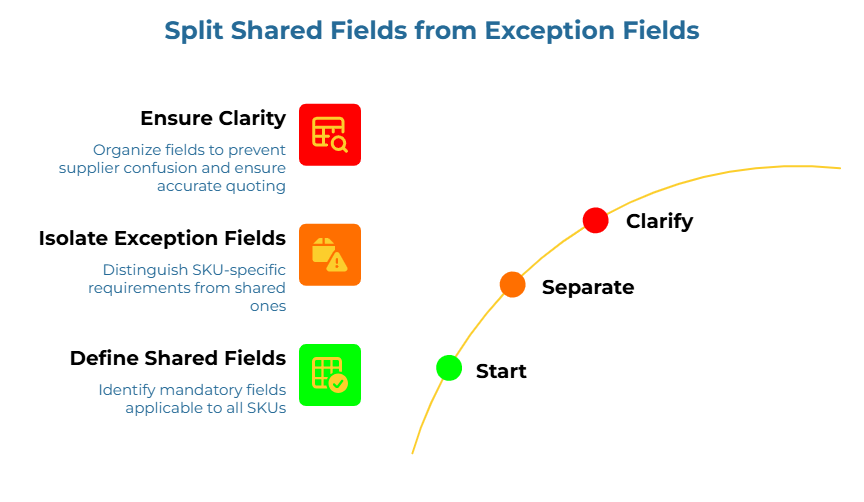
Effective field architecture begins by distinguishing universal requirements from SKU-specific variables.
A quote-ready folding carton definition starts by separating two categories. Mandatory shared fields apply to the entire product family—these are fields every supplier must answer the same way, regardless of which SKU they quote. Material type, board grade family, and primary structural format typically belong here.
Exception-only fields are triggered by specific SKU needs that do not apply across the portfolio. A single SKU requiring a window cutout or heavier caliper should not force that requirement into the shared field set.
The goal is clarity, not compression. When shared fields and exception fields live in one undifferentiated block, suppliers cannot tell which requirements are universal and which apply only to specific items. The result is either over-specification or under-specification—neither helps comparison.
Step 2 — Name the Quote-Critical Field Groups
With the shared-versus-exception logic established, the next step is naming the field groups suppliers must respond to. For folding carton sourcing, six high-level groups define the requirement:
- Material fields cover board type, grade family, virgin versus recycled content, and coating requirements. This is where material naming discipline matters most. To tighten this language further, review our guide on establishing strict board grade tolerances across your supplier network.
- Structural fields address folding carton style, dimensions, closure mechanism, and any die-cut features.
- Performance fields capture load-bearing requirements, moisture resistance expectations, and stacking behaviour.
- Test-method fields specify which standards the supplier should reference when reporting results.
- Tolerance and interpretation fields establish the permissible deviation limits for structural and material attributes.
- Exception and SKU-variance fields document requirements applying only to specific SKUs, not the full family.
The objective is categorization, not invention. Each field group should reflect real decision points the team needs answered—not aspirational technical depth the team cannot verify or enforce.
Step 3 — Standardise How Each Field Should Be Expressed
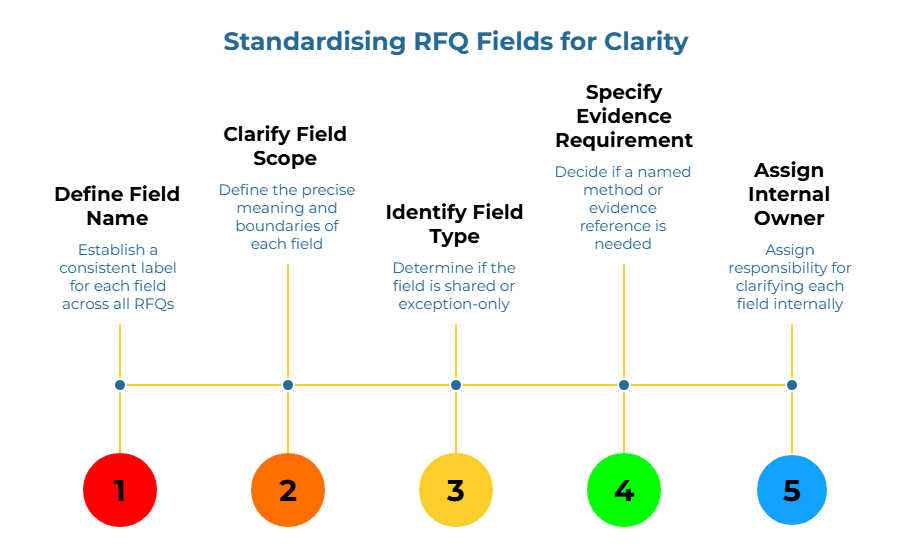
A named field is only useful if it can be answered consistently. For each field, the team should clarify five elements before supplier outreach.
First, what the field is called—using a consistent label across all RFQs and internal documents. Second, what it refers to—defining scope so suppliers and internal teams interpret it the same way. Third, whether it is shared or exception-only, flagged explicitly so suppliers know which requirements are universal. Fourth, whether a named test method or evidence reference is required—some fields need a test method cited, others do not. Fifth, who owns clarification internally before supplier outreach—assigning responsibility for resolving ambiguity on each field.
This step converts a list of field names into a working specification language. The payoff is fewer clarification emails after the RFQ goes out and fewer surprises when quotes come back—whether you’re working with established partners or beginning to find suppliers for a new programme.
Standardization must be buyer-led. When the supplier becomes the first party to normalise the request, the comparison basis has already started drifting. When specifications are clear, suppliers can respond more accurately and efficiently, building immediate trust with procurement teams. For adjacent reading on that risk, see The Danger of Vendor-Led Data Sheets: Establishing Rigid Folding Carton Specification Requirements.
Step 4 — Add Lightweight Exception Logic for Unlike SKUs
Quote readiness improves when the request makes room for controlled exceptions instead of forcing false uniformity.
If the product family includes SKUs with meaningfully different requirements—a heavier item needing reinforced corners, a premium variant requiring specialty coating—those differences should surface in the RFQ structure, not hide inside a single vague master description.
The mechanism is straightforward: create a clearly labelled exception section listing SKU-specific requirements alongside the shared field set. Suppliers can then quote the shared baseline and add line items for exceptions, rather than guessing which requirement applies where.
This prevents two common failures. The first is stretching one folding carton specification too far across unlike SKUs. The second is discovering the mismatch only during validation or after launch.
Step 5 — Run a Fast Internal Alignment Check Before Supplier Outreach
Before the RFQ leaves, a short pre-send validation prevents weeks of downstream confusion. Once aligned, buyers are fully prepared to submit their RFQs to qualified suppliers. Before sending, ask these five plain questions:
- Have procurement, packaging engineering, and brand operations agreed on the shared fields?
- Are exception fields visible and clearly labelled rather than buried in general notes?
- Are any copied legacy fields still relevant to the current SKU set, or are they artefacts from a previous programme?
- Is the request specific enough to reduce clarification churn after quotes arrive?
- Does each field have an internal owner for pre-send clarification?
It catches internal misalignment before it surfaces in supplier responses.
Quick Reference: Field Logic Table
| Field Logic | What Belongs Here | Why It Helps |
| Mandatory shared fields | Fields every supplier must answer the same way for the family | Improves comparability |
| Exception-only fields | Fields triggered by unlike SKU needs | Prevents false uniformity |
| Named test method / interpretation fields | Where a result, tolerance, or test method must be interpreted consistently | Reduces translation drift |
Starter RFQ Field Checklist
Shared Fields (Required for All SKUs)
- Board type and grade family
- Primary structural format and folding carton style
- Outer dimensions (length × width × height)
- Closure mechanism
- Coating or barrier requirements
- Minimum performance expectations (load, moisture, stacking)
- Required test methods for reported values
- Tolerance ranges for critical dimensions
Exception Fields (SKU-Specific Only)
- SKU-specific structural features (windows, inserts, reinforced corners)
- SKU-specific material upgrades or coatings
- SKU-specific dimensional variances
Interpretation Fields
- Named test methods for any reported performance values
- Internal owner assigned for each ambiguous field
Final Check
- Read the RFQ once as a supplier would. Rewrite any line that invites interpretation instead of response.
For a broader parameter view that sits alongside this field-design approach, see The Baseline Packaging Parameter Checklist: Structuring Your Folding Carton Specification Requirements.
Common Mistakes That Recreate Supplier Guesswork
Copying old fields without checking current SKU fit. Legacy RFQ templates carry forward requirements from previous programmes. If the current SKU set has different needs, those inherited fields create noise rather than clarity.
Using broad folding carton language instead of named fields. Phrases like “standard quality” or “appropriate strength” feel efficient but invite interpretation. Named fields with defined scope produce comparable answers.
Mixing standard fields and exception fields in one undifferentiated block. When suppliers cannot distinguish universal requirements from SKU-specific ones, they either over-quote or under-quote. Neither outcome helps comparison.
Assuming supplier clarification later will solve a buyer-side definition problem. If the team has not aligned internally on what a field means, asking the supplier to clarify transfers the problem rather than solving it. The confusion returns when quotes arrive.
From Guesswork to Governed Comparison
The difference between a broad folding carton request and a quote-ready field structure is not volume of detail. It is clarity of structure.
When the buyer-side team names the fields, separates shared requirements from exceptions, and runs a fast alignment check before outreach, the quotes that come back become genuinely comparable. The team stops debating whether supplier variance reflects real cost differences or field ambiguity. A disciplined field structure treats the request as a decision architecture rather than a loose description.
With your quote-ready fields established, you are ready to begin sourcing. Start comparing qualified folding carton suppliers on PaperIndex.
Disclaimer:
This article is for educational purposes only. Specifications, tolerances, and field structures discussed are illustrative frameworks—not definitive standards. Actual requirements vary by application, supplier capability, and regulatory context. Verify all technical parameters with qualified packaging engineers before implementation.
Our Editorial Process:
Our expert team uses AI tools to help organize and structure our initial drafts. Every piece is then extensively rewritten, fact-checked, and enriched with first-hand insights and experiences by expert humans on our Insights Team to ensure accuracy and clarity.
About the PaperIndex Insights Team:
The PaperIndex Insights Team is our dedicated engine for synthesizing complex topics into clear, helpful guides. While our content is thoroughly reviewed for clarity and accuracy, it is for informational purposes and should not replace professional advice.