

📌 Key Takeaways
Supplier pre-qualification becomes defensible when you replace subjective debates with a structured scoring rubric that separates evidence from claims.
- Gates First, Scores Second: Mandatory pass/fail requirements (complete PQQs, certificate copies, method-verified test reports) eliminate unqualified suppliers before comparative scoring begins, saving review time and preventing weak candidates from advancing.
- Weighted Criteria Reflect Real Risk: Assign the highest weights to product capability (25%) and quality systems (20%) because off-spec material or inconsistent production creates operational disruptions that no amount of low pricing can offset.
- Method IDs Make Lab Reports Comparable: Test results citing ISO 536 for grammage or ISO 2758 for burst strength enable direct comparison to your standards, while generic “internal methods” are unverifiable claims that should lower scores significantly.
- Dual Reviewers Reduce Bias: Two independent evaluators scoring each criterion separately, then averaging their assessments, eliminates the risk of one person’s preferences dominating supplier selection decisions.
- Registry Verification Stops Certificate Fraud: Before awarding points for FSC or ISO 9001 claims, confirm “Active” status through official registries—certificates with expired dates, wrong scope coverage, or entity name mismatches are disqualifiers disguised as credentials.
Evidence-first scoring transforms fifty supplier PDFs into ranked shortlists you can defend to finance, quality, and operations teams. Procurement and quality managers in kraft paper sourcing will find this framework immediately actionable, preparing them for the detailed eight-criterion rubric and step-by-step implementation guide that follows.
The conference room fills with paper. Twelve supplier PQQs sit on the table, each claiming ISO certification, each promising on-time delivery, each presenting lab reports with impressive numbers. The procurement team debates for three hours, but without a structured method, the decision comes down to gut feelings rather than evidence.
A lightweight scoring rubric eliminates this chaos. It defines what matters, assigns each factor a weight, and scores every supplier on the same 0–5 scale. Thirty minutes later, you have ranked results and a defensible answer when your CFO asks why you chose one mill over another.
Why PQQs Fail Without a Scoring Rubric (and What to Fix)
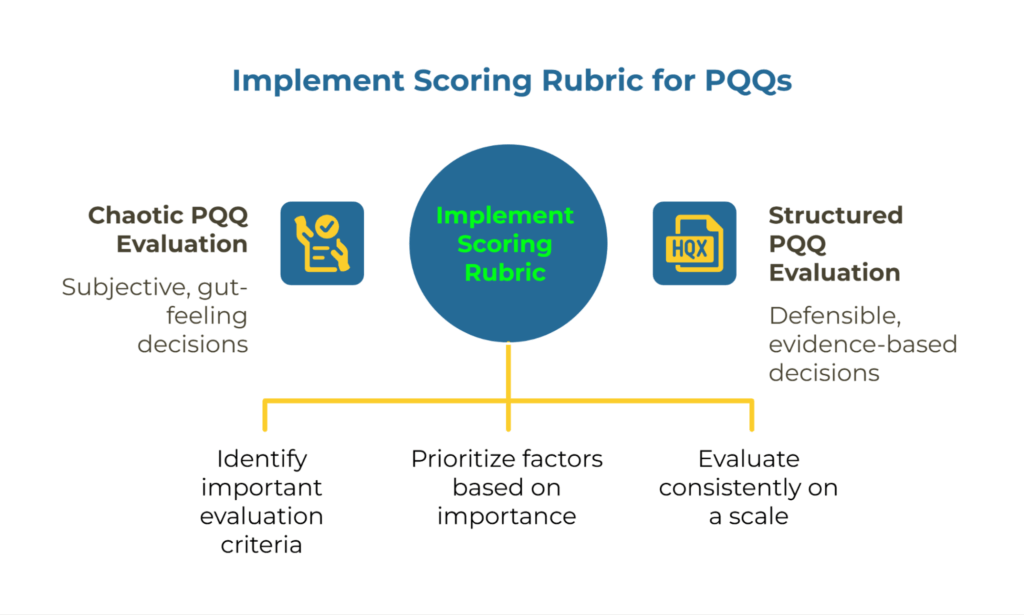
Pre-qualification breaks down when different team members apply different standards. The quality manager prioritizes certifications. The procurement lead focuses on price and lead times. The production planner wants proof of spec consistency. Each evaluates the same PQQ through a different lens, leading to conflicting recommendations.
The deeper problem is conflating claims with evidence. A supplier states they hold ISO 9001 and FSC certification. The attached PDF shows a certificate dated five years ago with scope limited to tissue paper—not the virgin kraft liner board you need. Another vendor lists “advanced quality systems” but provides no calibration records, making it impossible to trust their lab results.
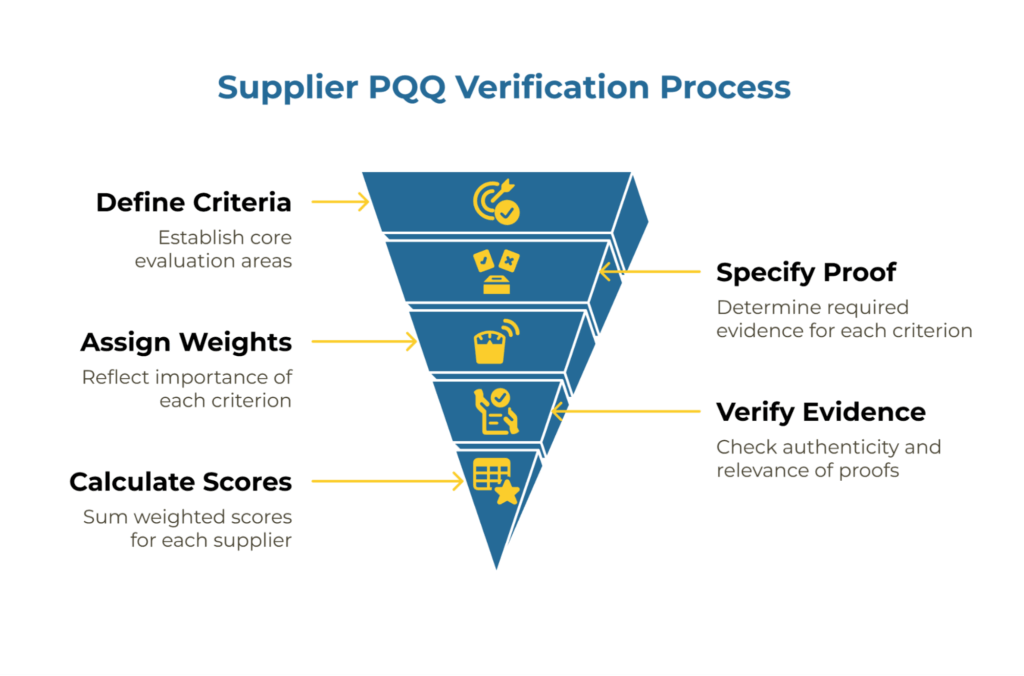
A scoring rubric separates what suppliers claim from what they prove. You define eight core criteria—legal identity, product capability, quality systems, certifications, test evidence, logistics, compliance, and commercial references. For each criterion, you specify the exact proof required and assign a weight reflecting its importance.
When suppliers claim FSC certification, the rubric demands an “Active” status screenshot from the official FSC registry, not just a scanned PDF. When they cite burst strength results, you require the test method ID confirming whether the measurement uses ISO 2758 or TAPPI T 403—critical for verifying the result compared to your standards. Additional testing standards like ISO 1974 for tear resistance, ISO 536 for grammage, and ISO 534 for thickness provide comprehensive property verification.
This transforms PQQ review from subjective discussion into systematic verification. Score each criterion, multiply by its weight, sum the totals, and apply threshold rules.
The Scoring Framework: Gates and Weighted Criteria
Before applying the rubric, separate mandatory requirements from scored elements. Gates are pass/fail items—missing any gate requirement immediately disqualifies a supplier from further consideration. Scored criteria allow comparative evaluation among suppliers who clear all gates.
Gate Requirements (Must Pass All):
- Complete PQQ response with all sections addressed
- Required certificates provided (copies, not “available upon request”)
- Test reports include recognized method references
- Signed acknowledgment of your terms and policies
Only suppliers clearing all gates advance to scored evaluation.
Scoring Scale (0–5):
- 5 = Exemplary evidence; exceeds requirements with comprehensive proof
- 4 = Strong evidence; fully meets requirements
- 3 = Adequate evidence; meets minimum baseline
- 2 = Weak evidence; partial documentation or unclear proof
- 1 = Minimal evidence; significant gaps requiring remediation
- 0 = Missing or invalid evidence
What to Score: The 8 Weighted Criteria

| Criterion | Weight | What You’re Evaluating |
| Legal identity & registry | 10% | Verified legal entity with name consistency across documents |
| Product capability & spec fit | 25% | Grade range, GSM, strength properties matching your RFQ with method-verified lab reports |
| Quality system & process capability | 20% | ISO 9001 certificate with kraft paper scope; documented CAPA workflows; calibration records |
| Certifications relevance | 10% | Active FSC/PEFC chain-of-custody with correct scope; food-contact certs if applicable |
| Test evidence & method matching | 15% | Recent lab reports citing ISO or TAPPI methods (≤12 months old) |
| Logistics & delivery capability | 10% | Demonstrated lane coverage, booking lead times, OTD performance data |
| Compliance & ESG basics | 5% | Documented policies, traceability statements, audit summaries |
| Commercial references | 5% | Two verifiable customer contacts with sample commercial documents |
Legal Identity & Registry (10%)
Verify the supplier exists as a registered legal entity and that company names match across all documents. Require government registry extract or certificate of incorporation showing legal name, registration number, and current status. Cross-check against names on ISO certificates, FSC registrations, and compliance documents.
Score 5 when documentation is complete and current with perfect name alignment. Score 0 when no legal identity evidence appears or verification through public registries fails.
Product Capability & Spec Fit (25%)
This highest-weighted criterion answers whether the supplier can manufacture the exact kraft paper grades, basis weights, and technical specifications your RFQ demands. Require technical specification sheets listing production range for GSM, burst factor or burst strength, Cobb absorbency, and moisture content. Lab reports must be recent (≤12 months) with method IDs: ISO 536 for basis weight, ISO 287 for moisture, ISO 535 for Cobb, ISO 2758 or TAPPI T 403 for burst strength, plus ISO 1974 for tear resistance and ISO 534 for thickness where relevant.
Score 5 when the supplier’s range fully covers your specs and lab reports confirm recent production within tolerances using correct methods. Score 0 when no spec sheet or lab evidence appears.
Quality System & Process Capability (20%)
Evaluate whether the supplier operates a structured quality management system ensuring consistent production. An ISO 9001 certificate signals documented processes and corrective actions—but only when scope explicitly includes “manufacture of kraft paper.” Beyond the certificate, assess day-to-day quality operations: documented change control, CAPA workflows, and traceability systems.
Require the ISO 9001 certificate showing scope, accreditation body, and validity dates. Request a calibration summary listing key testing equipment and most recent calibration dates. As recommended by the Chartered Institute of Procurement & Supply, use independent dual-reviewer scoring to reduce bias—have two team members score this criterion separately, then average their assessments.
Score 5 when the certificate is current with explicit kraft paper scope and calibration records show annual maintenance. Score 0 when no quality system certificate appears.
Certifications Relevance (10%)
Assess whether the supplier holds specific certifications your supply chain requires. For sustainability claims, verify FSC or PEFC chain-of-custody certification through official registries. Navigate to the FSC registry or PEFC registry, enter the certificate code, and confirm three details: status shows “Active,” scope explicitly lists “kraft paper,” and legal entity name matches.
Before awarding high marks for certifications, verify credentials using certification-body databases or the International Accreditation Forum’s IAF CertSearch tool. This stop-and-verify checkpoint prevents scoring based on unverifiable claims.
Score 5 when verifiable proof shows “Active” status with correct scope. Score 0 when no certification appears or when credentials cannot be verified through official registries.
Test Evidence & Method Matching (15%)
Ensure suppliers prove compliance using recent lab results citing exact test methods you recognize. Method IDs confirm whether measurements compare to your standards. Require recent lab reports (≤12 months) covering key properties with recognized method references from the ISO catalogue for paper testing.
Score 5 when reports are recent, cover all requested properties with proper method IDs, and results fall within tolerances. Score 0 when no lab report appears.
Logistics & Delivery Capability (10%)
Evaluate whether the supplier can reliably deliver to your region and maintain consistent performance. Require shipping lane lists, typical booking lead times, and OTD or OTIF performance summaries over 12 months. Assess contingency plans: backup production lines, maintenance schedules, and supply continuity strategies.
Score 5 when the supplier demonstrates consistent service to your region with OTD exceeding 90%. Score 0 when no logistics evidence appears.
Compliance & ESG Basics (5%)
Check for documented policies and basic traceability. Require policy summaries (anti-bribery, labor standards, environmental compliance) and traceability statements explaining raw material origin. Request non-confidential audit summaries if available.
Score 5 when clear policies, credible traceability, and audit evidence appear. Score 0 when no compliance documentation is provided.
Commercial References (5%)
Verify the supplier has a track record serving similar customers. Require contact details for two current customers and sample commercial documents (redacted purchase order, packing list, or bill of lading).
Score 5 when two verifiable references and relevant commercial documents appear. Score 0 when no references are provided.
How to Use the Rubric: Six Essential Steps
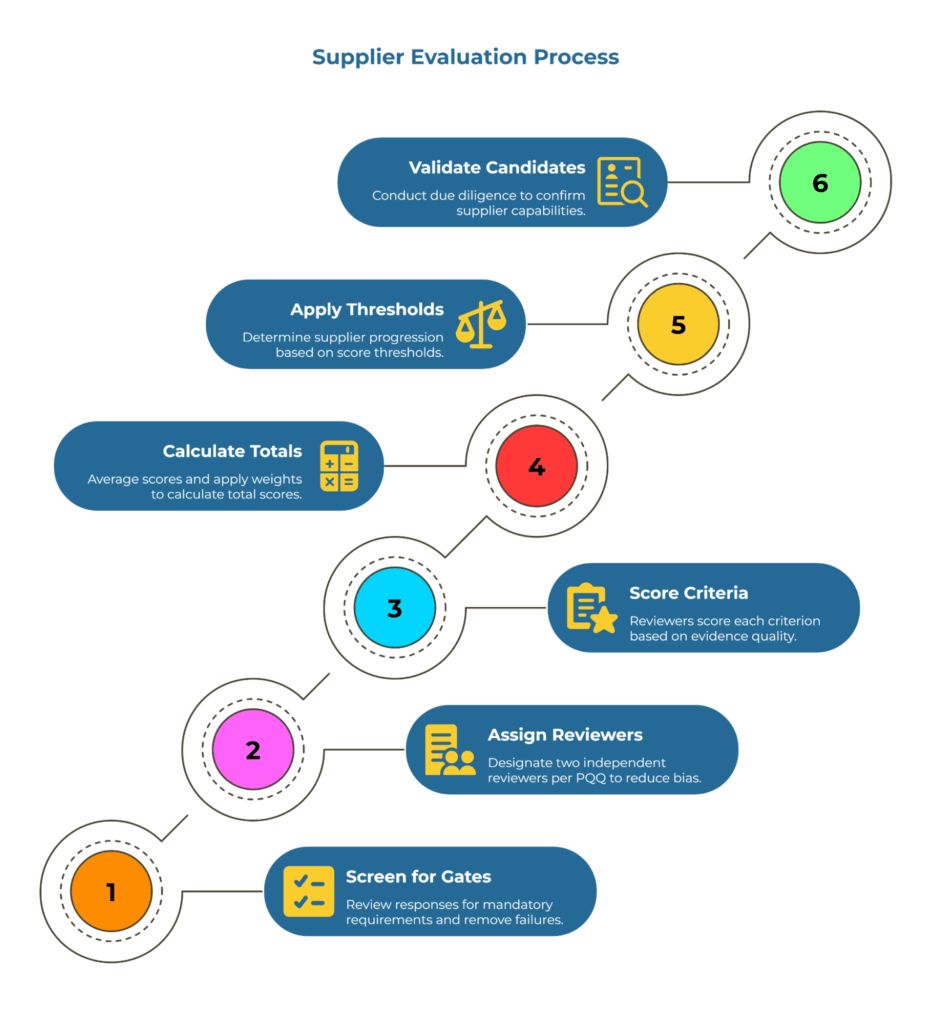
Step 1: Screen for gates. Review all responses for mandatory requirements. Remove any failing gate requirements and document the decision.
Step 2: Assign dual reviewers. Following supplier evaluation best practices, designate two independent reviewers per PQQ. Each scores all eight criteria separately to reduce individual bias.
Step 3: Score each criterion. Each reviewer scores 0–5 based on evidence quality. Compare submitted proof against the requirements outlined above.
Step 4: Calculate weighted totals. Average the two reviewers’ scores for each criterion. Multiply each averaged score by its weight, then sum to produce a total out of 100.
Step 5: Apply thresholds and resolve ties. Suppliers scoring ≥80 advance to factory audit or trial order. Those scoring 65–79 enter a conditional pilot with enhanced monitoring. Scores below 65 trigger decline or remediation. For tied scores, use pre-defined tie-breakers: stronger technical evidence quality, shorter lead times with documented backup capacity, or cleaner audit history with documented corrective actions.
Step 6: Validate top candidates. Move shortlisted suppliers to due diligence—factory audits, reference calls, and trial orders. During validation, confirm production equipment exists and is operational, calibration records match summaries, and FSC processes align with certificate scope.
Red Flags and Caution Signals
Immediate disqualifiers (gate failures) include missing mandatory certifications when claims are made, refusal to supply basic test reports, or incomplete PQQ sections. These stop the evaluation process.
Caution flags lower scores but don’t automatically disqualify: non-accredited certificates, test data without method references, or aggressive lead times with no continuity plan. Each may be addressable with additional evidence.
The distinction matters. Gate failures end consideration immediately. Caution flags reduce scores, placing suppliers in lower-threshold categories where remediation remains possible.
Common Pitfalls and Practical Fixes
Overweighting price at the PQQ stage. Pre-qualification screens for capability and risk. Keep commercial fit in the evaluation mix but avoid turning the PQQ into a price-based tender. The goal is identifying capable suppliers, not awarding contracts.
Scoring without evidence of discipline. Require document names, dates, and issuing bodies in responses—not “available on request.” Evidence makes scores defensible during internal reviews or audits.
Inconsistent reviewer calibration. Align reviewers on what a “3” versus “5” looks like for each criterion before scoring begins. A one-page guidance sheet defining score meanings prevents days of rescoring debates.
Accepting chain-of-custody claims without verification. When certified fiber matters, product group and site coverage on the certificate must match the offer. No match means no points—check the registries before awarding scores.
Frequently Asked Questions
Should ISO 9001 be a gate requirement or a scored criterion?
Most teams score it within “Quality Management” rather than gating, reserving gates only for claims requiring specific certificates (like certified fiber requiring FSC/PEFC). This approach balances risk tolerance with flexibility.
What if test methods differ across suppliers?
Prioritize results using recognized standards from ISO or TAPPI. For suppliers using different methods, request re-testing or cross-references demonstrating equivalence. Linking values to methods is standard practice in paper testing.
Can we adjust weights for specific projects?
Yes. If projects emphasize logistics reliability for just-in-time production, increase Criterion 6 weight from 10% to 20% and proportionally reduce others. Ensure totals sum to 100% and communicate adjusted weights to suppliers in PQQ instructions.
How do we handle suppliers scoring 65–79 with strong references?
Strong references are valuable but don’t override evidence gaps. Approve them for conditional pilot—issue small trial orders with enhanced monitoring. Use pilot phases to confirm whether actual performance matches references’ endorsements.
Resources for Buyers and Suppliers
For buyers seeking kraft paper suppliers meeting quality and certification standards, explore the suppliers directory on PaperIndex or submit an RFQ to receive quotes from the global network.
For suppliers strengthening PQQ responses, this rubric provides the roadmap. When you demonstrate legal identity verification, capability with proper test methods, current certifications with verified scope, and documented delivery performance, you advance faster. Join PaperIndex Free to reach global buyers actively seeking verified suppliers.
Additional resources:
- Kraft Paper Supplier Pre-Qualification & Documentation: Standardized PQQ Templates & Onboarding Checklist
- Kraft Paper Supplier Audit & Compliance Program: A Practical Framework for Verifiable Supply
- Kraft Paper Manufacturer Certifications: FSC, ISO & Food-Contact – A Verification Guide for Buyers and Evidence Playbook for Suppliers
- Kraft Paper Supplier Reliability Scorecard: Booking Lead Times, Lane Coverage & Documentation Accuracy Compared
Disclaimer: This article provides educational guidance on developing supplier pre-qualification scoring rubrics. It does not constitute professional procurement, legal, or quality assurance advice. For specific compliance or regulatory questions, consult with qualified professionals in your jurisdiction.
Our Editorial Process
Our expert team uses AI tools to help organize and structure our initial drafts. Every piece is then extensively rewritten, fact-checked, and enriched with first-hand insights and experiences by expert humans on our Insights Team to ensure accuracy and clarity.
About the PaperIndex Insights Team
The PaperIndex Insights Team is our dedicated engine for synthesizing complex topics into clear, helpful guides. While our content is thoroughly reviewed for clarity and accuracy, it is for informational purposes and should not replace professional advice.