

📌 Key Takeaways
Folding carton quotes become comparable only after you confirm every supplier priced the exact same job.
- Price Gaps Signal Specification Gaps: A 15% spread between quotes usually means suppliers read your request differently—not that one is actually cheaper.
- Freeze the Ranking Reflex: Spend the first 48 hours mapping blanks and assumptions instead of comparing bottom-line numbers.
- Align Five Baselines First: Material, structure, performance, proof requirements, and delivery terms must all match before any price comparison means anything.
- Re-Quote for Clarity, Not Discount: Ask suppliers to quote against one shared specification sheet—you’re standardizing the job, not negotiating the price.
- Surface Hidden Assumptions: Add an “unresolved assumptions” column to your worksheet so nothing stays buried in fine print.
Same specification, same terms, then compare.
Procurement managers and packaging buyers sourcing folding cartons for the first time will gain a practical framework here, preparing them for the detailed step-by-step guide that follows.
~ ~ ~ ~ ~ ~ ~ ~ ~ ~ ~ ~ ~ ~ ~ ~ ~ ~
A high quote does not always start with supplier pricing. It often starts with the barrier requirements already built into the specification.
Barrier requirements belong inside a cost control methodology because they directly shape what materials suppliers quote and how comparable those quotes become. Think of it like creating an architectural blueprint before asking builders for a price: when everyone prices the same house, you can actually compare bids. Without that blueprint, each contractor interprets your vague request differently, and you end up comparing apples to oranges while wondering why one quote is so much higher than another.
That is the critical inflection point in procurement. When a quote arrives. The board looks heavier. The coating looks stronger. The price feels high. The unspoken question follows: are these barrier requirements protecting the product, or protecting an assumption? That is where specification alignment starts to matter.
Run a Fast Over-Packaging Audit Before You Blame the Supplier
Before negotiating, run a quick diagnostic on your own specifications. Many high quotes are requirements signals, not pricing signals.
Three signs the folding carton may be over-specified:
- The barrier requirements were inherited from an older product version, a different SKU family, or a legacy supplier’s data sheet rather than derived from your current product’s actual performance needs.
- “Premium” barrier treatments appear in your specification without a direct, documented link to shelf-life extension, moisture defense, grease resistance, oxygen sensitivity, or handling stress.
- You are comparing prices across suppliers without first confirming that every supplier received the same protection-level baseline.
When quotes diverge significantly, the divergence often originates in how suppliers interpreted vague or inherited specifications. A supplier quoting high may simply be the one who read your requirements conservatively and priced accordingly. Recognizing this pattern is the first step toward regaining control over your folding carton budgets.
To standardize these comparisons, utilize internal alignment checklists that link compliance to supplier vetting and structure specific requirement fields.
Map the Product’s Real Protection Needs First
Before discussing materials or coatings, translate your product’s reality into barrier logic. The goal is to define what your packaging actually needs to do, not what it could theoretically do.
Start by answering these questions for each SKU or product family:
- What is the required shelf life, and what degrades the product before that shelf life ends?
- What storage and transport conditions will the folding carton experience—temperature swings, humidity levels, stacking loads, rough handling?
- What specific exposures require protection: moisture ingress, grease migration, oxygen transmission, light degradation, mechanical abrasion, or compression?
- Is the folding carton serving as primary packaging (direct product contact), secondary packaging (protecting an inner container), or a presentation-oriented retail display?
A folding carton protecting a sealed glass jar of dry spices faces a fundamentally different stress profile than a folding carton holding a fatty snack in direct contact with the paperboard. The former may need only modest barrier performance, though it requires higher structural integrity due to the primary container’s weight. The latter may require verified grease resistance per TAPPI T 559 and moisture control per TAPPI T 441. Matching barrier logic to actual product stress is the foundation of specification alignment.
In food-contact applications, separate regulatory suitability from functional performance. Regulatory suitability addresses whether a material can be used in the intended food-contact context, while performance validation addresses whether it can handle the real operating conditions. Review FDA Packaging & Food Contact Substances, FDA guidance on how food-contact substances are regulated, and the European Commission overview of food contact materials when those requirements apply.
Set Minimum and Maximum Acceptable Material Grades
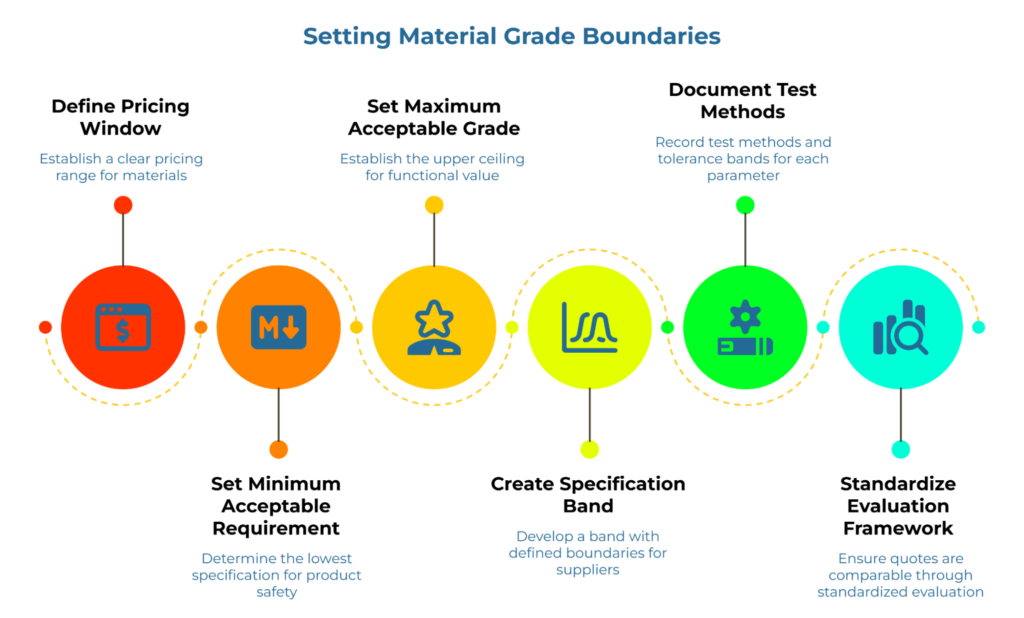
The most effective budget control move is defining a pricing window rather than a vague wish list. This means establishing both the floor and the ceiling for acceptable barrier performance.
Minimum acceptable requirement: This is the lowest specification that still protects product safety, quality, and intended shelf life. Going below this threshold creates real risk—product spoilage, customer complaints, or regulatory exposure. The minimum is non-negotiable.
Maximum acceptable grade: This is the upper ceiling beyond which you are paying for protection your product does not require. Going above this threshold does not harm the product, but it inflates cost without adding functional value. The maximum is where over-packaging begins.
When you name both boundaries explicitly, you create a specification band that suppliers can quote against consistently. That three-part structure—minimum, maximum, and validation method—narrows supplier interpretation and makes overspecification easier to spot during quote review.
For each barrier parameter, document the test method and tolerance band. If moisture resistance matters, specify the Cobb value range (per TAPPI T 441) rather than leaving “moisture resistant” undefined. If grease resistance matters, specify the Kit Level range (per TAPPI T 559) rather than accepting “greaseproof” as a sufficient description. Named test methods and tolerance bands are central to the standardized evaluation framework that makes quotes genuinely comparable. For a stronger tolerance-setting workflow, board grade tolerances explained: securing folding carton specifications across suppliers is the most relevant companion read.
Build a Budget Predictability Architecture Matrix
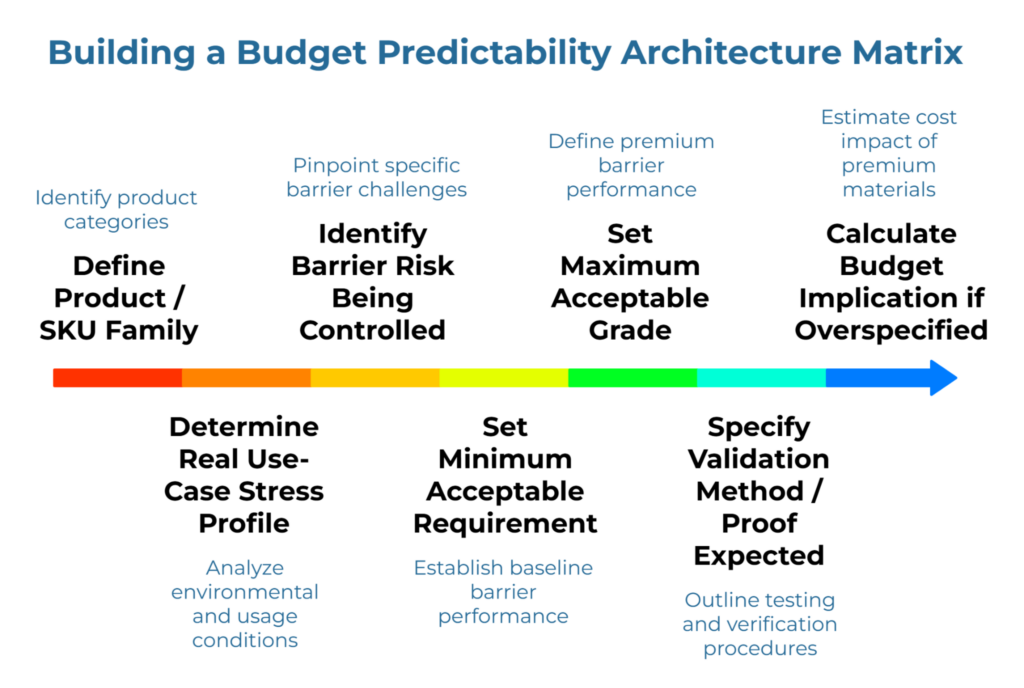
To operationalize everything above, consolidate your barrier decisions into a single reference matrix. This matrix becomes a decision tool you can use before requesting quotes and during quote review.
Recommended columns:
| Product / SKU Family | Real Use-Case Stress Profile | Barrier Risk Being Controlled | Minimum Acceptable Requirement | Maximum Acceptable Grade | Validation Method / Proof Expected | Budget Implication if Overspecified |
| Example: Dry snack bars | Ambient retail, 9-month shelf life, sealed inner pouch | Moisture ingress to outer carton (cosmetic, not product-critical) | Cobb60 ≤ 35 g/m² | Cobb60 ≤ 25 g/m² | Supplier COA citing TAPPI T 441 | Paying for barrier treatment that protects appearance only |
| Example: Fatty confectionery, direct contact | Ambient retail, 6-month shelf life, no inner wrap | Grease migration through board | Kit Level ≥ 8 | Kit Level ≥ 10 | Supplier test report per TAPPI T 559 | Premium coating cost for marginal grease-load difference |
Populate one row per SKU family. When you receive supplier quotes, use the matrix to verify that quoted materials fall within your defined band. If a supplier quotes above your maximum grade, you now have a documented basis for questioning whether that premium is necessary. If a supplier quotes below your minimum, you have a documented basis for rejecting the quote on safety grounds.
This is budget architecture in practice. It connects safety requirements to landed cost normalization before the pricing debate begins. It also gives finance-oriented buyers a cleaner way to explain why one specification belongs in the base requirement and another belongs in a controlled premium band. The matrix supports the kind of cross-SKU material standardization that prevents cost creep as your product portfolio expands.
How to Downgrade Specifications Safely Without Creating New Risk
The hidden fear behind cost optimization is cutting too far and creating a new problem. A safe downgrade does not start with “How much can be removed?” It starts with “What must stay fixed because it protects actual product performance?”
Keep the protection logic fixed where it clearly supports shelf life, safety, handling stability, or a validated quality requirement. Challenge the elements that are legacy, untested, or supplier-inherited. That includes premium language copied from older specifications, inherited coatings that no longer match the SKU, or broad phrases that let suppliers choose the most protective interpretation.
Questions to ask before lowering a barrier requirement:
- Is this barrier requirement protecting actual product performance, or is it protecting against a theoretical risk that has never materialized?
- Was this requirement validated against your current product formulation and current distribution conditions, or was it inherited from a different context?
- If you lower this spec, what is the failure mode, and how would you detect it before it reaches customers?
What evidence to request before changing a spec:
- Request historical quality data: has your current packaging ever failed in a way this barrier requirement would have prevented?
- Request a controlled trial: test the proposed lower-specification material under realistic conditions before committing to volume.
- Request updated compliance confirmation if your product requires food-contact packaging oversight.
Lower cost should never mean less defined. A cheaper specification that is loosely described creates more ambiguity, more quote variance, and more downstream risk. A downgraded specification still needs named test methods, tolerance bands, and validation protocols. The goal is a leaner spec, not an ambiguous one.
If supplier-led assumptions are shaping the specification more than buyer-owned logic, the truth decay of data sheets: why relying on supplier specifications ruins folding carton specifications is worth reviewing.
Common Mistakes That Quietly Inflate Packaging Budgets
Several patterns cause buyers to over-pay without realizing it.
Letting suppliers fill in technical blanks. When your RFQ lacks explicit barrier parameters, suppliers interpret requirements based on their own assumptions—or their own inventory. You may receive quotes for premium materials simply because your specification was silent and the supplier defaulted to a conservative interpretation. Defining these parameters prior to the RFQ prevents interpretative variance.
Confusing facility-level certificates with run-specific suitability. A supplier’s ISO certification or generic food-contact declaration confirms their quality system exists. It does not confirm that a specific folding carton run meets your specific barrier requirements. Relying on supplier data sheets without buyer-side verification is a common source of both over-specification and under-specification.
Treating higher-grade material as automatically safer. A heavier board weight or a more aggressive coating does not inherently protect your product better if your product does not face the stress that treatment addresses. Over-specifying is not cautious—it is expensive without being protective.
Failing to separate mandatory protection from premium preference. Some barrier requirements are non-negotiable because they protect safety, shelf life, or regulatory compliance. Others are preferences that crept into the specification without validation. Confusing the two inflates budgets while creating a false sense of security.
Keeping one overspecified standard across mismatched SKU families. A barrier specification that makes sense for your greasiest, most sensitive product may be overkill for your dry, shelf-stable items. Applying a single conservative specification across your entire portfolio is administratively simpler but financially wasteful.
A disciplined buyer avoids all five by using a Specification-True Mindset: map the risk, define the minimum, cap the maximum, and name the proof. That is the cleaner path to cost control. Not price haggling. Not guesswork. Better requirement design.
Financial stability in packaging stems from precise requirement definitions. When you map barrier requirements to product reality rather than inherited assumptions, you regain control over both cost and quality.Explore more guides on PaperIndex Academy to continue building your specification discipline, or find folding carton suppliers when you are ready to apply these principles.
Disclaimer
This article is educational and methodology-first. PaperIndex does not sell market intelligence or publish pricing indices. Any examples or cost scenarios are illustrative, not current market pricing.
Our Editorial Process:
Our expert team uses AI tools to help organize and structure our initial drafts. Every piece is then extensively rewritten, fact-checked, and enriched with first-hand insights and experiences by expert humans on our Insights Team to ensure accuracy and clarity.
About the PaperIndex Insights Team:
The PaperIndex Insights Team is our dedicated engine for synthesizing complex topics into clear, helpful guides. While our content is thoroughly reviewed for clarity and accuracy, it is for informational purposes and should not replace professional advice.