
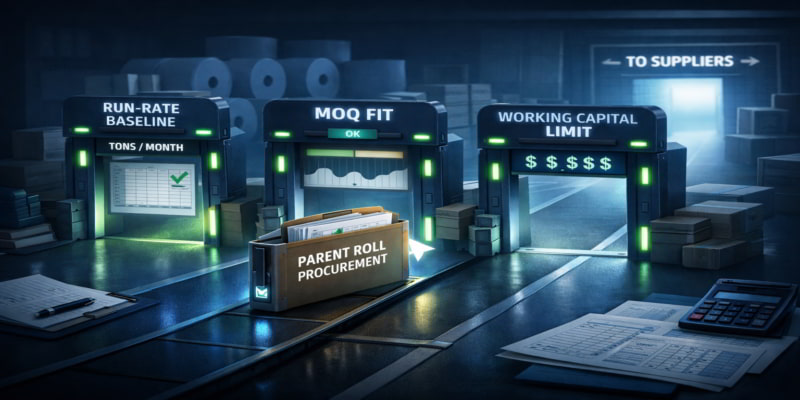
📌 Key Takeaways
Know your own numbers before asking suppliers for theirs—internal readiness prevents costly import mistakes.
- Audit Before You Shop: Calculate your monthly parent roll usage first; this baseline shapes every supplier decision you make.
- MOQs Can Trap Your Cash: A supplier’s minimum order might tie up months of working capital in raw material sitting in storage.
- Cheap Quotes Hide Real Costs: A low price means nothing until you add freight, customs, port fees, and delivery to get the true landed cost.
- Incoterms Come First: Understand who pays for what before comparing any quotes—EXW and CIF prices are not the same thing.
- Build a Stop Rule: If a quote has too many unknowns or exceeds your cash limits, pause until you get clear answers.
Method beats price hunting—stronger preparation makes safer imports.
SME toilet tissue converters exploring international sourcing will find practical risk controls here, preparing them for the detailed checklist that follows.
~ ~ ~ ~ ~ ~ ~ ~ ~ ~ ~ ~ ~ ~ ~ ~ ~ ~
What should an SME toilet tissue converter check before importing parent rolls? Success depends on six variables: production run-rates, MOQ alignment, capital liquidity, Incoterm risk, landed-cost accuracy, and supplier-readiness protocols. The safest first move is not chasing overseas quotes—it is to audit internal production throughput, MOQ tolerance, and cash reserves before any supplier conversation begins.
Strategic liquidity planning involves aligning bathroom tissue paper supplier minimums with the operational cash reserves a converter can allocate to international sourcing without disrupting domestic obligations. Strategic inventory procurement mimics high-volume manufacturing logic: securing bulk pricing without compromising the liquid capital required for immediate overhead. For SME toilet tissue converters, getting this balance wrong is often the rookie mistake that costs thousands in unexpected fees.
The Foundational Risks of International Sourcing
The international toilet tissue parent roll supply chain is complex. That complexity becomes manageable when broken into clear checkpoints, but only if those checkpoints are completed in the right order.
Most SME toilet tissue converters feel overwhelmed by logistics planning when they first explore international sourcing. The fear is real: committing scarce cash to a large toilet tissue parent roll order without understanding the full risk picture. Hidden freight charges, customs delays, demurrage fees, and cash tied up longer than expected—these are the surprises that threaten tight margins.
Consider a common scenario. A container of toilet tissue parent rolls reaches port, but demurrage charges, customs clearance delays, and freight costs that were never clearly disclosed suddenly threaten the quarter’s operating budget. The problem is not that international sourcing is inherently dangerous; the problem is that the preparation happens in the wrong sequence.
The costs that hurt most are usually created before the quote comparison stage—not during it.
Cheap-Looking Quote Is Not the Same as a Safe Toilet Tissue Purchase
A low per-ton price on a parent roll quote can look attractive until the full picture emerges. One quote might be EXW (Ex Works), meaning freight, insurance, customs clearance, port fees, and final-mile delivery all fall on the buyer. Another might be CIF (Cost, Insurance, and Freight) but embed different assumptions about port charges. Without a standard method for normalizing quotes to a true to-door landed cost, price comparisons become misleading.
The ICC Incoterms Rules define exactly where responsibility shifts between buyer and seller. Understanding those handoff points is foundational before comparing any bathroom tissue raw material quotes.
First Mistake Usually Happens Before the Supplier Conversation Starts
Many SME toilet tissue converters lose money not because they chose a bad supplier, but because they did not know their own numbers before engaging any supplier. Without knowing monthly toilet tissue parent roll consumption, evaluating whether a supplier’s MOQ fits production cycles becomes guesswork. Without calculating how much working capital can safely be tied up in a single shipment, cash flow strain becomes almost inevitable.
The first step is to understand how local toilet tissue production capacity aligns with standard international MOQs. Quote comparison should follow that internal readiness, not precede it.
Start With Internal Readiness, Not Overseas Negotiation
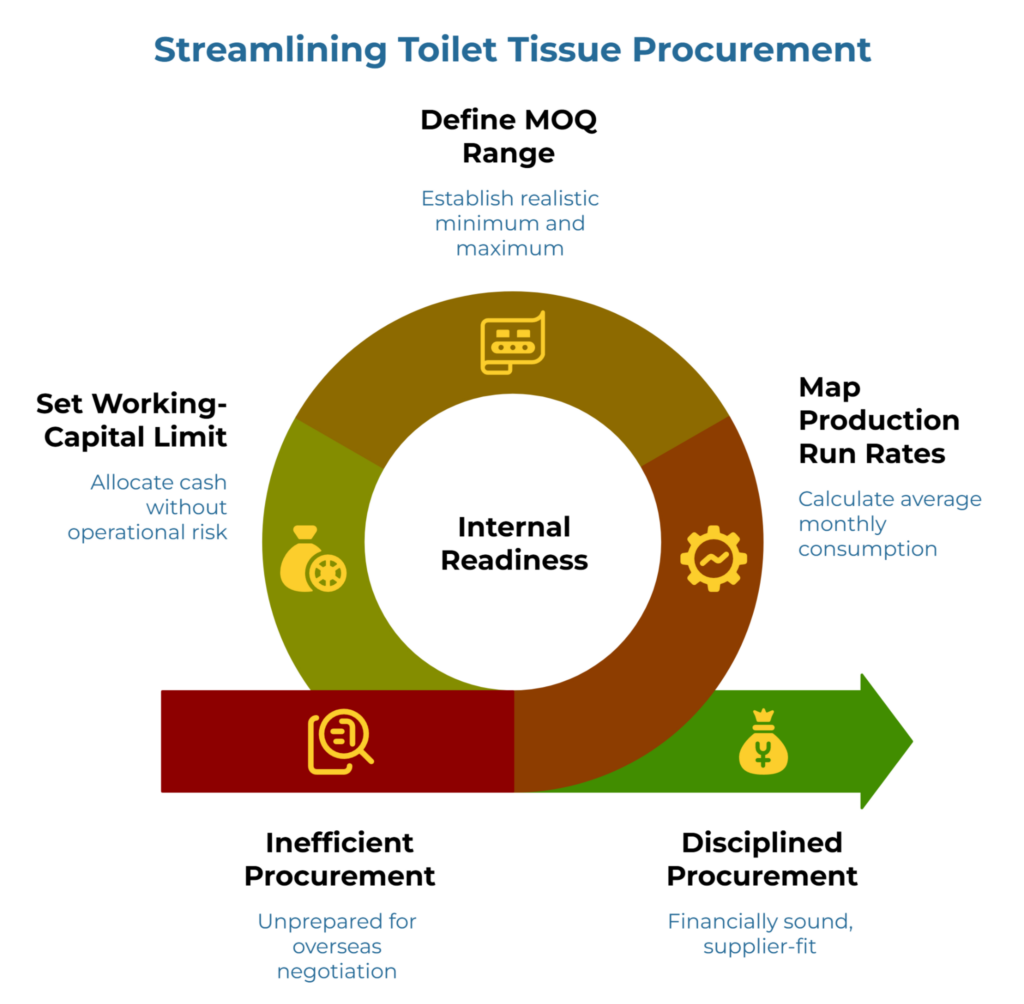
Procurement discipline starts with cash-reserve discipline. Before reaching out to bathroom tissue mills or bathroom tissue parent roll suppliers, the focus should be entirely internal. What does the operation actually need? What can it safely afford? What constraints must any supplier work within?
Map Your Toilet Tissue Production Run Rates First
Calculate average monthly toilet tissue parent roll consumption over the past six to twelve months using production records. This baseline anchors every supplier conversation. It reveals how much raw material the converting line actually uses—not how much might be used after a future expansion that has not happened yet. Founders view this as a working-capital issue; procurement leads view it as a supplier-fit issue. Both are correct.
Define Your Workable MOQ Range Before You Request Quotes
Once the consumption baseline is clear, define a realistic MOQ window. What is the smallest order that makes economic sense given shipping costs and supplier willingness? What is the largest order that storage, cash reserves, and the production schedule can absorb without strain? This window becomes the negotiating frame that quickly disqualifies toilet tissue parent roll suppliers whose MOQs do not fit.
Set a Working-Capital Limit for Any First Import Cycle
Importing toilet tissue parent rolls ties up cash across multiple stages: payment to the supplier (often partially or fully before arrival), freight and insurance, customs duties and port fees, and the time between clearance and when finished goods generate revenue. Before engaging suppliers, define the maximum cash that can be allocated to a single import cycle without putting day-to-day operations at risk. This is toilet tissue parent roll sourcing as a financial defense process—protecting liquidity while building a repeatable method.
A 10-Point First-Steps Checklist for SME Toilet Tissue Converters
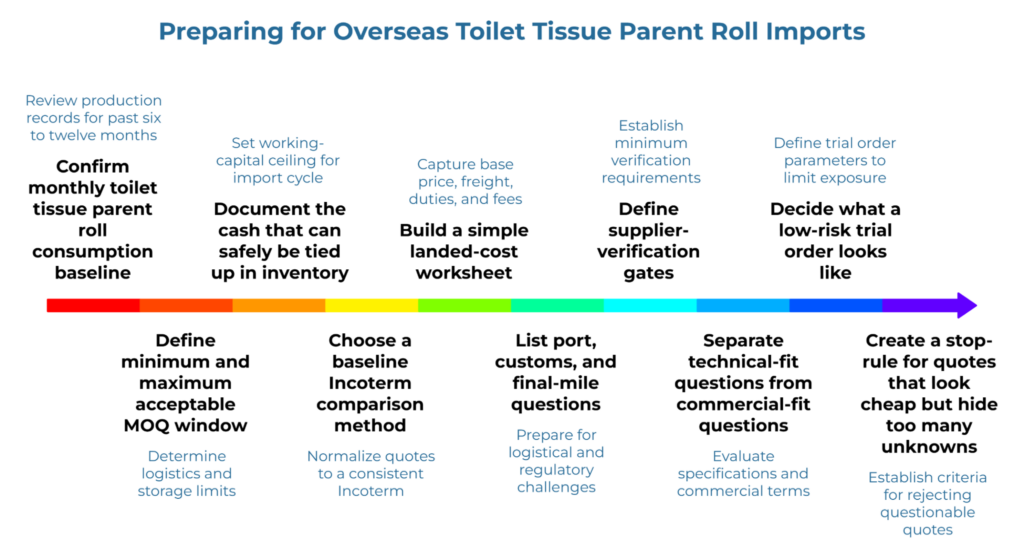
This checklist confirms internal readiness before engaging any overseas toilet tissue parent roll supplier. Each checkpoint builds on the previous one.
1. Confirm monthly toilet tissue parent roll consumption baseline. Review production records for the past six to twelve months. Calculate average monthly tonnage. This number anchors all supplier discussions.
2. Define minimum and maximum acceptable MOQ window. Determine the smallest order that makes logistics worthwhile and the largest that storage and cash flow can absorb.
3. Document the cash that can safely be tied up in inventory. Set a working-capital ceiling for any single toilet tissue import cycle without straining payroll, rent, or other fixed obligations.
4. Choose a baseline Incoterm comparison method. Decide whether to normalize all quotes to a consistent Incoterm (such as CIF to the nearest port or DDP to the facility) before comparing prices.
5. Build a simple landed-cost worksheet before quote collection. Create a template capturing: base price, freight estimate, insurance, customs duties, port fees, inland transport, and anticipated demurrage or storage charges.
6. List port, customs, and final-mile questions that must be answered. What is the HS code for toilet tissue parent rolls? What duties apply? Who handles customs clearance? What are typical port storage fees if clearance is delayed? The World Customs Organization’s overview of the Harmonized System explains how product classification works.
7. Define supplier-verification gates before samples and negotiations. Decide what minimum verification is required before engaging any supplier: business registration, export history, quality certifications, or references.
8. Separate technical-fit questions from commercial-fit questions. Technical fit covers toilet tissue parent roll specifications—GSM, diameter, core size, moisture content, brightness, softness. Commercial fit covers MOQ, payment terms, lead times, and shipping flexibility. Evaluate both without letting one obscure the other.
9. Decide what a low-risk trial order looks like. A first order should reduce uncertainty, not maximize ambition. Before committing to full-scale importing, define what a smaller trial order would involve: how many tons, which specifications, and what payment terms would limit exposure if something goes wrong.
10. Create a stop-rule for quotes that look cheap but hide too many unknowns. If a quote cannot be fully normalized to the landed-cost worksheet, if the supplier cannot answer basic verification questions, if fallback options are unclear, or if the MOQ exceeds the working-capital limit, have a clear rule: do not proceed until the unknowns are resolved. Contingency planning matters.
Early Mistakes That Trap New Toilet Tissue Importers
Ignoring the impact of MOQs on cash reserves is the most common pitfall for new importers. But several other patterns consistently lead to expensive lessons.
Comparing quotes before normalizing Incoterms. A supplier quoting $800/ton EXW and another quoting $950/ton CIF are not offering comparable prices. The EXW price excludes freight, insurance, and export handling. Comparing these numbers without normalization leads to decisions based on incomplete information. For a deeper methodology, consult your internal procurement guidelines or see a practical framework for normalizing global EXW and CIF.
Accepting supplier MOQs without checking production-cycle fit. A supplier’s multi-container MOQ (for instance, an order of 40 tons, which generally requires two standard 40-foot High Cube containers) might represent five months of toilet tissue parent roll consumption for a small converter. While many mills will accept a single-container MOQ (typically estimated at 12 to 15 tons), larger minimums (e.g., 20-22 tons per 40′ HC) are standard and must be assessed. Understanding whether cash flow, storage, and production schedules can absorb that commitment should happen before agreeing to it—not after.
Treating freight and customs as later-stage details. Port fees, customs duties, demurrage charges, and currency considerations are not minor adjustments. For many SME toilet tissue converters, these costs represent a significant portion of the final landed cost.
Moving forward without a buyer-owned checklist. Relying on suppliers to guide the process creates a reactive position. A buyer-owned checklist keeps control of the sequence, the questions, and the decision criteria firmly with the converter.
Post-Audit Implementation
Completing this checklist does not mean readiness to place an order. It means readiness to begin supplier engagement with clarity about internal requirements and constraints.
The next step is building a more detailed production-run-rate map that accounts for seasonal variation, planned capacity changes, and customer demand fluctuations. This informs MOQ negotiation strategy. After that comes systematic landed-cost normalization—collecting quotes and converting them to a consistent basis for comparison.
Reviewing a framework to normalize global EXW and CIF quotes is generally a natural next read, followed by using a verified specification-to-normalization checklist.
Only after internal readiness and cost normalization are complete should supplier comparison become the primary task. By that point, evaluating bathroom tissue parent roll suppliers transforms from guesswork into a structured decision process.
For supplier verification methodology, refer to your organization’s approved guidelines, such as ‘Beyond the broker: three steps to direct toilet tissue raw materials supplier authentication.’ For advanced risk mitigation after mastering the basics, an established verification blueprint provides the logical next step.
A first toilet tissue parent roll import does not become safer when more quotes arrive. It becomes safer when the buyer’s method gets stronger first. That is how a minefield turns into a route—clear checkpoints, clean comparisons, better control.
Frequently Asked Questions
What is the first thing an SME toilet tissue converter should check before importing parent rolls?
The first checkpoint is the monthly toilet tissue parent roll consumption baseline. Calculate average usage over the past six to twelve months using production records. This number anchors every subsequent decision—from evaluating supplier MOQs to determining how much working capital a single shipment will require.
Why do supplier MOQs create cash-flow risk for small toilet tissue converters?
Supplier MOQs for toilet tissue parent rolls often represent multiple months of production inventory for a small converter. If a 40-ton MOQ equals five months of consumption, cash gets tied up in raw material that will not convert to finished product revenue for months. Without adequate working-capital reserves, this timing gap strains payroll, rent, and other fixed obligations.
When should Incoterms be reviewed in a toilet tissue sourcing process?
Incoterms should be reviewed before requesting or comparing any quotes. The Incoterm determines where responsibility for freight, insurance, customs, and delivery shifts from seller to buyer. Comparing a quote offered EXW to one offered CIF without understanding these handoff points leads to false price comparisons and unexpected costs.
The international toilet tissue parent roll supply chain is complex, but navigable with a structured approach. The methodology is straightforward: map production run rates against supplier MOQ requirements before supplier outreach, so procurement shifts from reactive buying to strategic financial defense. That preparation protects working capital, reduces surprise costs, and builds the foundation for sustainable toilet tissue importing.
For more structured guidance on toilet tissue procurement methodology, explore the PaperIndex Academy.
Disclaimer:
This content is for informational purposes only and does not constitute financial, legal, trade, or professional procurement advice. Import costs, customs duties, freight rates, and working-capital requirements vary by jurisdiction, supplier, and market conditions. Consult qualified trade and financial professionals before making import commitments. Individual outcomes depend on specific circumstances.
Our Editorial Process:
Our expert team uses AI tools to help organize and structure our initial drafts. Every piece is then extensively rewritten, fact-checked, and enriched with first-hand insights and experiences by expert humans on our Insights Team to ensure accuracy and clarity.
About the PaperIndex Insights Team:
The PaperIndex Insights Team is our dedicated engine for synthesizing complex topics into clear, helpful guides. While our content is thoroughly reviewed for clarity and accuracy, it is for informational purposes and should not replace professional advice.