

📌 Key Takeaways
Picking on press calls for structured evidence, not a snap decision to switch paper.
- Evidence Before Action: Document the symptom, paper identity, ink conditions, and press setup before changing stock, because skipping steps hides the real cause.
- Picking Isn’t Proof: A surface defect on press can point toward paper surface strength, but ink tack, blanket condition, and press settings all play a role.
- Test Numbers Need Context: Wax pick and IGT results use different methods and units, so never compare them directly or treat either as a universal pass/fail threshold.
- One Change at a Time: Swapping paper, ink, and blanket together may fix the symptom but tells the team nothing about which variable actually mattered.
- Specifications Beat Memory: Converting trial results into a documented approval rule with re-evaluation triggers makes the next paper decision repeatable instead of starting from scratch.
Same evidence, every time — that’s what turns a fix into a standard.
Production, quality, and procurement teams evaluating offset paper will find a ready-to-use investigation framework in the detailed method below.
~ ~ ~ ~ ~ ~ ~ ~ ~ ~ ~ ~ ~ ~ ~ ~ ~ ~
When picking appears on a sheetfed offset press, the paper’s surface strength becomes an immediate question—but not an immediate answer. Fragments of the sheet surface lift away during printing and transfer to the blanket or appear as defects in the printed image. Finding the root cause requires evidence.
Before rejecting a stock or changing the grade, the team needs evidence connecting surface strength to the problem, confirmation that the test data applies to the offset printing paper that ran, and an open view of other variables. This method covers evidence capture, test-data interpretation, controlled comparison, and specification writing.
Surface Strength Is a Risk Variable, Not a Picking Verdict
Surface strength belongs in the evaluation whenever picking is observed or a new offset paper is being assessed. It describes the surface’s ability to resist forces during ink transfer—a property that directly affects whether the surface stays intact under press conditions.
A picking symptom on press does not prove that the paper’s surface strength is insufficient. Ink behavior, blanket condition, press settings, and job-specific demands all interact with the paper surface. A single observation can point toward surface strength as a factor worth investigating, but it cannot establish it as the confirmed cause.
Three stages keep the investigation useful:
- Observation: What physically happened on press, where, and how consistently?
- Hypothesis: Could the paper’s surface behavior be contributing?
- Evidence-supported decision: Does the combined material, test, and production evidence justify proceeding, holding the stock, running another comparison, or revising the specification?
Teams that skip from observation to decision often change stock without learning what drove the defect. The useful question is: how strong is the evidence that this paper or lot presents a surface-strength risk under these specific job conditions?
This distinction aligns production, quality, and procurement around the same evidence. Other runnability concerns—static, sheet separation, squareness, dimensional variation, edge condition—fall outside this evaluation.
What Surface Strength Needs to Withstand During Offset Printing
Paper surface strength refers to the resistance of a paper’s surface to disruption under an applied force. In sheetfed offset, that force comes from the ink film during transfer and separation between blanket and sheet. When the ink’s adhesive pull exceeds the bonding strength of the surface layer—coating, surface treatment, or fiber network—material detaches. Those fragments are the physical basis of picking, producing image defects, blanket deposits, or both.
Several factors influence how much stress printing places on the surface: ink tack and rheology, separation speed, blanket condition and compliance, and the demands of the image being printed. A high-coverage area with a tacky ink on a fast press presents a different challenge than a light-coverage job with a lower-tack formulation. In offset lithography, it is also vital to distinguish between dry pick (caused purely by ink tack) and wet pick (where the fountain solution weakens the paper’s surface strength before ink transfer). Environmental factors, particularly pressroom temperature and humidity, can also drastically alter ink tack and sheet moisture on the fly. Surface strength is the paper’s side of that interaction, and it should not be evaluated in isolation from the conditions that stress it.
Surface strength should not be confused with basis weight, thickness, or a ‘premium quality’ label. Two papers at the same g/m² can differ significantly in surface behavior depending on fiber bonding, coating formulation, surface treatment, or manufacturing process.
What a Picking Symptom Can—and Cannot—Tell You

Before assigning a cause, document the observation. Record where the defect appeared—image area, edge, specific color unit—whether it recurs, moves, or is intermittent, the affected sheet side, and the paper’s grade, lot, and sample identity. To quickly isolate whether a defect is tied to a specific sheet area or press mechanics, rotating the stock 180 degrees (if grain direction permits) can reveal whether the picking symptom moves with the paper or stays with the press unit.
Check whether the problem correlates with specific ink conditions: high-tack inks, heavy coverage areas, or particular positions in the color sequence. If deposits appear on the blanket, note their character—fibrous fragments, coating particles, or fine dust. That distinction matters because not every loose-particle problem is picking.
Linting and dusting involve loose fibers or fine particles already poorly bonded or present as surface debris before printing. Picking involves material torn from the surface during printing. Grouping all three under one label can lead a team to investigate the wrong property or request the wrong test data.
Record what is suspected, identify what evidence would strengthen the hypothesis, and note what remains unresolved before acting on the symptom.
Build the Evidence Before You Change the Paper
The evaluation matrix below converts the investigation into a structured record.
| Evaluation Field | What the Team Should Capture | Why It Matters |
| Observed symptom | What detached, where it appeared, affected sheet side, image area, recurrence pattern | Separates observation from assumed cause |
| Paper identity | Grade, supplier or mill source if known, sample or lot identifier, side | Keeps evidence tied to the actual material |
| Job context | Ink coverage, color sequence, demanding image areas, relevant production conditions | Provides application context for the symptom |
| Press and ink condition snapshot | Only variables relevant to the investigation and available to the team | Prevents paper-only assumptions |
| Surface-strength evidence | Test method, reported result, source of data, sample identity | Makes technical data interpretable |
| Comparison baseline | Known-good paper, prior approved lot, or controlled reference | Gives the result a practical frame |
| Trial outcome | What changed and what did not during any controlled comparison | Supports a controlled conclusion |
| Alternative causes still open | Ink, blanket, setup, handling, or other unresolved variables | Prevents false certainty |
| Decision status | Proceed, conditional trial, hold for review, or revise specification | Converts evidence into action |
| Next action and owner | Production, quality, procurement, or supplier follow-up | Prevents the investigation from stalling |
Work through these fields before changing the paper. If the team replaces stock, adjusts ink, swaps the blanket, and modifies press speed in one intervention, the trial produces a different result but little usable evidence about which variable mattered. Change as few variables as practical and document what stayed the same. This framework works without in-house laboratory equipment; the point is structured evidence capture.
To illustrate: in a hypothetical scenario, a candidate stock and a known-good reference run under closely comparable conditions, and picking appears consistently with the candidate but not the reference. That strengthens the case for investigating the candidate’s surface characteristics—but it should not be treated as absolute proof of one cause without further evidence. In a different hypothetical situation, both the suspect paper and a previously satisfactory stock begin picking after a significant press condition changes. The investigation should then broaden rather than focus solely on the new paper.
Use Surface-Strength Tests and Production Trials Without Inventing Universal Limits
Two recognized standard methods address paper surface strength and resistance to picking.
TAPPI/ANSI T 459 is an official wax pick test used to evaluate this specific property. A supplier reporting a wax-pick value is likely referencing this method or a closely related procedure.
ISO 3783 covers the determination of resistance to picking using an accelerated-speed IGT-type tester.
These are different methods with different test principles, equipment, and reporting conventions. A wax-pick number and an IGT result should not be treated as interchangeable unless a verified technical basis supports the comparison. When an offset paper supplier provides a surface-strength value, the first question is which method produced it—and whether the tested sample represents the material actually being offered.
When reviewing supplier or laboratory data, the team should confirm:
- What method produced the reported result?
- What units or reporting basis does that method use?
- How should the result be interpreted within that method?
- Which grade, sample, source, or lot was tested?
- Is the tested material representative of the stock now being evaluated?
- What production evidence shows that the result is relevant to the intended work?
A laboratory or supplier test result describes surface behavior under that test’s conditions, not performance on a particular press, ink, or job. Production evidence from a controlled comparison against a known-good reference adds the application context a lab value alone cannot supply.
No universal surface-strength number separates ‘acceptable’ from ‘unacceptable’ across all sheetfed offset applications. A successful production trial can inform an internal acceptance criterion but does not establish an industry-wide threshold. Setting tolerances before a production trial positions the team to interpret results against a defined standard rather than an ad hoc judgment.
Turn the Result Into a Better Paper Specification and Approval Rule
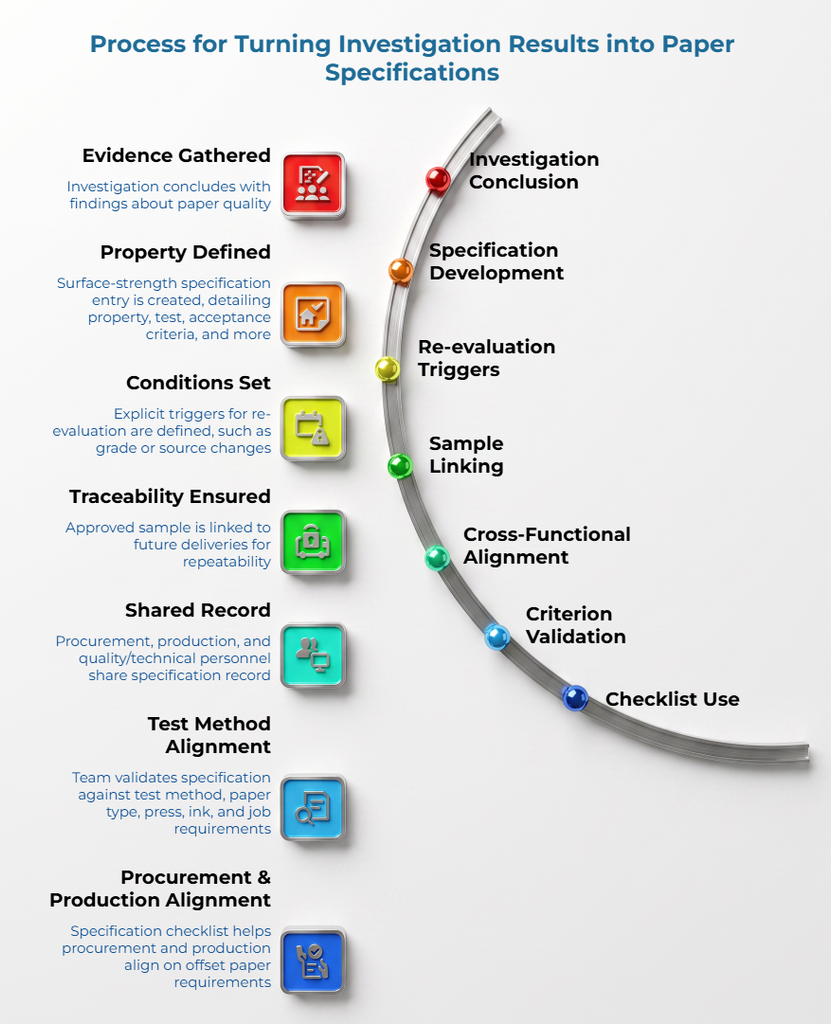
An investigation that ends with ‘this lot was fine’ or ‘we switched suppliers’ is a one-time outcome. Converting evidence into a documented specification makes the decision repeatable.
A surface-strength specification entry should capture the property being controlled, the test method, which side or configuration is relevant, the evidence source, the buyer-owned acceptance criterion, the production-trial conditions used for approval, any known-good reference, the sample-to-grade-to-source linkage, the conditions that trigger re-evaluation, and the decision owner.
Make re-evaluation triggers explicit. A change in grade, source, configuration, test evidence, or another approval-relevant condition should prompt review rather than automatic continuation of a previous approval.
Pay particular attention to linking the approved sample to future deliveries. A successful trial loses repeatability value if future lots cannot be tied back to the approved grade, source, and evidence.
Procurement communicates the requirement, production recognizes the approved context, and quality or technical personnel review the evidence behind the criterion. A shared record keeps all three functions aligned. The team must validate its own criterion against the chosen test method, paper type, press, ink, and job requirements. Surface strength is one property among several that affect press performance; understanding which paper specifications matter on press prevents over-indexing on one parameter.
When procurement and production need shared criteria, a specification checklist helps both teams align procurement and production on an offset paper specification.
Frequently Asked Questions
Does picking always mean the paper’s surface strength is too low?
Review material identity, test evidence, ink and press context, and controlled comparison results before reaching a conclusion.
Is a wax pick test enough to approve offset paper?
A wax pick test is one recognized method, not a universal press-performance guarantee. Confirm the tested sample’s material identity and the result’s relevance to the actual job, and consider production-trial evidence alongside laboratory data.
Can surface-strength values from different test methods be compared directly?
Do not assume so. Confirm the method, units, and interpretation before comparing values across suppliers or reports.
What should a production team record when picking appears?
Capture the paper grade, lot, and sample identity; the affected side; the exact symptom and location; relevant job and press conditions; available surface-strength evidence; a known-good comparison if available; unresolved alternative causes; and the next action with a named owner.
Should every printer use the same surface-strength acceptance value?
No. Validate criteria against the chosen test method, paper, press, ink, job requirements, and production-trial evidence.
From Symptom to Specification
The structured path from picking symptoms to documented specification follows a consistent sequence. Record the symptom, confirm the test method and material identity, compare candidate stock against a known-good reference under production conditions, and translate the finding into a documented, repeatable approval rule that captures method, evidence, and re-evaluation triggers.
Before approving a new stock, document the picking symptom, paper identity, surface-strength evidence, comparison baseline, relevant production conditions, and the acceptance decision in a single shared record. Once the requirement and evaluation method are documented, compare candidate offset paper exporters or suppliers against the same evidence questions rather than changing the criteria from one offer to the next.
Disclaimer:
This article provides general educational guidance about paper surface-strength evaluation and picking risk in sheetfed offset printing. Test methods, acceptance criteria, press conditions, and material-approval decisions depend on the specific paper, ink, equipment, job, testing method, and internal quality procedures. Confirm final requirements with the appropriate production, quality, technical, and supplier teams before approving material.
Our Editorial Process:
Our expert team uses AI tools to help organize and structure our initial drafts. Every piece is then extensively rewritten, fact-checked, and enriched with first-hand insights and experiences by expert humans on our Insights Team to ensure accuracy and clarity.
About the PaperIndex Insights Team:
The PaperIndex Insights Team is our dedicated engine for synthesizing complex topics into clear, helpful guides. While our content is thoroughly reviewed for clarity and accuracy, it is for informational purposes and should not replace professional advice.