

📌 Key Takeaways
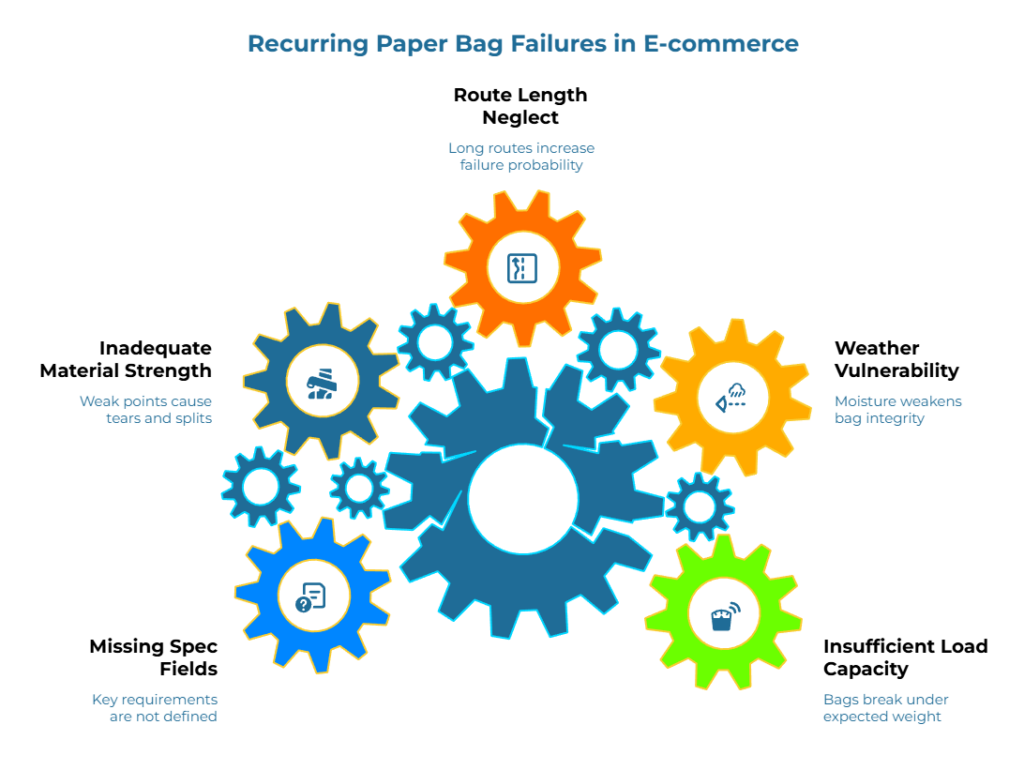
Most paper bag failures trace to five predictable specification gaps, not to bad suppliers or careless staff.
- Static Weight Misses Delivery Stress: Bags need safety factors and reinforcement specs to survive swinging loads and long carry distances.
- Moisture and Grease Go Unaddressed: Without Cobb values and coating requirements, rain and condensation soften bases mid-delivery.
- Handles Are Load Paths, Not Style: Attachment method, reinforcement patches, and carry distance must drive handle specs to prevent detachment.
- External Dimensions Invite Overfilling: Internal dimensions, headspace rules, and fill lines prevent staff from guessing what fits safely.
- “Looks Fine” Isn’t Control: Measurable tolerances, sampling plans, and golden samples catch drift before production batches fail.
Diagnosis beats blame—spec gaps create failures, not bad luck.
Procurement and operations teams managing e-commerce and delivery packaging will gain a diagnostic framework here, preparing them for the detailed specification upgrade guidance that follows.
Paper bag specifications & use-case matching is the process of defining and aligning paper bag characteristics—dimensions, paper grade, ply, GSM, handles, coatings/laminations, print, and strength—with specific e-commerce and delivery use cases. It’s like choosing the right shoes for different activities—you wouldn’t wear the same pair for hiking, a formal event, and running a marathon. In practice, operations and marketing work together to define a small set of bag ‘families’ that cover most product types and delivery scenarios, avoiding constant one-off designs. The objective is to convert qualitative requirements into technical specifications, streamlining procurement cycles and establishing objective benchmarks for QC.
The photo lands in the operations inbox: a torn bag, spilled contents, an angry customer review already posted. Within the same week, three more complaints follow the same pattern. The procurement team points at the supplier. Operations blame the packing line. Marketing insists the design was approved months ago.
Sound familiar? This cycle of blame rarely leads anywhere productive. The real cause is usually hiding in plain sight—not in a “bad” supplier or careless staff, but in the specification sheet itself.
Most paper bag failures in delivery are predictable. They trace back to gaps between what the spec assumed and what actually happens when a rider walks 200 metres in the rain, or when a customer lifts a bag by one handle while juggling keys. Smart wholesale paper bag sourcing is a discipline of specs, risk, and total landed cost—not a race to the lowest per-bag price. Understanding where specs commonly fall short is the first step toward fewer failures and more productive conversations with suppliers.
The Pattern: Failures Start with Specs, Not Bad Luck
When bags tear, handles snap, or bases go soft, teams typically respond in one of two ways. Some blame the supplier and start shopping for a replacement. Others over-specify blindly—demanding heavier paper or thicker handles without diagnosing the actual problem. Neither approach reliably prevents repeats, and the second often inflates costs without addressing root causes.
A more effective path is diagnosis. Most delivery bag failures cluster around five specification gaps. When raw material quality proves inconsistent, connecting with verified kraft paper suppliers who can demonstrate batch-to-batch consistency becomes essential. Each gap reflects a mismatch between what the original spec assumed and what the bag actually encounters in real-world use. Addressing these gaps produces clearer RFQs for buyers and fewer rework cycles for suppliers—a benefit for both sides of the transaction.
Gap #1: Load Specified as Static Weight, Not Delivery Stress
How It Shows Up
A bag rated for “up to 3 kg” tears when a delivery rider walks a long distance with a swinging load. Two items shift mid-transit and concentrate force on a single seam. The spec assumed a static, evenly distributed weight; the real world delivered dynamic stress, swinging momentum, and uneven distribution.
What Was Missing
Weight capacity alone does not capture swinging loads, stacking pressure, long carry distances, or uneven weight distribution. A bag rated for 3 kg might fail at 2.5 kg under real delivery conditions if the spec never accounted for these forces.
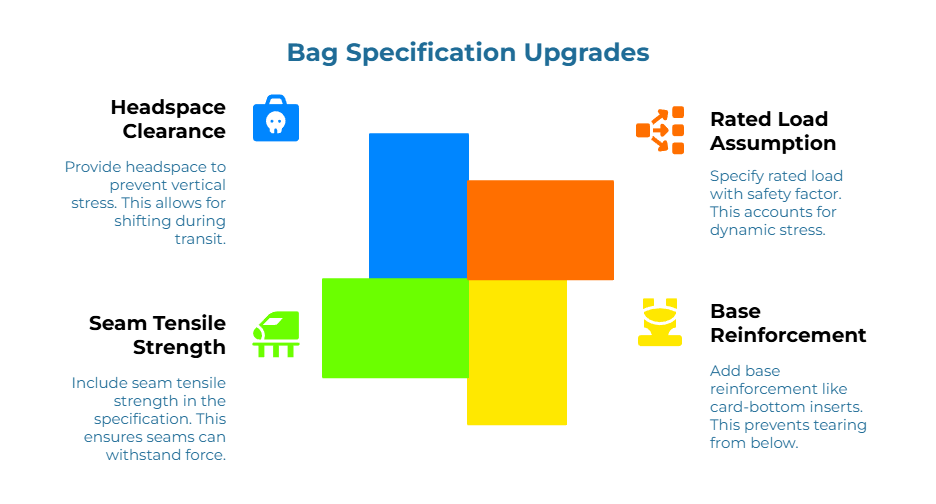
Spec Upgrades
Consider adding the following fields to the specification sheet:
- Rated load assumption with explicit safety factor (illustrative example: “designed for 3 kg with 1.5× margin”)
- Base reinforcement (e.g., card-bottom inserts)
- Seam tensile strength (N/15mm)
- Headspace clearance (minimum 50mm) to prevent vertical stress
How to Verify
Request samples and conduct a simple carry test: load the bag to typical order weight, walk 150–200 metres with a natural swinging motion, then inspect seams and base for signs of stress. This low-cost test often reveals weaknesses that static warehouse checks miss.
Gap #2: Moisture, Grease, and Temperature Exposure Unspecified
How It Shows Up
A bag that performed well in warehouse testing fails after 15 minutes of light rain during delivery. Hot food containers create condensation inside, softening the base. Grease from food packaging migrates through uncoated paper and weakens structural layers.
What Was Missing
The spec never defined expected moisture, grease, or temperature exposure. Water absorptiveness is a measurable property—industry standards such as the Cobb method (ISO 535 or TAPPI T 441) provide a standardised way to specify and test water pickup. For detailed guidance on specifying COBB values for different shipping routes and weather conditions, see our guide on how to specify COBB values for dry arrival of paper shipments. Without these requirements, the paper may default to a standard internal sizing which offers minimal moisture resistance, often resulting in high Cobb values (>30–40 g/m²) that cannot withstand rain exposure, leaving the base vulnerable.
Spec Upgrades
- Water absorptiveness requirement (referencing Cobb test values where moisture resistance matters)
- Lining or coating callouts for grease resistance
- Adhesive performance expectation under wet or hot conditions
- Storage and conditioning notes (humidity, temperature during storage)
How to Verify
Ask suppliers for Cobb test results if moisture resistance matters for the use case. For food delivery, conduct a simple wet-base test: place a damp cloth under a loaded bag for 10 minutes and inspect for softening or delamination. Additionally, ensure any coating meets applicable food-grade certification standards for delivery packaging bags such as FDA 21 CFR 176.170/180 or EU Regulation 1935/2004.
Gap #3: Handles Treated as Style Choice, Not Load Path
How It Shows Up
Handles tear through the paper or detach at the glue point while the bag body remains intact. Customers over-grip uncomfortable handles, accelerating failure. The handle looked elegant in the design mockup but was never engineered for the actual load and carry distance.
What Was Missing
Handle design was chosen for aesthetics without specifying attachment strength, reinforcement patch requirements, or expected carry distance. A twisted paper handle might suit a boutique gift bag but fail on a 400-metre delivery walk with a heavy order.
Spec Upgrades
- Handle type and material (flat, twisted, die-cut, reinforced)
- Reinforcement patch requirement and minimum size
- Attachment method and strength expectation
- Handle placement and tolerance
- Expected carry distance as a design driver
How to Verify
Conduct a handle pull test on samples: load the bag to capacity, lift by handles, and sustain for 30 seconds. Inspect attachment points and paper around handles for stress marks. For a deeper discussion of how handle failure relates to overall bag construction, see diagnosing packaging failures: why paper bags tear during delivery.
Gap #4: Dimensions and Fill Behaviour Guessed
How It Shows Up
Packing staff overstuff bags because external dimensions appeared “big enough.” Sharp corners poke through thin walls. Mixed orders create bulky, uneven loads that stress seams. Bags tip during transit because the base is too narrow relative to the height.
What Was Missing
External dimensions do not tell packing staff how to fill the bag safely. Without internal dimension guidance, gusset sizing rationale, or headspace rules, teams guess—and guesses drive failures.
For retailers navigating kraft paper selection decisions, our guide to kraft paper grades for paper bags maps five common retail use cases to specific kraft grade bands, helping match material strength to actual load requirements.
Spec Upgrades
- Internal dimensions (usable space, not external footprint)
- Gusset and base size rationale linked to product types
- Headspace rules (minimum clearance above contents)
- Maximum fill line guidance for packing staff
How to Verify
Pack sample bags with the actual product mix—including the bulkiest and most awkward items—and simulate delivery handling. If staff have to force items in or bags bulge excessively, the dimensions need revision.
Gap #5: No Acceptance Criteria, Tolerances, or Testing Plan
How It Shows Up
The samples looked fine. The first bulk order performed adequately. By the third shipment, failure rates spike. Variations crept in—thinner paper, weaker adhesive, inconsistent handles—but no one caught them because there were no defined acceptance criteria.
What Was Missing
Without measurable acceptance criteria—referencing standard test methods such as ISO 536 for grammage and ISO 2758 for bursting strength—there is no way to catch drift between batches. “Looks fine” is not a quality standard, and “same as sample” is not controlled.
When selecting kraft paper grades for bag production, understanding the trade-offs between virgin vs. recycled kraft paper is essential, as each grade performs differently under load and moisture conditions.
Spec Upgrades
- Measurable criteria (GSM with tolerance, burst factor range)
- Defect definitions (what counts as rejectable)
- Sampling frequency and inspection protocol
- Version control for artwork and structural changes
How to Verify
Request Certificates of Analysis (COAs) documenting ISO 2759 (Board) or ISO 2758 (Paper) burst tests. (Note: ISO 2759 is generally reserved for corrugated board and may be inapplicable to standard e-commerce paper bags). Retain a ‘golden sample’ from the approved batch. Note: Material performance is non-linear; empirical stress testing suggests that a 10% reduction in basis weight (GSM) can lead to a disproportionate and significant drop in dynamic load capacity (often exceeding 20%), particularly at the fold lines and gussets. For critical applications, consider third-party testing against specified tolerances. For a deeper explanation of how GSM and burst factor interact, see paper bag raw material grades: gsm and burst factor explained.
Quick-Reference: Failure Symptoms and Probable Gaps
Use this table when investigating a bag failure to quickly identify which specification area likely needs attention:
| Failure Symptom | Likely Gap(s) | Priority Spec Update | First RFQ Upgrade to Trial |
| Base splits under load | Load stress (#1) | Add safety factor, base reinforcement | Define load case + base reinforcement expectation |
| Soggy or soft base | Moisture exposure (#2) | Specify Cobb value, coating/lining | Exposure scenario + wet-route verification concept |
| Handle tears or detaches | Handle as style (#3) | Define attachment method, patch size | Define load case + handle reinforcement/attachment |
| Seams fail on full bags | Overfilling (#4) | Add internal dimensions, fill line | Internal dimensions + headspace + packing trial |
| Quality drift across batches | No acceptance criteria (#5) | Add tolerances, sampling plan | Tolerances + sampling plan + version control |
| Gusset bursts / corners poke through | Overfilling (#4) | Internal dimensions, headspace | Internal dimensions + headspace + packing trial |
Spec Sheet Minimum Fields for Delivery-Use Paper Bags
The following table summarises the minimum fields a specification sheet should include to address each of the five common gaps:
| Gap Area | Required Spec Fields | Why It Matters in Delivery | Verification Method |
| Load & Stress | Rated load + safety factor; base reinforcement; seam strength | Converts “weight” into stress | Carry test (150–200m walk with swing) |
| Moisture/Grease | Cobb value; coating/lining type; adhesive performance | Prevents wet surprises | Cobb test; wet-base simulation |
| Handles | Handle type; patch size; attachment method; carry distance | Handles are the load path | Handle pull test (30s sustained) |
| Dimensions/Fill | Internal dimensions; gusset rationale; headspace; fill line | Stops overstuffing | Pack test with actual product mix |
| QC & Tolerances | GSM ± tolerance; burst factor; defect definitions; sampling | Prevents production drift | COA review; third-party testing |
A 20-Minute Post-Failure Spec Review
When a failure pattern emerges, gather operations, procurement, and brand stakeholders for a focused review. This short session replaces blame with shared diagnostic language and produces actionable spec updates.
Collect evidence (5 minutes). Photos of failure, estimated load, weather on delivery day, route length proxy, item count and types.
Identify the failure mode (3 minutes). Base split? Handle tear? Seam failure? Moisture softening?
Map to specification gaps (5 minutes). Using the diagnostic table above, identify which spec fields were missing or inadequate.
Agree on spec updates (5 minutes). What specific fields will be added or changed in the next RFQ?
Assign verification steps (2 minutes). Who will test samples against the updated spec before the next bulk order?
Prevent Repeats: Standardise into Bag Families
One-off bag designs for every product or promotion create specification chaos. Each new design means new specs, new sampling, and new opportunities for gaps to slip through.
A more resilient approach involves defining three to five “bag families” that cover the most common use cases. Each family has a locked spec sheet covering load, moisture resistance, handle type, dimensions, and acceptance criteria. When a new product or promotion needs packaging, the first question becomes “which family does this fit?” rather than designing from scratch.
Audit current orders. Group past bag purchases by size, load range, and use case.
Define family specs. Create a complete spec sheet for each family, incorporating lessons from past failures.
Simplify new requests. Route new packaging needs through family selection rather than custom design.
Update families after failures. Each failure feeds back into the relevant family’s spec sheet, building institutional knowledge over time.
Once you’ve defined your bag family specifications, the next critical step is supplier qualification. Learn how to verify supplier capability when the price list isn’t the risk—focusing on evidence of capability and execution rather than promises.
For more on building a consistent verification process across suppliers, see wholesale paper bags sourcing: a verification methodology for brand consistency.
Frequently Asked Questions
Why do paper bag handles fail before the bag body?
Handles are the primary load path—all the weight transfers through a small attachment area. If the handle type, reinforcement patch, or adhesive were not specified for the actual load and carry distance, handles become the weakest link regardless of how strong the bag body is.
What is the fastest way to diagnose a recurring tear or bottom split?
Start with the failure location. Base failures usually trace to load or moisture specs. Side tears often indicate overfilling or sharp contents. Handle failures point to attachment and reinforcement gaps. Use the diagnostic table above to map symptoms to spec fields quickly.
How should moisture exposure be specified without over-engineering?
Define the exposure window. For light precipitation (10 mins), specify a 60-second Cobb value below 30 g/m2. This provides a quantitative metric for the supplier rather than a vague ‘rain’ scenario. If hot food creates internal condensation, address that separately from external moisture. Avoid specifying full waterproofing when splash resistance is all that is needed.
What should a minimum paper bag spec sheet include for delivery use cases?
At minimum: rated load with safety factor, internal dimensions, handle type and attachment method, paper grade with GSM and burst requirements, moisture resistance level (with Cobb reference if relevant), and acceptance criteria including tolerances and defect definitions.
How do I verify international suppliers before placing bulk orders?
For buyers sourcing internationally, our guide on verifying international paper bag suppliers provides a 7-step desk-check process to filter suppliers before placing trial orders. This includes checking business registries, requesting timestamped stock photos, and running controlled trial orders to verify claims.
How can “good sample, bad production” surprises be prevented?
Specify measurable acceptance criteria upfront. Request COAs with each shipment. Conduct incoming inspection on a defined sampling basis. If critical properties drift outside tolerance, there are grounds for rejection or rework—”it looked fine” is not enforceable.
When is a lining or coating worth considering for delivery use cases?
Consider linings or coatings when delivering hot or greasy foods, operating in consistently wet climates, or when contents might leak. The cost-benefit depends on the failure rate without protection versus the cost premium. For food delivery, also verify that any coating meets applicable food-contact requirements—such as FDA 21 CFR 176.170/180 in the US, or Regulation (EC) No 1935/2004 in Europe. Ensure the supplier provides a ‘Declaration of Compliance’ (DoC) specifically for the adhesive and ink migrations. For more on food-grade standards, see food-grade certification standards for delivery packaging bags.
Resources
- Diagnosing Packaging Failures: Why Paper Bags Tear During Delivery
- Paper Bag Raw Material Grades: GSM and Burst Factor Explained
- Food-Grade Certification Standards for Delivery Packaging Bags
- Wholesale Paper Bags Sourcing: A Verification Methodology for Brand Consistency
From Failures to Better Specs
Paper bag failures in delivery are not mysteries to solve—they are signals pointing to specification gaps. The pattern is predictable: load stress that exceeds static weight assumptions, moisture exposure no one accounted for, handles designed for aesthetics rather than function, dimensions that invite overfilling, and quality drift that goes undetected.
The next time a bag fails, resist the urge to simply blame the supplier or order heavier stock. Instead, diagnose the gap, update the spec sheet, and verify before committing to the next bulk order. Over time, each failure makes the specification program stronger—and conversations with suppliers more productive.
Use the diagnostic checklist in this article for the next post-failure review. When ready to find suppliers who can work with updated specs, browse the paper bag suppliers directory on PaperIndex to discover and compare options—then run qualification and sampling independently.
Disclaimer
This is for educational purposes only.
Our Editorial Process:
Our expert team uses AI tools to help organize and structure our initial drafts. Every piece is then extensively rewritten, fact-checked, and enriched with first-hand insights and experiences by expert humans on our Insights Team to ensure accuracy and clarity.
About the PaperIndex Insights Team:
The PaperIndex Insights Team is our dedicated engine for synthesizing complex topics into clear, helpful guides. While our content is thoroughly reviewed for clarity and accuracy, it is for informational purposes and should not replace professional advice.