

📌 Key Takeaways
Paper bag failures in delivery stem from construction mismatches and missing validation, not insufficient material weight alone.
- Match Specs to Failure Modes: Side bursts require bursting strength specs (ISO 2758), while handle tear-out needs reinforcement patches and tensile strength verification—GSM alone misses the construction drivers.
- Condition Before Testing: Paper absorbs moisture, changing strength properties by 20-30%, so require ISO 187 conditioning (23°C, 50% RH, 4 hours minimum) in all test reports for comparable quotes.
- Validate on Real Routes First: Laboratory tests confirm material properties, but pilot trials on actual delivery routes with moisture exposure, drops, and stacking reveal construction failures before scaling orders.
- Specify Construction, Not Just Material: RFQs must define base fold type, seam overlap width, handle patch dimensions, and paste type—vague “heavy duty” language yields incomparable quotes.
- Build Evidence Packs Into RFQs: Require suppliers to provide method-coded test reports, construction photos, traceability documentation, and change control commitments with every quote to prevent post-award surprises.
Construction clarity eliminates rework; route validation prevents scale-up failures.
E-commerce procurement teams and delivery operations managers will gain repeatable spec frameworks here, preparing them for the detailed RFQ templates and validation checklists that follow.
Paper bags fail in delivery for predictable reasons: side bursts under dynamic loads, bottom tears from compression, handle pull-out, and soggy collapse when moisture hits.. The fix is not buying “heavier” bags. It is specifying the right combination of construction, material properties, and performance metrics for your specific delivery workflow—then validating those specs before scaling.
This playbook provides a repeatable method to translate any e-commerce or delivery use case into testable paper bag specifications. By the end, readers will have a use-case matching matrix, an RFQ-ready spec template, and a validation workflow that prevents failures before they reach customers.
Quick Start: Use-Case to Spec in Five Steps

The following five-step decision workflow establishes the technical baseline:
Define the delivery workflow. Single-drop or multi-drop? Rider-carried or parcel-shipped? Hot food or ambient goods? Time-to-door under 30 minutes or over 2 hours? Each variable changes the stress profile.
Identify primary failure modes. If bags arrive torn, is it the side, bottom, seam, or handle? If bags collapse, is it moisture-driven or compression-driven? Failure mode determines which specs need tightening.
Pick the construction. Bag style (SOS or pinch-bottom), dimensions (width × gusset × height), base reinforcement, handle type (flat or twisted), handle patch, and any inner ply or coating.
Specify measurable performance metrics. At minimum: basis weight (GSM) with tolerance, one strength metric with test method cited (e.g., bursting strength per ISO 2758), and moisture/wet performance if relevant.
Validate with conditioning and trials before scaling. Paper properties change with temperature and humidity. Condition samples per ISO 187 (23°C, 50% RH), run pilot batches on real routes, and iterate.
The following technical breakdown details the specifications, material metrics, and validation protocols required for procurement.
What Actually Breaks Bags in Delivery
GSM (grams per square meter) describes a material input—how much paper is used per unit area. It does not describe system output: whether the finished bag survives a rider’s handlebar, a stack of parcels, or humid transit conditions. Understanding the difference between GSM and burst factor is critical for proper specification. Performance depends on construction, converting quality, and the interaction of multiple material properties under real-world stress.
Five Failure Modes and Their Measurable Drivers
| Failure Mode | What Happens | Root Cause | Spec Focus |
| Side burst | Bag wall ruptures outward under load | Insufficient bursting strength relative to payload and handling forces | Bursting strength (ISO 2758); paper tensile MD/CD |
| Bottom tear | Base opens or tears during lift or transit | Weak seam design, inadequate fold geometry, or paper strength mismatch | Seam construction; paper tensile and tear; base fold type |
| Handle pull-out | Handle detaches from bag body | Insufficient adhesion, no reinforcement patch, or paper tears around attachment | Handle patch area; paste type; paper tear resistance (ISO 1974) |
| Soggy collapse | Bag loses rigidity and structure | Paper absorbs moisture; no wet strength treatment or barrier | Cobb value (ISO 535); wet tensile (ISO 3781); coating or liner |
| Seam rip | Side seam separates under stress | Adhesive failure, narrow overlap, or converting defect | Seam overlap width; adhesive specification; converting QC |
| Puncture / abrasion | Contents poke through or surface scuffs | Sharp edges inside; friction during transit stacking | Paper puncture resistance; surface friction; inner ply if needed |
Dynamic loads—repeated jolting on a delivery bike, stacking and unstacking at a hub, compression from parcels above—combine with moisture exposure to create the conditions under which bags fail. For a systematic approach to diagnosing these failures and translating them into specifications, see our diagnostic framework. A bag that performs well in a static warehouse test may fail within 20 minutes on a humid multi-drop route. This is why conditioning and real-route validation matter. For deeper analysis of failure diagnostics, see diagnosing packaging failures: why paper bags tear during delivery.
Bag Anatomy: Construction Elements That Determine Performance
Understanding bag construction helps translate performance requirements into RFQ language. Each element affects how the bag responds to specific stresses.
Bag Style: SOS vs. Pinch-Bottom
SOS (Self-Opening Sack): Features a rectangular, block-style base that opens flat and stands upright. The base construction provides a larger footprint and distributes weight across a wider area. Suitable for retail, grocery, and applications where the bag must stand during filling or display.
Pinch-bottom: The base is sealed by folding and gluing the bottom edges together. Generally more economical for flat or lightweight contents but offers less structural stability for heavy or bulky items. Common in bakery, pharmacy, and quick-service applications.
Decision rule: For retail and grocery delivery payloads exceeding 5 kg, SOS (Self-Opening Sack) construction is the established industry benchmark for ensuring base stability and multi-axial load distribution; while pinch-bottom designs exist for higher weights, they are typically reserved for multi-wall industrial sacks rather than single-ply delivery bags. For lighter items or single-item orders where flat packing is acceptable, pinch-bottom may suffice.
Dimensions: Width, Gusset, and Height
Dimensions are expressed as Width × Gusset × Height (W × G × H). Width is the face measurement; gusset is the depth (side fold expansion); height runs from base to top edge.
Fit for boxed items: Measure the box diagonal and add clearance. A bag too tight causes stress at the gusset folds; a bag too loose allows shifting and internal abrasion.
Fit for loose items: Consider the aggregate volume and how contents will settle. Height should allow for folding or sealing the top without compressing contents.
Always specify dimensional tolerances in the RFQ (e.g., ±3 mm) to prevent inconsistent bag-to-bag fit. For comprehensive guidance on structuring paper bag RFQs that yield comparable quotes, review our sourcing framework.
Base and Seam Construction
Paste type: Specify water-based ‘cold glue’ for ambient delivery; however, for cold-chain or sub-zero environments, specify low-glass-transition-temperature (Tg) adhesives to prevent bond embrittlement and subsequent seam crystallization/failure.. Hot-melt adhesives offer faster setting and can provide stronger bonds in high-speed converting but may have different temperature tolerances.
Fold geometry: The base fold pattern affects load distribution. Some constructions include reinforcing tabs or double-fold designs that add strength at stress points.
Seam overlap: Wider overlap generally provides stronger seams but uses more material. For heavy loads, specify minimum seam overlap dimensions.
Handles: Type, Reinforcement, and Position
Flat handles: Made from the same paper stock, die-cut from the bag top. Economical but limited load capacity. Suitable for lighter payloads.
Twisted handles: Paper rope handles attached to the bag body, often with reinforcing patches. Higher load tolerance and more comfortable grip. Preferred for grocery, retail, and heavier payloads.
Reinforcement patch: A cardboard or heavy paper insert at the handle attachment point distributes stress and prevents tear-through. Specify patch dimensions and material weight.
Handle position: Distance from the bag top edge affects balance and ease of carrying. Side-set handles may be appropriate for tall bags; top-set is standard for most applications.
Add-ons: Inner Ply, Coatings, and Liners
Inner ply: A second paper layer inside the bag adds strength and can provide a barrier. Common in multi-wall construction for industrial applications but increasingly used in delivery bags for enhanced durability.
Coatings: Surface treatments can provide grease resistance, moisture resistance, or enhanced printability. Common coatings include polyethylene (PE) lamination, wax coating, and water-based barrier coatings. Each has different recyclability implications—PE-laminated papers typically require specialized recycling streams, while water-based barriers may maintain standard recyclability. For aligning packaging choices with sustainability requirements, see our sustainability sourcing framework.
Liners: Separate inserts (often biodegradable films or grease-resistant papers) protect the bag from contents that would otherwise degrade paper performance.
Material and Performance Specs That Matter
This section covers the metrics that should appear in an RFQ. Each metric addresses a specific performance requirement. The key principle: paper properties measured in a laboratory under controlled conditions may differ from real-world performance. Conditioning—bringing samples to standard temperature and humidity before testing—enables consistent, comparable results.
The Conditioning Requirement
Paper is hygroscopic: it absorbs and releases moisture depending on ambient conditions. A bag tested at 30% relative humidity will show different strength values than the same bag tested at 70% RH. ISO 187 specifies a standard atmosphere for conditioning and testing: 23°C ± 1°C and 50% ± 2% RH, with samples conditioned for a minimum period (typically 4 hours for paper under 225 g/m²). For buyers implementing incoming inspection protocols, conditioning is the first critical step. Any performance metric in an RFQ should reference conditioning per ISO 187 or an agreed equivalent.
Key Performance Metrics
Buyers need to specify metrics that control their dominant failure modes. The following table maps each metric to its purpose and application.
| Metric | What It Measures | Test Method | When Critical |
| Basis weight (GSM) | Mass per unit area; relates to paper thickness and material cost | ISO 536 | Always specify with tolerance (e.g., 80 GSM ±3%) |
| Bursting strength | Pressure required to rupture paper; indicates resistance to puncture and expansion forces | ISO 2758 or TAPPI T 403 | Bags carrying rigid containers or heavy items |
| Tensile strength (MD/CD) | Force to break paper in machine direction and cross direction | ISO 1924-2 | Handle attachment areas; seam integrity |
| Tear resistance | Force to propagate a tear once initiated | ISO 1974 (Elmendorf) | Bags subject to snagging, sharp contents, or rough handling |
| Cobb value | Water absorption over time (g/m² absorbed) | ISO 535 (Cobb60) | Moisture exposure: condensation, rain, humid routes |
| Wet tensile strength | Tensile strength after water soaking; indicates wet-strength treatment | ISO 3781 | Hot food delivery, beverages, frozen goods thawing |
| Stiffness | Resistance to bending; affects bag rigidity and stand-up performance | ISO 5628 (Taber) or ISO 2493 (bending resistance) | Bags that must stand upright during filling or display |
| Friction coefficient | Surface slip characteristics; affects stacking stability | ISO 15359 | Bags stacked during transit or storage |
For a deeper explanation of GSM versus Burst Factor and how they interact, see our paper bag raw material grades guide.
Minimum Viable Spec (MVS) Approach
Not every bag needs every metric. A minimum viable spec includes:
- Dimensional tolerances (W × G × H with ±mm)
- Construction and style (bag type, handle type, reinforcement)
- Basis weight (GSM) with tolerance
- At least one strength metric with test method (e.g., bursting strength per ISO 2758)
- Moisture/wet performance requirement if the use case involves humidity, condensation, or liquids
- Moisture window specification (Specify a target moisture window based on the paper’s fiber profile; while 6.5–8.5% is a standard industry benchmark for virgin kraft to prevent brittleness)
Add printing/ink constraints if food contact is possible, but keep this general and ensure the supplier confirms compliance applicability for destination markets.
Use-Case → Spec Matrix
This hybrid matrix maps common e-commerce and delivery use cases to recommended construction and spec focus. The matrix balances practical guidance with technical precision—use it as a starting point, then refine through validation trials.
Legend: GSM = grams per square meter | BF = Burst Factor | WT = wet tensile retention | Cobb = water absorption | T(MD/CD) = tensile in machine/cross direction | SOS = Self-Opening Sack | PB = Pinch-Bottom
| Use Case | Payload Profile | Key Risks | Construction | Spec Focus | Priority Tests | Validation Notes |
| Grocery | Mixed items, 3–8 kg, rigid + soft | Bottom tear, handle pull-out | SOS, twisted handles, reinforcement patch | 70–100 GSM, BF, tensile, handle pull | Burst, tear, handle adhesion | Test with cornered items; validate handle under swing + snag |
| Meal delivery | Hot containers, condensation, 1–4 kg | Soggy collapse, grease-through | SOS or PB, coating/liner, flat or twisted handles | 60–90 GSM, Cobb ≤30, wet tensile, grease barrier | Cobb60, wet tensile, grease resistance | Moisture hold → drop; base inspection after steam exposure |
| Beverages | Bottles/cans, high point loads, 2–6 kg | Puncture, bottom tear, handle tear-out | SOS, heavy base, twisted handles, reinforcement patch | 80–120 GSM, high BF, high tensile, tear resistance | Burst, puncture, handle pull | Loaded carry + compression; test cup carrier fit if applicable |
| Fashion / apparel | Folded garments, light, 0.5–2 kg | Abrasion, appearance damage | SOS or PB, die-cut or flat handles | 50–70 GSM, surface finish, print quality | Friction, print adhesion | Rub test on printed surface; validate appearance retention |
| Pharmacy | Small boxes/bottles, light, 0.2–1 kg | Moisture ingress, tamper evidence | PB, fold-top closure, optional seal | 50–70 GSM, Cobb for moisture, closure integrity | Cobb, seal strength | Validate closure holds under normal handling |
| Electronics | Boxed items, fragile, 1–5 kg | Puncture, compression, static | SOS, inner ply optional, twisted handles | 80–100 GSM, high BF, stiffness, ESD if required | Burst, compression, stiffness | Test with sharp-cornered boxes; validate stacking behavior |
Decision rules:
- If hot food → specify Cobb value and wet tensile strength; consider grease-resistant coating or liner
- If payload exceeds 5 kg → use SOS construction with twisted handles and reinforcement patch; specify minimum handle pull strength
- If multi-drop route with ambient humidity variability → add moisture window spec and consider barrier coating
- If contents have sharp edges → specify higher puncture resistance and consider inner ply
Beyond specifications, buyers should also consider landed cost calculation methods to ensure accurate supplier comparisons across different Incoterms and shipping origins.
For buyers managing compliance requirements alongside sourcing, the sourcing and compliance integration checklist ensures regulatory requirements are embedded from RFQ through delivery.
Ready to benchmark suppliers? Submit an RFQ and receive quotes free from verified paper bag suppliers worldwide, or browse the paper bag supplier directory to start your search.
Validation Plan: Prove It Before You Scale
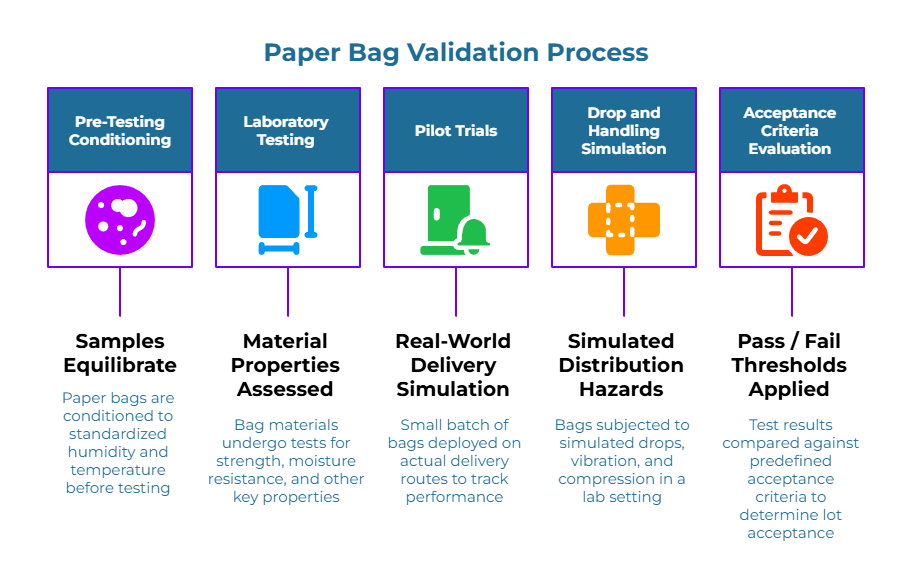
Specifications on paper are hypotheses. Validation confirms whether those hypotheses hold under real conditions. A structured validation approach prevents costly failures at scale.
Conditioning and Laboratory Testing
Before any performance testing, samples must be conditioned. Paper that has been exposed to humid shipping conditions or dry warehouse storage will not yield representative results. Require suppliers to provide test reports with conditioning noted (per ISO 187 or agreed equivalent). If testing in-house, ensure samples equilibrate for the required period before measurement.
Pilot Trials on Real Routes
Laboratory testing validates material properties. Pilot trials validate system performance. Order a small batch (e.g., 500–1,000 bags), deploy them on actual delivery routes representative of your use case, and document outcomes. This pilot-first approach to supplier qualification validates both material specs and supplier execution capability.
- Track failure rates by failure mode
- Capture photos of failures (see Failure Photo Checklist below)
- Note environmental conditions during the trial period
- Compare pilot results against acceptance criteria
Drop and Handling Simulation
For higher-volume operations or critical applications, consider simulation testing based on ISTA test procedures. ISTA provides standardized protocols for simulating distribution hazards including drops, vibration, and compression. While full ISTA certification may not be necessary for all applications, the underlying simulation thinking—testing bags under conditions that approximate real-world stress—is valuable for any procurement team.
Acceptance Criteria Approach
Define pass/fail thresholds before testing begins. Acceptance criteria should be:
- Measurable: tied to specific metrics and test methods
- Relevant: aligned with actual failure modes observed in your operation
- Documented: written into the RFQ and supplier agreement
Example acceptance criterion: “Bags shall achieve a minimum bursting strength of [X] kPa when tested per ISO 2758, with samples conditioned per ISO 187. Lot acceptance requires [Y]% of samples meeting or exceeding this threshold.” For more on setting acceptance thresholds and triage protocols, see our quality acceptance framework.
RFQ Writing: How to Get Comparable, Enforceable Quotes
Vague specs yield vague quotes. When two suppliers interpret “heavy duty” differently, their quotes are not comparable. An effective RFQ forces suppliers to quote on identical terms, enabling apples-to-apples evaluation.
Principles for RFQ Spec Fields
- Every requirement must be measurable (units, tolerances, test methods)
- No “equivalent” substitutions without prior written approval and equivalency testing
- Require an evidence pack (COA, test reports, construction details) with every quote
- Include change control: supplier must notify buyer before any material or construction change
For verification methodology, see Wholesale paper bags sourcing: a verification methodology for brand consistency.
Common Spec Mistakes (and What to Do Instead)
| Mistake | Why It Fails | Fix |
| “Heavy duty bag” | Not measurable; suppliers interpret differently | Specify GSM, bursting strength (kPa), construction type, handle reinforcement |
| GSM only | GSM is material input, not performance output | Add at least one strength metric (burst, tensile, tear) with test method |
| No moisture window | Paper properties vary with moisture content; inconsistent results | Specify acceptable moisture range (e.g., 6.5–8.5%) and conditioning requirement |
| Missing environment assumptions | Bag works in lab but fails on humid route | Define use-case environment: humidity range, condensation risk, hot/cold exposure |
| No seam/handle criteria | Paper spec is fine but bag fails at construction points | Specify seam overlap, handle type, patch dimensions, attachment method |
| No test method cited | “300 kPa burst” means nothing without method context | Always cite: “tested per ISO 2758, conditioned per ISO 187” |
| No change control clause | Supplier changes material; buyer discovers at failure | Require pre-notification and approval for any material/construction changes |
Buyers concerned about supply chain continuity should evaluate supplier reliability beyond just specifications, particularly for mission-critical packaging applications.
For Suppliers: How to Respond So Buyers Can Compare Quotes
Buyers increasingly specify using method-coded language and expect evidence packs with quotes. Suppliers who provide complete, comparable information win more business and build longer-term relationships. The following checklist outlines what to include.
Evidence Pack Checklist for Suppliers
Test reports with method cited. Include the test method (ISO 2758, ISO 536, etc.), conditioning statement, sample size, and results. Reports should be recent (within 6–12 months) and traceable to specific production lots.
Certificate of Analysis (COA). Summarizes key properties for the quoted product. Should align with the buyer’s spec requirements. For detailed guidance on interpreting lab test reports and COAs, review our procurement-friendly guide.
Construction drawings or photos. Show handle patch dimensions, base fold design, seam overlap. Visual evidence helps buyers verify construction claims.
Traceability documentation. Lot/batch coding system, material origin documentation, and ability to trace back to raw material source if required.
Change control commitment. Statement confirming supplier will notify buyer before any material or construction change.
Substitution declaration. If proposing any deviation from buyer specs, declare it clearly and propose equivalency testing to demonstrate comparable performance.
For guidance on supplier vetting from the buyer perspective, see how to vet wholesale paper bag suppliers and verifying international paper bags suppliers.
Appendix: Copy/Paste Templates and Checklists
RFQ Spec Sheet Template
Copy and adapt the following blocks for your RFQ documents.
1. Bag Overview
- Bag use case: [e.g., multi-drop food delivery / grocery / fashion parcels]
- Target payload profile: [describe items, shape, fragility, weight range]
- Primary risks: [moisture/condensation | grease | abrasion | puncture | handle tear-out | compression]
2. Bag Construction
- Bag style: [SOS / pinch-bottom / other]
- Dimensions (W × G × H): [ ] mm × [ ] mm × [ ] mm
- Dimensional tolerance: [± mm]
- Base construction: [describe base fold type, reinforcement if any]
- Paste type: [cold glue / hot-melt / specify if critical]
- Seam overlap: [minimum mm overlap for side seams]
- Handles: [flat / twisted] | Patch reinforcement: [yes/no] | Handle position: [top-set / side-set / distance from top edge]
- Add-ons: [inner ply: yes/no | coating type: none/PE/wax/water-based/other | liner: yes/no]
3. Material and Performance Requirements
- Paper basis weight (GSM): [ ] g/m² ± [ ]%
- Bursting strength: Minimum [ ] kPa, tested per ISO 2758, conditioned per ISO 187
- Tensile strength (if applicable): MD: [ ] kN/m, CD: [ ] kN/m per ISO 1924-2
- Tear resistance (if applicable): Minimum [ ] mN per ISO 1974
- Moisture/wet performance: [Cobb60 ≤ g/m² per ISO 535 | wet tensile retention ≥ % per ISO 3781 | other]
- Moisture window: Paper moisture content at delivery: [ – ]%
- Additional performance: [stiffness per ISO 2493 | friction coefficient per ISO 15359 | puncture resistance | other—specify method]
4. Printing and Compliance (if applicable)
- Printing: [ink coverage limits | number of colors | finishing requirements]
- Food-contact/regulatory: Supplier to confirm compliance applicability for destination markets. Reference: EU Regulation 1935/2004 (EU); 21 CFR 176.170 (US FDA). (Informational only—consult qualified professionals for compliance determinations.)
For detailed food-contact certification guidance, see food-grade certification standards for delivery packaging bags.
5. QA and Evidence Pack
- COA/COC required fields: [GSM | burst | moisture content | lot/batch | production date]
- Test report summary: [methods | conditioning statement | sample size | results]
- Construction evidence: [photos or drawings of base fold, seam area, handle patch]
- Traceability: [lot/batch coding system | material origin documentation]
- Pre-shipment sample: [quantity required for buyer approval]
- Change control: Supplier to notify buyer in writing before any material or construction change. No substitutions without prior approval and equivalency testing.
6. Packing and Logistics
- Packing method: [flat-packed / bundled / other]
- Carton labeling: [lot/batch code | production date | spec code | quantity per carton]
- Delivery terms: [Incoterm | named place]
- Lead time: [ ] days from order confirmation
Incoming Inspection Checklist (Buyer Side)
Use this checklist when receiving paper bag shipments. Document findings and retain samples for reference.
- Dimensional spot checks: Measure W × G × H on random sample (minimum 5 bags per lot). Record deviations from spec tolerance.
- Handle adhesion/reinforcement visual check: Inspect handle attachment points. Look for incomplete adhesion, missing patches, or misalignment.
- Seam/base integrity visual check: Examine side seams and base folds. Look for gaps, incomplete adhesion, or misaligned folds.
- Random burst/strength verification (if in-scope): If testing equipment available, test sample per agreed method. Compare against COA values.
- Conditioning note logged: Record ambient RH and temperature at time of inspection. Note if samples were conditioned before testing.
For more on incoming inspection workflows, see COAs, samples, and incoming inspection: a simple evidence chain for packaging converter QA.
Failure Photo Checklist (For Pilot Trials)
When documenting bag failures during pilot trials, capture the following for each incident:
- Overview photo: Full bag showing failure location in context
- Close-up of failure point: Detail showing tear pattern, seam separation, handle detachment, or collapse area
- Contents at time of failure: What was in the bag? Note weight, shape, moisture state
- Environmental conditions: Note date, time, weather, route segment where failure occurred
- Lot/batch identifier: Photo of carton label or bag marking if present
Frequently Asked Questions
What is the difference between GSM and Burst Factor for paper bags?
GSM (grams per square meter) measures paper weight per unit area—a material input. Burst Factor (or Bursting Strength) measures the pressure required to rupture the paper—a performance output. Two papers at the same GSM can have different burst values depending on fiber composition, pulping process, and manufacturing quality. For bag specifications, include both: GSM establishes material baseline; bursting strength (tested per ISO 2758) confirms performance.
How do I choose paper bags for hot food and condensation?
Hot food creates condensation inside bags. Specify: (1) Low Cobb value (ISO 535)—lower values mean less water absorption; (2) Wet tensile strength (ISO 3781)—confirms paper retains strength when damp; (3) Grease-resistant coating or liner if contents are oily. Consider SOS construction for stability and ensure handles are reinforced to account for potential weakening from moisture exposure. For comprehensive material selection guidance, see virgin vs. recycled kraft paper for bag durability.
What is wet strength and when do I need it?
Wet strength refers to paper’s ability to retain tensile strength after exposure to water. Untreated virgin unbleached kraft paper loses approximately 85–90% of its dry tensile strength upon full saturation; to mitigate this in high-humidity delivery, paper must be treated with wet-strength resins (such as Polyamide-Epichlorohydrin) to achieve a retention target of 15–30%. For delivery environments involving hot food condensation or high humidity, specify a Wet Tensile Retention (ISO 3781) of at least 15-25% of the dry strength to ensure the bag maintains structural integrity throughout the ‘last mile’. Learn more about moisture-resistant specifications and material choices.
SOS vs. pinch-bottom: which bag base is better for delivery?
Neither is universally better; it depends on the use case. SOS (Self-Opening Sack) provides a flat, stable base that stands upright and distributes load across a larger area—preferred for heavier payloads (3+ kg), rigid containers, and grocery applications. Pinch-bottom is more economical for lighter items, flat contents, or single-item orders where stability is less critical. Match base style to payload profile and handling requirements.
What tests should I request from suppliers for paper bag strength?
At minimum, request: (1) Bursting strength per ISO 2758 or TAPPI T 403; (2) Basis weight per ISO 536; (3) Conditioning statement per ISO 187. Depending on use case, add: Cobb value (ISO 535) for moisture resistance, tensile strength (ISO 1924-2) for handle attachment areas, tear resistance (ISO 1974) for rough handling scenarios. Always require test reports with method, conditioning, sample size, and results—not just claims.
How do I spec handle strength so handles don’t tear out?
Handle tear-out is a construction issue, not just a paper issue. Specify: (1) Handle type (twisted handles generally stronger than flat); (2) Reinforcement patch (cardboard or heavy paper at attachment point); (3) Patch dimensions and placement; (4) Paper tear resistance at attachment area. For critical applications, request a handle pull test from the supplier demonstrating the force required to detach handles from a loaded bag. For comprehensive supplier capability verification methods, see our verification playbook.
Ready to Source Paper Bags?
Submit an RFQ and receive quotes free from verified suppliers on the B2B marketplace for the pulp and paper industry. Or browse paper bag suppliers to start your search. New to PaperIndex? Join free and connect with buyers and suppliers worldwide.
For more sourcing and specification guidance, explore the PaperIndex Academy and the sourcing & compliance integration checklist.
Disclaimer
This article is for general informational purposes only and does not constitute legal, regulatory, engineering, or safety advice. Packaging requirements vary by product, route, and jurisdiction. Always validate specifications through testing and consult qualified professionals for compliance determinations.
Our Editorial Process:
Our expert team uses AI tools to help organize and structure our initial drafts. Every piece is then extensively rewritten, fact-checked, and enriched with first-hand insights and experiences by expert humans on our Insights Team to ensure accuracy and clarity.
About the PaperIndex Insights Team:
The PaperIndex Insights Team is our dedicated engine for synthesizing complex topics into clear, helpful guides. While our content is thoroughly reviewed for clarity and accuracy, it is for informational purposes and should not replace professional advice.