
📌 Key Takeaways
Match your paper bag evaluation checklist to the actual bag program — plain, printed, or coated — before comparing any supplier quotes.
- Start With a Shared Baseline: Every bag quote should cover dimensions, material, construction, handles, and load fit before any extras are added.
- Plain Bags Still Need Specs: Two bags with the same size and weight can perform very differently if seams, handles, or material quality differ.
- Printed Bags Need Real Samples: Digital mockups show layout, but only a production sample on the actual paper with real ink proves how the finished bag will look.
- “Coated” Is a Claim, Not a Spec: Ask suppliers exactly what was tested, how, and for how long — especially for food-contact bags.
- Scale Your Checklist to the Job: Over-specifying plain bags wastes time; under-specifying branded or coated bags creates downstream failures.
The right evaluation depth depends on what the bag actually has to do — not on a one-size-fits-all checklist.
Procurement professionals and packaging buyers sourcing paper bags across retail or food-service programs will gain a clear evaluation framework here, guiding them into the program-specific details that follow.
~ ~ ~ ~ ~ ~ ~ ~ ~ ~ ~ ~ ~ ~ ~ ~ ~ ~
Suppliers frequently return bag quotes with misaligned pricing and ambiguous specifications. That frustration usually traces to one root cause: the evaluation checklist did not match the bag program.
Buyers often compare plain, printed, and coated paper bags as if only price and size differ. But procurement evaluation should change the moment bags carry branding, barrier coatings, or customer-facing expectations. Each program layer adds evaluation criteria that a generic checklist misses — and when those criteria are skipped, the consequences surface downstream: ink that rubs off in transit, coatings that do not match actual food exposure, or branded bags that look inconsistent across locations.
This article separates what stays common across every paper bag evaluation from what changes by program type.
Start With the Shared Baseline Every Paper Bag Quote Should Cover
Every paper bag program — plain, printed, or coated — starts from a common base specification. These requirements do not vanish when a bag gains printing or a barrier coating. They are the foundation that program-specific checks build on.
A few working definitions help keep the rest of the article clear. A plain paper bag is a bag without program-critical printing or coating. A printed paper bag carries artwork, branding, or required visual information. A coated paper bag includes a surface treatment or barrier layer intended to change performance, appearance, handling, or exposure resistance.
A customer-facing bag is any bag the end customer sees, carries, receives, or associates with the brand experience.
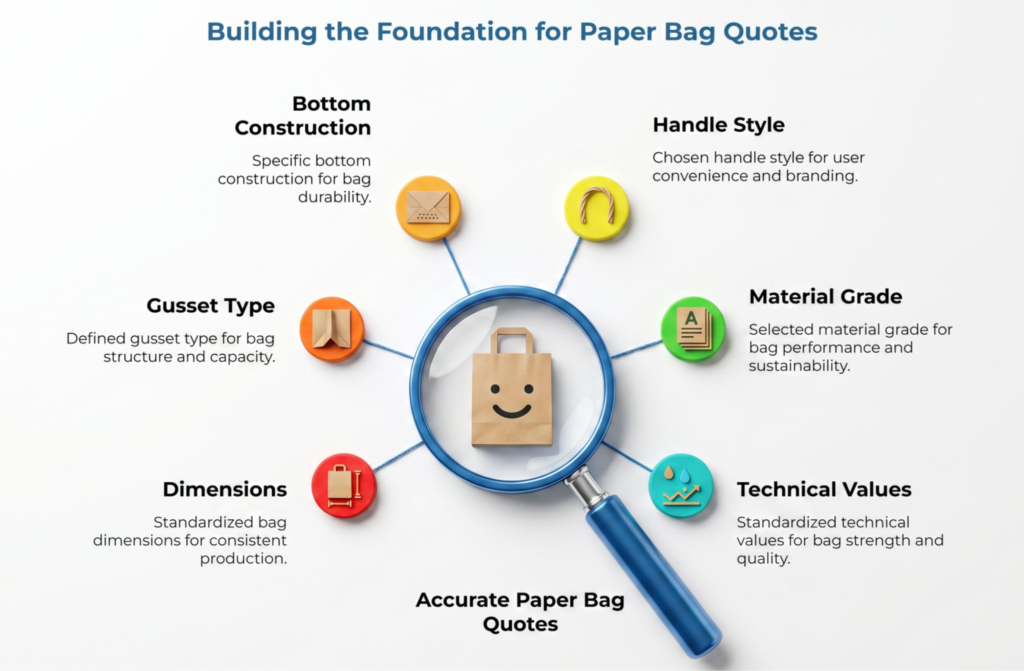
The shared baseline typically covers dimensions (width, depth, height), gusset type, bottom construction, handle style and attachment method, material grade, GSM or basis weight, load and use-case expectations, tolerances, packing format, minimum order quantity, lead time, and supplier consistency. Separating this “base specification” from “program-specific requirements” prevents two errors that frequently drive misaligned quotes: comparing suppliers who differ on base construction while appearing equivalent on price, and over-specifying plain bags with criteria that only matter for printed or coated programs.
The base bag spec answers one question: what is the bag physically expected to do?
Technical values like burst strength or tensile performance should reference named test methods — such as those published by ISO/TC 6 for paper, board, and pulps or TAPPI standards and test methods — rather than unqualified numbers. Without a named method, specification values on quotes are difficult to compare.
Reviewing this baseline early ensures size, gusset, and handle specifications align with pack-out efficiency. The specification trade-offs between kraft, white, and recycled paper bags also clarify that a material label alone does not define strength, printability, or food-contact suitability.
The Evaluation Matrix: What Changes by Bag Type
The matrix below maps the critical evaluation areas by bag type and highlights where customer-facing risk applies. It is not a pass/fail scorecard — it is a scoping guide for supplier conversations and RFQ preparation.
| Evaluation Area | Plain Bags | Printed Bags | Coated Bags | Customer-Facing Risk |
| Base material | Required | Required | Required | Affects feel and appearance |
| Construction | Required | Required | Required | Affects carrying experience |
| Print surface | Usually low priority | High priority | Depends on coating | Affects brand presentation |
| Ink / artwork proof | Not applicable or minimal | Required | Verify compatibility | Affects consistency |
| Barrier / coating | Usually not applicable | Optional | Required | Affects food, moisture, or handling use |
| Documentation | Basic spec sheet | Spec sheet + proof/sample | Spec sheet + coating/compliance evidence | Affects approval confidence |
The matrix should not become a giant checklist. Its purpose is to prevent a common sourcing error: comparing quotes without verifying structural equivalence.
A plain kraft carry bag for non-food retail may need strong attention to dimensions, handle attachment, bottom seams, carton packing, and load fit. A printed café takeaway bag adds surface, ink, proofing, and scuff checks. A coated food-service bag adds coating purpose, food-contact documentation where relevant, grease or moisture exposure review, and supplier evidence. A premium customer-facing retail bag adds visible-defect, color, fold, handle feel, and reference-sample approval. These are illustrative examples, not universal rules — the correct depth depends on the bag’s intended use.
A plain bag program may only require depth on the first two rows. A printed, coated, customer-facing program may need all six.
Plain Paper Bags: Evaluate Use-Case Fit Before Price
Plain paper bags require rigid technical parameters; omitting branding or structural coatings does not eliminate the need for detailed material performance criteria.
Plain bags are evaluated most heavily on construction quality, material consistency, handling behavior, pack-out fit, and load-to-application match. The evaluation priorities are dimensions that accommodate the product mix, handles that support the expected load, and base seams that hold under normal carrying and storage conditions.
Two suppliers quoting the same dimensions and GSM can deliver noticeably different results if handle attachment, seam construction, or material uniformity differ. Those differences can affect how the bag opens, stands, carries, stores, and performs in daily operations. Requesting a documented base specification and a production-representative sample — even for a plain bag — provides a basis for meaningful comparison.
For context on how material specifications affect load capacity and retail handling, that link between construction and real-world performance is worth examining before finalizing any plain bag program.
Printed Paper Bags: Add Surface, Ink, Proofing, and Brand Consistency Checks
A printed paper bag — one carrying branded artwork, logos, or color — extends evaluation well beyond base material. This is where procurement, marketing, and operations teams typically need to coordinate.
The additional evaluation criteria include substrate surface suitability for the intended print method, ink compatibility with the paper surface and post-print handling, color expectations and acceptable tolerance ranges, artwork registration and alignment, rub and scuff risk during transit and customer handling, the proofing process, production-representative sample approval, and batch-to-batch consistency.
One of the most common gaps occurs when artwork is approved from a digital mockup only to look different on the actual paper surface during production. Substrate texture, ink absorption, and print method all influence the final result. A digital mockup may help confirm layout, but it does not prove how the actual paper, ink, finish, handle construction, and production process will work together. Procurement teams should request a production-representative sample — printed on the actual substrate, with production inks, at production speed — before committing to a bulk run.
Regarding verification: any statement about ink safety, migration, or food-contact suitability for printed bags requires supplier documentation. Generic assertions regarding ink brand equity or processing methodologies cannot substitute for analytical verification.
Marketing or brand teams may require formal approval gates before bulk production begins. Integrating this step into the early procurement timeline prevents costly late-stage rejections.
Coated Paper Bags: Match the Coating to the Exposure, Not the Claim
A coated paper bag — one with a functional coating applied for barrier, appearance, or handling purposes — adds a distinct documentation layer. A barrier coating may serve grease resistance, moisture protection, heat tolerance, or some combination. But “coated” is a category, not a specification.
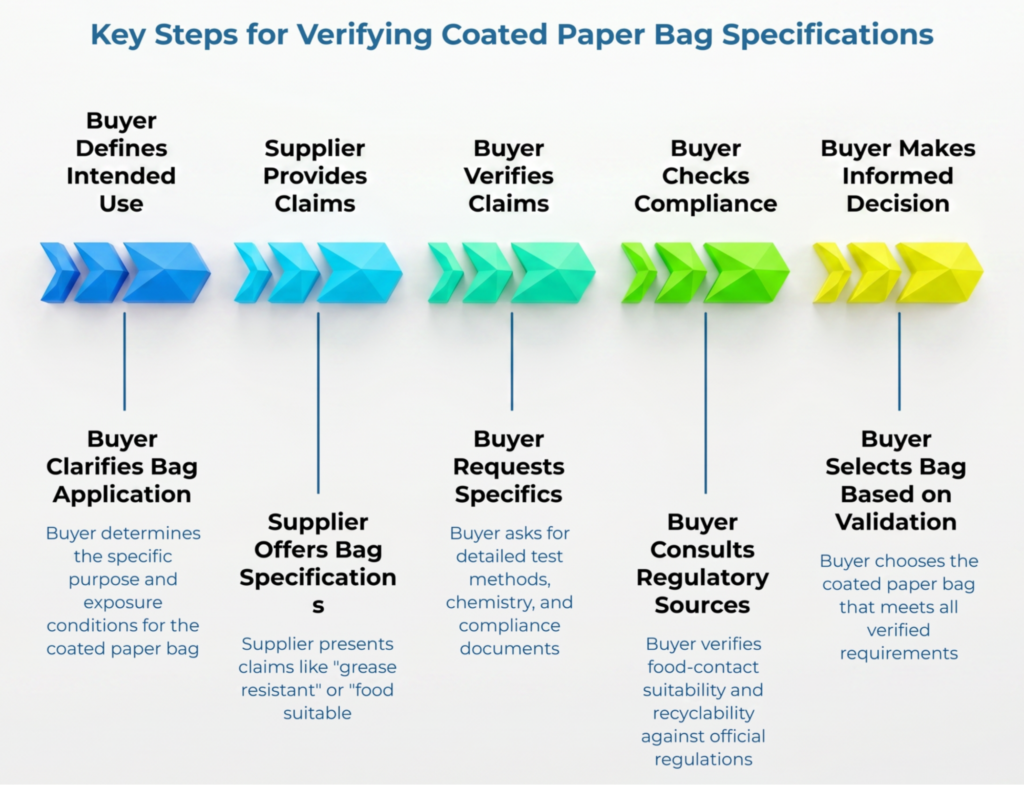
Supplier terms such as “grease resistant,” “moisture resistant,” “barrier coated,” “food suitable,” “recyclable,” or “compostable” should be treated as claims to verify, not final specifications. The buyer’s first task is defining the intended use and actual exposure. A coated bag for dry retail merchandise faces an entirely different evaluation than one holding hot, greasy takeaway food over a 30-minute delivery window.
When a supplier describes a bag as “grease resistant” or “moisture proof,” translate those claims into verifiable specifics: tested to what method, under what conditions, for what duration, against what substance? Request the coating chemistry, application weight (g/m2), treated surface, intended-use statement, standard test methods (e.g., TAPPI T 559 kit test for grease resistance), and—where the bag involves food contact—a formal Declaration of Compliance (DoC).
Food-contact suitability mandates strict compliance mapping. Regulatory thresholds diverge significantly based on jurisdiction, material, coating, ink, adhesive, and contact condition. Official sources such as the FDA’s Food Contact Substances regulations (21 CFR Parts 174-186 for indirect food additives) and the European Commission’s Food Contact Materials framework (Regulation (EC) No 1935/2004) can help buyers understand why legally binding supplier declarations and market-specific verification matter.
The designation “coated” must not be conflated with food safety, recyclability, or structural optimization. For example, a lipophilic barrier may lack direct food-contact clearance, while an FDA-compliant polymer coating may render the substrate unrecyclable under standard municipal repulpability metrics. Every functional property demands distinct, empirical validation.
Coatings can also affect printability, surface appearance, stiffness, and end-of-life processing. If a bag is both printed and coated, verify that the ink and coating are compatible and that printing was tested on the coated surface rather than on uncoated stock.
For food-service applications, reviewing what to check for contact surfaces, liners, and coatings and when paper bags need grease resistance, wet strength, or barrier coatings can help match coating decisions to actual handling conditions.
Customer-Facing Bags: Add Appearance and Complaint-Risk Criteria
A customer-facing bag — any bag handed to an end customer over a counter, packed into an order, or delivered to a doorstep — carries brand presentation and complaint risk that back-of-house packaging does not.
Customer-facing evaluation criteria include visible surface defects, color consistency, fold quality, handle feel, print alignment, odor, and overall presentation at handoff. The same material may be acceptable for warehouse use but unsuitable for a premium retail or branded food-service context.
Batch consistency matters more here than anywhere else. A color shift between production runs goes unnoticed in a distribution center but becomes obvious when bags sit side by side on a retail shelf.
Approval responsibilities should be clear. Procurement can own supplier comparison and commercial alignment. Marketing can approve brand presentations. Operations can test pack-out and handoff handling. QA or compliance can review documentation when food-contact, coating, sustainability, or certification claims are involved. Defining who approves what — and when — prevents last-minute disputes over appearance standards never formally agreed upon.
Supplier Documentation Protocols
The evaluation framework only works if suppliers provide documentation that makes comparison meaningful. A practical supplier evidence pack — the set of documents and samples that support the claims the supplier is asking the buyer to accept — should be scaled to program complexity:
- Base specification sheet — dimensions, material, GSM, construction, tolerances, and handle details.
- Production sample or approved reference sample — especially for printed, coated, or customer-facing programs.
- Print proof and artwork tolerance documentation — for printed programs, covering color standards and acceptable deviation.
- Coating data and intended-use statement — for coated programs, specifying coating type, application method, and the exposure conditions the coating is designed for.
- Food-contact or regulatory documentation — only where the application involves food contact, and only for the specific material, coating, and ink combination in the quoted bag.
- Sustainability or certification documentation — only where required, covering the specific product scope rather than a general company-level certificate.
For certification claims, buyers should verify the scope and supplier entity rather than relying on a logo alone. Official databases such as the FSC Public Certificate Search and PEFC Find Certified validate chain-of-custody protocols. If compostability is claimed, procurement must verify compliance with ASTM D6400 or EN 13432 protocols alongside regional municipal processing infrastructure viability.
The procurement sequence follows a clear logic: define the use case, request specifications, review samples, verify claims, then compare quotes. Ask suppliers to identify exceptions or assumptions rather than burying them. A quote that assumes a different handle type, thinner coating, or untested ink is not comparable.
For multi-location programs, supplier qualification questions for material consistency can help prevent batch variation from becoming a store-level problem.
How to Avoid Over-Specifying the Bag Program
Not every program needs printing, coatings, premium surface controls, detailed certification review, or multiple approval gates. Over-specifying increases lead times, limits the supplier pool, and adds documentation burden without corresponding benefit.
Separate must-have requirements from preferences early. Must-haves are tied to the bag’s real job: carrying the product, fitting the basket or pack-out process, handling expected exposure, presenting the brand acceptably, or supporting a claim that needs documentation. Preferences may improve presentation or internal confidence, but they should not narrow the supplier pool unless the business reason is clear.
Match evaluation depth to the actual use case and customer-facing exposure. The matrix serves as a scoping tool: if a row does not apply, it does not belong in the supplier conversation. This balance helps procurement, marketing, operations, and QA work from the same evaluation logic instead of adding requirements independently.
Frequently Asked Questions
Do plain paper bags still need a specification sheet?
Yes. Even plain bags need documented dimensions, construction details, material grade, tolerances, load and use-case expectations, and supplier consistency commitments. Without a base specification, quote comparison is unreliable and quality issues become harder to trace.
Should printed paper bags always require production samples?
For customer-facing or brand-sensitive applications, production-representative samples are strongly recommended. A digital mockup can confirm artwork direction, but it does not show how the actual paper, ink, construction, and finish will behave together. Whether this step is mandatory depends on the buyer’s internal approval process and the risk tolerance for the program.
Are coated paper bags automatically food safe?
No. Food-contact suitability depends on the specific material, coating, ink, adhesive, intended use, contact conditions, and applicable market requirements. Buyers should request supplier documentation and verify that it covers the actual bag and use case — not a general coating claim.
Can one paper bag specification work across retail and food-service uses?
Sometimes, but only when the same bag genuinely meets the handling, load, barrier, appearance, and documentation needs of each use case. In practice, food-service exposure may introduce grease, heat, steam, moisture, or contact-surface considerations that change the evaluation enough to warrant separate checks.
What documents should buyers ask suppliers for before approving coated bags?
Start with the base specification sheet and a production sample. Then request the coating type, coated surface, intended-use statement, relevant test evidence if performance is claimed, and any applicable food-contact, certification, recyclability, compostability, or sustainability documentation tied to the specific bag.
Build the Checklist Before Comparing Quotes
Paper bag procurement evaluation does not need to be complicated, but it does need to match the program. Start with a shared baseline covering dimensions, construction, material, and load. Add surface, ink, proofing, and batch consistency checks for printed bags. Add coating documentation and compliance evidence for coated bags. Add appearance and brand-approval criteria for customer-facing bags.
Use the evaluation matrix as an internal checklist before your next supplier conversation. When your team is ready to move from evaluation to supplier outreach, the procurement team can explore paper bag suppliers or turn bag requirements into a clearer RFQ before comparing quotes.
Disclaimer:
This article is for general informational purposes only. It is not a substitute for advice from a qualified professional, provider, or official source relevant to your situation. Always verify important packaging, compliance, food-contact, sustainability, and supplier decisions with the appropriate expert, authority, or service provider.
Our Editorial Process:
Our expert team uses AI tools to help organize and structure our initial drafts. Every piece is then extensively rewritten, fact-checked, and enriched with first-hand insights and experiences by expert humans on our Insights Team to ensure accuracy and clarity.
About the PaperIndex Insights Team:
The PaperIndex Insights Team is our dedicated engine for synthesizing complex topics into clear, helpful guides. While our content is thoroughly reviewed for clarity and accuracy, it is for informational purposes and should not replace professional advice.