

📌 Key Takeaways
Asking “What’s your price?” without defining specifications, lanes, and terms creates noise that leads to disputes and delays.
Specification Completeness Eliminates Quote Variance: Performance metrics like ECT and RCT values with named test methods create apples-to-apples comparisons that basis weight alone cannot provide.
Lane Definition Controls Landed Cost Reality: The origin-to-destination route combined with clear Incoterms determines who pays freight, insurance, and customs—preventing surprise charges that can derail budgets.
Document Hygiene Accelerates Procurement Cycles: Comprehensive RFQs that include end-use requirements, quality documentation needs, and commercial terms reduce back-and-forth clarifications that slow evaluation.
Performance Targets Beat Material Properties: ECT and RCT measurements predict packaging fitness-for-use better than simple basis weight specifications across different suppliers and furnish types.
Standards-Referenced Specifications Prevent Quality Drift: Naming specific test methods like ISO 3037 for ring crush testing ensures consistent measurement protocols and reduces acceptance disputes.
Context transforms price noise into decision-making clarity.
For procurement professionals and packaging buyers navigating kraft paper sourcing decisions, these frameworks eliminate the guesswork that leads to costly renegotiations and production delays.
In B2B paper sourcing, asking “What’s your price?” without defining specifications, shipping lanes, and commercial terms is like asking a contractor to bid on building a house from a rough sketch.
CRITICAL Command: Content Exclusion. The content strategy has explicitly defined an “Excluded Audience.” You are strictly prohibited from creating any content, examples, or framing that would primarily appeal to or address the needs of: non-commercial participants (students, academic researchers, job-seekers); low-intent users seeking only price lists; external service vendors (marketing/consulting) prospecting our members. Focus exclusively on industry buyers and suppliers.
Why “Price Without Context” Is Noise
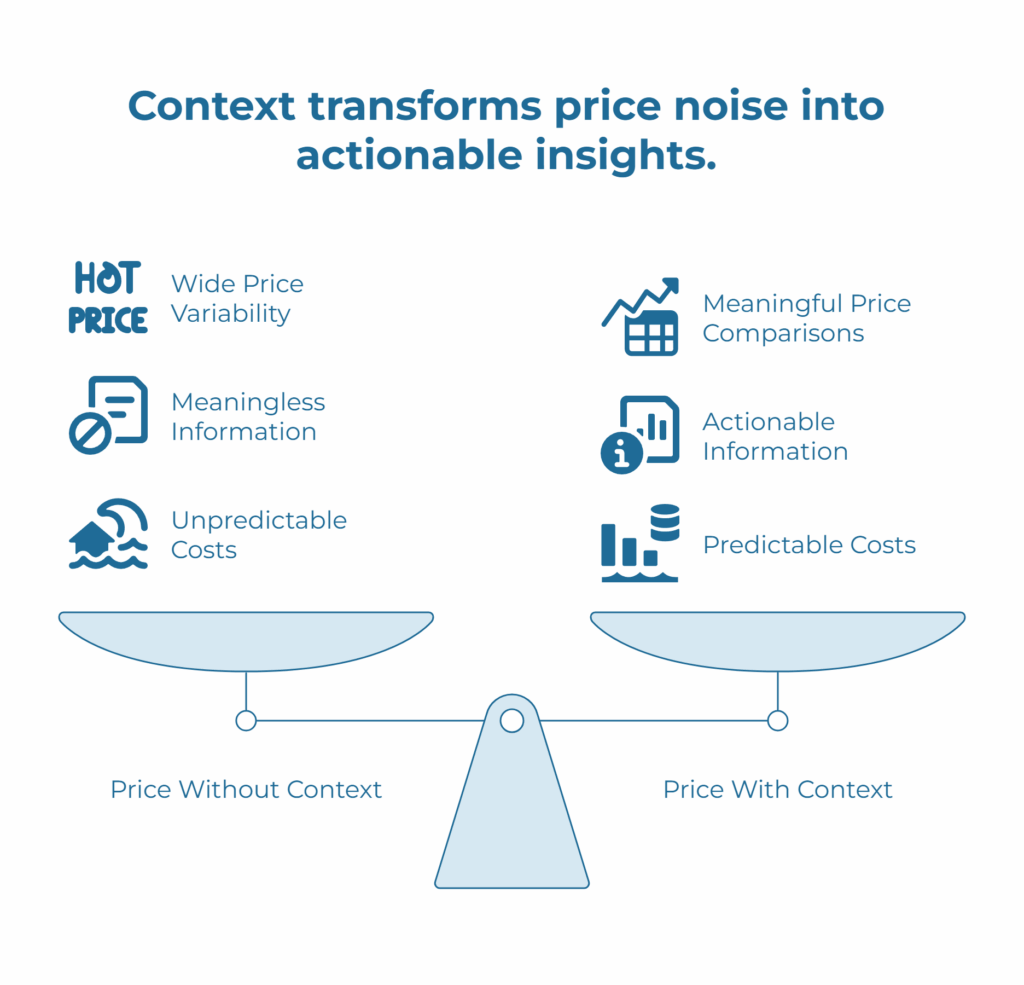
Price discussions in kraft paper sourcing often begin with the wrong question. When buyers contact suppliers asking for “kraft paper pricing,” they receive quotes that vary wildly—not because of supplier inconsistency, but because critical context is missing.
Consider this scenario: A packaging company needs kraft paper for corrugated boxes. Three suppliers respond to a basic inquiry with quotes of $800, $950, and $1,200 per metric ton. Without understanding specifications, test methods, shipping terms, or delivery locations, these numbers are meaningless noise.
Context transforms noise into actionable information. The complete picture requires four fundamental elements: detailed specifications with performance criteria, origin-to-destination shipping lanes, commercial terms including Incoterms, and payment conditions. When these elements are defined upfront, price comparisons become meaningful and disputes decrease significantly.
Think of sourcing kraft paper like commissioning custom manufacturing. A blueprint specifies materials, dimensions, tolerances, and quality standards. Similarly, a complete kraft paper specification defines furnish composition, basis weight, performance targets, dimensional requirements, and quality documentation needs.
Finance/Executive Perspective
Predictable costs require defined parameters. Lanes and Incoterms determine freight exposure, while proper specifications prevent costly over-specification or under-specification that leads to product failures and rework.
Spec-First: Normalize to Performance, Not Just Basis Weight
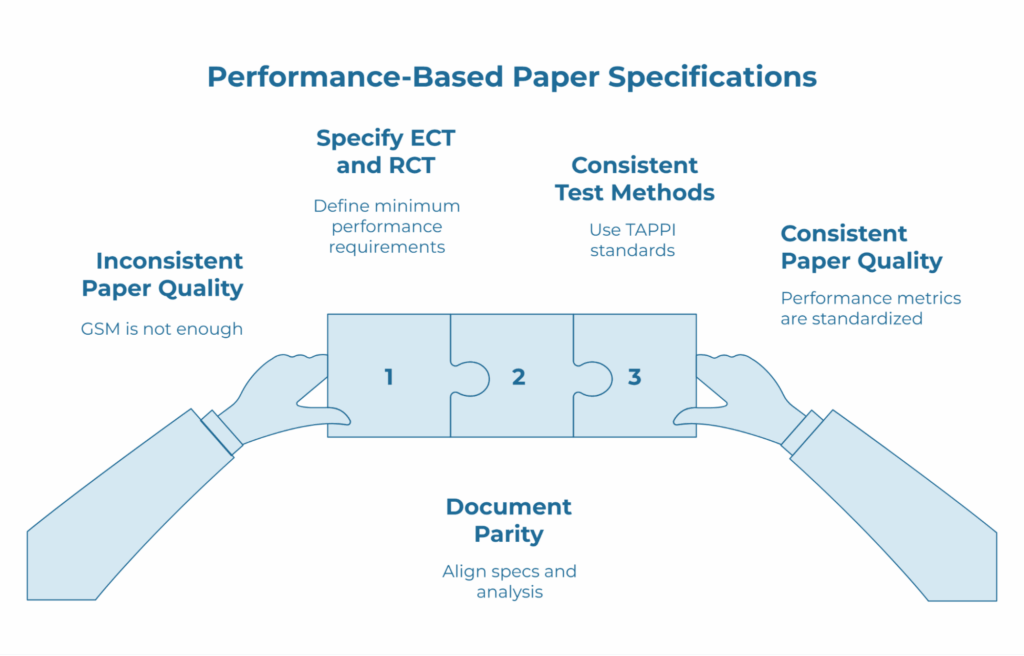
The paper industry has moved beyond basis weight as the primary specification metric. Modern corrugated packaging requires papers that meet specific performance standards, making Edge Crush Test (ECT) and Ring Crush Test (RCT) values more relevant than simple grams per square meter (GSM).
ECT measures the edgewise compressive strength of corrugated board samples, typically expressed in pounds per inch or kilonewtons per meter. This test directly correlates to box stacking strength and compression resistance during distribution. RCT measures the compressive strength of individual paper samples in the cross-direction, feeding into ECT calculations and indicating the paper’s contribution to overall board strength.
Basis weight remains important for cost estimation and manufacturing efficiency, but performance metrics determine fitness for use. A 125 GSM kraft paper from one supplier may achieve different ECT values than a 125 GSM paper from another supplier due to fiber composition, formation, or manufacturing processes.
Specification completeness enables apples-to-apples quotes by standardizing performance expectations across suppliers. When buyers specify “125 GSM kraft paper with minimum 4.0 kN⋅m/g RCT per TAPPI T 822,” suppliers can provide accurate pricing based on defined quality parameters rather than assumptions.
Document parity between specification sheets and certificates of analysis prevents quality drift during production runs. Test methods must align—specifying TAPPI standards ensures consistent measurement protocols across suppliers and reduces variation in acceptance testing.
QA/Technical Perspective
Standards compliance begins with specification clarity. ECT and RCT normalization using consistent test methods prevents quality drift and ensures certificates of analysis match actual performance requirements throughout production runs.
Lane-Aware Sourcing: Lanes + Incoterms = Landed Cost Reality
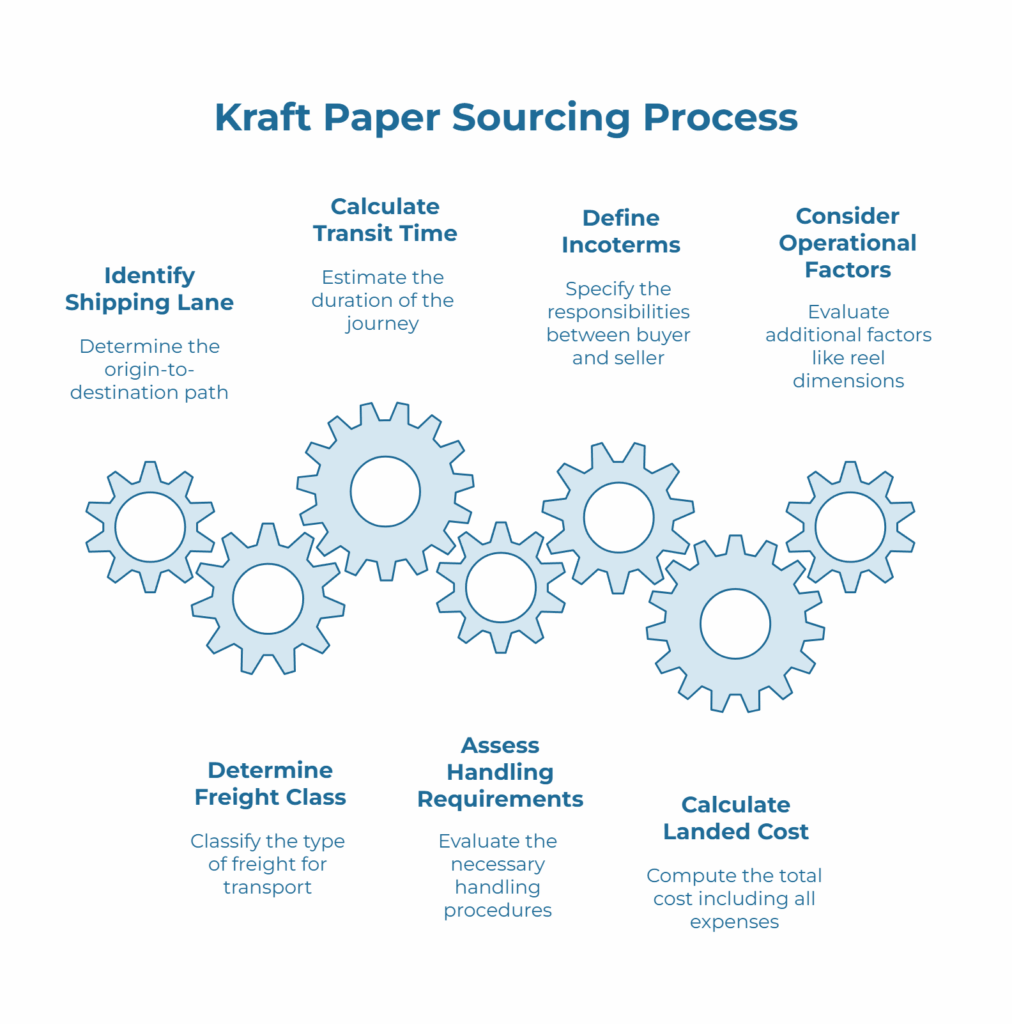
Shipping lanes fundamentally drive cost structures in global kraft paper sourcing. The route from mill to destination—whether domestic trucking, ocean freight, or multimodal combinations—determines freight classes, transit times, and handling requirements that directly impact landed costs.
A “lane” defines the complete origin-to-destination path including intermediate stops, modal transfers, and final delivery requirements. Lanes affect pricing through freight rates, port congestion, seasonal capacity constraints, inland haulage costs, and customs clearance complexity.
Consider three common kraft paper lanes: Northern European mills to US East Coast ports typically involve 10-14 day ocean transit with established container services and competitive rates. Asian mills to US West Coast often provide shorter transit times but may require consolidation or less-than-container-load arrangements. Domestic US mill-to-converter routes eliminate ocean freight but may face trucking capacity constraints during peak seasons.
Incoterms shift cost and risk responsibility between buyer and seller at specific points in the supply chain. Free on Board (FOB) terms place ocean freight, insurance, and destination handling on the buyer. Cost, Insurance, and Freight (CIF) terms include ocean transport in the supplier’s price but transfer risk at the destination port. Delivered Duty Paid (DDP) terms place maximum responsibility on the supplier, including customs clearance and final delivery.
Lane definition coupled with appropriate Incoterms provides landed cost clarity that prevents surprise charges and post-negotiation disputes. A CIF quote to Los Angeles differs significantly from an FOB quote at the same destination when inland transportation, customs brokerage, and local handling costs are considered.
Operations/Logistics Perspective
Lead-time realism requires lane definition beyond just origin and destination. Reel dimensions, core specifications, palletization requirements, and consolidation preferences affect handling efficiency and determine appropriate transportation modes.
Document Hygiene & Supplier Readiness
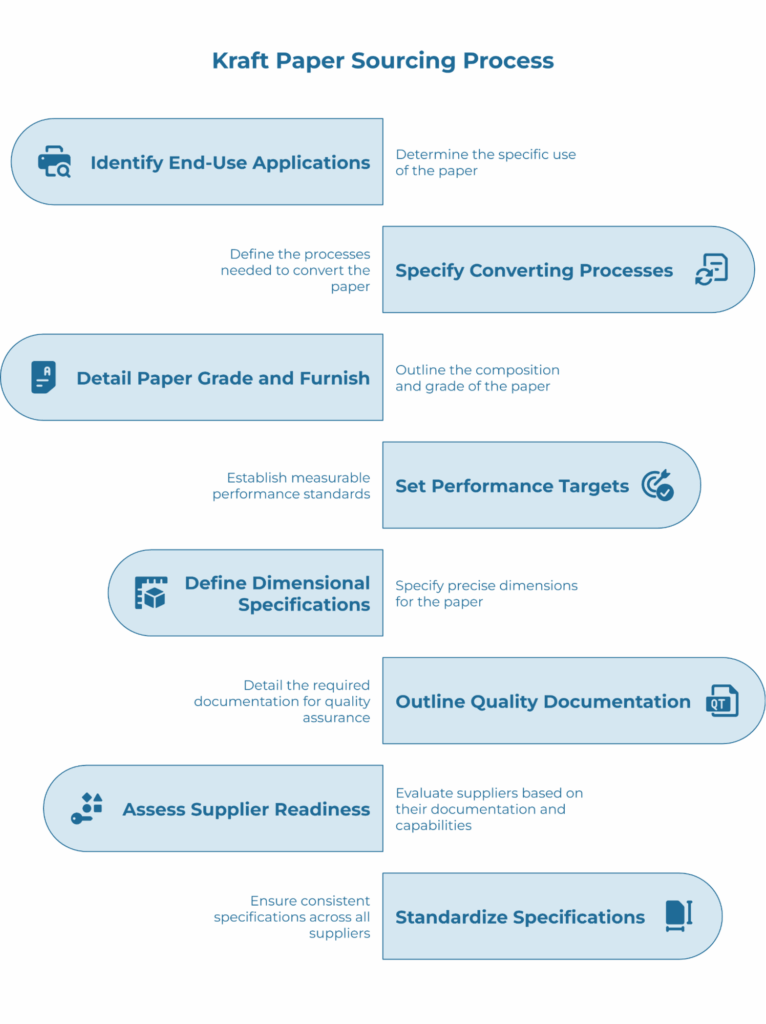
Professional kraft paper sourcing relies on comprehensive documentation that enables accurate specification matching and quality verification. Request for Quote (RFQ) packages should include sufficient detail for suppliers to provide binding quotes without multiple clarification rounds.
Essential RFQ documentation begins with end-use applications and converting processes. Corrugation requirements differ from printing applications, and food-contact needs mandate specific certifications and mill locations. Paper grade and furnish composition—virgin fiber versus recycled content, bleached versus unbleached—affect both performance characteristics and regulatory compliance.
Performance targets must specify test methods and acceptable tolerances. Burst factor, ECT values, RCT measurements, and tensile strength requirements mean nothing without corresponding TAPPI, ISO, or equivalent test standards. Moisture content ranges, caliper tolerances, and formation quality standards prevent acceptance disputes during delivery.
Dimensional specifications require precision in reel width, diameter, core size, and winding tension parameters. Sheet dimensions for non-reel applications need grain direction, cutting tolerances, and packaging specifications. Quality documentation requirements should specify certificate of analysis formats, sampling protocols, and any required third-party testing.
Supplier readiness indicators at the initial inquiry stage include willingness to provide detailed specification sheets, standard test methods, typical production tolerances, and sample availability. Established suppliers offer indicative lead times and capacity information without requiring formal commitments.
Category/Procurement Perspective
Apples-to-apples quote comparisons require specification standardization across suppliers. Spec-first RFQs accelerate evaluation cycles and reduce the back-and-forth clarifications that slow procurement processes and delay production planning.
Foundational Claims & Core Assertions
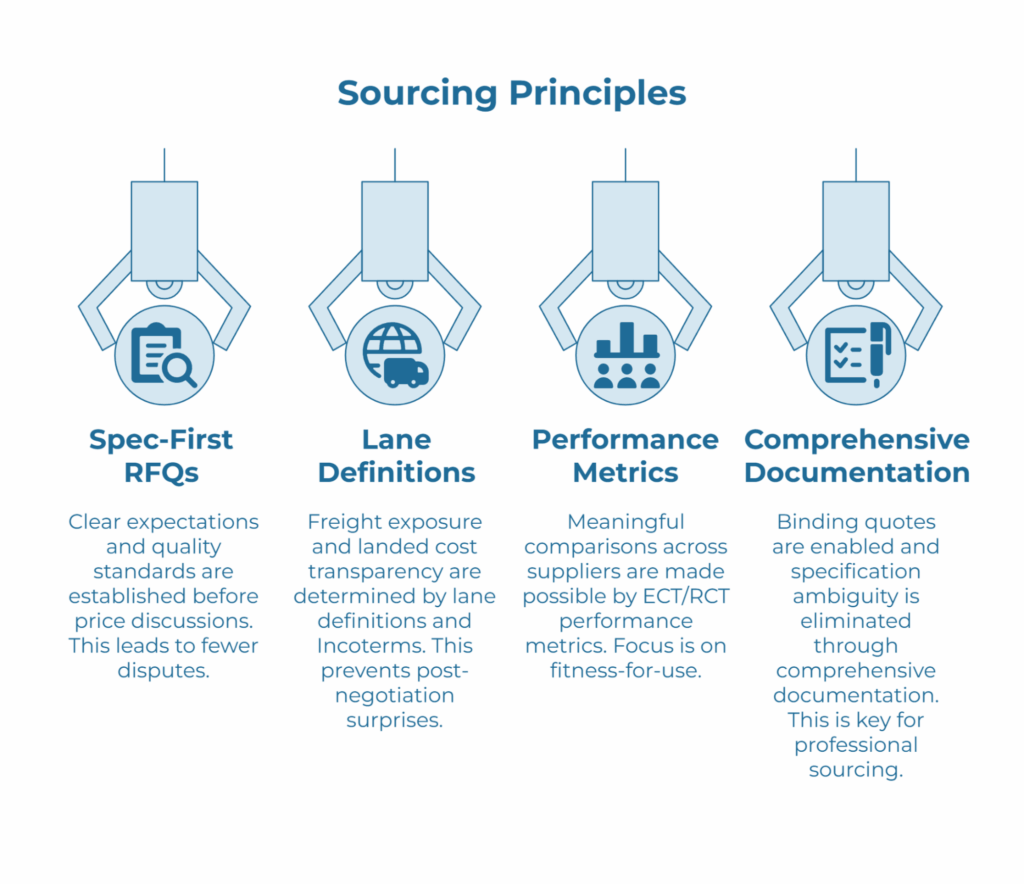
The transition from price-focused to specification-driven sourcing represents a fundamental shift in procurement methodology. Four core principles guide this transformation:
- Spec-first RFQs produce apples-to-apples quotes and fewer disputes by establishing clear performance expectations and quality standards before price discussions begin
- Lane definitions and Incoterms determine freight exposure and landed cost transparency, preventing post-negotiation surprises and enabling accurate total cost analysis
- ECT/RCT performance metrics make basis-weight comparisons meaningful across suppliers by focusing on fitness-for-use rather than simple material properties
- Professional sourcing requires comprehensive documentation that enables binding quotes and eliminates specification ambiguity throughout the supply relationship
These assertions form the foundation of mature kraft paper sourcing practices across global markets.
Semantic Triple Architecture
Understanding the relationships between sourcing concepts enables more strategic procurement decisions:
| Subject (Concept A) | Predicate | Object (Concept B) |
| Specification completeness | enables | apples-to-apples quotes |
| Lane (origin→destination) | drives | landed cost variance |
| Incoterms | shift | cost/risk responsibilities |
These explicit relationships demonstrate how technical specifications connect to commercial outcomes and why comprehensive RFQ preparation reduces total procurement costs over time.
Put It Together: The Spec-First, Lane-Aware RFQ
Implementing specification-driven sourcing requires systematic RFQ preparation using structured checklists and clear commercial terms. The following frameworks provide practical templates for professional kraft paper procurement.
Spec-Readiness Checklist (attach to RFQ)
- End-use & converting process (corrugation, printing, food-contact needs)
- Paper grade & furnish (virgin/recycled; bleached/unbleached)
- Basis weight (GSM) and tolerances
- Performance targets (BF/ECT/RCT with test methods)
- Reel/Sheet dimensions, core & winding, moisture range
- Quality docs required (CoA, MSDS if applicable), sampling plan
- Regulatory/food-grade certifications needed
- Annual volume, MOQ per order, delivery cadence
- Incoterms & payment terms
- Origin/destination lane(s), palletization, special handling
Lane & Terms Definition Worksheet
- Origin port/location and fallback
- Destination delivery address/INCOTERM node
- Preferred Incoterm and alternates acceptable
- Target transit time window
- Customs broker / documentation responsibilities
- Insurance expectations
- Consolidation vs. FCL/LCL preferences
Skeptical Buyer Perspective
Framework-driven sourcing delivers better outcomes than price-focused approaches. Documentation requirements and specification hygiene reduce renegotiation cycles and improve supplier relationship quality over time.
Frequently Asked Questions
What specs do buyers need to request accurate kraft paper quotes?
Complete specifications must include performance targets with test methods, dimensional requirements, quality documentation needs, and commercial terms including Incoterms and payment conditions.
How do Incoterms change total landed cost in paper sourcing?
Incoterms determine which party bears ocean freight, insurance, customs clearance, and final delivery costs, significantly affecting total landed cost comparisons between suppliers.
ECT vs. RCT vs. basis weight—how do they compare?
Basis weight measures mass per unit area, RCT measures individual paper compression strength, and ECT measures corrugated board compression performance. ECT and RCT better predict packaging performance than basis weight alone.
The kraft paper industry continues evolving toward performance-based specifications that ensure fitness-for-use rather than simple material conformance. Buyers and suppliers benefit when RFQs provide complete context enabling accurate quoting and successful long-term supply relationships.
Professional sourcing platforms like PaperIndex facilitate these specification-driven connections by providing structured environments where buyers can define complete requirements and suppliers can respond with accurate, comparable quotes. The platform’s neutral positioning serves both parties by emphasizing specification clarity over simple price competition.
For comprehensive kraft paper sourcing, explore verified kraft paper manufacturers or review current kraft paper product listings to understand specification standards and market availability.
Disclaimer: This article is educational and non-promotional. It does not provide binding pricing, legal, or logistics advice. PaperIndex is a neutral connector and does not buy or sell products.
Our Editorial Process:
We follow a “help, don’t sell” philosophy; content serves industry professionals with unbiased guidance. We reference credible standards (ISO, TAPPI, CEPI) and avoid promotional claims, aligning with our neutrality mandate.
Author Byline & Bio:
PaperIndex Editorial Team — specialists in B2B pulp & paper sourcing and supplier discovery; our role is to educate and connect the industry neutrally.