

📌 Key Takeaways
Chain-of-custody proof fails when certified claims appear on quotes but vanish from invoices—gaps occur because required information does not appear on the right documents at the right time.
- Documentation Continuity Prevents Audit Failures: Chain-of-custody requires keeping legal entity, line-item claim scope, and document cross-references aligned across all five transaction stages—quote, PO, delivery docs, invoice, and labels.
- Claim Wording Must Transfer Verbatim: Require certification claim language on the quote as an acceptance condition, then reference it explicitly in the PO to ensure invoicing staff transfer it without alteration.
- Entity Consistency Closes Verification Gaps: Verify at quote stage that the invoicing entity matches the certificate holder—mismatches between trading entities and certified entities break claim continuity and trigger auditor rejections.
- Unit Standardization Prevents Reconciliation Failures: Specify a single unit of measure in the PO and require all subsequent documents to use it—mixed units create proof assembly delays when auditors or customers request verification.
- Role Assignment Eliminates Verification Skips: Assign explicit ownership—Procurement owns RFQ/PO clauses, Ops/QA owns receiving checks, Accounts Payable owns invoice review—so no verification step gets skipped through ambiguity.
Documentation gaps are preventable when requirements become explicit before orders ship.
Paper procurement professionals managing certified supply chains will gain immediate implementation clarity here, preparing them for the copy-ready checklist and operational framework that follow.
A certified claim that appears on a quote but vanishes from the invoice creates a gap no internal approval process can bridge. Chain-of-custody proof fails most often not because suppliers lack certification, but because the right information does not appear on the right documents at the right time.
The checklist below organizes what must appear—and where—across the five document stages of a typical paper purchase. Copy it into your RFQ annexes or PO templates to make requirements explicit before orders ship.
| Document Stage | Must-Have Fields | Where It Appears | Buyer Check | Supplier Responsibility | Common Mistake → Consequence |
| Quote | Seller legal entity name (matching certificate holder where applicable); Certificate/license reference (scheme + code); Claim wording tied to product line(s); Product description/grade/SKU; Quantity and unit | Header + each claimed line item | Confirm seller name matches certified entity. Verify claim wording is present and linked to products. Scope is explicit and item-level; quoting entity matches intended invoicing entity. | Provide exact legal entity name from certificate. Include certificate code and claim wording. Confirm invoicing entity and scope; state how the claim will appear on the invoice. | Claim discussed verbally but not documented → No paper trail; invoice-stage disputes difficult to resolve. |
| Purchase Order | Seller legal entity name (consistent with quote); PO number; Certificate/license reference; Claim wording tied to line items; Product description/SKU/grade; Quantity and unit; PO clause requiring the claim on the invoice | PO terms/annex + line items | Verify PO mirrors quote’s claim wording and certificate reference. PO mirrors quote scope and placement; descriptions and units match. | Mirror quote details exactly. Flag any changes before confirmation. Accept PO without changing scope; ensure templates can print claim wording and PO references. | Entity name differs from certificate holder → Claim continuity breaks; auditors may reject transaction. PO is silent on claim placement; invoice arrives without the claim and must be reissued. |
| Delivery/Shipping Docs | Seller/shipper entity name; PO number cross-reference; Delivery note number; Product description/grade/SKU; Quantity and unit; Lot/batch/reel numbers (where relevant) | Delivery pack accompanying shipment | Cross-check delivery note against PO. Record lot/batch numbers if traceability required. Receiving can match goods to PO lines; quantities/IDs reconcile. | Include PO number on shipping paperwork. Provide lot/batch numbers if specified. Provide a complete delivery pack citing the PO; include operational identifiers when used. | Lot numbers missing → Traceability chain breaks; receiving cannot verify production run. Delivery docs cannot be reconciled; proof pack becomes manual reconstruction. |
| Invoice | Seller legal entity name and address (must match PO and certificate); Invoice number; PO number cross-reference; Claim wording at line-item or document level; Certificate reference; Quantity and unit; Delivery note number | Header + line items (or defined claim block) | Confirm claim wording appears and matches PO. Verify all cross-references align. Claim is tied to the right products and quantities; entities and references match PO/delivery docs. | Ensure invoice claim wording corresponds to the product’s actual certified status and matches the agreed PO requirements. Include all cross-references. Print claim in agreed placement; include references; keep descriptions/units consistent. | Claim on quote but missing from invoice → Buyer cannot pass certified status to customer; proof request fails. Claim sits in a generic footer or is not linked to claimed lines; buyer must request correction or cannot assemble proof. |
| Labels/Packaging (if applicable) | Certified claim mark (per scheme rules); Product identification; Lot/batch/reel number; Seller/manufacturer name | Cartons/pallets/reels/products | Check label claim matches invoice. Verify lot numbers align with delivery docs. Labels do not contradict invoice scope. | Apply correct claim marks per scheme requirements. Match label lot numbers to paperwork. Apply labels only where paperwork supports the same claim; keep identifier linkage consistent. | Label claim differs from invoice → Product and documentation mismatch; receiving hold likely. Labels imply a broader claim than paperwork; creating customer-risk exposure. |
Note: Requirement variations depend on specific certification schemes (e.g., FSC or PEFC) and product context.
Why These Fields Matter
Chain-of-custody is documentation continuity—the ability to trace a certified claim from sale through delivery into the buyer’s records. Whether sourcing from kraft linerboard suppliers or tissue paper mills, the documentation principles remain consistent. Official chain-of-custody standards — FSC-STD-40-004 and PEFC ST 2002—establish these continuity requirements.
While implementation varies across organizations, the core principle remains consistent: chain-of-custody controls depend on records that keep the legal entity, line-item claim scope, and document cross-references aligned through each handoff. When any one of those three drifts, a buyer may still receive the right paper, but the claim becomes hard to defend internally and difficult to pass downstream.
When a field is missing or inconsistent, the gap surfaces at invoice time. Internal approvals stall because accounts payable cannot verify the invoice claim matches what procurement ordered. Customer proof requests fail because the buyer cannot produce a document trail. Receiving holds delay product release because QA cannot reconcile physical labels with shipping paperwork.
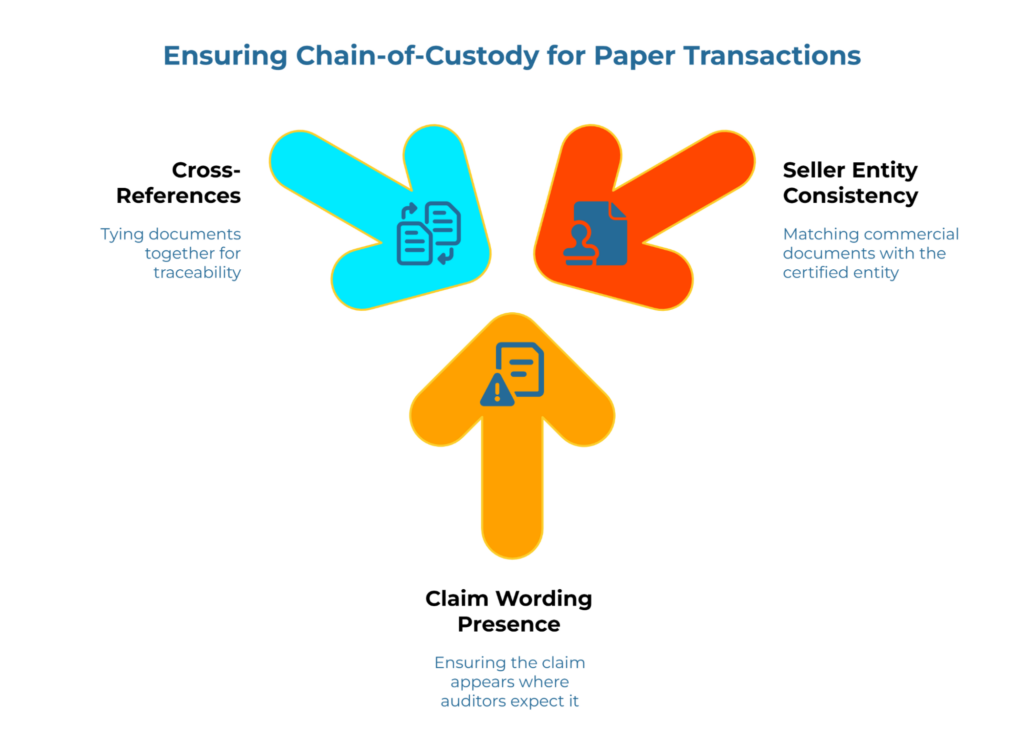
Each field addresses one of these failure points. Seller entity consistency ensures commercial documents match the certified entity. Claim wording presence ensures the claim appears where auditors expect it. Cross-references tie documents together so any single document can be traced through the transaction chain.
Common Failure Modes and Fast Fixes
Claim missing on invoice even though it appeared on quote. Invoicing staff may not know claim wording must transfer from the quote. For kraft paper buyers and other procurement professionals, establishing clear RFQ requirements upfront prevents these downstream documentation failures. Prevention: Require claim wording on the quote as acceptance condition, then reference it in the PO: “Invoice must include certified claim wording as stated on Quote #[number].”
Claim present but not tied to the correct line item. The invoice shows a claim at document level, but only some products are certified. Auditors cannot determine which lines the claim covers. Prevention: Specify in the PO that claim wording must appear at line-item level.
Mismatch between invoice entity and certificate holder. The invoice arrives from a trading entity, but the certificate belongs to a different legal entity. Prevention: Verify at quote stage that the invoicing entity matches the certificate holder.
Units or quantities do not match across documents. Different documents use different units—metric tons, kilograms, pounds. Auditors cannot confirm quantities align. Prevention: Specify a single unit of measure in the PO; require all subsequent documents to use it.
Example: For instance, if a PO specifies tonnes but the delivery note lists reels without conversion factors, the material balance becomes impossible to verify. What should be routine verification becomes reconciliation work—complicating the verification of the ‘Percentage’ or ‘Credit’ system required for compliance.
Lot numbers missing from delivery documents. Months later, a customer requests proof of origin for a specific production run—and it cannot be traced. Prevention: If lot-level traceability is required, include the requirement explicitly in the PO.
How to Operationalize This
Build a proof folder per supplier. Create subfolders aligned to document stages: Quotes, POs, Delivery_Docs, Invoices, Certificates. Use naming conventions with date and PO number. When an auditor requests proof, retrieve the full chain in minutes.
Assign role handoffs clearly. Procurement owns RFQ/PO clauses—whether you’re working with kraft paper mills, packaging paper suppliers, or other vendors. Ops/QA owns receiving checks. Accounts Payable owns invoice review. If no one is explicitly responsible for a verification step, it gets skipped.
Embed these requirements directly into your RFQ template. Attach it as an annex so suppliers know requirements upfront. For additional guidance, see how to structure comprehensive requests in our guide on submitting RFQs. For guidance on structuring RFQs, see The spec-driven kraft paper RFQ template: combine technical specs and commercial terms for comparable quotes. For certification claim language specifics, claim wording on quotes, POs, and invoices: what buyers should require for FSC/PEFC covers exact phrasing requirements.
Protocol for Suppliers and Traders: How to Send Paperwork That Clears Buyer Checks
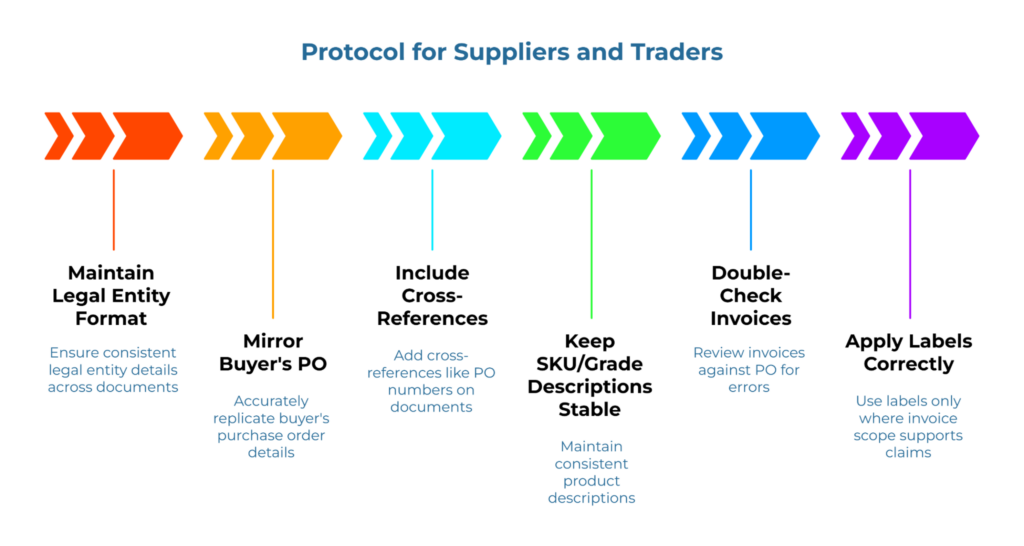
For paper suppliers and traders, reducing holds means getting documentation right the first time.
- Keep one legal entity format across quote, delivery docs, and invoice—name and address aligned to your certificate.
- Mirror the buyer’s PO exactly—transfer claim wording and certificate references word-for-word. Put the claim on the same line items every time; avoid generic footer-only claims.
- Include cross-references on every document—PO number on delivery docs and invoices, delivery note number on invoices.
- Keep SKU/grade descriptions stable from quote through invoice. Provide lot or batch numbers proactively if the product type uses them.
- Double-check invoices against the PO before sending—a five-minute review catches most errors that cause payment delays. If labels are used, apply them only where the invoice scope supports the same claim.
Closing
Chain-of-custody documentation failures are preventable. They occur when requirements remain implicit—when buyers assume suppliers know what is needed, and suppliers assume buyers will fill gaps later.
A stage-by-stage checklist removes the guesswork. It tells suppliers what to provide, gives buyers a verification framework, and creates a document trail that survives audits. Requirements vary by scheme and product context, so treat this as a practical minimum and refine it to match your internal policy and the standards relevant to your supply chain.
Explore our guides for more on structuring procurement workflows and building reliable documentation systems: The buyer’s guide to paper certifications: FSC, PEFC, and beyond. For buyers ready to implement these standards, connect with suppliers on PaperIndex.
Disclaimer:
This guide is provided for educational and informational purposes only.
Our Editorial Process:
Our expert team uses AI tools to help organize and structure our initial drafts. Every piece is then extensively rewritten, fact-checked, and enriched with first-hand insights and experiences by expert humans on our Insights Team to ensure accuracy and clarity.
About the PaperIndex Insights Team:
The PaperIndex Insights Team is our dedicated engine for synthesizing complex topics into clear, helpful guides. While our content is thoroughly reviewed for clarity and accuracy, it is for informational purposes and should not replace professional advice.