
📌 Key Takeaways
Chasing spot-market dips might look like smart procurement, but the real cost isn’t in any single price—it’s in the variance that destabilizes budgets, disrupts quotes, and erodes stakeholder trust.
- Variance Trumps Price: High cost swings create more damage than slightly elevated unit costs—lumpy payables strain working capital, quotes become unreliable, and internal approvals slow to a crawl.
- Index-Linked Pricing Dampens Swings: Tying purchases to a third-party benchmark smooths volatility without eliminating flexibility, creating an audit trail that speeds approvals and builds trust with finance and ownership.
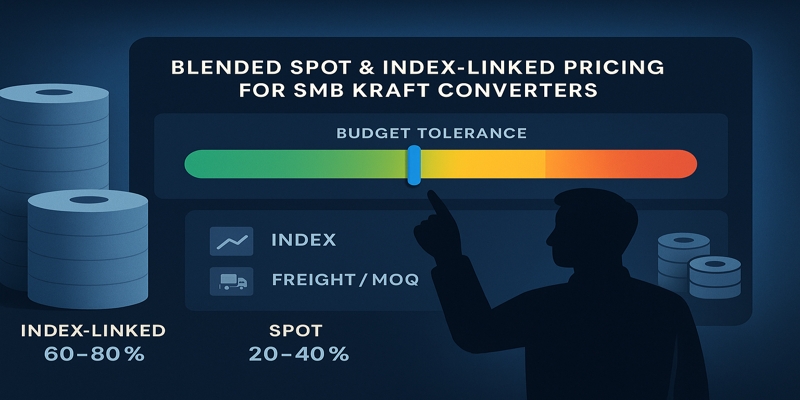
- The Blended Model Wins for SMBs: Securing 60–80% of volume through index-linked contracts while reserving 20–40% as a governed spot tranche balances predictability with tactical agility—rules prevent spot buying from becoming the default.
- Governance Requires Pre-Decided Triggers: Document tolerance bands, define when spot purchases are allowed (inventory gaps, seasonal patterns, band-edge hits), and establish a 30/60/90-day review cadence so decisions follow process, not personality.
- Landed Cost Is the Only Real Metric: Fold minimum order quantities and freight surcharges into every comparison—apparent spot wins often disappear when true delivered cost is calculated.
Rules-based procurement de-personalizes decisions and accelerates approvals when markets test discipline. Procurement and sourcing managers at small and medium-sized packaging converters will find a practical framework here, setting the foundation for the detailed implementation guidance that follows.
The meeting starts with a simple question: “Why don’t we just wait for the market to dip?” It sounds reasonable—almost savvy. After all, if kraft paper prices are trending down, shouldn’t your procurement team hold off and capture a better price next month?
Here’s the problem. That approach treats today’s price as the metric that matters most. It’s not. For small and medium-sized kraft packaging converters operating on tight margins, the real enemy isn’t a slightly higher unit cost this week. Its variance—the unpredictable swings that make your quotes unreliable, your budgets unstable, and your internal approvals a nightmare.
Chasing dips might deliver a win on one purchase order. But it introduces a pattern of lumpy demand and reactive decision-making that erodes planning confidence and creates friction with stakeholders who need to defend your numbers. When procurement becomes a game of timing the market, you’ve shifted from managing supply to gambling on it.
This article examines two fundamental pricing approaches—spot buying and index-linked contracts—and explains why most SMB converters benefit from a blended model that dampens swings without eliminating flexibility. You’ll leave with a defensible framework: a governed mix of stable, index-linked volume and a small, controlled spot tranche.
What You’re Actually Optimizing: Variance vs “Cheapest Today”
Most procurement conversations start with the wrong question. Teams ask, “What’s the price today?” when they should be asking, “What’s our cost variance over the next quarter?”
Why Variance Kills SMB Margins
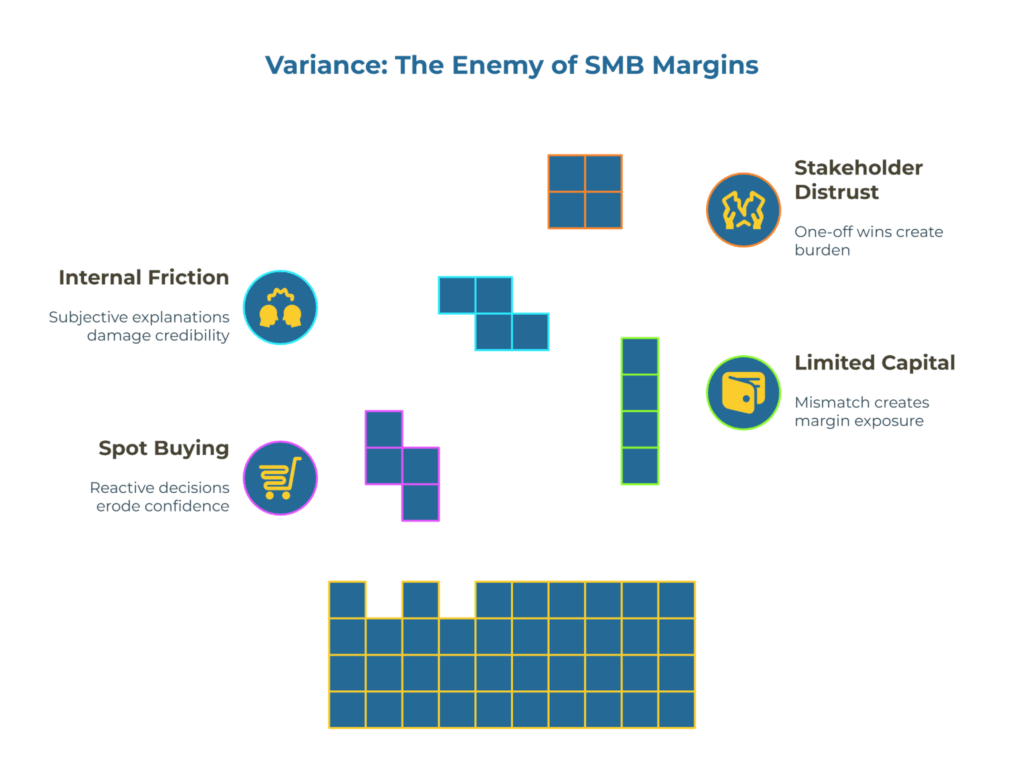
When you chase spot-market dips, you’re making a bet that timing will offset the operational cost of constantly renegotiating, adjusting quotes to customers, and explaining price changes to finance. For large converters with dedicated procurement systems and multi-month inventory buffers, that trade-off can work. They have the cash flow to buy forward and the analytical infrastructure to model scenarios.
SMBs rarely do. Your working capital is limited. Your quotes to customers are often locked in for 30 to 90 days, but your input costs can shift weekly if you’re buying spots. That mismatch creates exposure: if kraft paper jumps 8% mid-contract, your margins evaporate unless you’ve built in a protective cushion—which makes your quotes less competitive.
High variance also creates internal friction. When finance or ownership asks why material costs moved 12% between February and March, the explanation becomes subjective. “We waited for a dip, but it didn’t come” isn’t a governance model; it’s a post-hoc rationalization. Planning confidence falls. Quotes face pushback. Your credibility as a procurement function takes a hit.
Perceived Fairness Beats One-Off Wins
There’s a psychological dimension here that procurement teams often underestimate. Stakeholders—whether it’s your CFO, plant manager, or sales team pricing jobs—want to believe your procurement decisions follow a rule, not a hunch. They’re more willing to accept price increases when they can see a clear mechanism behind them.
This is where index-linked pricing creates unexpected value. Even if the index moves up, the process feels systematic. You can point to a third-party benchmark and say, “Here’s the formula we agreed to; here’s what happened this quarter.” That audit trail improves approvals and builds trust with ownership. One-off spot wins, by contrast, create an expectation that you can always “find a deal”—which becomes a burden when market conditions tighten.
Two Models, One Decision
Let’s define the two core approaches and their mechanics before we discuss blending them.
Spot Buying: Tactical and Time-Boxed
Spot buying means negotiating each purchase order individually at the current market rate. You contact suppliers, request quotes, and lock in a price for a specific shipment. Payment terms and delivery windows are short—often 30 to 60 days.
When it helps: Spot buying makes sense in narrow windows where you need tactical flexibility. If you’re filling a short-term inventory gap, responding to a sudden customer order, or testing a new supplier before committing to volume, spot purchases let you move quickly without long-term obligations.
The risks: Every purchase becomes a negotiation. You lose visibility into future costs, which makes budgeting speculative. If the market moves against you, there’s no damping mechanism—your costs swing in real time.
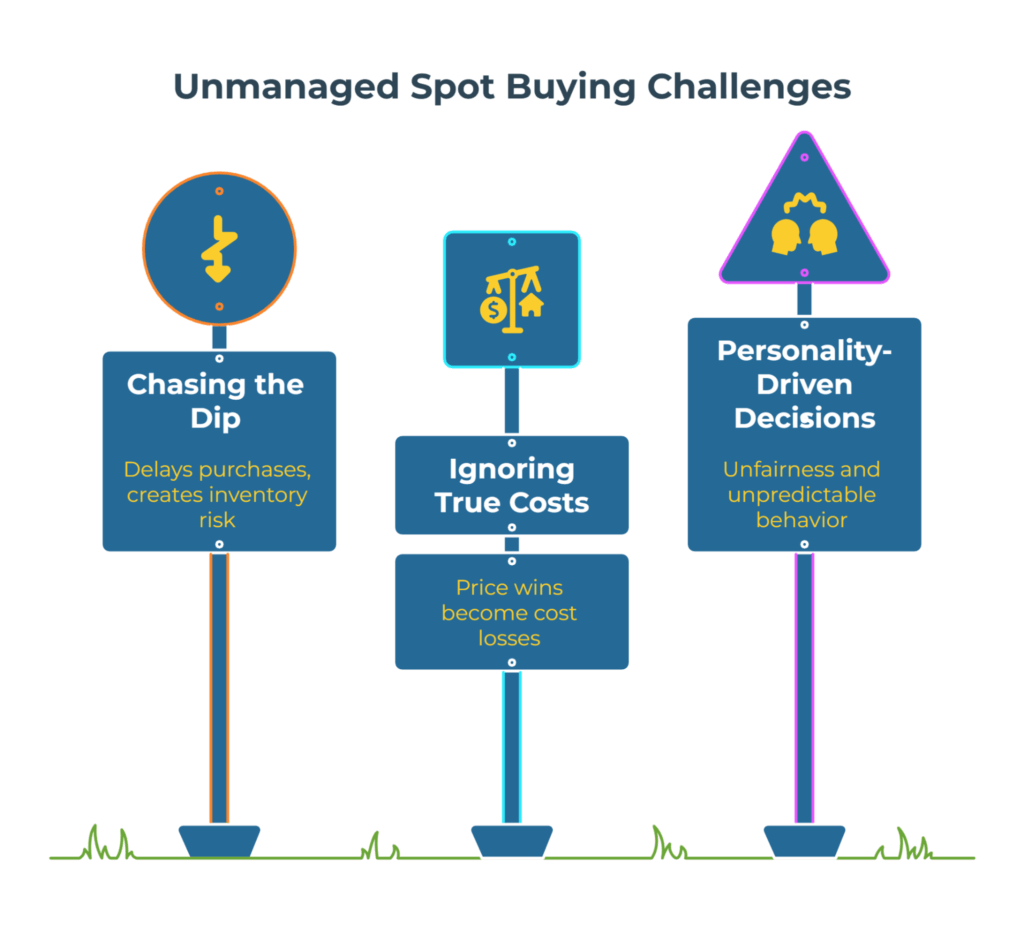
Common pitfalls when spot buying is unmanaged:
When spot purchases lack governance, three problems tend to emerge. First, “chasing the dip” becomes the default operating mode rather than the exception it should be. Teams get conditioned to wait for better pricing, which delays necessary purchases and creates inventory risk. Second, unit economics often ignores minimum order quantities and freight surcharges, so what looks like a price win disappears when you calculate true landed cost. Third, decisions become personality-driven rather than policy-driven—whoever argues most convincingly gets their way, which raises perceived unfairness both internally and with suppliers who can’t predict your behavior.
Index-Linked: Dampen, Not Dictate
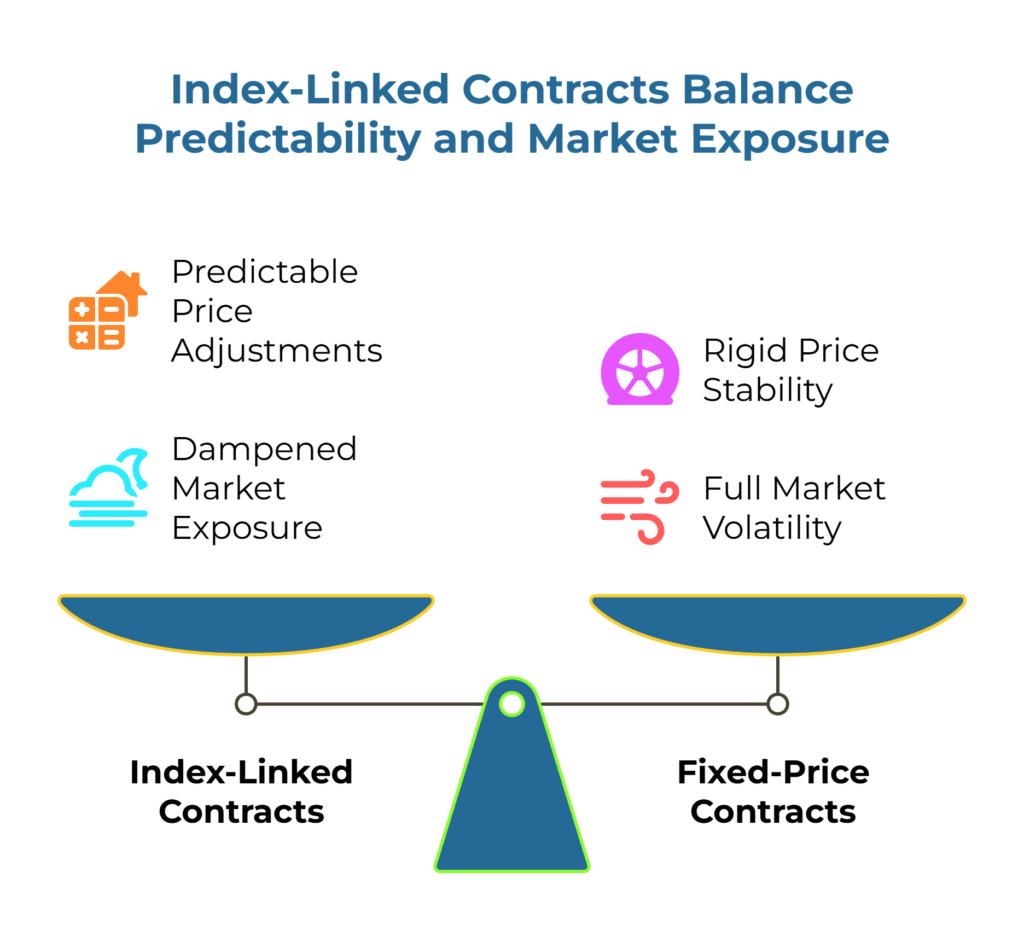
Index-linked contracts tie your purchase price to a third-party market index, typically with a predetermined formula. The most common structure is a base price that adjusts quarterly or monthly based on percentage moves in the index.
For example, if you agree to a base price of $800 per ton and the index rises 5%, your next contract price becomes $840. The index reference point, adjustment frequency, and any caps or floors are negotiated upfront.
The goal here is damping, not dictating. You’re not locked into a rigid fixed price, but you’re also not exposed to the full swing of daily spot rates. The formula creates predictability for both sides, which means suppliers are more willing to commit capacity and you can forecast costs with confidence. While organizations like the U.S. Bureau of Labor Statistics and the IMF Primary Commodity Prices portal track high-level statistical data, most commercial contracts use specific benchmarks from Price Reporting Agencies (PRAs) as the neutral reference point..
What to watch: Index lag is real. Most indices reflect market activity from the prior period, so there’s a delay between actual price movements and your contract adjustments. You also need to confirm the index covers your specific grade and geography. A North American softwood kraft index won’t accurately track European recycled linerboard.
Practical Comparison
The table below summarizes how different pricing models compare across use cases, benefits, risks, and governance requirements:
| Model | Best-Use Cases | Benefits | Risks (If Unmanaged) | Governance Essentials |
| Fixed | Rare windows of long-term price clarity | Predictable unit cost | Opportunity loss if market falls; renegotiation friction | Clear term, walk-away triggers, review clause |
| Index-Linked | Baseline volume across quarters | Dampened variance; auditability; perceived fairness over time | Index lag/coverage mismatch | Public, citable index; logged methodology; band-edge actions |
| Spot | Tactical fills, seasonal spikes, discrete flips | Agility; occasional price wins | Higher variance; freight/MOQ surprises; decision friction | Caps by grade/season; evidence log; inventory-based gates |
This comparison clarifies that no single model wins in all contexts. The choice depends on your volume predictability, working capital constraints, and tolerance for variance.
The Blended Mix Most SMBs Can Defend
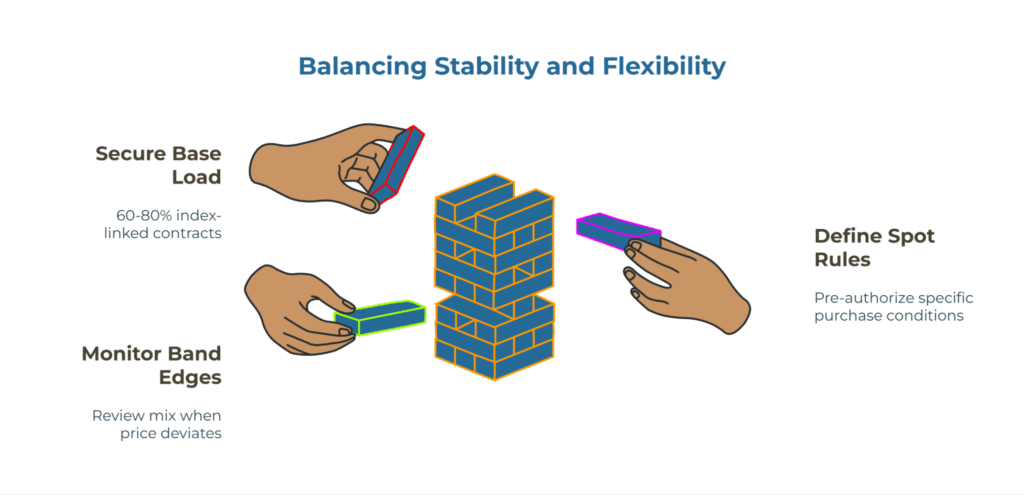
Here’s the practical question: how do you balance the stability of index-linked pricing with the flexibility of spot buying?
The answer for most small and medium converters is a governed blend—a predefined split between stable, index-linked volume and a capped spot tranche that you use only under specific conditions.
Illustrative Guardrail: 60–80% Index-Linked Base; 20–40% Governed Spot
A defensible starting point is to secure 60% to 80% of your anticipated volume through index-linked contracts. This becomes your base load—the predictable, smoothed supply that stabilizes budgets and supports your core production schedule.
The remaining 20% to 40% stays available as a spot tranche. This isn’t a license to chase every dip. It’s a pre-authorized allowance that gives you tactical room to respond to specific scenarios without destabilizing the budget.
Pre-Decided Rules: When Spot Is Allowed
The discipline comes from defining, upfront, the conditions under which you’ll use spot purchases. Without rules, the spot tranche becomes a temptation to second-guess every index adjustment. With rules, it becomes a tool.
Consider allowing spot purchases when:
- Inventory targets are at risk. If lead times stretch unexpectedly or demand spikes, spot buying lets you fill the gap without renegotiating your index-linked contract.
- Seasonal patterns favor it. Some grades experience predictable softness during low-demand periods. If your historical data shows consistent price dips in August, pre-plan spot purchases for that window.
- Band edges are hit. If your index-linked price moves outside a tolerance band you’ve set (more on this below), you may pause and evaluate whether to bring forward spot purchases or renegotiate the base.
Decision Mini-Flowchart:
IF spot tranche > 40% of volume OR index price hits upper band edge
→ Trigger review: Pause spot purchases, evaluate re-linking
IF spot tranche < 20% AND price is within band
→ Maintain current mix; continue per schedule
IF lower band edge is hit
→ Evaluate: Lock additional volume via index-linked contract
This logic prevents spot buying from becoming the default behavior while preserving flexibility when market conditions genuinely warrant it.
Budget Stability Without Big Systems (Step-by-Step)
You don’t need enterprise software to implement a blended approach. Here’s a practical governance model that works for SMB converters with basic tools.
Step 1: Set a baseline cost and tolerance band.
Start with your current average landed cost for the grade in question. Define a tolerance range—for example, ±5% to 8%—that represents acceptable variance for your business. This band becomes your decision trigger.
Step 2: Choose and confirm a relevant third-party index.
Select an index that tracks your specific grade, region, and quality level. Confirm the publication lag (for example, monthly indices may report on a 15- to 30-day delay) and verify that your supplier accepts it as a reference. Well-known indices include those published by RISI, Fastmarkets, and regional industry associations. Your supplier will typically have a preferred reference; the key is ensuring both parties trust the source.
Step 3: Define your base volume and the index-linked portion.
Agree on a contracted volume that represents 60% to 80% of your forecasted annual need. Document the base price, the adjustment formula, and the frequency of resets (monthly or quarterly). Cap the spot tranche at 20% to 40% of total volume, and specify that spot purchases require approval if they exceed this threshold.
Step 4: Pre-agree band-edge actions and review cadence.
Document what happens when the index price hits your upper or lower tolerance band. Common actions include pausing spot purchases, triggering a contract renegotiation, or adjusting the base price formula. Set a standing review schedule—30-day, 60-day, and 90-day checkpoints—to evaluate whether the mix still aligns with actual demand and market conditions.
Step 5: Document MOQs and freight so unit economics are real.
Index-linked pricing only stabilizes costs if your total landed cost is well-defined. Confirm minimum order quantities, lead times, and freight terms upfront. If freight surcharges (like peak season or bunker adjustment factors) can swing your delivered cost by 15%, you need visibility into those variables, too. For more detail on how freight impacts landed cost, see our guide on containerboard cost stack explained.
This five-step model gives you a defensible process without requiring complex forecasting software. It turns procurement into a rule-based function rather than a reactive scramble.
Implementation Tips
Three practical reminders as you execute this approach: Always treat landed cost as your unit of analysis—fold in MOQs and freight every time you compare options. Keep your spot gate conditional on inventory position and seasonality, not just price attractiveness. And maintain a simple decision register where you record the rationale for purchases made at band edges; this log becomes invaluable during quarterly business reviews when stakeholders want to understand why costs moved.
When to Re-Link, Re-Balance, or Pause Spot
No pricing model is static. Markets shift, suppliers change, and your production mix evolves. The discipline comes from knowing when to revisit your decisions.
Triggers: Index Moves, Variance Breaches, Supplier Changes
Re-evaluate your blended mix when any of the following occur:
- The index moves beyond your tolerance band. If your base price was set at $800 and the index now implies $880 (a 10% move), you’ve exceeded a typical ±8% band. This triggers a review to decide whether to re-link the base price or pause spot purchases until the market stabilizes.
- Actual cost variance breaches your budget threshold. If your monthly procurement variance exceeds the tolerance you set in your budget, it’s a signal that the spot tranche is being overused or that market conditions have decoupled from your index.
- A key supplier exits or your capacity needs change. If your primary index-linked supplier can no longer meet volume commitments, you may need to renegotiate or shift more volume to spot until a replacement contract is in place.
Governance: QBR/MBR Cadence; Who Decides; Evidence to Attach
Establish a quarterly business review (QBR) or monthly business review (MBR) cadence where procurement, finance, and operations review the blended mix together. This isn’t a deep-dive strategy session; it’s a 30- to 45-minute checkpoint to confirm the model is working as intended.
Assign clear decision rights. Typically, procurement can execute spot purchases within the pre-agreed tranche and band limits, but any decision to re-link the base price or adjust the mix requires finance approval. Document the rationale and attach supporting evidence: index references from public sources, supplier quote comparisons, inventory snapshots, and a brief justification measured against your pre-agreed rules.
For a structured approach to handling price adjustments in contracts, refer to our guide on change control in paper contracts.
Supplier Perspective: How Band-Edge Rules Smooth Order Books
For suppliers and traders, a buyer’s blended approach actually improves demand predictability. When converters chase spot dips, supplier order books become erratic—high volume one month, silence the next. This makes capacity planning and inventory management harder for mills.
Index-linked contracts with clear band-edge rules signal stable, recurring demand. Suppliers know that 60% to 80% of a buyer’s volume will flow consistently, which lets them allocate capacity more efficiently and avoid the volatility that drives up their own costs. Publishing buyer-side band-edge rules—at least internally and selectively in requests for quotation—can reduce whipsaw episodes for mills and traders by clarifying when demand will flex and why. When both sides benefit from reduced uncertainty, pricing negotiations tend to be more collaborative and less adversarial.
If you’re a supplier looking to build long-term relationships with stable buyers, consider offering index-linked terms with transparent adjustment formulas. Buyers who adopt blended models are often signaling a preference for partnership over transactional spot haggling. You can contact buyers on PaperIndex to explore structured contract opportunities.
Frequently Asked Questions
Which index should I use for kraft paper—and what about lag?
The best index is one that tracks your specific grade, region, and quality tier. For North American kraft linerboard, RISI’s pricing indices are widely referenced. In Europe, Price Reporting Agencies like Fastmarkets (which provides the FOEX indices) publish the regional pricing benchmarks used in contracts, while trade bodies like CEPI (Confederation of European Paper Industries) provide broader industry statistics.. Always confirm the index’s publication lag—which often ranges from several days for weekly reports to several weeks for monthly benchmarks—and ensure your supplier accepts it as a valid reference.
Remember that the index serves as a guide to dampen swings, not as a perfect mirror of immediate mill quotes. Note the lag explicitly in contracts and in internal presentations so stakeholders stay aligned on expectations. For context on industry standards and methodologies, organizations like ISO, TAPPI, and CEPI provide frameworks for paper testing and quality specifications that underpin many commercial indices.
If lag is a concern, you can negotiate a hybrid adjustment that blends the current index with a forward-looking estimate, though this adds complexity.
Can I ever go 100% spot?
Yes, but it’s rarely advisable for converters with recurring production schedules. A 100% spot strategy makes sense if your demand is highly variable, your order sizes are small, or you’re in a testing phase with multiple suppliers. For most SMBs, going fully spot sacrifices the budget stability and stakeholder trust that index-linked volume provides. If you’re considering it, ensure you have strong cash flow buffers and board-level tolerance for significant cost variance.
How do I explain fairness to ownership or finance?
Frame it around the process, not price. When you present a blended model with index linkage, you’re showing a systematic approach to managing volatility. Walk ownership through the tolerance bands, the spot tranche rules, and the review cadence. Emphasize that this model reduces fire drills, improves quote reliability, and creates an audit trail for price changes. Most financial stakeholders prefer a clear mechanism over ad hoc negotiations, even if the mechanism occasionally produces higher costs in the short term. Fairness comes from rules, not guesses—and approvals become faster when the method is transparent and repeatable across quarters.
For a broader framework on stabilizing costs, see from volatility to clarity: a practical playbook for containerboard cost & contract foundations.
Decisions Made at the Band Edge Are Faster and Fairer
The instinct to chase dips is understandable. It feels proactive. But for SMB converters managing tight margins and demanding customers, variance is the real cost driver—not the spot price on any given Tuesday.
A blended approach—securing 60% to 80% of your volume through index-linked contracts and reserving 20% to 40% as a governed spot tranche—gives you the stability to forecast confidently and the flexibility to respond when conditions warrant it. The key is discipline: pre-decide when spot purchases are allowed, document your tolerance bands, and establish a review cadence that keeps the model aligned with your business reality.
When you move from reactive spot chasing to a rules-based blend, something shifts. Quotes become defensible. Approvals move faster. Stakeholders trust the process. You’re no longer gambling on market timing; you’re managing supply with a clear, fair framework that de-personalizes decisions at the moments that matter most.
Ready to connect with suppliers who understand blended contracting models? Find kraft paper suppliers on PaperIndex, or if you’re a buyer looking to source kraft paper with transparent pricing terms, submit an RFQ and receive quotes free. For additional guidance on managing spot versus term supply decisions, explore our article on spot vs. term supply in containerboard.
Disclaimer: This article discusses market-intelligence concepts for educational purposes only. All numerical examples provided are illustrative and hypothetical.
Our Editorial Process
Our expert team uses AI tools to help organize and structure our initial drafts. Every piece is then extensively rewritten, fact-checked, and enriched with first-hand insights and experiences by expert humans on our Insights Team to ensure accuracy and clarity.
About the PaperIndex Insights Team
The PaperIndex Insights Team is our dedicated engine for synthesizing complex topics into clear, helpful guides. While our content is thoroughly reviewed for clarity and accuracy, it is for informational purposes and should not replace professional advice.