
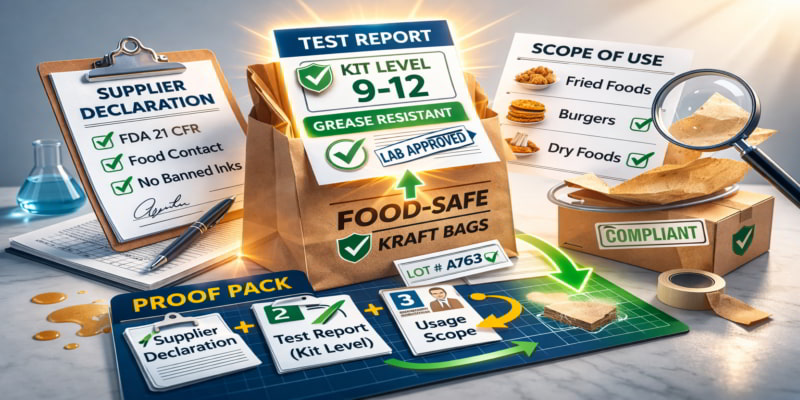
📌 Key Takeaways
Brown Kraft paper bags are not automatically food safe—proof comes from documentation that matches your actual use conditions, not from color or thickness.
- Color Proves Nothing: “Brown” and “kraft” describe appearance, not safety—bags need traceable compliance documents tied to how you actually use them.
- Thickness Doesn’t Block Grease: Paper weight (GSM) measures heaviness, not barrier strength—only chemical treatments with Kit level ratings stop oil from soaking through.
- Get Three Documents Before Ordering: Request a supplier declaration, test reports matching your food type and temperature, and scope confirmation covering the whole bag including inks.
- Spot Checks Flag Problems, Not Safety: Visual inspection catches obvious red flags like flecks or odors, but a clean-looking bag can still lack proper documentation.
- Specification Sheets Beat “Brown Bag” Language: RFQs that name fiber type, food contact conditions, and documentation requirements filter out risky suppliers before inspection day.
Documentation you can retrieve in minutes beats hoping your packaging holds up.
Food service operators and procurement managers sourcing takeout packaging will gain a clear verification framework here, preparing them for the detailed compliance workflow that follows.
~ ~ ~ ~ ~ ~ ~ ~ ~ ~ ~ ~ ~ ~ ~ ~ ~ ~
Brown paper is often assumed to be kraft, and kraft is often assumed to be food-safe. Neither is a legal guarantee.
The bag looks natural. It feels sturdy. It holds the weight. But when a health inspector asks for compliance documentation, that familiar brown color offers no answer. And when grease bleeds through onto a customer’s car seat, the thickness that seems robust fails to prevent lipid migration—a failure mode that traces to grease resistance ratings, not paper weight.
A single failed inspection can generally cost an operation significantly more than its estimated annual food packaging paper savings. Staff double-wrapping items because paper cannot handle the grease typically doubles the immediate material cost for that specific packaging invisibly—a hidden waste that proper specifications can eliminate. Customers who find oil stains do not complain—they simply do not return.
Are brown paper bags food safe? Not automatically. Many operators unknowingly use food packaging paper that lacks proper documentation, risking health violations and brand damage. This guide moves from that uncertainty to confidence—through a quick spot-check that flags obvious problems, a proof checklist that verifies suppliers, and specification language that closes documentation gaps before the next order ships.
Quick Answer: Are Brown Kraft Paper Bags Food Safe?
A ‘brown kraft paper bag’ is not a food-safety specification. Some brown bags are virgin kraft made for food-contact use; others are low-grade recycled paper with unknown additives and contaminants. The difference is not reliably visible—proof comes from traceable documentation that matches your real use (dry vs fatty foods, heat, and contact time), which is why verification protocols must replace supplier promises.
Think of food-contact certification as a passport for your food packaging paper—without it, the product cannot legally travel to your customer’s plate. Inspectors require documentation that connects the specific bag to the conditions it will face in your operation. Color and thickness tell them nothing. Verified documentation tells them everything.
Generic bags are commodity products sold by appearance and price rather than verified specification and proof—a sourcing approach that introduces hidden risks beyond what ‘food safe’ labels reveal. They may work perfectly well. They may also carry undisclosed risks. Without documentation, there is no way to distinguish between the two.
Myth vs. Reality: Why ‘Brown Kraft Paper’ Is a Risky Label
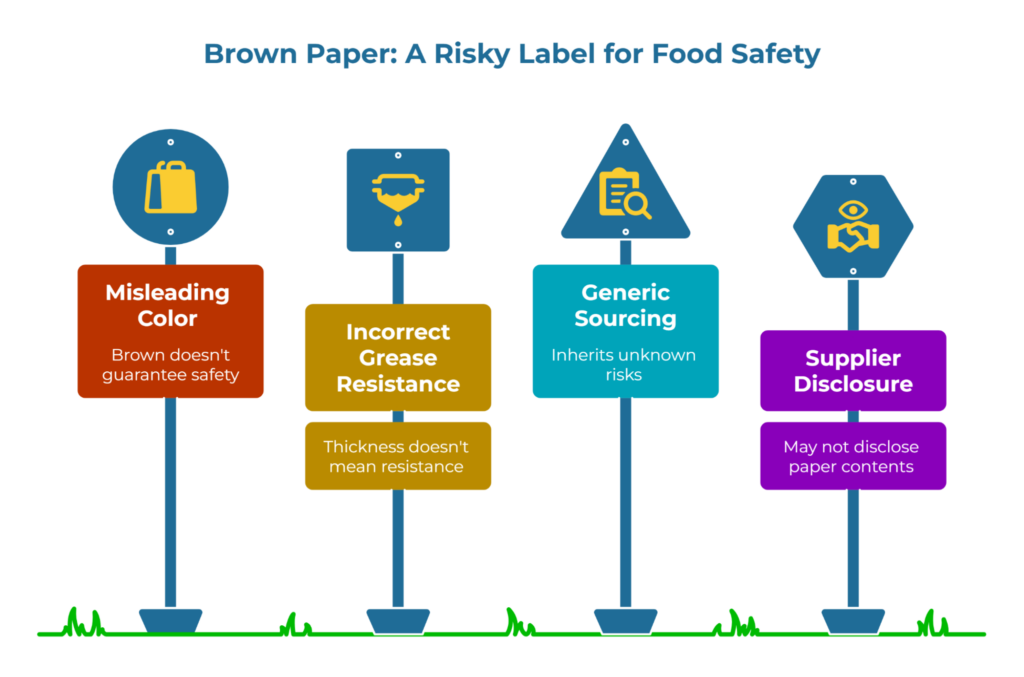
Myth: Brown paper equals kraft equals food safe.
Reality: Brown Kraft can mean virgin kraft manufactured specifically for food contact. It can also mean low-grade recycled board with no food-contact testing whatsoever. The color itself communicates nothing about regulatory alignment.
A common misconception: thicker paper (higher GSM) provides better grease resistance. It does not. As explained in food packaging paper specifications 101, GSM measures weight, not barrier performance. A heavy sheet without proper treatment will still wick grease through capillary action over time—sometimes in minutes with hot, fatty foods. Resistance to grease migration is achieved through internal sizing or surface treatments, verified by TAPPI T 559 ‘Kit’ test ratings. Kit levels function like SPF for paper: higher numbers indicate greater resistance to grease and oil penetration.
When buyers purchase by appearance rather than specification, they inherit unknown risk—a failure of generic sourcing that the specifications-first protocol was designed to prevent. The supplier may not know—or may not disclose—what actually went into that paper. And that risk transfers directly to your operation, your inspection record, and your brand reputation.
What Can Go Wrong: Chemical Migration in Recycled Paper
The concern is not whether paper looks clean. The concern is chemical migration—substances moving from paper into food under heat, moisture, and extended contact.
Migration risk refers to the potential for food packaging paper substances to transfer into food. Recycled paper enters the manufacturing stream from mixed waste. It can carry residues from printing inks, adhesives, and processing chemicals from its previous use. Mineral oil hydrocarbons—specifically Mineral Oil Aromatic Hydrocarbons (MOAH)—represent a documented concern. While the European Food Safety Authority’s 2023 assessment concluded that Mineral Oil Saturated Hydrocarbons (MOSH) do not raise health concerns at current exposure levels, it confirmed that MOAH with three or more aromatic rings poses a possible health risk, prompting ongoing investigation of these compounds in food-contact materials (FCMs) (EFSA, “Update of the risk assessment of mineral oil hydrocarbons in food,” 2023).
The U.S. regulatory framework governs these materials under 21 CFR 176.170 (components of paper and paperboard in contact with aqueous and fatty foods) and 21 CFR 176.180 (components of paper and paperboard in contact with dry food), which dictate extractive limits based on solvent simulant testing.
The distinction between virgin kraft and recycled fiber matters here. Virgin kraft comes from controlled inputs with documented processing. Recycled fiber can be excellent for food contact—when manufactured and tested specifically for that purpose. The problem is unknown recycled inputs with unknown documentation.
The 30-Second Spot Check (Useful, but Not Proof)
A quick visual and sensory check can flag obvious problems. Think of this as triage—it identifies bags that warrant immediate scrutiny, not bags that pass compliance.
Watch for these warning signs:
- Visible flecks or dark spots may indicate mixed-grade recycled content with unknown inputs.
- Unusual odor—chemical or musty—can signal ink residues or processing aids.
- Rough or inconsistent texture within the same batch suggests variable quality control.
- Uneven thickness can reflect low-grade fiber sources.
Critical caveat: Passing this check does not mean the bag is food safe. A clean-looking bag can still contain undisclosed additives or lack documentation for your specific use conditions. The spot check identifies bags that are obviously suspect. It cannot validate bags that merely appear acceptable.
What to Ask Your Supplier: The FDA-Aligned Proof Pack
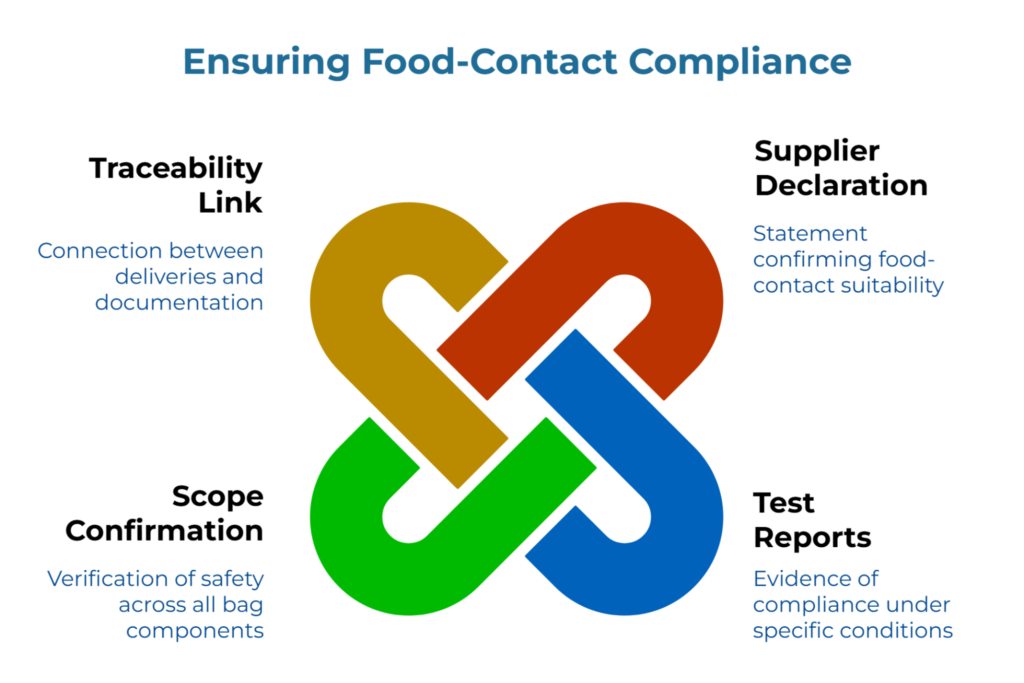
Documentation turns assumptions into evidence. A supplier who can produce these items demonstrates supply chain visibility. A supplier who cannot be selling bags never intended for direct food contact.
Food-contact compliance means documentation aligned to your intended use—not a generic claim, but traceable proof covering the actual conditions your food packaging paper will face.
Request these three items before placing your next order:
- A supplier declaration or letter of guarantee stating the paper is manufactured for food-contact use. This declaration should identify the relevant regulatory basis—for U.S. markets, typically FDA 21 CFR Part 176.
- Test reports or third-party statements that match your actual conditions of use. A report for dry food at room temperature does not validate bags used for hot, greasy takeout—understanding how to read your supplier’s technical data sheet prevents this mismatch. Temperature, food type, and contact duration must align with your operation.
- Scope confirmation covering the complete bag—paper, coatings, inks, and adhesives. Food-safe paper can still create risk if printing ink is not formulated for food contact.
A simple readiness habit: keep these three items per bag SKU, along with a traceability link (invoice or lot reference) that connects deliveries back to the documentation.
If a supplier cannot provide these documents, it signals either a gap in their supply chain visibility or a product never intended for direct food contact. For guidance on organizing compliance documentation, see the food packaging paper trail guide.
Safer Specification Language: How to Avoid the ‘Generic Bag’ Trap in RFQs
The phrase ‘brown kraft paper bag’ belongs in a grocery store, not a sourcing document. It describes appearance, not compliance. Replace vague descriptions with verifiable requirements.
Fiber type: Specify virgin kraft or certified food-contact recycled fiber. This single requirement closes the door on unknown waste-stream inputs.
Intended contact type: State whether the bag will contact dry, aqueous, or fatty foods—and include typical hold time and whether delivery is involved. Different food types require different migration testing under the FDA framework.
Performance requirements: If grease resistance matters, specify a Kit level range. If structural strength matters, specify a GSM target with tolerance. Measurable specifications produce comparable quotes..
Documentation requirement: State that quotes must include food-contact compliance documentation covering the complete bag construction—paper, coatings, inks, and adhesives. Suppliers who cannot meet this requirement filter themselves out before you discover the gap at inspection.
This approach shifts the conversation from price-per-bag to total risk. For context on the broader stakes, see beyond the fine: the reputation risk of non-compliant food packaging.
Next Steps: Move from Guessing to Verified Sourcing
The path from uncertainty to confidence requires a transition from aesthetic-based procurement to evidence-based sourcing.
- Audit your current bags. Do you have documentation that matches your actual use conditions? If not, you have identified a gap worth closing.
- Shortlist suppliers who provide proof upfront. Browse paper bag suppliers and filter for those who can support documentation requests. Willingness to provide documentation signals operational maturity.
- Post an RFQ with clear specifications and documentation requirements. Request proof documents as part of the quoting process, not after the shipment arrives. Submit an RFQ for paper bags and require compliance evidence before committing.
- File documentation for fast retrieval. When an inspector asks, the proof should be available within minutes—not buried in an email thread from six months ago.
Escaping the ‘brown kraft paper’ trap requires a shift from aesthetic-based procurement to evidence-based sourcing: verify compliance, archive documentation, and vet suppliers.
That shift—from reactive to proactive, from assumption to verification—is what separates operations that scramble during inspections from those that pass them without breaking stride. It is the difference between hoping your food packaging paper holds up and knowing it will.
Disclaimer:
This article is for informational purposes only and does not constitute legal, regulatory, or professional advice. Food-contact compliance depends on the exact materials, additives, and conditions of use. Always confirm requirements with qualified professionals and request current documentation from suppliers before making sourcing decisions.
Our Editorial Process:
Our expert team uses AI tools to help organize and structure our initial drafts. Every piece is then extensively rewritten, fact-checked, and enriched with first-hand insights and experiences by expert humans on our Insights Team to ensure accuracy and clarity.
About the PaperIndex Insights Team:
The PaperIndex Insights Team is our dedicated engine for synthesizing complex topics into clear, helpful guides. While our content is thoroughly reviewed for clarity and accuracy, it is for informational purposes and should not replace professional advice.