

📌 Key Takeaways
Reusing old food-contact documents only works when the file still matches today’s product, supplier, coating, market, and contact conditions.
- Same Name Doesn’t Mean Same Product: A cupstock grade name can stay identical while coatings, suppliers, or production sites quietly change behind the scenes.
- Check Scope Before You File: Every reused document should match the exact product code, coating system, food type, temperature range, and target market for the current order.
- One Market’s Proof May Not Work Elsewhere: A supplier statement written for one country’s rules does not automatically satisfy another market’s food-contact requirements.
- Assign Clear Owners for Every Review: Procurement checks supplier and product alignment, QA verifies technical scope, and regulatory confirms market fit — no single team should decide alone.
- When in Doubt, Hold and Ask: Documents missing key details like coating type, issue date, or production site should not support approvals until the supplier clarifies.
Treat document reuse as a verification step, not a shortcut — matched files save time, mismatched files create risk.
Procurement managers, QA leads, and regulatory specialists sourcing cupstock across markets will gain a repeatable screening method here, preparing them for the detailed verification framework that follows.
~ ~ ~ ~ ~ ~ ~ ~ ~ ~ ~ ~ ~ ~ ~ ~ ~ ~
Existing food-contact records can save procurement teams significant time — fewer supplier requests, faster approvals, less repetition across repeat orders. But that speed only holds when the document still matches the product, supplier, intended use, and target market under current review. For procurement teams under pressure to move quickly, the temptation is to treat an existing file as sufficient. For QA and regulatory teams, the same file is useful only when its scope can be traced to the exact cupstock decision being made. When any of those elements have shifted, or when the original statement was never specific enough to confirm them, the file may create a false sense of coverage rather than genuine evidence.
This article provides a practical verification framework for deciding when reuse is reasonable and when updated evidence should be requested. It does not determine legal compliance for any market or application.
What “Reusing a Document” Really Means in Cupstock Procurement
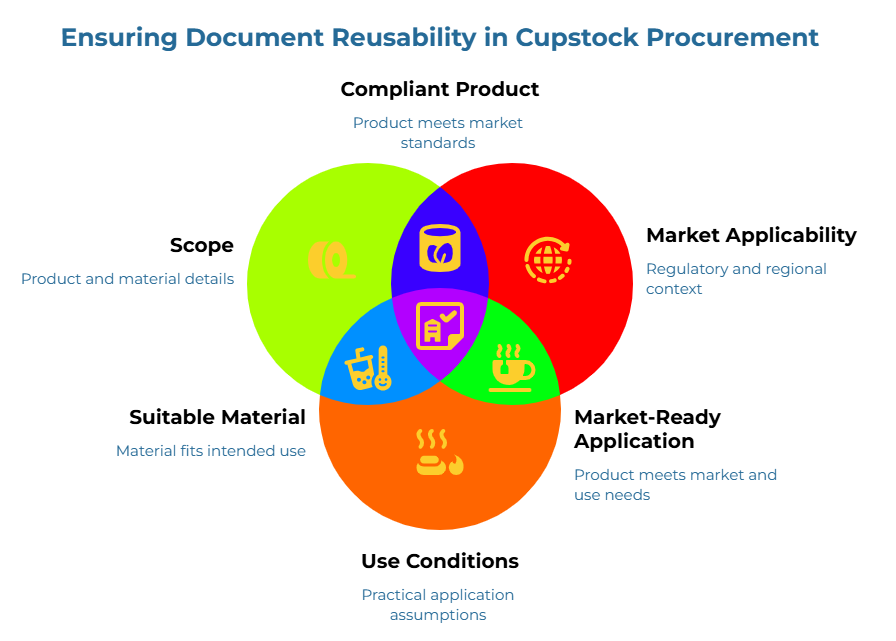
Reusing a food-contact document is not the same as copying an old PDF into a new approval folder. It means confirming that the document still applies to the same cupstock grade, coating, supplier entity, manufacturing context, intended food or beverage contact, and regulatory scope that the current decision requires.
Three dimensions define whether a document still applies. The document’s scope is the set of conditions it actually covers — product name, grade, product code, basis weight, coating or barrier system, supplier entity, production site, converter, intended beverage type, temperature assumptions, and target market. The document’s market applicability is the market or regulatory context it is intended to support; a supplier statement written for one market, one customer requirement, or one intended use should not be treated as automatically reusable for another destination without review. The document’s use conditions are the practical assumptions behind the statement — hot or cold beverage contact, contact duration, food or drink type, and whether the document covers base board, coated cupstock, or the final converted cup.
A cupstock supplier’s declaration may have been issued for a specific product code, a particular coating system, a defined production site, and a stated set of contact conditions. If any of those details no longer match — even when the product name looks identical — the document may not cover the material being purchased. Common gaps appear when the grade name stays the same but the coating formulation changes, when the statement covers the base board but not the coated or converted product, when the supplier entity that signed the document no longer fulfills the order, or when old documents lack product codes or revision dates altogether.
Treating reuse as a deliberate verification step helps teams avoid gaps that surface during audits, customer complaints, or market-entry reviews.
The Document-Reuse Verification Matrix
Before relying on an existing cupstock food-contact document, review each area below. The “Signal” column suggests whether to proceed, hold, or request updated evidence.
| Verification Area | What to Check | Why It Matters | Signal | Owner |
| Product name, grade, code | Exact cupstock product match including grade, product code, GSM or basis weight, and supplied format | Generic names may cover multiple grades with different compositions | Proceed if exact match. Hold if vague. | Procurement / QA |
| Coating or barrier system | Coating type, barrier layer, coating weight, or lamination identified | Suitability often depends on the contact-surface coating, not only base paper | Hold if unnamed. Update if changed. | QA / Procurement |
| Base board vs. coated board vs. converted cup | Scope: base paper only, coated board, or finished cup | A base-paper declaration may not address coating, adhesive, ink, or conversion | Hold if narrower than application requires. | QA / Regulatory |
| Supplier legal entity | Issuing entity matches current supplier | Restructuring or acquisitions can disconnect document from current relationship | Update if entity changed. | Procurement |
| Manufacturing site or converter | Production site, coating site, or converter identified and unchanged | Different facilities may use different materials or processes | Hold if unstated or changed. | QA |
| Date and version | Dated, with revision number and document title | Undated or uncontrolled files may not reflect current material or supplier controls | Hold if undated. Update if outdated. | Procurement / QA |
| Authorized issuer | Signature, issuer role, and issuing organization confirmed | Buyers need to know whether the statement came from an authorized supplier source | Request updated evidence if the issuer is unclear. | Procurement / Supplier |
| Food or beverage type | Stated food types, beverages, or contact conditions | Cold-beverage evidence may not apply to hot-fill or fatty foods | Hold if unstated or mismatched. | QA / Regulatory |
| Temperature and contact duration | Temperature range and contact time specified | Hot coffee and cold drinks may require different evidence | Hold if unstated or mismatched. | QA |
| Market or jurisdiction scope | Named regulatory framework or market | One framework may not satisfy another market’s requirements | Update if target market is not covered. | Regulatory |
| Component coverage | All layers addressed: fiber, coating, adhesive, ink, additives | Partial-scope documents leave material layers unaddressed | Hold if key components are excluded. | QA / Regulatory |
| Test report or declaration references | Referenced test reports or declarations still current and available | Outdated references weaken evidentiary value | Hold if expired or unverifiable. | QA |
| Change history | Supplier confirms no material, process, or formulation changes since issue date | Changes may occur between orders without updated documentation | Update if change status unknown. | Procurement / QA |
| Internal approval record | Record who reviewed the reuse decision and for which product, market, and order | Traceability helps future teams understand why the file was accepted or escalated | Proceed only when the reuse rationale is documented. | Procurement / QA / Regulatory |
For teams preparing new specifications, related cup making board specification fields can help align supplier requests with the document checks above.
Material, Processing, and Supply Chain Variations Affecting Document Validity
Even when a product label looks familiar, underlying variations can render a document incomplete. Teams accustomed to evaluating material revisions will recognize similar principles here. None of the following changes automatically invalidates a document, but each should trigger a review.
Coating or barrier changes. A change in coating chemistry, polyethylene grade, barrier type, coating weight, or coating supplier may mean that the original food-contact evidence no longer applies. The same is true when a document refers only to base paper while the current order involves coated cupstock or a converted cup.
Supplier entity or ownership changes. Mergers, acquisitions, or restructuring can change the responsible legal entity. A document signed by a previous entity may not carry forward automatically.
Mill or converter changes. A different facility may use different raw materials, processes, or quality systems. Site or converter changes can affect traceability and the supporting evidence behind a supplier statement.
Formulation or raw material changes. Shifts in fiber source, recycled-to-fresh fiber ratio, functional additives, or sizing chemistry can affect food-contact suitability and may not always be communicated proactively. A supplier may also change product naming or internal production routing while the commercial description remains familiar.
Intended use changes. Cupstock documented for cold beverages may not be supported for hot-fill or microwave applications without additional evidence.
Market Applicability Questions for Global Buyers
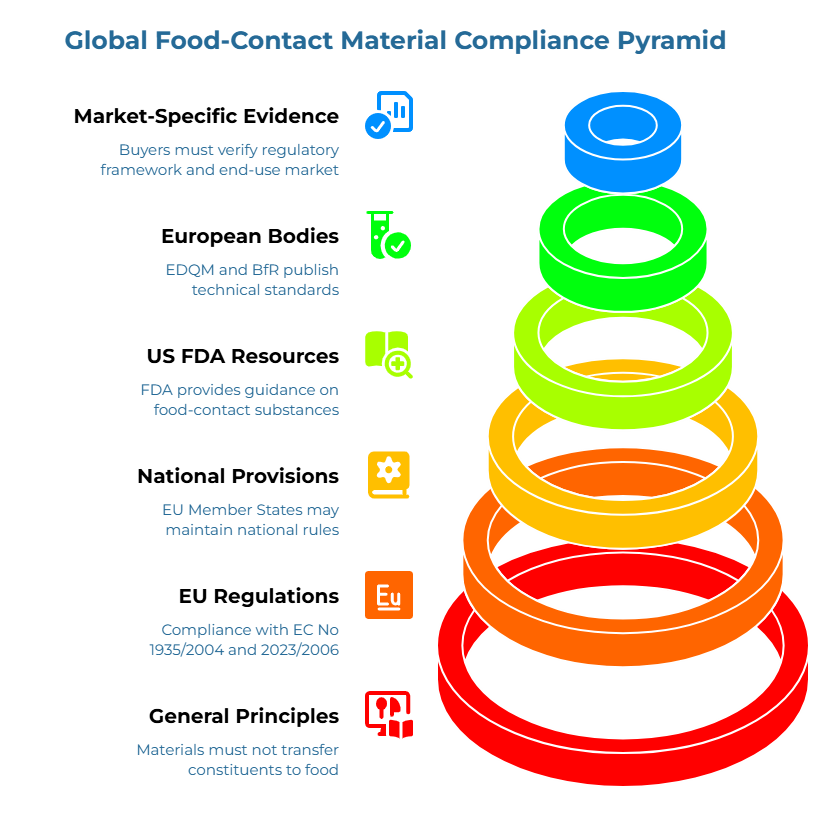
A food-contact declaration prepared for one market may not satisfy requirements in another — and global teams sometimes assume cross-market applicability without checking.
Within the European Union, food-contact materials must comply with Regulation (EC) No 1935/2004. This regulation establishes general principles, including the requirement that materials must not transfer constituents to food in quantities that endanger human health. EU requirements also include good manufacturing practice rules under Regulation (EC) No 2023/2006, and material-specific or national legislation where applicable. Buyers should be aware that where specific EU-wide measures are absent, EU Member States may maintain national provisions for food-contact materials — so a single EU-level statement may not cover all applicable requirements.
In the United States, the FDA provides resources related to food-contact substances including inventories, notifications, and guidance on conditions of use. Outside the US and complementing the broader EU framework, other European bodies provide specific technical standards: the Council of Europe’s EDQM publishes technical guidance on definitions, fibers, functional barriers, and testing for paper and board. Additionally, the German BfR publishes widely respected recommendations on food-contact materials, including paper and board, though these are not legally binding standards in themselves.
Buyers sourcing cupstock across multiple markets should verify whether the document names its regulatory framework, covers the end-use market, and whether additional market-specific evidence may be needed. Requirements vary by jurisdiction.
What to Ask the Supplier Before Relying on the Document Again
When an existing document is being considered for reuse, a focused set of verification questions can help confirm whether the file still applies. These are especially useful when preparing a subsequent order, onboarding a returning supplier, or entering a new market with an existing cupstock grade.
- Does the document apply to the exact product code, grade, basis weight, and coating or barrier system being supplied now?
- Does it cover base paper, coated cupstock, or the final converted paper cup application?
- Which markets, jurisdictions, or regulatory frameworks was it intended to support?
- What food or beverage type, temperature, and contact-duration assumptions were used?
- Have any formulation, raw material, coating, production site, supplier entity, or supply chain changes occurred since the issue date?
- Are the referenced test reports, declarations, or specifications still current?
- Who is authorized to issue updated statements or clarifications?
The goal is not to turn procurement into a regulatory function. The goal is to make supplier responses precise enough for QA and regulatory teams to review. If the supplier cannot confirm scope, the document should usually be held until updated evidence or clarification is available. Buyers preparing for broader supplier conversations may also benefit from reviewing their questions to ask cupstock suppliers alongside document verification.
Who Should Review Document Reuse Decisions Internally
Unclear ownership is one of the most common reasons outdated files stay in active use. When no one is specifically accountable, mismatched documents persist — especially when procurement wants speed while QA and regulatory teams need traceability.
Procurement confirms supplier identity, product code alignment, and current sourcing context. Procurement can also maintain the request log and make sure the file is tied to a specific order, product, and market review. QA checks whether the document’s technical scope matches the specification and incoming quality records, and whether version traceability is intact. QA is often the team most likely to notice when a document refers to base paper while the current decision concerns coated board or a converted cup. Regulatory or compliance reviews market applicability, intended-use coverage, and regulatory framework alignment. The supplier provides updated evidence, clarification on scope, or confirmation that no changes have occurred.
This ownership model keeps the process practical: procurement organizes the file, QA verifies the material match, regulatory checks market and use fit, and the supplier closes scope gaps.
Reuse Decision Outcomes: Proceed, Hold, or Request Updated Evidence
After working through the verification matrix and confirming scope, the reuse decision typically falls into one of three outcomes.
Proceed when the document clearly matches product identity, supplier entity, coating, intended contact conditions, target market, and version — and the supplier confirms no relevant changes since the issue date. The team should still record the reuse rationale for traceability.
Hold when the document appears plausible but is missing key scope details, such as an unspecified coating, unnamed production site, unclear market scope, a missing issue date, or absent supporting reports. The document should not support approval decisions until the missing information is clarified.
Request updated evidence when the product, supplier, coating, manufacturing site, intended use, or target market has changed or cannot be verified. This does not mean the product is non-compliant — it means the existing documentation does not provide sufficient scope coverage for the current context.
Make Document Reuse a Controlled Verification Step
Reusing cupstock food-contact documents can reduce administrative burden and speed up procurement — but only when treated as a deliberate verification step rather than a default filing practice. The verification matrix, supplier questions, and internal ownership model covered here give procurement, QA, and regulatory teams a repeatable way to screen documents before relying on them.
Before sending a new RFQ or reusing older supplier files, organize the exact cupstock grade, coating, intended use, and market scope that suppliers need to support. Buyers can use PaperIndex to find cupstock exporters and suppliers and prepare clearer documentation questions. For additional sourcing and packaging guidance, explore the PaperIndex Academy.
Frequently Asked Questions
Can an old food-contact declaration be reused for a repeat cupstock order?
In some cases — but only after confirming that product grade, supplier entity, coating, document version, contact conditions, and target-market scope still match. If any element has changed or cannot be verified, updated evidence should be requested.
Is a supplier certificate enough to approve cupstock for food contact?
Not by itself. Review what the certificate specifically covers — including product, coating, food type, contact conditions, and market — and confirm whether the relevant regulatory framework is addressed. Additional review by a qualified professional may be needed for the intended application and market.
Who should decide whether existing cupstock documents can be reused?
Procurement organizes the initial check. QA reviews technical scope and specification alignment. Regulatory assesses market applicability and use-condition fit. The decision benefits from cross-functional input rather than resting with a single team.
Disclaimer:
This article is for general informational purposes only and does not constitute compliance, safety, technical, legal, or professional advice. Requirements, risks, and best practices may vary by context, jurisdiction, supplier, product construction, intended use, and market. Confirm important decisions with the appropriate qualified professional, regulatory authority, supplier, or technical expert.
Our Editorial Process:
Our expert team uses AI tools to help organize and structure our initial drafts. Every piece is then extensively rewritten, fact-checked, and enriched with first-hand insights and experiences by expert humans on our Insights Team to ensure accuracy and clarity.
About the PaperIndex Insights Team:
The PaperIndex Insights Team is our dedicated engine for synthesizing complex topics into clear, helpful guides. While our content is thoroughly reviewed for clarity and accuracy, it is for informational purposes and should not replace professional advice.