
📌 Key Takeaways
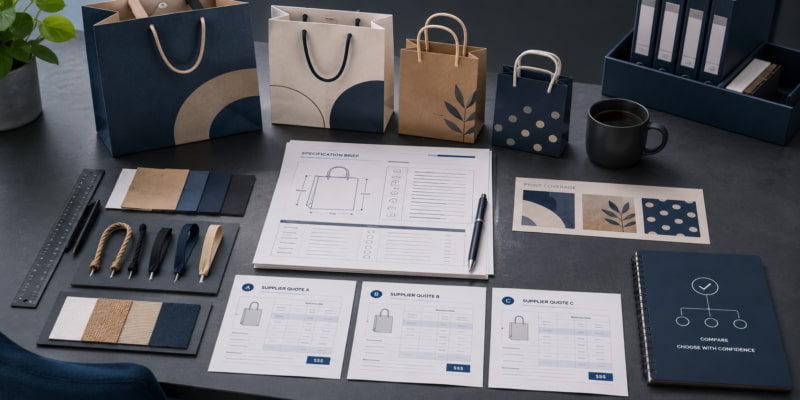
A quote-ready branded paper bag brief aligns your team on use case, size, print, quantity, and documentation before suppliers ever see the request.
- Define Use Before Design: How the bag will be carried, stored, and displayed should shape size, material, and handle choices before any branding decisions are made.
- Spec the Bag Precisely: “Medium bag” means different things to different suppliers — pin down width, height, gusset, handle type, and product fit so every quote covers the same scope.
- Separate Your Decisions From Theirs: Buyers own the brand brief and quantity; suppliers confirm what is technically feasible — this split prevents hidden assumptions on both sides.
- State Ink Coverage Explicitly: A small one-colour logo and a full-bleed graphic are entirely different production jobs, and leaving coverage open invites mismatched quotes.
- Back Every Claim With Documentation: Recyclability, recycled content, or food-contact suitability should be supported by supplier evidence, not repeated from broad marketing language.
Clear specs today mean comparable quotes tomorrow — and fewer surprises after production starts.
Retail procurement managers, marketing leads, and store operations teams coordinating branded paper bag sourcing will find a structured checklist and supplier-brief framework below, preparing them for the detailed overview that follows.
~ ~ ~ ~ ~ ~ ~ ~ ~ ~ ~ ~ ~ ~ ~ ~ ~ ~
A successful branded paper bag quote begins long before supplier outreach. A logo, a rough bag size, and an estimated quantity may be enough to begin a conversation, but they are usually not enough to make supplier responses easy to compare.
Retail buyers need a clearer requirement set. That does not mean becoming a print-production expert. It means aligning procurement, marketing, and store operations on the practical details suppliers need: how the bag will be used, what it must carry, how the branding should appear, which material or finish preferences matter, and any required documentation.
For paper bags used in retail settings, the same design idea can lead to different supplier assumptions about size, substrate, print coverage, handles, finish, quantity, and claim support. A better RFQ helps suppliers quote against the same requirement, not against guesswork.
Start With How the Bag Will Actually Be Used
Before discussing branding, define the bag’s practical role. A branded paper bag is still a functional package. Its size, construction, handle style, and material should reflect how customers and store teams will use it.
A specialty retailer may need a premium gift bag for selected purchases and a simpler everyday checkout bag for routine orders. A grocery retailer may need different bag sizes for light, medium, and bulky basket mixes. A franchise or multi-store brand may care less about novelty and more about consistent logo placement across locations.
Procurement teams should clarify the product mix, approximate handling path, and retail context. Will the bag be used at checkout, for pickup, for delivery, for gifting, or for a seasonal campaign? Will customers carry it briefly, place it in a vehicle, or use it as part of a premium presentation?
Retail display context matters as well. Bags stored flat behind a register do not need to stand upright on a shelf, but bags that form part of a counter display may need stiffer material or a flat bottom. Clarifying whether the bag is recurring everyday stock or a limited-run campaign item also affects decisions downstream — a seasonal bag may justify heavier ink coverage or a specialty finish that would not make sense for a high-volume checkout bag.
Define the Physical Bag Requirements Before Discussing Branding
Bag dimensions are often discussed too casually. “Medium paper bag” may mean different things to different suppliers. A quote-ready brief should define width, height, gusset, handle type, and product fit as clearly as possible.
The gusset — the expandable side or bottom area that helps the bag hold volume — matters because a bag can look tall enough but still fail to fit the intended product mix comfortably. Handle style also matters. Twisted paper handles, flat handles, die-cut handles, rope handles, and no-handle formats each create different handling, production, and presentation outcomes.
Material preference should be stated, but not overstated. Some buyers may prefer kraft paper bags, white stock, recycled-content paper, or another substrate. Others may be open to supplier recommendations. Both positions are acceptable if they are clear. For example: “The preferred appearance is natural kraft, but suppliers may recommend alternatives if print contrast, finish, or handling requirements would be affected.” The substrate shade and surface texture directly affect how printed colors appear, so stating the preference early helps suppliers assess feasibility before quoting.
Retailers operating multiple store formats should clarify whether a single bag size works across locations or whether SKU variations are needed. A franchise brand may consolidate into one standard bag, while a retailer with boutique and flagship locations may require two or three versions. Identifying this before quoting prevents scope confusion. For detailed internal specification planning, analyzing exact pack-out configurations and handling tolerances helps buyers establish dimensions before finalizing a brief.
Clarify Print Expectations in Buyer-Friendly Terms
Print requirements can create quote confusion when buyers and suppliers make different assumptions about the same artwork. The buyer may think in terms of “our logo on the bag.” The supplier may need to understand the number of printed sides, print area, ink coverage, artwork readiness, substrate shade, and expected color consistency.
Retail buyers should define the desired visual result in simple terms. Is the bag expected to show a small one-color logo on one side, a two-sided print, a large brand panel, or heavier campaign artwork? Does the design need to wrap around the side gusset? Should the artwork stay consistent across several bag sizes? A single-color logo on one panel is a fundamentally different production job than a full-coverage graphic wrapping both faces and the gusset.
Ink coverage deserves its own line in the brief. A light logo on natural kraft uses far less ink than a full-bleed design. When coverage expectations are left open, suppliers estimate on their own — and those estimates may not match the buyer’s vision.
Brand color expectations should be framed carefully. Print appearance can vary depending on material shade, surface texture, ink coverage, and finish. A dark logo on natural brown kraft may not look the same as the same logo on a white substrate. If specific Pantone references are required, note them alongside acceptable tolerance for variation. Buyers should state the intended brand appearance and ask suppliers to confirm what the chosen material can realistically support. Understanding how paper bag material choice affects print coverage helps set realistic expectations before the first quote arrives.
Separate What the Buyer Defines From What the Supplier Confirms
A strong paper bag RFQ does not need to solve every production question internally. It should separate buyer-owned decisions from supplier-confirmed details.
| Buyer Defines | Supplier Confirms |
| Desired brand appearance | Feasible print method and production approach |
| Bag size and use case | Material and construction fit |
| Artwork and color expectations | Proofing or sample process |
| Quantity and SKU mix | Production constraints and tolerances |
| Sustainability or food-contact claim expectations | Supporting documentation and claim scope |
This separation keeps the buyer in control of the commercial and brand brief while giving suppliers room to confirm what is technically practical.
When uncertainty exists, phrase it as a question rather than forcing a supplier to quote something they may not be able to produce:
“Please confirm whether the selected material can support this print coverage and color contrast.”
“Please advise whether the artwork is suitable for the proposed bag size and print area.”
“Please identify any expected variation between proof, sample, and production output.”
These questions reduce hidden assumptions. They do not guarantee identical supplier responses, but they make the differences easier to understand.
Define Quantity, Replenishment, and Store-Level Variation
Order quantity shapes the economics of every branded paper bag quote, but suppliers need more than a single number. How the order fits into a broader pattern — onetime campaign, quarterly replenishment, seasonal spikes — affects production planning and the structure of the quote itself. Because MOQ ranges and lead times vary by supplier, avoid treating them as universal benchmarks.
Start by defining the initial order quantity and expected repeat cadence. A one-time campaign run is quoted differently than ongoing stock for a 40-location store network. If seasonal campaigns require a separate design or heavier coverage, treat those as distinct line items.
A buyer may choose one standardized bag to simplify procurement and storage. Another may need several versions to fit different basket sizes, product categories, or gift-packaging needs. Neither approach is automatically better. The right choice depends on the buyer’s product mix, store operations, brand expectations, and storage capacity.
For quote comparability, suppliers should know whether they are quoting one standard item or several versions. When multiple versions are needed, procurement should ask suppliers to price and describe each version separately. That helps prevent a low headline price from hiding differences in size, print coverage, finish, or quantity assumptions.
Storage limitations are worth mentioning. If locations cannot receive a full pallet, the delivery schedule and packing configuration become part of the requirement. Stating these details keeps quotes realistic and comparable. For more on how order structure interacts with pricing, see this overview of cost drivers in paper bag material specifications.
Ask for Documentation When Claims Matter
Sustainability, recycled content, compostability, recyclability, and food-contact suitability are increasingly important in retail packaging — but these are areas where assumptions can outrun evidence. If a claim appears in marketing, internal approval documents, customer communication, or compliance review, the buyer should ask suppliers what documentation supports it.
Rather than writing “we need recyclable bags” in a supplier brief, ask what evidence backs the claim. Whether a bag qualifies as recyclable, compostable, or made from a stated percentage of recycled fiber depends on its full construction — paper grade, coating, ink system, adhesive, and handle material all play a role. A statement about the base paper may not automatically apply to coatings, inks, adhesives, handles, or the finished bag.
Food-contact suitability, where applicable, requires strict regulatory compliance. A general product label does not guarantee that the specific materials in a given bag meet the legally required safety standards for the buyer’s intended use and jurisdiction (such as FDA regulations in the U.S. or European Commission framework regulations in the EU). Ask whether the supplier can provide formal declarations of compliance for the actual materials and finished construction.
For environmental marketing claims in the U.S. market, the FTC Green Guides provide the agency’s primary guidance on how to avoid deceptive marketing. Because the FTC actively takes enforcement action against deceptive environmental claims under the FTC Act, buyers should ensure their claims align with the most recently published version of these guides. For food-contact context in the United States, FDA’s Packaging & Food Contact Substances resources provide a relevant official reference. If FSC-related claims matter, buyers can check certificate status through the FSC Public Certificate Search.
These links are high-authority reference points that show why broad claims should be checked before being repeated. They should not be treated as a substitute for supplier documentation or professional review.
For paper-bag-specific supplier questions, see our guide to paper bag sustainability requirements.
Branded Paper Bag Quote-Readiness Checklist
Use this checklist before sending a branded paper bag RFQ. It helps procurement, marketing, and operations align on what the buyer should define internally and what the supplier should confirm.
| Requirement Area | What to Define Internally | Why It Affects Supplier Quotes | Who Should Confirm It | Supplier Follow-Up Question |
| Bag use case | Checkout, gifting, pickup, delivery, campaign, or recurring stock | Aligns the bag format with real use | Procurement + operations | Does this construction fit the stated use case? |
| Size and gusset | Width, height, gusset, and product fit | Prevents unsuitable samples and mismatched assumptions | Store operations + procurement | Are these dimensions suitable for the product mix? |
| Handle style | Twisted, flat, cut-out, no handle, or open to recommendation | Affects handling, format, and presentation | Procurement + operations | Which handle style fits the intended use? |
| Material/substrate | Kraft, white, recycled-content, or supplier-recommended | Affects appearance, print result, and documentation needs | Procurement + supplier | How will this material affect print contrast and finish? |
| Print area and sides | Logo placement, number of sides, approximate print area | Clarifies artwork and setup assumptions | Marketing | Can the artwork fit the available print area? |
| Ink coverage and color | Simple logo, heavier graphics, color expectations | Print appearance can vary by substrate and finish | Marketing + supplier | What variation should be expected? |
| Finish/coating | Uncoated, matte, gloss, coated, or open question | Can affect appearance, handling, and documentation needs | Marketing + supplier | Is the finish compatible with the material and print? |
| Artwork readiness | Final files, draft files, color references, proof needs | Reduces prepress uncertainty | Marketing | Is the artwork production-ready? |
| Quantity and reorder pattern | Initial quantity, repeat expectations, campaign or ongoing use | Supports production and replenishment planning | Procurement | Should this be quoted as onetime or recurring supply? |
| SKU or store variation | One standard bag or multiple versions | Prevents mixed assumptions across locations | Procurement + operations | Can each version be quoted separately? |
| Documentation needs | Sustainability, recycled-content, recyclability, compostability, or food-contact documentation | Avoids unsupported claim repetition | Procurement + compliance | What documentation supports each claim? |
| Packing and delivery expectations | Bundle count, carton preferences, storage limits, rollout needs if known | Supports receiving and store handling | Operations + procurement | How will finished bags be packed and labeled? |
What to Send Suppliers After Internal Alignment
After internal alignment, the supplier brief should be concise but complete. It should include the company use case, product or basket context, bag dimensions, material preference or open material questions, handle expectations, artwork files, print placement, color expectations, finish needs, order quantity and reorder pattern, SKU variations, documentation requirements, proof or sample expectations, and any known delivery or rollout timing.
The objective is to streamline the dialogue. A comprehensive brief enables partners to identify structural constraints early, propose viable alternatives, and eliminate the protracted clarification cycles that routinely delay procurement.
Frequently Asked Questions
Do buyers need final artwork before requesting a branded paper bag quote?
Final vector artwork allows suppliers to assess feasibility and quote with accuracy, especially when print area, ink coverage, and color expectations matter. Buyers can still open preliminary conversations with suppliers if they clearly indicate that artwork is in draft. Expect that the final quote may shift once production-ready files are reviewed.
Should retail buyers choose a material before contacting suppliers?
Defining a preference helps — whether that means natural kraft, white stock, or recycled-content paper. But the material decision often benefits from supplier input, especially when the choice affects print quality or bag performance. State the preference and the use conditions, then ask the supplier to confirm fit.
What makes branded paper bag quotes hard to compare?
Quotes become hard to compare when suppliers assume different bag sizes, gussets, handles, materials, print coverage, finishes, quantities, proofing steps, or documentation requirements. Two quotes at different price points may reflect different scopes rather than different value. Price alone does not show whether every supplier quoted the same branded paper bag program.
Should sustainability claims be included in the first quote request?
Yes, if recycled content, recyclability, compostability, or other sustainability requirements matter to the brand or market. Including them early ensures suppliers can address documentation as part of the quote rather than as a late-stage surprise. The RFQ should ask suppliers to provide documentation for each relevant claim instead of treating broad sustainability language as sufficient.
Conclusion
A strong branded paper bag quote begins with internal clarity, not supplier outreach. Retail buyers do not need complete technical expertise, but they do need a structured requirement set that connects brand goals, store handling, print expectations, quantity planning, and documentation needs.
Use the checklist above to align procurement, marketing, and operations before requesting quotes. After defining the requirements, buyers can explore paper bag suppliers or submit buying requirements when the branded paper bag brief is ready.
Disclaimer:
This article is for general informational purposes only. It is not a substitute for advice from a qualified packaging, print, compliance, or supplier-selection professional. Product specifications, documentation needs, regulatory requirements, and supplier capabilities may vary by use case, market, and buyer requirements.
Our Editorial Process:
Our expert team uses AI tools to help organize and structure our initial drafts. Every piece is then extensively rewritten, fact-checked, and enriched with first-hand insights and experiences by expert humans on our Insights Team to ensure accuracy and clarity.
About the PaperIndex Insights Team:
The PaperIndex Insights Team is our dedicated engine for synthesizing complex topics into clear, helpful guides. While our content is thoroughly reviewed for clarity and accuracy, it is for informational purposes and should not replace professional advice.