
📌 Key Takeaways
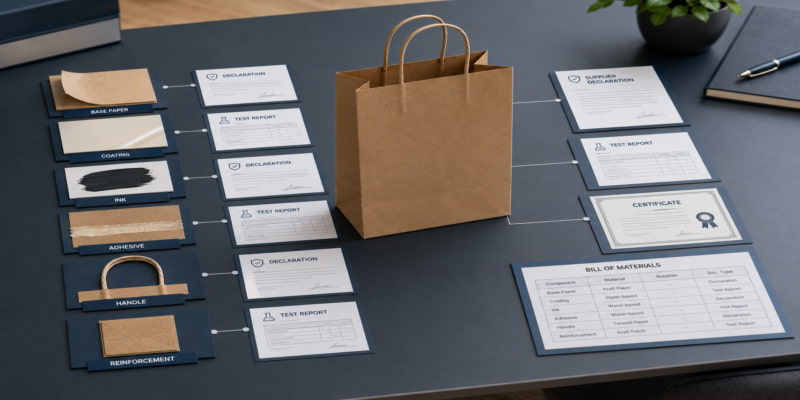
A paper bag’s sustainability claims depend on every component in the finished bag — not just the base paper.
- Paper Alone Proves Nothing: Kraft appearance, recycled content, or fiber certification only covers the paper — not coatings, inks, adhesives, or handles that change what claims hold up.
- Coatings Raise the Biggest Red Flags: A barrier layer for grease or moisture can affect whether the bag is truly recyclable, compostable, or plastic-free, so buyers should ask for coating-specific test data.
- Small Parts Create Big Gaps: Inks and adhesives rarely get questioned, but their chemistry can break recyclability, composting, and food-contact claims if left undocumented.
- Handles Can Kill a “Plastic-Free” Claim: A synthetic rope handle, plastic reinforcement patch, or non-paper adhesive turns a paper bag into a mixed-material product that no longer supports mono-material language.
- Ask for Finished-Bag Proof Early: Request a full bill of materials and claim-specific evidence before shortlisting suppliers — not after marketing has already approved label language.
Document every component before you claim anything about the finished bag.
Packaging engineers and B2B procurement teams evaluating paper bag suppliers will gain a clear, component-level documentation framework here, preparing them for the detailed overview that follows.
~ ~ ~ ~ ~ ~ ~ ~ ~ ~ ~ ~ ~ ~ ~ ~ ~ ~
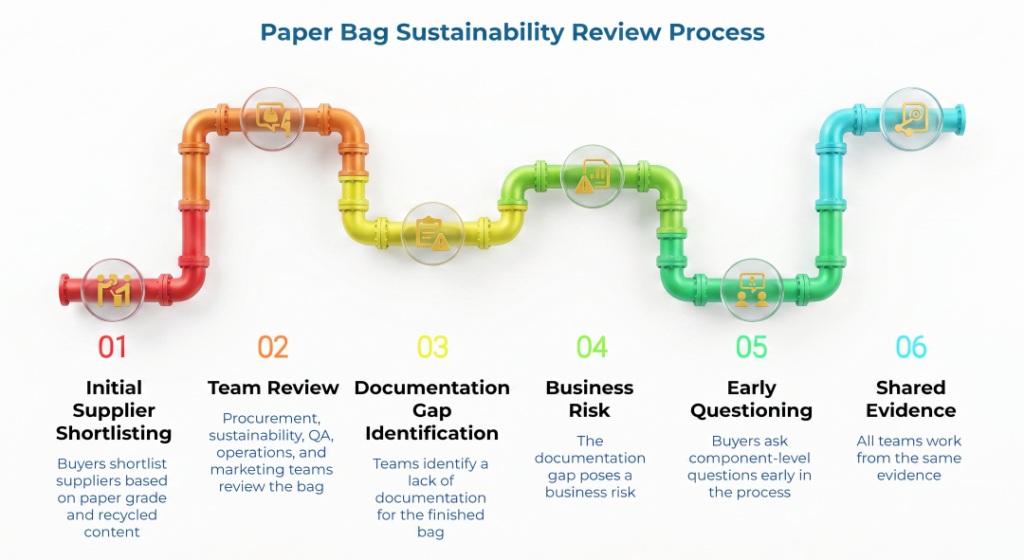
A paper bag’s sustainability review must go beyond the base paper. Buyers often begin with paper grade, fiber source, recycled content, or kraft appearance, but the finished bag may also include coatings, inks, adhesives, handles, liners, reinforcement patches, and attachment methods. Each of these components can change what a supplier needs to document before any sustainability-related claim is accepted.
This distinction matters because a material attribute is not the same as a finished-bag claim. A bag made with paper is not automatically recyclable, compostable, plastic-free, food-contact suitable, or compliant in every destination market. Those claims may depend on the full bill of materials, the intended use, the evidence available from the supplier, and the requirements of the market where the bag will be used or labeled.
This creates a practical problem. Procurement teams may shortlist suppliers based on paper grade and recycled content, only to find that sustainability, QA, operations, or marketing teams later ask for proof covering the entire finished bag. When that proof does not exist, the documentation gap becomes a business risk — one that could have been avoided by asking the right component-level questions before the shortlist was finalized.
For packaging engineers and B2B buyers, the practical goal is not to turn every paper bag RFQ into a legal review. It is to ask those questions early enough that every team evaluating the bag can work from the same evidence before suppliers are shortlisted or claim language is approved.
Why Base Paper is Only One Part of the Sustainability Requirement
Base paper — whether virgin kraft, recycled liner, or a specialty grade — is a necessary starting point for sustainability review, but not a sufficient one. It can help define strength, stiffness, print surface, recycled content, fiber source, and chain-of-custody documentation when certification is claimed. Buyers comparing kraft paper bags should ask for the paper grade, GSM or basis weight, fiber source statement, recycled-content proof if relevant, and certificate scope if FSC or PEFC claims are being made.
But base paper does not settle every sustainability question.
Recycled content in the base paper does not automatically mean the finished bag can be described as recyclable. A kraft appearance does not confirm that the fiber was responsibly sourced. Chain-of-custody certification for the paper does not necessarily cover every claim about the converted bag — especially if coatings, adhesives, printed areas, or handle components are added later.
Standards that govern environmental marketing claims reinforce this point. The FTC Green Guides (16 CFR Part 260) and ISO 14021 generally require that claims be substantiated for the product as marketed — which means the complete, finished construction. Certification scope is a useful example. The FSC chain-of-custody system and PEFC chain-of-custody processes are designed to support traceability and claims about certified forest-based material, but they should not be treated as blanket proof that every environmental claim about the finished bag is valid.
A safer buyer question is: “Does this document support the base paper only, or does it support the finished bag and the exact claim being made?”
When a finished bag includes materials beyond the base paper, the documentation requirement expands accordingly.
Coatings and Barriers: The Component Most Likely to Change the Evidence Request
Coatings are among the most common additions to paper bags, particularly those used in food service, retail, and industrial applications. A coating may serve several practical purposes: grease resistance, moisture management, wet strength, print surface preparation, scuff resistance, or improved handling in food-service conditions. Coating types range from water-based dispersions and wax applications to polyethylene (PE) films and newer bio-based polymer layers. Those performance requirements may be commercially valid — they simply need to be separated from sustainability claim wording.
The documentation impact depends on what the coating is, why it was applied, and what claims the buyer intends to make. A PE-coated bag may behave differently in a recycling stream than an uncoated bag because the plastic layer can affect repulpability. That does not mean every coated paper bag is unsuitable for recycling or composting. It means the buyer should ask what the coating is, where it is applied, and what evidence supports the specific claim.
For paper-based packaging design, the American Forest & Paper Association’s Design Guidance for Recyclability is one high-authority reference point because it discusses how non-fiber elements — inks, adhesives, coatings, barriers, foils, wet-strength resins, and other materials — can influence recyclability considerations. Buyers should still verify relevance to the exact product, market, and recycling system.
For bags marketed with a compostable coating, the documentation bar rises further. To validate industrial compostability, the entire finished packaging asset—including base paper, inks, and structural adhesives—must undergo physical validation testing under monolithic standards like ASTM D6868 or EN 13432 rather than relying on disparate component certifications.
For food-service applications, coatings must align with chemical safety regulations governing oil and grease resistance. While fluorinated chemicals traditionally provided this performance, regional restrictions on long-chain and short-chain per- and polyfluoroalkyl substances (PFAS) require buyers to verify alternative barrier chemistry. Performance requirements for hot or moist food do not automatically support end-of-life claims. Additional reading on food-service paper bag materials and paper bag barrier coatings can help frame supplier questions before determining the required evidence.
As a general principle: ask the supplier to identify the coating type, its purpose, and whether supporting test data or declarations are available for the intended use and destination market. The issue is not whether coatings are used — it is whether the documentation covers the claim.
Inks and Adhesives: Small Components that can Create Documentation Gaps
Inks and adhesives tend to receive less scrutiny because they are visually secondary to the bag structure. They remain, however, part of the finished product — and their composition can affect sustainability review in ways that procurement teams may not anticipate.
Inks. Printed inks vary by chemistry (water-based, solvent-based, UV-cured, soy-based), coverage area, and application method. A bag with full-coverage flexographic printing may raise different documentation questions than one with a single-color logo. Ink type can influence recycling performance — particularly at the deinking stage — and whether additional food-contact declarations are needed for direct or indirect contact surfaces. If the bag is used for food service, the review should distinguish between external printing and any surface that may be relevant to food-contact conditions. Broad claims such as “non-toxic,” “food-safe,” “water-based,” “soy-based,” or “eco ink” should not be accepted without claim substantiation. Ask for the ink type, a technical data sheet (TDS) or safety data sheet (SDS), and any applicable compliance statement relevant to the bag’s intended use.
Adhesives. These compounds anchor seam construction, bottom closures, handle attachment points, reinforcement patches, and liners. Adhesive composition can affect end-of-life claims and food-contact documentation — particularly when the adhesive is part of, or near, a contact surface. Even if the adhesive is not visible to the end user, it may still matter for documentation. Identify what adhesive type is used, request a supplier declaration, and confirm whether it has been included in any finished-bag claim or test report.
Under self-declared environmental protocols like ISO 14021, procurement units must require suppliers to define claim scopes and supply corresponding testing validation records before finalizing specifications.
Handles and Reinforcements: When a “Paper Bag” Becomes a Mixed-Construction Product
Moving beyond chemical applications, structural additions like handles and reinforcements turn a simple paper carrier into a mixed-construction product. Many handle types also involve a reinforcement patch, adhesive layer, staple, or mechanical fastener at the attachment point.
The sustainability documentation impact is often underestimated. A bag described as “plastic-free” needs to account for the handle material, any adhesive used in attachment, and any reinforcement layer. A rope handle made from synthetic material changes the bag’s mono-material status and may affect recyclability claims. A glued paper handle may also behave differently in a recycling system than a stapled rope handle, because mixed materials and metal fasteners can complicate sorting and repulping.
Operational needs also matter. A reinforced handle may be necessary for heavier retail loads, repeated carrying, or pack-out efficiency. While necessary for performance, the bill of materials must identify these reinforcements clearly, and any sustainability-related claim should reflect the finished-bag construction rather than the paper body alone.
For a practical example: a retail buyer specifies recycled kraft bags but does not ask about handle reinforcement. If the reinforcement uses a different fiber type, a plastic film, or a non-paper adhesive, the finished bag may not support the claim the buyer intended. The claim review should not stop at recycled paper content — it should include handle material, patch material, adhesive type, and claim scope.
Buyers evaluating paper bag size, gusset, and handle specifications should include handle material and attachment method in documentation requests. The supplier should provide a bill of materials covering every component — not just the paper body.
Component Evaluation and Verification Framework
The matrix below gives procurement and packaging teams a practical way to request documentation without overclaiming. It summarizes why each component can affect sustainability review, what to ask the supplier to provide, and which claims should not be made without verification. This is a starting framework — not a pass/fail certification tool or compliance checklist.
| Component | Why It Can Affect Sustainability Review | What to Ask Supplier For | Claims Not to Make Without Verification |
| Base paper | Fiber source, recycled content, paper grade, and certification scope form the foundation of many sustainability-related claims. | Paper grade, fiber source statement, recycled-content proof if claimed, chain-of-custody documents if certification is claimed, product or SKU coverage. | “FSC-certified,” “PEFC-certified,” “recycled,” “responsibly sourced,” “sustainable.” |
| Coating or barrier | May affect end-of-life documentation, repulpability review, compostability evidence, food-service use, disposal claims, and destination-market relevance. | Coating type, application area, purpose, test reports, supplier declaration, claim-specific evidence, destination-market relevance. | “Recyclable,” “compostable,” “biodegradable,” “plastic-free,” “repulpable.” |
| Ink | Ink type, coverage, and location may affect claim scope, deinking and recycling behavior, and food-contact review for printed surfaces. | Ink system, print coverage, technical data sheet, safety data sheet where relevant, supplier declaration, food-contact statement if applicable. | “Non-toxic,” “food-safe,” “eco ink,” “water-based” as a broad environmental claim. |
| Adhesive | Adhesives are part of finished-bag construction and may be present in seams, handles, patches, liners, or labels. | Adhesive type, use location, supplier declaration, technical data sheet, safety data sheet where relevant, food-contact statement if applicable. | “Compostable,” “recyclable,” “biodegradable,” “compliant.” |
| Handle and reinforcement | May introduce mixed materials, patches, stitching, glue, or additional construction layers that change the claim scope. | Handle material, attachment method, reinforcement material, bill of materials, claim scope for the finished bag. | “100% paper,” “plastic-free,” “mono-material,” “recyclable.” |
Compostability claims need particular care. If a polymer coating, film, or additive is attached to paper and the entire item is intended for municipal or industrial composting, standards such as ASTM D6868 may be relevant. For EU-facing packaging, the Packaging and Packaging Waste Regulation (PPWR) establishes mandatory criteria for recyclability, minimum recycled content, and labeling. These strict European Union parameters operate under distinct legal mandates and cannot serve as operational proxies for North American or Asian compliance metrics.
For broader supplier claim review, our guide to verifying supplier sustainability claims can support internal documentation workflows.
RFQ Language That Avoids Overclaiming
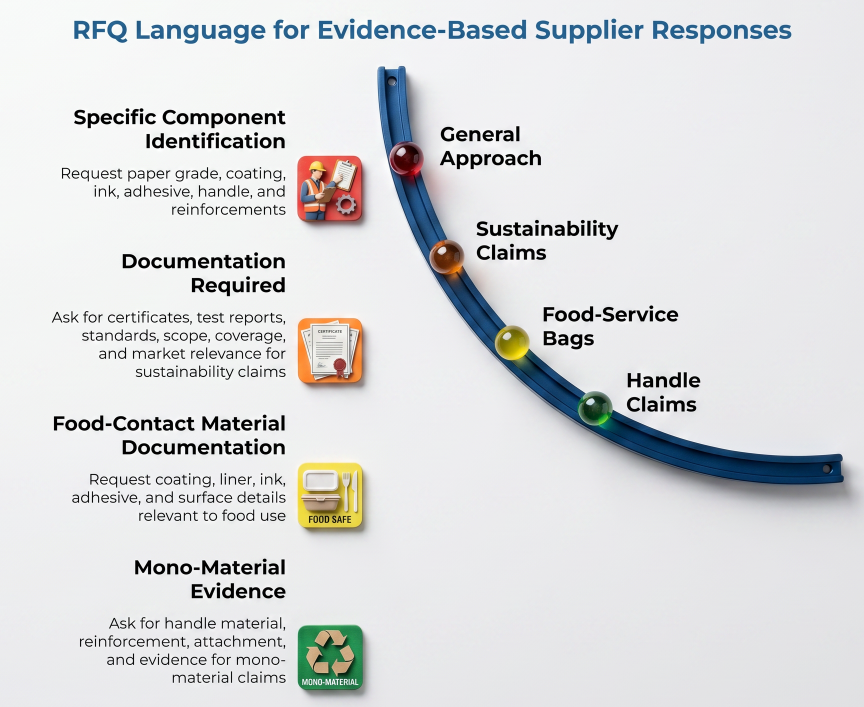
The language used in a request for quotation or supplier qualification document shapes the quality of the response. Broad terms invite vague answers; specific, documentation-focused requests invite evidence.
A more effective general approach:
“Please identify the paper grade, coating or barrier type, ink system, adhesive type, handle material, and any reinforcements used in the finished bag. For any sustainability-related claim, provide the applicable certificate, test report, standard reference, claim scope, product or SKU coverage, and destination-market relevance. Please identify whether the claim applies to the base paper only, a component, or the finished bag.”
For food-service bags, buyers can add:
“Please identify any coating, liner, ink, adhesive, or surface that may be relevant to the intended food-service use, and provide use-case-specific documentation where applicable.”
For handle-related claims, buyers can add:
“Please identify the handle material, reinforcement material, and attachment method. If the finished bag is described as mono-material, plastic-free, recyclable, or compostable, provide evidence that covers the full finished-bag construction.”
This framing shifts the conversation from marketing language to component-level evidence. While it does not force suppliers into a single documentation format, it clarifies evidence expectations and aligns procurement, packaging engineering, QA, sustainability, and operations teams around the same documentation requirements.
What Buyers Should Not Assume from Supplier Claims
Several common assumptions can create documentation gaps if left unchecked.
Kraft paper appearance does not confirm responsible sourcing. A brown kraft bag may use virgin, recycled, or mixed fiber without any sustainability certification. The look of the paper is relevant to brand presentation and paper type, but it does not prove recyclability, compostability, recycled content, or certification scope.
Paper as a material does not guarantee the finished bag is recyclable. Acceptance can vary by location, recycling system, coating type, contamination risk, and other design factors. Coatings, inks, adhesives, and handles can each affect performance in recycling or composting systems.
A compostable coating does not mean the entire finished bag meets a composting standard. The claim may depend on the paper, coating, ink, adhesive, handle, finished construction, test evidence, certification scope, and composting facility. The whole product may need separate testing.
Water-based or soy-based ink is not automatically safe or environmentally preferable. Ask what the claim means and what documentation supports it before accepting ink-related sustainability language.
An FSC chain-of-custody or PEFC chain-of-custody certificate for the base paper does not automatically extend to every component. Certificate scope, supplier entity, invoice claim wording, SKU coverage, and conversion steps may all matter. Certification scope and chain-of-custody coverage should be confirmed at the SKU level.
Consider a brand that wants to print “plastic-free” on a bag but has not verified the adhesive, coating, or handle composition. The safer approach is to hold the claim until the bill of materials and supplier declarations cover every relevant component.
Each of these represents a point where asking for documentation strengthens the specification review.
Treat Sustainability as a Specification-and-Proof Workflow
Finished paper bag sustainability review works best when buyers separate four things: material composition, intended use, claim wording, and evidence. Base paper is important, but coatings, inks, adhesives, handles, liners, and reinforcements can each change what needs to be documented.
The safest procurement workflow is straightforward: define the use case, identify every material component, request supplier documentation, connect each claim to its evidence, and verify destination-market requirements before final approval.
Before shortlisting suppliers, review the composition of the finished bag — not just the base paper. Ask for documentation on coatings, inks, adhesives, handles, and reinforcements. Confirm certificate scope and test coverage for any sustainability-related claim, and match every claim to the intended use and destination market.
Use the documentation matrix above as a starting framework, and compare bag suppliers with component-level requirements in hand.
Frequently Asked Questions
Does kraft paper automatically make a bag sustainable?
No. Kraft appearance or base paper type does not prove that the finished bag meets a specific sustainability-related requirement. Buyers should still check fiber source, recycled-content evidence if claimed, certification scope if relevant, coatings, inks, adhesives, handles, and destination-market requirements.
Can a coated paper bag still be recyclable?
It depends on the coating type, the finished-bag construction, available test evidence, and the recycling system in the destination market. Do not describe a coated bag as recyclable without supplier evidence and market-specific verification that covers the finished product.
Do inks matter for paper bag sustainability claims?
They can. Ink composition and coverage may affect deinking, recycling behavior, and food-contact documentation. Buyers should ask for ink type, coverage, print location, TDS/SDS, supplier documentation, and any applicable compliance statement. Ink-related claims such as “non-toxic,” “water-based,” or “eco ink” should be substantiated before use.
What documents should a supplier provide for sustainability-related claims?
Common documentation requests include a bill of materials, coating details, ink system details, adhesive type, handle and reinforcement materials, supplier declarations, test reports, certification scope, chain-of-custody documents, and claim-specific evidence tied to the finished bag or SKU.
Disclaimer:
This article is for general informational purposes only and does not constitute compliance, sustainability, safety, technical, legal, or professional advice. Requirements, risks, and best practices may vary by jurisdiction, product design, supplier, certification scope, recycling system, composting facility, and intended use. Confirm important decisions with the appropriate qualified professional, certification body, regulator, supplier, or technical expert.
Our Editorial Process:
Our expert team uses AI tools to help organize and structure our initial drafts. Every piece is then extensively rewritten, fact-checked, and enriched with first-hand insights and experiences by expert humans on our Insights Team to ensure accuracy and clarity.
About the PaperIndex Insights Team:
The PaperIndex Insights Team is our dedicated engine for synthesizing complex topics into clear, helpful guides. While our content is thoroughly reviewed for clarity and accuracy, it is for informational purposes and should not replace professional advice.